If another driver totaled your car, you have the legal right to sue them for your damages, and in most cases, their auto insurance will pay up to their policy limits before any personal assets are ever pursued.
But the process is not always simple as the insurance system is not designed to maximize your recovery, and there are critical deadlines, documentation requirements, and strategic decisions that will determine how much you ultimately receive.
This complete guide walks you through every dimension of suing a driver who totaled your car, including the legal theories that support your claim.
You’ll also learn how fault is determined and contested, the full range of damages you can pursue beyond the car’s value, what happens when the at-fault driver has no insurance or insufficient insurance, the statute of limitations in each state, and when going to court is better than settling with an insurance company.
The Legal Foundation for Your Claim Against the At-Fault Driver
Negligence: The Core Theory in Car Accident Cases
The legal basis for suing a driver who totaled your car is negligence. Every licensed driver in the United States owes a duty of reasonable care to other motorists, passengers, cyclists, and pedestrians.
When a driver breaches that duty through distracted driving, speeding, running a red light, failing to yield, driving impaired, or any other unsafe conduct, and that breach directly causes damage to your vehicle and person, the legal elements of negligence are satisfied.
Your attorney or you must prove four elements:
- The other driver owed you a duty of care which is established automatically by the act of driving on public roads.
- They breached that duty through some negligent act or omission.
- The breach was the proximate cause of the accident and your losses
- You suffered actual, quantifiable damages.
In cases where a police report clearly assigns fault, a traffic citation was issued, or the other driver admitted liability, establishing these elements is often straightforward.
Per Se Negligence When a Traffic Law Was Violated
If the driver who totaled your car violated a traffic statute at the time of the accident, negligence per se applies. Under this doctrine, the violation of a safety statute is treated as negligence as a matter of law without requiring you to prove that the driver’s conduct fell below a reasonable person standard.
If the driver ran a red light, exceeded the speed limit by 30 miles per hour, failed to stop at a stop sign, or drove under the influence of alcohol or drugs, their traffic violation is direct evidence of negligence.
The per se doctrine is particularly powerful in DUI cases. A driver whose blood alcohol content exceeded the legal limit at the time of the crash is negligent per se in virtually every U.S. jurisdiction, and most states also allow punitive damages against drunk drivers, which can significantly increase total recovery.
Vicarious Liability: Suing More Than Just the Driver
In some situations, the driver who hit you is not the only party financially responsible.
Vicarious liability allows you to sue the driver’s employer if the accident occurred while the driver was acting within the scope of their employment, such as a delivery driver, a rideshare driver on an active trip, a sales representative traveling to a client meeting, or a commercial truck driver on a route.
The employer’s liability can be critical when the individual driver has minimal insurance or assets. Commercial vehicle operators are often required to carry substantially higher liability limits than personal auto policies, making the employer a far more meaningful financial recovery target.
Negligent entrustment is an additional theory applicable when an employer or vehicle owner allowed a driver they knew or should have known was unfit or unlicensed to operate the vehicle.
Damages You Can Recover After Your Car Is Totaled
Vehicle Property Damage: What Totaled Actually Means
A vehicle is considered totaled when the cost of repair exceeds the car’s actual cash value (ACV) at the time of the accident, or when the repair cost exceeds a threshold percentage of ACV set by state law.
In Florida, for example, a vehicle is legally a total loss if the cost to repair equals or exceeds 80 percent of its pre-crash fair market value, but in most other states, the threshold ranges between 70 and 100 percent.
The at-fault driver’s insurance company is required to pay you the actual cash value of your vehicle, which is its fair market value immediately before the crash, not the amount you paid for it or the amount you still owe on a car loan.
If you have a loan balance exceeding the ACV, you are responsible for the difference unless you carry gap insurance.
It’s best practice to always obtain at least two independent appraisals before accepting an insurance company’s stated ACV, because insurers routinely undervalue totaled vehicles.
A Relatable Scenario
A driver has her three-year-old SUV totaled in a rear-end collision. The at-fault driver’s insurer offers $18,500 ACV. She obtains an independent appraisal from a used car dealer and a certified auto appraiser, both of whom value the vehicle at $22,800 based on comparable recent sales.
Her attorney submits the independent appraisals, and the insurer increases the offer to $21,400 to avoid the cost and uncertainty of arbitration. That’s how it works.
Loss of Use and Rental Car Coverage
From the date of your accident until the date you receive payment for your totaled vehicle, you are entitled to compensation for your loss of use of the vehicle.
This typically means the at-fault driver’s insurance must pay for a rental car at a reasonable daily rate for a reasonable period. If the insurer delays processing your total loss claim unreasonably, the rental period extends accordingly.
To be entitled, you may want to keep every receipt for rental car expenses.
Personal Injury Damages When You Were Hurt in the Crash
If you suffered any physical injury in the crash, your claim extends far beyond the vehicle’s value. Personal injury damages in a car accident case include all past and future medical expenses, emergency room bills, diagnostic imaging, surgery costs, physical therapy, chiropractic care, prescription medications, medical equipment, and any long-term care required by permanent injuries.
Lost wages are recoverable for every day you missed work due to your injuries or medical appointments. If your injuries limit your future earning capacity, that projected income loss is also recoverable through expert economic testimony.
Non-economic damages for pain and suffering, emotional distress, loss of enjoyment of life, and loss of consortium for a married claimant round out the personal injury component of your total damages.
To Drive The Point Home:
A 35-year-old electrician is t-boned at an intersection by a driver who ran a red light, his truck is totaled and he also suffers a torn rotator cuff requiring surgery and 14 weeks of physical therapy, preventing him from working during that period.
His total claim includes: $24,000 vehicle ACV, $31,500 in medical bills, $18,200 in lost wages as a licensed trades worker, and $55,000 in pain and suffering documented by his surgeon and therapist. The at-fault driver’s $50,000 bodily injury policy limits are exhausted, and his own underinsured motorist coverage is triggered for the balance.
Punitive Damages in Egregious Cases
When the driver who totaled your car engaged in conduct that was willful, wanton, or malicious, punitive damages may be available in addition to compensatory damages.
The most common scenarios where courts award punitive damages in car accident cases involve driving under the influence of alcohol or drugs, street racing, extremely aggressive road rage behavior, and operating a vehicle with complete disregard for safety after receiving multiple prior DUI convictions.
Punitive damages are not available in every state and the standard for awarding them varies. States like California, Florida, Texas, Georgia, Illinois, and Nevada recognize punitive damages in motor vehicle cases.
States such as Nebraska, Washington, and Louisiana have restrictions or prohibitions on punitive awards.
When the At-Fault Driver Is Uninsured or Underinsured
Uninsured Motorist Coverage as Your First Line of Defense
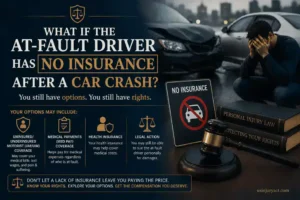
If the driver who totaled your car had no insurance, your own uninsured motorist (UM) coverage steps in to compensate you up to your policy limits as if your own insurer were the at-fault party.
UM coverage is mandatory in many states and strongly recommended everywhere. States requiring UM coverage include New York, New Jersey, Illinois, Maryland, Massachusetts, North Carolina, and others.
In states where it is optional, insurers are required to offer it in writing before a policyholder can waive it.
Underinsured Motorist Coverage When Policy Limits Are Insufficient
Underinsured motorist (UIM) coverage applies when the atfault driver has insurance but their policy limits are too low to cover your full damages.
let’ say the at-fault driver carries the state minimum liability of $25,000 and your total damages are $150,000, your UIM coverage covers the gap up to your own policy’s UIM limit.
UIM claims are made against your own insurer, and the same insurer often becomes adversarial in these situations.
A good attorney is essential when pursuing a UIM claim to prevent your insurer from using the evaluation tactics typically reserved for opposing parties.
Suing the Uninsured Driver Personally
You can also file a personal lawsuit directly against an uninsured driver. The practical challenge is that drivers without insurance frequently lack the personal assets to satisfy a judgment.
However, a judgment against an uninsured driver is not worthless. Judgments are typically enforceable for 10 to 20 years depending on state law and can be renewed.
As the defendant’s financial circumstances improve, wage garnishment, bank account levies, and property liens become available collection tools.
Statute of Limitations by State: Do Not Miss Your Deadline
Every state sets a deadline for filing a personal injury or property damage lawsuit after a car accident. Filing after this deadline results in automatic dismissal regardless of how strong your case is.
The following represent the limitations periods in the most populated states, all verifiable through each state’s legislative website.
- California: 2 years for personal injury, 3 years for property damage – Cal. Code Civ Proc. Section 335.1 and 338
- Texas: 2 years for personal injury and property damage – Tex. Civ. Prac. & Rem. Code Section 16.003
- Florida: 2 years for personal injury (effective March 2023), 4 years for property damage – Fla. Stat. Section 95.11
- New York: 3 years for personal injury and property damage – N.Y. C.P.L.R. Section 214
- Illinois: 2 years for personal injury, 5 years for property damage – 735 ILCS 5/13-202 and 5/13-205
- Georgia: 2 years for personal injury, 4 years for property damage – O.C.G.A. Section 9-3-33 and 9-3-30
- Pennsylvania: 2 years for personal injury and property damage – 42 Pa. C.S. Section 5524
- Ohio: 2 years for personal injury, 2 years for property damage – Ohio Rev. Code Section 2305.10
- Michigan: 3 years for personal injury, 3 years for property damage – M.C.L. Section 600.5805
- North Carolina: 3 years for personal injury and property damage – N.C.G.S. Section 1-52
Recommended: Exhaustive List of the 50 U.S. States Statute Of Limitation For Personal Injury
What to Do Immediately After the Crash to Protect Your Claim
The actions you take in the hours and days following your crash are foundational to the strength of your legal claim.
- Call the police and ensure an official accident report is generated with the responding officer’s name and badge number.
- Photograph the damage to both vehicles from multiple angles, skid marks, traffic signals, road conditions, and any visible injuries on your body.
- Exchange insurance and licensing information with the other driver.
- Collect contact information from every witness at the scene.
- Seek medical evaluation even if you feel uninjured, because many soft tissue injuries, concussions, and internal injuries do not produce immediate symptoms.
- Notify your own insurer of the accident as required by your policy, but do not provide a recorded statement to the at-fault driver’s insurer without first consulting an attorney.
- Send a written preservation demand to the at-fault driver’s insurer requesting that they preserve all dashcam footage, telematics data, driver cell phone records, and any other evidence in their possession or control.
Telematics data from modern vehicles can show speed at the time of impact, brake application, and steering inputs in the seconds before a crash, making it invaluable evidence.
Maximizing Your Recovery After a Totaled Vehicle
Your right to sue the driver who totaled your car is comprehensive and extends well beyond simply replacing your vehicle
A complete car accident property damage claim combined with a personal injury lawsuit after a car crash can include vehicle replacement value, medical expenses, lost income, pain and suffering, and in some cases punitive damages.
The at-fault driver liability insurance system is there to compensate you, but it also exists to protect the insurer’s bottom line.
So retaining an experienced auto accident attorney ensures that you understand every element of your claim, meet every applicable statute of limitations, and receive the full recovery the law entitles you to.