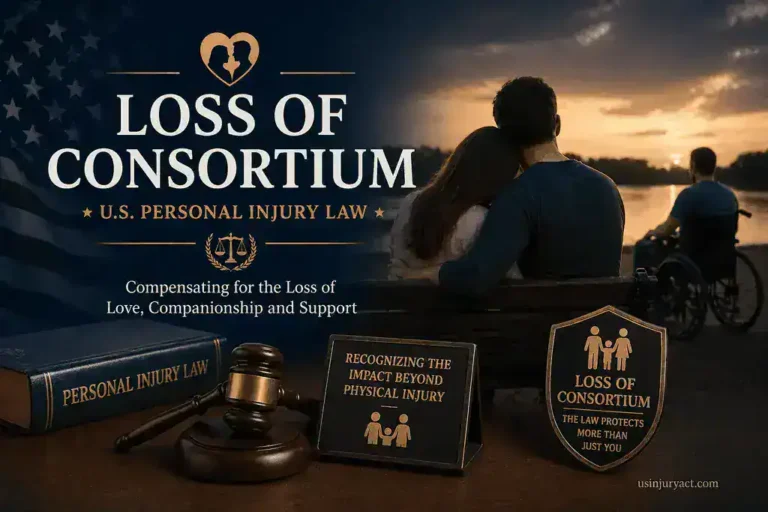
When a serious injury or wrongful death devastates a family, the harm does not stop with the person who was physically hurt. Spouses lose partners. Children lose parents. The invisible injuries suffered by the people who surround the victim are real, profound, and legally compensable under a doctrine known as loss of consortium.
This guide explains every dimension of a loss of consortium claim, from the legal definition and historical roots to proof strategies, state-specific rules, and realistic settlement ranges. This reference is suitable for you either as the injured victim, as a family member of a victim trying to understand your rights or an attorney building a damages framework.
What Is Loss of Consortium
Loss of consortium is the legal term for the damage a close family member suffers because their loved one was seriously injured or killed due to someone else’s negligence. When a husband is left permanently disabled after a truck accident, his wife does not just lose a breadwinner.
She loses a companion, a partner in parenting, an intimate partner, and the day-to-day emotional support that defines married life. That loss has real value in the eyes of the law, and the negligent party can be held financially responsible for it.
The word “consortium” comes from Latin, meaning fellowship or partnership. In the legal context it refers to the full bundle of benefits that flow between family members in a loving relationship: companionship, affection, guidance, household services, and intimacy.
Legal Definition
Legally, loss of consortium is classified as a derivative cause of action. It derives from the primary tort claim of the injured person. If the injured person cannot prove that another party’s negligence caused their injuries, the consortium claim fails along with it.
However, once negligence is established, the spouse or eligible family member may pursue their own, separate damages for the relational harm they have experienced.
Courts define loss of consortium to include deprivation of the benefits of a family relationship, including loss of society, companionship, comfort, affection, solace, moral support, guidance, services, and sexual relations.
The exact contour vary by jurisdiction, but those core elements appear in virtually every state’s formulation.
Historical Background and Evolution
The doctrine has ancient roots. Under early English common law, only a husband could bring a consortium claim, and it was framed as a property-like injury.
A husband had an ownership interest in his wife’s services, and injuring her deprived him of that value. This framing was deeply paternalistic and treated wives as chattel rather than persons.
American courts began slowly expanding the doctrine through the twentieth century. A landmark shift came in 1950 with Hitaffer v. Argonne Co. in the U.S. Court of Appeals for the D.C. Circuit, which for the first time recognized a wife’s right to recover for loss of her husband’s consortium.
Most states followed, and by the 1970s and 1980s, gender-equal consortium rights were broadly established nationwide.
Modern courts have continued to wrestle with who qualifies as an eligible claimant, particularly regarding children and unmarried partners, which remains an area of significant variation across states.
What Does Loss of Consortium Cover
A loss of consortium claim is not limited to any single type of harm. Courts recognize multiple categories of relational damage, each of which carries independent weight in a damages analysis.
Loss of Companionship
Companionship means more than physical presence. It encompasses the social engagement, shared activities, joint decision-making, and mutual emotional investment that characterize a close relationship.
A severely injured spouse may still be physically present but incapable of participating in shared hobbies, attending family events, or sustaining the conversations and routines that form the fabric of married life.
That deprivation of genuine connection is compensable as loss of companionship.
Loss of Affection
Affection in the legal sense refers to the warmth, tenderness, and emotional intimacy that flow between partners. Traumatic brain injury, chronic pain, PTSD, and many other serious conditions can fundamentally alter a person’s personality and emotional availability.
A once-affectionate spouse who becomes irritable, withdrawn, or emotionally detached causes a real and measurable harm to the partner who relied on that affection as a cornerstone of their wellbeing.
Loss of Intimacy
Physical intimacy is explicitly recognized as a component of loss of consortium in the vast majority of American jurisdictions. Spinal cord injuries, traumatic injuries to the reproductive system, medications required for serious conditions, and psychological trauma can all impair or eliminate the ability to engage in sexual relations.
Courts have consistently recognized this as a significant element of the consortium claim because it affects a dimension of marital life that cannot be replicated or replaced by other means.
Loss of Household Support and Services
Although sometimes classified separately as “loss of household services,” many jurisdictions treat this as a component of consortium. If a husband did all the home maintenance, childcare pickup, or financial management and can no longer perform those functions due to injury, his wife has lost practical contributions of real economic value.
This category tends to be one of the more easily documented components of a consortium claim because the services have a quantifiable market replacement cost.
Emotional and Psychological Impact on the Family
Perhaps the least tangible but most devastating component of loss of consortium is the broader psychological impact on the claiming family member. Watching a spouse endure chronic pain, repeated surgeries, or permanent disability generates grief, anxiety, depression, and caregiver burnout in the non-injured partner.
Many spouses of seriously injured people develop diagnosable psychological conditions of their own. While these conditions may be addressed in part through separate claims in some jurisdictions, they are also highly relevant to the weight a jury places on the overall consortium damages.
Loss of consortium is not really about the injured person’s suffering. It is about what the family member has lost. Juries are instructed to evaluate the consortium claimant’s experience, not the underlying victim’s pain and suffering.
Who Can File a Loss of Consortium Claim
Spouses and the Core Consortium Claim
In every state that recognizes loss of consortium, a legally married spouse has the right to bring a claim when their husband or wife is seriously injured or killed by another’s negligence. This is the original and most universally accepted form of the consortium claim.
The claimant must establish that they were legally married to the injured party at the time of the incident. Couples engaged to be married but not yet wed generally do not qualify unless a specific state statute extends coverage to them.
Domestic Partners and Unmarried Couples
This is one of the most contested areas of consortium law. Some states, including California, extend consortium rights to registered domestic partners. Other states have been slow to expand beyond the formal marriage requirement.
Unmarried cohabiting couples, regardless of how long they have lived together, lack consortium standing in most jurisdictions unless they are formally registered under a state domestic partnership or civil union law.
Children Filing a Loss of Consortium Claim
A growing number of states now permit minor children to bring a loss of consortium claim for the serious injury of a parent. This is sometimes referred to as a filial consortium or parental consortium claim. States that recognize child consortium claims typically require that the child be a minor at the time of the injury and that the parent’s injury be so severe as to deprive the child of the parent’s society and guidance.
States including California, Florida, and Hawaii have recognized this form of consortium. However, many states still do not, viewing child consortium as a legislative question rather than a judicial one.
Parents of Injured Children
Parental consortium claims for the injury of an adult child are recognized in the fewest jurisdictions of all. Most states confine recovery to parents of minor children or reject parental consortium altogether in non-wrongful-death contexts.
This remains one of the frontiers of consortium law, with advocates arguing that the emotional bond between parents and adult children can be just as profound as the spousal relationship.
Jurisdictional Variation Is Critical
The differences in eligibility across states are not minor technicalities. They can determine whether a family member has any claim at all. An attorney must evaluate the specific statutory and case law of the state where the case will be filed before advising a client on consortium standing.
Is Loss of Consortium a Separate Claim or Part of Personal Injury
The Derivative Nature of the Claim
Loss of consortium is a derivative claim, meaning it flows from and depends on the primary personal injury action brought by the injured person. If the injured person’s claim is dismissed because there is no negligence, the consortium claim dies with it.
If the injured person accepts a settlement that includes a full release of all claims, that release may extinguish the consortium claim as well unless the settlement documents specifically carve it out.
This derivative nature has important practical implications. The consortium claimant’s recovery is tied to the fate of the primary claim. Defense attorneys regularly argue that the consortium claim should be reduced proportionately if comparative negligence reduces the primary claimant’s damages. Many courts agree.
Filed as a Separate Count
Despite its derivative nature, loss of consortium is typically pleaded as a separate count or cause of action in the complaint. The consortium claimant is usually a separately named plaintiff.
This distinction matters because it means the consortium claimant has their own standing to participate in discovery, present evidence, and argue for damages before the jury.
Relationship to the Primary Injured Party Claim
The two claims are tried together in the vast majority of cases. The jury hears evidence about the primary plaintiff’s injuries and then separately evaluates the consortium plaintiff’s damages. Verdict forms typically include a separate line for consortium damages, allowing the jury to award distinct amounts for each claimant.
The connection between the two claims also means that evidentiary overlap is extensive. The same medical records, expert testimony, and witness accounts often serve both claims simultaneously.
How to Prove Loss of Consortium
Evidence Required
Because consortium damages are intangible, the evidentiary burden requires more creativity than a standard economic damages claim. Attorneys build consortium cases through multiple overlapping layers of evidence, each reinforcing the others.
- Before-and-after testimony from the consortium claimant describing specific changes in the relationship
- Testimony from friends, family members, and coworkers who observed the couple or family before and after the injury
- Photographs and videos demonstrating the relationship and shared activities prior to the incident
- Journal entries, text messages, and emails reflecting the emotional reality of the relationship
- Medical documentation establishing the nature and permanence of the injured party’s condition
- Mental health records documenting the consortium claimant’s own psychological response
- Financial records showing the cost of replacing household services the injured party can no longer perform
The Power of Testimony
In consortium cases, testimony is often the most persuasive evidence of all. A spouse who can describe, in specific and human terms, how their marriage has been altered can have an enormous impact on a jury.
Effective testimony focuses not on abstract suffering but on concrete, specific changes. Something like:
“We used to coach our daughter’s soccer team together every Saturday. He cannot walk without pain now and has not been to a game in two years.”
That specificity transforms an intangible concept into a tangible loss that jurors can understand and quantify.
Medical Documentation
The strength of the underlying injury claim directly affects the consortium claim. Severe, permanent, and objectively documented injuries generate larger consortium awards than minor or fully recovered injuries.
Medical records establishing permanent impairment, disfigurement, cognitive changes, or chronic pain conditions provide the foundation on which a strong consortium claim is built.
Neuropsychological evaluations, functional capacity assessments, and psychiatric diagnoses are particularly valuable in establishing the kinds of personality and emotional changes that are most relevant to consortium losses.
Expert Witnesses
Expert testimony can significantly strengthen a consortium claim. Mental health professionals, such as psychologists or psychiatrists, can diagnose and explain the psychological harm suffered by the consortium claimant.
Vocational and life care planning experts can quantify the value of household services that are no longer being performed. In some cases, relationship and family therapists have testified about the impact of specific injury types on marital functioning and family dynamics.
Medical experts who can explain how the primary injury affects the person’s capacity for intimacy, emotional engagement, and daily interaction are also valuable in consortium cases.
“The goal of consortium evidence is to make the jury understand, in specific human terms, what this family has permanently lost that no amount of money can fully restore.”
Examples of Loss of Consortium Cases
SCENARIO ONECatastrophic Car Accident Marcus and Linda have been married for eighteen years. Marcus is struck by a distracted driver running a red light and suffers a severe traumatic brain injury. He survives but experiences significant cognitive impairment, emotional dysregulation, chronic headaches, and diminished executive function. He can no longer work, cannot reliably manage finances, loses his temper frequently, and is unable to engage emotionally with Linda or their children the way he once did. Linda files a loss of consortium claim alongside Marcus’s primary personal injury action. She presents testimony about their shared life before the accident, expert psychiatric evaluation confirming Marcus’s personality changes, and her own therapist’s documentation of her depression and caregiver burnout. The jury awards Marcus significant compensatory damages and awards Linda separate consortium damages for the loss of the husband and partner she knew before the accident. |
SCENARIO TWOMedical Malpractice Injury Theresa undergoes a routine procedure that is botched due to anesthesia error, leaving her with permanent nerve damage in her lower body. She can walk with difficulty but is in constant pain and has lost sensation that renders sexual intimacy impossible. Her husband David files a loss of consortium claim. The medical malpractice attorney presents testimony from both spouses about the impact on their marriage, a urology expert who explains the physiological basis for the intimacy impairment, and a marriage therapist who has counseled the couple about navigating this permanent change. The consortium claim substantially increases the overall settlement value of the case beyond what the primary physical damages alone would have generated. |
SCENARIO THREEWrongful Death Case Carlos is killed when a defective tire causes a blowout and his vehicle rolls over on a highway. His wife Elena and their two minor children survive. Elena brings a wrongful death action that incorporates loss of consortium claims on behalf of herself and the children. The claims address the permanent loss of Carlos as husband, father, co-parent, household contributor, and emotional anchor for the family. Expert testimony from a forensic economist values the household services contribution. A child psychologist testifies about the developmental impact on the children of losing a present, engaged father during critical years. These consortium claims, combined with the economic wrongful death damages, produce a significantly larger recovery than would otherwise have been possible. |
Loss of Consortium in Wrongful Death Cases
How Wrongful Death Differs from Standard Personal Injury
In a standard personal injury consortium case, the injured person is still alive, and the consortium claim runs alongside their primary claim. In a wrongful death case, the primary victim is gone, and the legal framework shifts substantially.
Wrongful death statutes are creatures of state law, and each state defines who may bring a wrongful death claim, what damages are available, and how those damages are distributed.
In the wrongful death context, loss of consortium is typically treated not as a derivative claim but as a component of the wrongful death damages themselves. A surviving spouse’s loss of companionship, affection, and support from the deceased is a central category of wrongful death damages in most states.
The claim is still relational, still based on the loss of the intimate partnership, but it is pursued through the wrongful death statute rather than as a separate personal injury-adjacent consortium claim.
Survivor Claims Versus Estate Claims
Most states distinguish between two types of claims that arise from a wrongful death. A survival action is brought on behalf of the deceased person’s estate and seeks damages for what the decedent experienced, including pain and suffering before death, medical expenses, and lost future earnings.
A wrongful death claim, by contrast, is brought by or on behalf of the surviving family members and seeks damages for their loss, including loss of consortium, loss of financial support, and loss of the decedent’s household contributions.
This distinction matters enormously in practice. In a case where a person dies instantly without suffering, the survival action may be of limited value. But the wrongful death and consortium claims brought by the surviving spouse and children may be substantial.
The two types of claims often proceed in parallel and are settled or tried together, but they involve different legal theories and different categories of damages.
| CRITICAL CONSIDERATION
In wrongful death cases, settlement agreements must be carefully structured to ensure that consortium damages are adequately allocated. Failure to do so can affect tax treatment and the distribution of funds among multiple claimants. |
State by State Differences in Loss of Consortium Law
| State | Spouse | Children | Notable Rules | Cap |
| California | Yes | Yes (minor) | Domestic partners included; robust non-economic damages | No general cap |
| Texas | Yes | Yes (expanded) | Bystander recovery; med-mal caps apply | $250K med-mal |
| Florida | Yes | Yes (parental) | Recognized parental consortium since 1989 | Caps in med-mal |
| New York | Yes | Limited | Child consortium not universal; pure comparative fault | No statutory cap |
| Georgia | Yes | Narrow | Wrongful death statute controls; spouse-only in standard PI | No general cap |
| Ohio | Yes | Yes (parental) | Recognized by statute; modified comparative fault | $350K non-econ cap |
California
California is among the most plaintiff friendly states for consortium claims. Spouses and registered domestic partners both have standing to file.
California courts have recognized filial consortium claims, allowing minor children to recover for the loss of an injured parent’s consortium.
California Civil Code Section 1714 and extensive case law establish a range of framework for relational damages. There is no statutory cap on non-economic damages in standard personal injury cases, though the Medical Injury Compensation Reform Act imposes separate caps in medical malpractice contexts.
California courts also take an expansive view of what consortium covers, including society, comfort, protection, and the full array of relational benefits.
Texas
Texas recognizes spousal consortium claims under well developed case law. Texas courts have also extended consortium rights to children in both the personal injury and wrongful death contexts, and the bystander recovery doctrine in Texas provides an additional avenue for certain family members who witness traumatic injuries.
In medical malpractice cases, Texas Civil Practice and Remedies Code Chapter 74 imposes non-economic damage caps, which directly limit consortium recoveries in that context.
In general personal injury cases, there is no such cap, and juries have broad discretion to award significant consortium damages when the evidence supports it.
Florida
Florida has been particularly progressive in expanding consortium rights. The Florida Supreme Court recognized parental consortium claims for minor children in Zorzos v. Rosen in 1989, decades before many states took similar steps.
Florida’s wrongful death statute contains a detailed framework for survivor benefits that incorporates consortium-type losses. Florida uses a modified comparative fault system, so consortium damages may be reduced if the primary claimant bears some fault.
Florida has also seen significant legislative activity on non-economic damage caps in medical malpractice cases, though those provisions have been subject to constitutional challenges.
New York
New York recognizes spousal consortium as a well-established component of personal injury damages. However, New York has been notably resistant to extending consortium rights to children, and appellate courts have generally deferred to the legislature on that question.
New York uses a pure comparative fault system, which allows a plaintiff to recover even if they are primarily at fault, with damages reduced proportionately.
New York has no statutory cap on non-economic damages in standard personal injury cases, meaning consortium awards can be very large in cases involving catastrophic injuries.
The state’s courts have, however, applied remittitur to reduce consortium awards that shock the conscience of the court.
Georgia
Georgia’s approach to consortium is more conservative than many other major states. Spousal consortium is well-recognized, but Georgia has been reluctant to extend recovery to children in standard personal injury cases.
In the wrongful death context, Georgia’s wrongful death statute controls the recovery, and it has its own structure or surviving family members’ claims. Georgia uses a modified comparative fault system with a 50 percent bar meaning a claimant who is 50 percent or more at fault cannot recover at all.
Georgia has no general statutory cap on non economic damages in personal injury cases.
Ohio
Ohio has made significant strides in expanding consortium law through both judicial decisions and legislative action. Ohio Revised Code Section 2307.60 and related provisions establish the framework for personal injury damages, and Ohio courts have recognized parental consortium claims in appropriate circumstances.
Ohio is notable for having a statutory non-economic damage cap in most civil tort cases, set at $250,000 or three times economic damages up to $350,000, whichever is greater. This cap applies to consortium claims and substantially limits recovery compared to uncapped states.
Ohio uses a modified comparative fault system with a 51% bar.
Loss of Consortium Settlement Amounts and Compensation
Realistic Settlement Ranges
Consortium claims are not typically settled in isolation but are resolved as part of the overall personal injury or wrongful death settlement. That said, the consortium component of a settlement can range from a few thousand dollars in minor injury cases to several hundred thousand dollars or more in cases involving catastrophic, permanent injury.
In wrongful death cases involving the loss of a young spouse with children, consortium components can reach into the millions.
A rough estimate for understanding ranges might look as follows.
In cases involving full recovery from injury, consortium claims may represent $5,000 to $30,000 of the overall settlement.
In cases involving serious but non-catastrophic permanent injury, consortium may contribute $50,000 to $200,000.
In cases involving catastrophic permanent disability or wrongful death with young surviving family members, consortium damages may reach $500,000 to several million dollars, particularly in states without non-economic damage caps.
Factors That Influence Value
Severity and permanence of the primary injury
More severe and more permanent injuries produce larger consortium claims because the relational damage is greater and lasts longer.
Age and length of the relationship
A young couple with decades of shared life ahead of them presents a more substantial consortium loss than an elderly couple near the natural end of their relationship.
Quality of the relationship before the injury
Evidence of a close, active, and loving relationship supports a larger award. A troubled marriage or estranged relationship undermines the claim.
Documentation and testimony
Cases with rich, specific, and credible evidence of relational harm command higher settlements.
Jurisdiction
State caps, local jury demographics, and the track record of verdicts in the specific venue all affect settlement value.
Insurance limits available
In many cases, the practical ceiling is the available insurance coverage, regardless of what a jury might award.
Jury Considerations in Consortium Cases
Jurors typically apply a common-sense standard to consortium claims. They consider whether the claimed losses seem genuine and proportionate to the injury, whether the consortium claimant appears credible and sympathetic, and whether the relationship described before the injury was truly as close as claimed.
Jurors are often instructed to use their own experience and judgment in valuing intangible damages, which means that storytelling and emotional authenticity are at least as important as clinical documentation.
Limitations and Defenses Against Loss of Consortium Claims
Comparative Negligence
Because consortium is a derivative claim, comparative fault assigned to the primary injured party typically reduces the consortium recovery proportionately. If a spouse was 30 percent at fault for the accident, most jurisdictions will reduce the consortium award by 30 percent as well, even though the consortium claimant was entirely blameless.
In modified comparative fault states, if the primary claimant is barred from recovery because their fault exceeds the state’s threshold, the consortium claim may be barred entirely with it also.
Lack of Evidence of Relational Harm
Defense attorneys frequently argue that the claimed consortium losses are exaggerated, speculative, or not causally connected to the injury. If the couple was already experiencing marital difficulties before the accident, or if the consortium claimant cannot point to specific, documented changes in the relationship, the defense will use this to argue for a reduction or elimination of consortium damages.
Pre-existing relationship problems are a significant vulnerability in consortium cases and must be addressed proactively in litigation strategy.
Relationship Disputes and Standing Challenges
Defense attorneys may challenge whether the claimant actually qualifies to bring a consortium claim. If the parties were separated, estranged, or contemplating divorce at the time of the injury, the defense may argue that the consortium being claimed did not exist in any meaningful sense.
Similarly, if a claimant asserts consortium rights as an unmarried partner in a state that does not recognize such claims, the entire cause of action can be dismissed as a matter of law.
The Release Problem
A settlement entered into by the primary injured party that includes a broad general release can inadvertently extinguish the consortium claim if the consortium claimant is not separately represented and does not sign their own release.
Defendants typically insist on resolving both claims simultaneously, and consortium claimants should always have their own counsel reviewing any settlement documents to ensure their rights are fully protected or properly extinguished with appropriate compensation.
Defense Strategies Attorneys Use
- Emphasize pre-existing marital problems through social media evidence and prior court records
- Argue that the injured party has substantially recovered and the claimed ongoing losses are overstated
- Challenge the qualifications of plaintiff’s mental health experts and seek defense expert evaluations
- Use surveillance footage or social media posts showing the injured party engaging in activities that contradict the claimed disability
- Argue for proportional reduction based on comparative fault of the primary claimant
- In jurisdictions with caps, argue for application of the cap to limit total non-economic recovery
Statute of Limitations for Loss of Consortium Claims
General Rule
Because loss of consortium is a derivative claim, it typically follows the same statute of limitations as the primary personal injury claim. In most states, that means a two-year or three-year window from the date of the accident or the date the injury was discovered. Missing this deadline can permanently bar the consortium claim, regardless of how strong the evidence might be.
When the Clock Starts
The limitations period generally begins running on the date of the tortious act that caused the primary injury. However, some states apply a discovery rule to consortium claims, meaning the clock does not start until the consortium claimant knew or reasonably should have known that they had a claim.
This can be particularly relevant in medical malpractice cases where the extent of the injury may not be apparent for some time after the negligent act.
State Variations
Statutes of limitations for personal injury and consortium claims vary significantly by state.
- California generally allows two years.
- Texas allows two years for personal injury and wrongful death.
- Florida recently shifted to a two-year statute for negligence cases.
- New York allows three years for most personal injury claims.
- Georgia allows two years.
- Ohio allows two years.
These deadlines are firm, and tolling provisions that might extend them are narrow and jurisdiction specific.
Common Mistakes to Avoid in Loss of Consortium Cases
Failing to File a Separate Consortium Claim
One of the most costly errors families make is failing to include the consortium claim in the original complaint. If a spouse is injured and files a personal injury lawsuit without adding a separate count for the non-injured spouse’s consortium claim, that claim may be waived.
Both the primary claim and the consortium claim must be timely filed, and some jurisdictions require that they be pleaded at the outset of the litigation.
Lack of Documentation
Consortium claims that are not supported by contemporary documentation are dramatically less valuable than those with a rich evidentiary record.
Family members who are experiencing relational harm should keep personal journals documenting specific changes in the relationship, attend therapy and keep all records, maintain a calendar of activities they can no longer do with the injured person, and save communications that reflect the emotional reality of the situation.
Documentation created contemporaneously with the harm is far more credible than testimony created years later at trial.
Misunderstanding Eligibility
Many potential consortium claimants do not realize they have a claim at all, or conversely assume they qualify when they do not.
Unmarried partners in states that do not recognize domestic partner consortium, parents of adult children in states that do not extend parental consortium, and adult children of injured parents in states that limit child consortium to wrongful death cases may all incorrectly believe they have standing.
The best way to go about it is to consulting an attorney early avoids both under-claiming and the disappointment of pursuing a claim that lacks legal foundation.
Settling Too Early Without Evaluating Long-Term Impact
Consortium damages are often tied to the long-term consequences of the primary injury. Settling a case before the full extent of permanent disability is understood can result in a consortium award that is far too low to compensate for a lifetime of relational harm.
Families should resist pressure to settle quickly and should ensure that the medical and functional prognosis is well documented before evaluating any settlement offer.
How Attorneys Handle Loss of Consortium Cases
Plaintiff Attorney Strategy
Experienced plaintiff attorneys treat consortium claims not as an afterthought but also as a central element of the overall damages case.
From the first client meeting, they gather information about the relationship, the couple’s life before the injury, and the specific ways in which that life has been changed.
They advise the consortium claimant to seek mental health treatment both for genuine therapeutic benefit and because treatment records become compelling evidence.
They work with life care planners and vocational experts to quantify every dimension of the claim, and they prepare the consortium claimant to testify in a specific, detailed, and emotionally authentic way that resonates with jurors.
Effective plaintiff attorneys also understand the strategic value of the consortium claim in settlement negotiations. A well developed, credible consortium claim increases the overall settlement demand, gives the plaintiff additional leverage, and demonstrates to the defense that the case has been thoroughly prepared across all damages categories.
Defense Attorney Strategy
Defense attorneys approach consortium claims by conducting a comprehensive investigation into the relationship before the injury. They review social media, seek prior court records, and depose friends and family members who may have observed the couple.
They retain their own mental health experts to conduct independent evaluations of the consortium claimant and offer opinions about the nature and extent of the claimed harm.
They look for prior marital issues, separations, or infidelities that can be used to undermine the picture of an idyllic relationship that the plaintiff’s attorney is trying to paint.
Defense counsel also focus heavily on the comparative fault argument and the cap argument in states where non-economic damages are limited. In jurisdictions with caps, demonstrating that the full award would exceed the statutory limit removes the marginal risk of a very large jury award and makes settlement ranges more predictable for their clients.
Frequently Asked Questions About Loss Of Consortium
Can I file a loss of consortium claim if I am not married to the injured person?
It depends entirely on your state. Most states limit consortium claims to legally married spouses. California and a small number of other states extend rights to registered domestic partners. Unmarried cohabiting partners, regardless of the length of the relationship, generally do not qualify in most jurisdictions. You should consult a personal injury attorney in your state to determine your specific eligibility.
How much is a loss of consortium claim worth?
There is no fixed value. Settlement amounts range from a few thousand dollars in minor injury cases to several hundred thousand or even millions in cases involving catastrophic permanent disability or wrongful death. The most important factors are the severity and permanence of the primary injury, the quality and documentation of the relational harm, the age of the parties, the jurisdiction, and the available insurance coverage.
Does loss of consortium require the injured person to survive?
No. Loss of consortium-type damages are available in both personal injury cases, where the injured person survives, and wrongful death cases. In wrongful death cases, the consortium losses are typically pursued under the state’s wrongful death statute rather than as a separate consortium cause of action.
Can children file a loss of consortium claim when a parent is injured?
In some states, yes. California, Florida, Ohio, Hawaii, and a growing number of other jurisdictions recognize parental consortium claims brought by minor children. However, many states, including New York, have not extended this right. Whether a child can recover for the loss of a parent’s consortium depends entirely on the law of the state where the case is filed.
Is a loss of consortium claim taxable?
Under federal tax law, damages received in connection with a personal physical injury or sickness are generally excluded from taxable income under Section 104 of the Internal Revenue Code. Consortium damages, because they arise from a physical injury to a family member, are generally treated as non-taxable. However, consult a qualified tax professional for advice specific to your situation.
Does the consortium claimant need their own attorney?
It is strongly advisable. The consortium claimant needs their own advocate to ensure their damages are adequately valued and that they are not released for inadequate compensation simply to finalize the primary plaintiff’s deal. A defendant will typically seek a global release from all claimants, and the consortium claimant’s interests may diverge from the primary claimant’s.
What is the difference between loss of consortium and loss of companionship?
Loss of companionship is one component of the broader loss of consortium claim. Consortium encompasses the full range of relational benefits including companionship, affection, intimacy, household services, guidance, and moral support. In some wrongful death contexts the terms are used interchangeably, but in personal injury law, companionship is best understood as one element within the broader consortium structure.
Can a defendant use evidence of marital problems to defeat a consortium claim?
Yes, and this is one of the most significant evidentiary vulnerabilities in consortium litigation. Defense attorneys routinely seek evidence of prior marital difficulties, infidelity, or separation to argue that the consortium being claimed was already impaired before the injury. Plaintiffs must be prepared to address this issue directly with evidence that demonstrates the genuine quality of the relationship despite any prior difficulties.
How long does it take to settle a loss of consortium claim?
Consortium claims are settled as part of the overall personal injury or wrongful death case. Simple cases may settle in months. Complex litigation involving catastrophic injuries, contested liability, or multiple defendants may take several years. Families should not rush to settle before the full extent of the primary injury is established, as an early settlement may significantly undervalue the long-term consortium damages.
What evidence is most important to win a loss of consortium case?
The most compelling evidence combines specific personal testimony about concrete relational changes with objective documentation. This means detailed testimony from the consortium claimant, corroborating accounts from friends and family, mental health records documenting the claimant’s psychological response, and medical evidence establishing the severity and permanence of the primary injury. Specific stories about specific losses resonate most powerfully with juries.