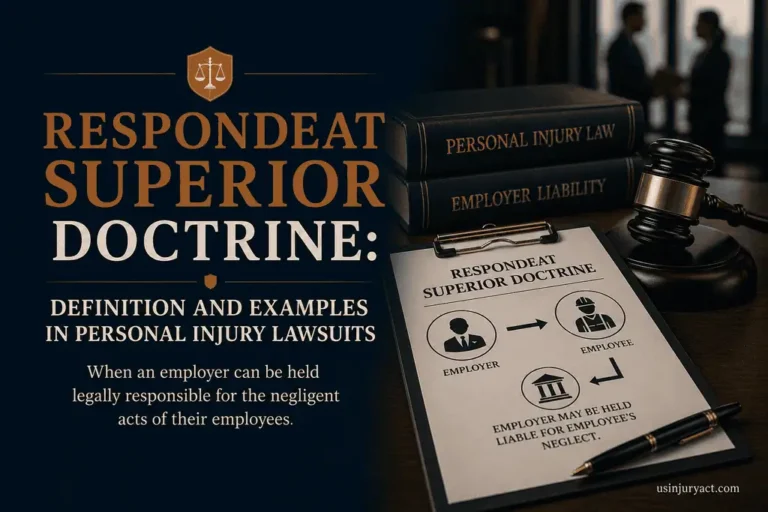
What Is the Respondeat Superior Doctrine?
Peradventure you were injured by someone who was acting in the course of their employment, you may have the right to hold their employer legally responsible for your damages. This is the essence of the respondeat superior doctrine, a foundational principle of employer liability in American tort law.
The Latin phrase translates to “let the master answer,” and that is precisely what the law requires under the right circumstances.
Respondeat superior allows injured plaintiffs to pursue compensation not just from the individual who caused harm, but from the organization that employed and directed that person.
In practical terms, this often means the difference between recovering full compensation from a well-funded corporation and fighting over the policy limits of an individual driver with minimal assets.
This article explains exactly how respondeat superior works, what elements must be proven, how courts have applied it in real cases, and what it means for your personal injury claim.
The Legal Foundation of Respondeat Superior
Respondeat superior is a form of vicarious liability, meaning one party is held responsible for the actions of another based on their legal relationship rather than their own direct fault.
Under this doctrine, an employer can be liable for the negligent acts of an employee if those acts occurred within the scope of the employee’s employment.
This principle is deeply rooted in American common law and has been affirmed by courts in every state. The Restatement (Third) of Agency, a highly influential legal authority published by the American Law Institute, addresses the scope of vicarious liability in detail and provides courts with guidance on applying these principles to modern employment relationships.
The policy reasoning behind respondeat superior is straightforward. Employers profit from the labor of their employees, direct and control how that work is performed, and are better positioned financially to absorb the costs of accidents that arise from their operations.
It would be unjust to allow corporations to benefit from their workforce while insulating themselves from the consequences of employee negligence.
Elements Required to Establish Respondeat Superior Liability
Element One: An Employer-Employee Relationship
The doctrine applies to employees, not independent contractors. This distinction is critical and heavily litigated.
Courts look at the totality of the working relationship to determine its true nature, examining factors such as who controls the manner and means of the work, who supplies the tools and equipment, whether the work is part of the regular business of the hiring party, and the degree of permanence of the relationship.
If a company misclassifies an employee as an independent contractor to avoid liability, courts have the authority to look behind the label and examine the actual working relationship.
Many gig economy companies have faced exactly this challenge as courts evaluate their liability exposure for accidents caused by their workers.
Element Two: Acting Within the Scope of Employment
The negligent act must have occurred within the scope of the employee’s employment.
This does not mean the employer authorized the specific act. It means the conduct was the kind of work the employee was hired to perform, occurred substantially within authorized work hours and space, and was motivated, at least in part, by a purpose to serve the employer.
Courts use a totality test rather than a rigid checklist, an employee who causes an accident while making a delivery for instance is clearly acting within scope.
An employee who causes an accident while driving to a work site is typically within scope. But an employee who commits a crime for purely personal reasons during work hours is generally outside the scope of employment.
The Frolic and Detour Doctrine: When Employers Are Not Liable
Even when an employee causes harm during working hours, an employer may escape liability if the employee was on a frolic or detour. Courts distinguish between these two concepts, and the distinction matters significantly.
A detour is a minor deviation from the employee’s authorized route or duties. An employer generally remains liable during a detour.
For example, a delivery driver who stops briefly at a coffee shop a block off route and then causes an accident on the way back to the route is likely still within scope. The deviation is minor and the employee has substantially returned to their job duties.
A frolic is a major departure from employment for purely personal purposes. An employer is generally not liable during a frolic.
For example, a company driver who uses the company van to take a two-hour personal trip to visit a friend and causes an accident during that trip is likely on a frolic. The employment connection has been substantially severed.
Courts analyze the nature, duration, and purpose of the deviation, and experienced personal injury attorneys know how to frame these facts to keep the employer in the case.
Examples of Respondeat Superior in Personal Injury Cases
Commercial Truck Driver Negligence
A trucking company employs a driver to transport goods across state lines. The driver, fatigued from exceeding federal Hours of Service regulations, falls asleep at the wheel and collides with a family sedan on an interstate highway. The family sustains severe injuries.
Under respondeat superior, the trucking company is liable for the vehicle’s accident because the driver was acting directly within the scope of his employment at the time of the crash.
The company’s own negligence in failing to monitor and enforce driving hour limits may also support a direct negligence claim alongside vicarious liability.
In trucking litigation, plaintiffs typically pursue both respondeat superior and direct liability theories simultaneously, giving them multiple pathways to employer accountability.
Healthcare Worker Negligence in a Hospital
A hospital-employed nurse administers the wrong medication dosage to a patient, causing a serious adverse reaction. The patient brings a medical malpractice claim.
The hospital is vicariously liable under respondeat superior because the nurse was performing core job duties, during regular working hours, under the hospital’s direction and control.
The patient can recover from the hospital’s far deeper financial resources rather than being limited to pursuing the individual nurse.
Retail Store Employee Assault
A security guard employed by a big-box retailer uses excessive force while detaining a suspected shoplifter, causing the detainee serious physical injury. The store argues the guard’s conduct was unauthorized.
Courts have held that when an employee is acting within a general category of duties, such as security, the employer remains liable even if the specific method used was unauthorized or excessive.
The guard was hired to perform security functions, and the assault occurred in that context.
Sales Representative Car Accident
A pharmaceutical sales representative employed by a large drug company is driving from one doctor’s office to another for sales calls when she runs a red light and strikes a cyclist. The cyclist sustains a broken pelvis and multiple fractures.
The company is liable under respondeat superior. The representative was traveling between clients for business purposes, within working hours, using a company vehicle. This is a textbook within-scope scenario, and the pharmaceutical company’s commercial auto policy will be the primary source of recovery.
Respondeat Superior vs. Direct Negligence: The Key Difference
Plaintiffs in employer liability cases often pursue two legal theories simultaneously: respondeat superior and direct negligence. These are distinct claims that can each provide independent grounds for employer liability.
Under respondeat superior, the employer is liable because of the employee’s negligence, even if the employer did nothing wrong personally.
Under direct negligence theories, the employer is liable because of its own failures, such as negligent hiring of an unqualified driver, negligent supervision of a known problem employee, negligent entrustment of a vehicle to someone with a suspended license, or negligent retention of an employee whose dangerous tendencies were known.
Pursuing both theories strengthens your case considerably. If the defendant disputes scope of employment and defeats respondeat superior at trial, your direct negligence claims may still survive.
Some states also allow punitive damages in direct negligence cases involving reckless employer conduct, which are not available under a pure vicarious liability theory.
Independent Contractor Exceptions and Evolving Standards
The traditional rule is that employers are not vicariously liable for the acts of independent contractors. However, significant exceptions exist and continue to expand through litigation and legislation.
The inherently dangerous activity exception holds employers liable for contractor negligence when the work involves activities that are inherently dangerous regardless of how carefully performed, such as demolition, blasting, or working with hazardous chemicals.
The non-delegable duty exception applies when the employer has a legal duty to the plaintiff that cannot be transferred to a contractor, such as a property owner’s duty to maintain safe premises for business invitees.
In recent years, courts in California, Massachusetts, and other states have adopted new multi factor tests that look more critically at misclassification of workers in app-based and gig economy platforms.
It is an area of rapidly developing law with significant implications for personal injury victims injured by gig workers.
Practical Implications for Your Personal Injury Claim
If you are injured by someone who was working at the time of the accident, you should immediately investigate the employment relationship.
Determine who employed the at-fault party, whether they were on duty at the time, what vehicle or equipment was involved and who owned it, and what the employer’s insurance coverage looks like.
Employers are required to carry commercial liability insurance for the actions of their employees, and these policies typically carry far higher limits than individual personal auto policies.
A commercial general liability policy may carry $1 million or more in coverage per occurrence, and commercial umbrella policies can provide additional millions in protection.
Respondeat superior claims also often support stronger discovery in litigation. You can subpoena employment records, training manuals, prior accident reports, supervision logs, and vehicle maintenance records that would not be available in a pure individual defendant case.
The respondeat superior doctrine
The respondeat superior doctrine is one of the most powerful tools available in personal injury litigation.
It allows you to pursue the employer, not just the employee, when you are harmed by someone acting within the scope of their job. Employers carry deeper financial resources, higher insurance limits, and greater accountability than individual defendants.
If you were hurt in an accident involving a commercial vehicle, a service worker, a healthcare provider, or any employee acting in the course of their duties, contact a personal injury attorney immediately.
Identifying and preserving the employer liability claim from the very start is the difference between partial and full compensation for everything you have lost.