Imagine a young man driving through Columbus on I-270 when a distracted driver runs a red light and crashes into his vehicle. He end up with a broken arm, missed weeks of work, and a stack of medical bills.
He assume the other driver’s insurance will simply pay but Ohio has specific laws governing how much he can recover, how long he have to act, and what happens if he was even slightly at fault.
According to the Ohio Department of Transportation, there were thousands motor vehicle crashes recorded in Ohio every single month, resulting in thousands of serious injuries. Yet most people involved in those crashes, and in countless other accidents across the state, have little idea what their legal rights actually are.
Understanding personal injury law in Ohio is not optional if you want to protect your financial recovery. This guide covers everything you need to know, including the basics of negligence, the Ohio statute of limitations personal injury deadline, the state’s modified comparative fault rule, how to build and file a claim, what damages you can recover, and how to choose the right attorney for your case.
Personal injury law gives people who are harmed by someone else’s negligent or intentional conduct the right to seek financial compensation. In Ohio, this area of law covers a wide range of situations, ranging from car accidents and slip-and-fall incidents to medical malpractice and defective products.
At the heart of every personal injury claim is the legal concept of negligence. To succeed, you generally must prove four elements:
Ohio follows common-law negligence principles but has layered them with specific statutory rules that can significantly affect the outcome of your case. Knowing those rules before you act is essential.
Ohio has several distinct legal rules that directly shape how personal injury claims are valued, filed, and decided. Ignoring any of them can cost you your entire case.
From Ohio Revised Code Section 2305.10, most personal injury claims in Ohio must be filed within two years from the date of the injury. This is known as the Ohio statute of limitations personal injury deadline, and it is strictly enforced.
If you miss this deadline, the court will almost certainly dismiss your case, regardless of how strong your evidence is. You permanently lose your right to sue.
There are important exceptions to be aware of:
Ohio follows the Ohio modified comparative negligence rule, codified in Ohio Revised Code Section 2315.33. This rule affects your recovery if you were partially responsible for your own injury.
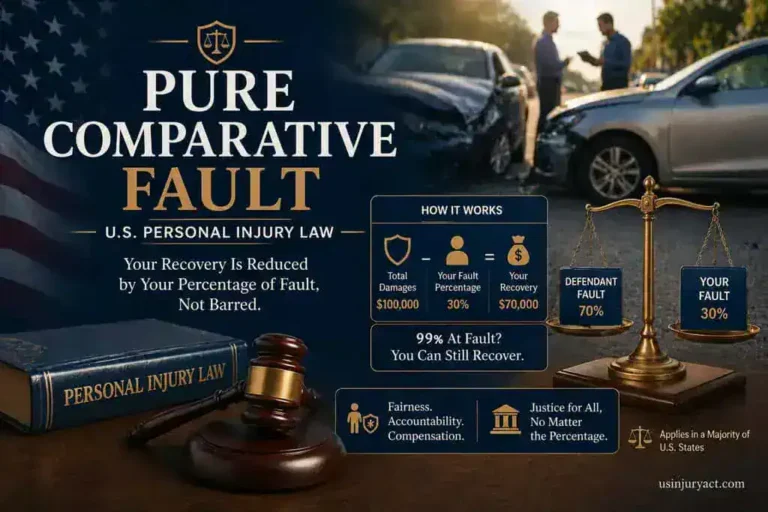
Under this rule, your compensation is reduced by your percentage of fault. However, if you are found to be 51 percent or more at fault, you recover nothing at all. This is called the 51 percent bar.
For example, You are injured in a car accident in Cleveland and your damages total $100,000. The jury finds you were 30 percent at fault for speeding slightly at the time of the crash. Under Ohio law, your recovery is reduced to $70,000. If instead the jury had found you 51% or more at fault, you would receive zero compensation.
This rule makes it critically important to build a strong case that establishes the other party’s fault clearly and minimizes any arguments that you contributed to your own harm.
Ohio is an at-fault insurance state. This means that the driver who caused the accident is responsible for covering the resulting damages. You can file a claim with the at-fault driver’s liability insurance, file a claim with your own insurer if you have applicable coverage, or pursue a personal injury lawsuit directly against the at-fault party.
Ohio requires minimum auto liability coverage of $25,000 per person and $50,000 per accident for bodily injury. In serious accident cases, minimum coverage is often insufficient to cover actual damages.
Ohio does not impose a general cap on economic damages such as medical bills and lost wages in standard personal injury cases. However, noneconomic damages such as pain and suffering are subject to caps under Ohio Revised Code Section 2315.18 in certain civil cases, generally limiting them to the greater of $250,000 or three times economic damages up to $350,000 per plaintiff.
Punitive damages, which are awarded to punish especially reckless conduct, are capped at twice the compensatory damages awarded or ten percent of the defendant’s net worth, whichever is less, under Ohio Revised Code Section 2315.21.
If you or a family member has been hurt in an accident, knowing how to file a personal injury lawsuit in Ohio can make the difference between full compensation and receiving nothing. Here is a practical roadmap.
Your health comes first, but medical documentation is also the foundation of your legal claim.
See a doctor as soon as possible after the accident, even if you feel you were not seriously hurt. Delays in treatment give insurance companies grounds to argue your injuries were not caused by the accident or were not as serious as claimed.
Keep records of every appointment, diagnosis, prescription, and treatment plan. These become essential evidence when calculating your economic damages.
If you are physically able, take photographs of the accident scene, your injuries, any property damage, road conditions, and any contributing factors like a broken handrail or obscured signage. Obtain witness names and contact information.
In Ohio car accidents, get the other driver’s insurance information, license plate number, and contact details. Request a copy of the police report. In slip-and-fall cases, ask the property owner or manager to complete an incident report and keep a copy for yourself.
Report the accident to the relevant insurance carrier promptly. In most car accident cases, this means notifying both your own insurer and, where applicable, the at-fault party’s insurance company.
Be cautious in your communications with insurance adjusters. Their goal is to minimize your payout. Avoid giving recorded statements without first consulting an attorney. Do not accept a settlement offer until you understand the full extent of your injuries and damages.
This is one of the most important steps you can take. An Ohio personal injury attorney can evaluate the strength of your claim, preserve evidence, handle communications with insurers, identify all liable parties, and ensure your case is filed before the statutory deadline.
Most personal injury attorneys in Ohio work on a contingency fee basis, meaning you pay nothing unless you win. This makes legal representation accessible regardless of your financial situation.
If a fair settlement cannot be reached, your attorney will file a formal lawsuit in the appropriate Ohio court. Remember that under Ohio Revised Code Section 2305.10, you typically have two years from the date of your injury to file. Waiting too long eliminates your options entirely.
The litigation process includes discovery, depositions, potential mediation, and, if no settlement is reached, a jury trial. Many cases in Ohio settle before reaching trial.
Ohio personal injury law allows injured plaintiffs to seek three broad categories of compensation.
Economic damages are the tangible, calculable financial losses you have suffered as a result of the injury. These include:
Noneconomic damages compensate you for losses that are real but harder to quantify. In Ohio, these include:
As noted above, Ohio law caps noneconomic damages in many civil cases. Your attorney can advise you on how these caps apply to your specific situation.
Punitive damages are not available in every case. Ohio courts award them only when the defendant’s conduct was especially malicious, fraudulent, or recklessly indifferent to the safety of others. They are meant to punish the wrongdoer and deter similar behavior, not simply to compensate the victim.
Because your damages are reduced by your percentage of fault under Ohio’s comparative negligence rule, maximizing your recovery depends on minimizing the fault attributed to you and clearly establishing the full extent of your losses.
Motor vehicle accidents are the most common source of personal injury claims in Ohio. Because Ohio is an at-fault state, the negligent driver’s liability insurance is typically the primary source of compensation. Ohio’s modified comparative negligence rule applies, meaning any shared fault will reduce your award.
Distracted driving, speeding, impaired driving, and failure to yield are among the most frequently cited causes of serious Ohio car accidents. Dashcam footage, traffic camera data, and accident reconstruction experts often play significant roles in these cases.
Slip-and-fall claims fall under Ohio premises liability law. Property owners owe different levels of care depending on your status as an invitee, licensee, or trespasser. Business customers, for example, are typically considered invitees and are owed the highest duty of care.
To succeed in a slip-and-fall claim in Ohio, you must show that the property owner knew or should have known about the hazardous condition and failed to fix it or warn you. Wet floors, broken steps, inadequate lighting, and icy entryways are common hazards in these cases.
Most Ohio workplace injuries are covered by the Ohio workers’ compensation system, which generally prevents employees from suing their employers directly. However, you may still have a personal injury claim against a negligent third party, such as an equipment manufacturer or a subcontractor on a job site.
In cases involving intentional employer misconduct, Ohio law may allow a direct lawsuit against the employer outside the workers’ compensation system. These cases are complex and require experienced legal guidance.
Medical malpractice claims in Ohio are governed by a shorter statute of limitations than standard personal injury cases. Under Ohio Revised Code Section 2305.113, you generally have one year from the date you discovered the malpractice to file a claim.
To succeed, you must show that a healthcare provider deviated from the accepted standard of care and that this deviation directly caused your harm. Ohio law requires an affidavit of merit from a qualified medical expert at the time of filing. These cases are technically demanding and expensive to pursue, making attorney representation essential.
Ohio follows a strict liability rule for dog bites under Ohio Revised Code Section 955.28. This means a dog owner is liable for injuries caused by their dog even if the animal had no prior history of aggression. You do not need to prove that the owner knew the dog was dangerous.
Exceptions include situations where the victim was trespassing, committing a criminal act, or tormenting the dog at the time of the attack. Dog bite injuries can be severe, particularly for children, and often result in significant medical bills, scarring, and psychological trauma.
When a person is killed as a result of another party’s negligence or misconduct, Ohio law allows eligible family members to bring a wrongful death claim under Ohio Revised Code Section 2125.01. Eligible claimants include the surviving spouse, children, and parents of the deceased.
Wrongful death damages in Ohio include medical and funeral expenses, lost future income of the deceased, loss of companionship and care, and the mental anguish suffered by surviving family members. The two-year statute of limitations runs from the date of death, not the date of the underlying accident.
While Ohio law applies statewide, practical factors like court culture, jury demographics, and local economic conditions can meaningfully influence the outcome of your case.
Columbus is home to the Franklin County Court of Common Pleas, one of Ohio’s busiest civil courts. As the state capital and a rapidly growing metropolitan area, Columbus juries reflect a diverse urban population. Cases involving tech professionals, university employees, and a younger demographic can be influenced by that jury pool’s expectations about medical costs and future earnings.
Columbus sees a high volume of car accident, slip-and-fall, and premises liability claims. Local courts are generally efficient, though significant case backlogs can push trial dates well into the future.
Cuyahoga County houses Cleveland’s primary civil courts and is known for handling a high volume of serious personal injury and medical malpractice cases. Cleveland juries have historically been receptive to substantial verdicts in cases involving clear corporate or institutional negligence.
The city’s industrial history and its population’s familiarity with workplace hazards can influence how juries perceive injury claims, particularly in cases involving unsafe work environments or defective products.
Hamilton County courts, which serve the Cincinnati metro area, tend to reflect the region’s more conservative legal culture, particularly in comparison to Cuyahoga County. Defense verdicts and lower damage awards have historically been more common here in certain categories of cases.
That said, Cincinnati courts handle sophisticated commercial and medical malpractice litigation regularly, and experienced local counsel can make a significant difference in navigating the local legal environment.
Lucas County serves the Toledo area and handles a mix of auto accident, premises liability, and occupational injury cases. Toledo’s manufacturing heritage and working-class demographics can create a jury pool sympathetic to injured workers and accident victims.
The economic impact of the injury on a working-class plaintiff, including lost wages and inability to return to physical labor, often carries particular weight with Toledo juries.
Montgomery County courts in Dayton see a significant volume of personal injury litigation. Dayton’s economic challenges over the years have contributed to a jury pool that is often attuned to the financial hardship that serious injuries cause for working families.
Local court familiarity is a genuine advantage. An attorney with experience in Dayton’s courts will know the preferences and tendencies of local judges, which can inform litigation strategy and settlement negotiations.
Selecting the right Ohio personal injury attorney is one of the most consequential decisions you will make after an accident. Here is what to look for and what to avoid.
Nearly all Ohio personal injury attorneys handle cases on a contingency fee agreement, meaning they only get paid if you recover compensation. Typical fees range from 33 percent to 40 percent of the total recovery, with the higher percentage often applying if the case goes to trial.
Make sure you understand exactly what costs will be deducted from your recovery. These can include filing fees, expert witness fees, deposition costs, and investigative expenses. Get the fee agreement in writing before signing anything.
Most reputable personal injury attorneys in Ohio offer a free consultation with no obligation. Use this meeting to assess the attorney’s knowledge of Ohio law, their experience with cases similar to yours, and whether you feel comfortable communicating with them.
Bring all documents you have gathered, including medical records, accident reports, insurance correspondence, and any photographs. This allows the attorney to give you a realistic assessment of your claim.
An attorney who regularly practices in the Ohio county where your case will be filed brings real advantages. They know the local judges, understand the tendencies of local juries, have relationships with reliable experts, and can anticipate procedural issues that a generalist or out-of-state firm might miss. In Ohio personal injury law, local knowledge is not a luxury. It is a practical asset that can affect your bottom line.
Ohio’s personal injury law is a little bit complex because of the two year filing deadline, the 51 percent bar under the modified comparative negligence rule, the various damage caps, and the city by city differences in how cases are tried
If you have experienced any injury maybe from a car crash in Columbus, a fall at a Cincinnati grocery store, or a workplace accident in Toledo, the decisions you make in the days and weeks following the incident can shape your recovery for years to come. Document everything, seek medical care immediately, and do not try to navigate the insurance system alone.
The right Ohio personal injury attorney will evaluate your case at no cost, protect you from the tactics insurers use to minimize claims, and fight to recover every dollar you are owed. Do not wait until a deadline is approaching.
Reach out to any qualified Ohio personal injury lawyer near you and get the guidance you need to move forward.
Learn and Connect with the best injury attorneys based on specific injury type
Stay ahead with our resources on personal injury laws across the U.S.