

When an accident happens, it is rarely one person’s fault entirely. A distracted driver may rear-end someone who stopped suddenly in a no-stopping zone.
A store may have a wet floor without a sign, but the customer may have been running. In these shared-fault situations, American courts rely on a legal framework called comparative fault to divide responsibility and determine compensation.
Modified comparative fault is the dominant form of that framework in the United States. It governs personal injury claims in the majority of American states and has a direct, quantifiable impact on how much money an injured person can recover. It rewards proportional accountability while still protecting defendants from paying for harm they did not cause.
This guide explains every dimension of modified comparative fault: its legal definition, how both threshold rules operate, which states apply each, how courts and juries calculate damages, and the strategies injury victims can use to protect their claim.
It is written for beginners, law students, and attorneys who want a single authoritative reference on this topic.
| 33
U.S. States Follow Modified Comparative Fault |
2
Threshold Rules: 50% and 51% Cutoffs |
13
States Use Pure Comparative Negligence |
What Is Modified Comparative Fault in U.S. Personal Injury Law?
Modified comparative fault is a legal doctrine that allocates responsibility for an accident among multiple parties and reduces each party’s compensation based on their assigned share of fault. It is the system used by a majority of U.S. states to resolve personal injury cases where more than one person contributed to an injury.
The Core Legal Definition
Under modified comparative fault, a plaintiff (the injured person) can recover monetary damages even if they were partially at fault for the accident. However, their compensation is reduced by the percentage of fault assigned to them. The critical rule is this: if the plaintiff’s fault reaches or exceeds a specific threshold, they recover nothing at all.
That threshold is either 50 percent or 51 percent, depending on the state. This threshold rule is what makes the system “modified” rather than “pure.” Pure comparative negligence has no cutoff. Modified comparative fault does.
Recommended: Pure Comparative Fault
| Legal Principle:
Modified comparative fault holds that an injured party should only bear the financial consequences of their own proportional contribution to harm. If their contribution exceeds the majority share of fault, the law concludes they should bear their own losses. |
Why This Doctrine Matters for Personal Injury Claims
The fault percentage assigned to you in a personal injury case is not an abstract number, it directly controls the dollar amount you receive. A plaintiff with $200,000 in total damages who is found 30 percent at fault takes home $140,000. If that same plaintiff is found 52 percent at fault in a 51 percent rule state, they receive nothing.
This makes fault allocation the single most important battleground in most personal injury litigation. Insurance adjusters, defense attorneys, plaintiffs’ counsel, and expert witnesses all invest significant resources into shifting the fault percentage in their client’s favor.
The Principle of Fault Allocation
Fault allocation is the process by which a court or jury assigns percentages of responsibility to each party. These percentages must add up to 100 percent. In a two-party case, if the defendant is found 70 percent at fault, the plaintiff is found 30 percent at fault. In multi-party cases, fault is distributed across all responsible parties, including those who may not be named in the lawsuit.
- The plaintiff’s fault percentage is determined by how much their own negligent conduct contributed to the accident.
- The defendant’s fault percentage reflects how their actions or failures caused the plaintiff’s injuries.
- Third parties may be assigned fault even if they are not defendants, depending on state rules about nonparty fault.
- Fault can be reassigned during settlement negotiations, trial discovery, and expert depositions.
How Does Modified Comparative Fault Work Step by Step?
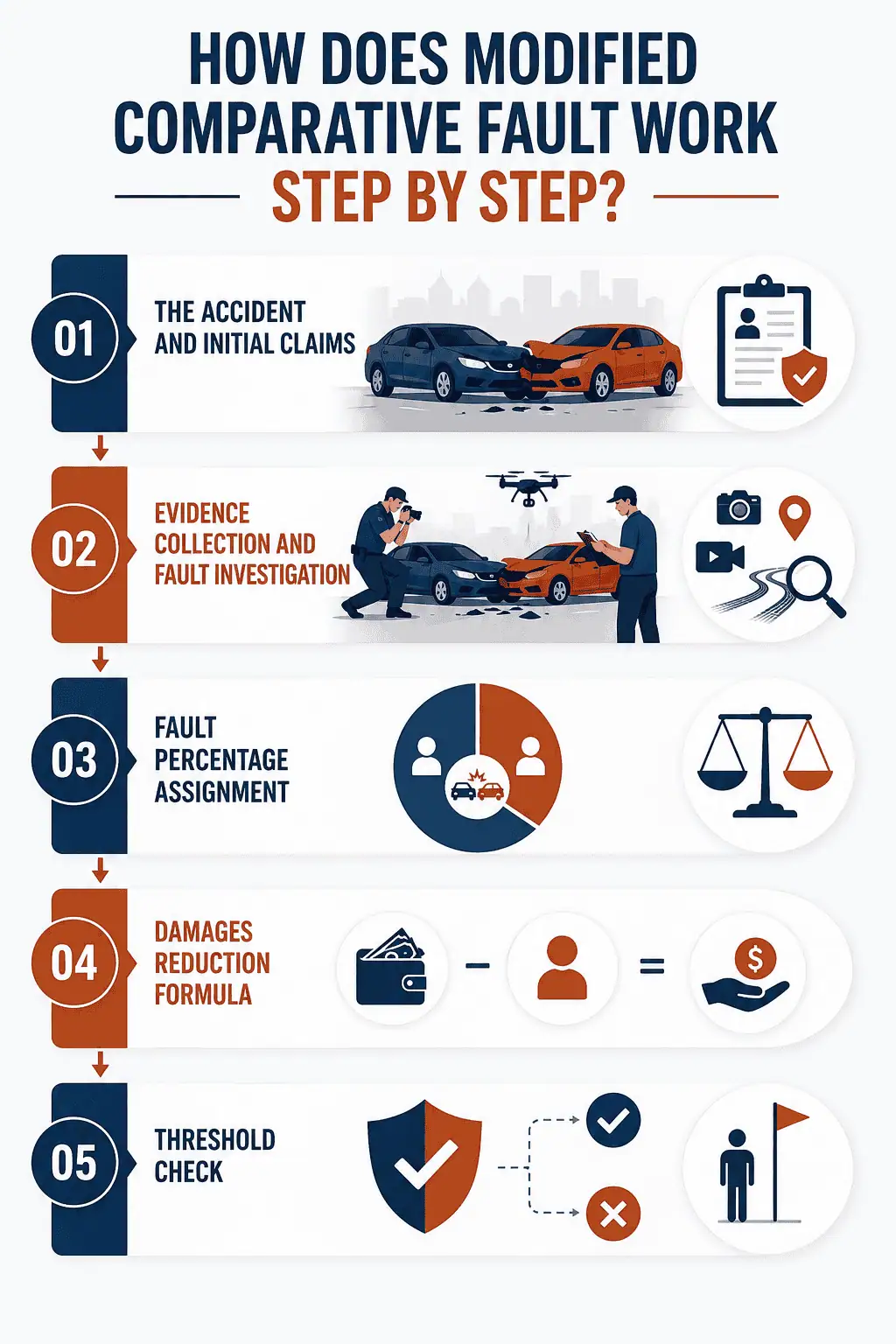
The modified comparative fault process unfolds across several stages, from the initial accident through final compensation. Each stage involves different legal actors and decision points. Here is a precise breakdown of how the system operates.
Step 1: The Accident and Initial Claims
An injured person files a personal injury claim or lawsuit. They allege that another party’s negligence caused their injuries. That party (or their insurer) responds with a defense that may include an assertion that the plaintiff was also negligent.
Step 2: Evidence Collection and Fault Investigation
Both sides gather evidence to support their version of the accident. This includes police reports, witness statements, surveillance footage, accident reconstruction analysis, and medical records. Insurance adjusters conduct their own investigation and assign an initial fault estimate for internal claim valuation purposes.
Step 3: Fault Percentage Assignment
In cases that go to trial, the jury receives instructions on comparative fault and deliberates to assign percentages to each party. In settled cases, fault percentages are negotiated between attorneys and insurers without a jury verdict.
| Who assigns fault percentages:
At trial, the jury assigns fault. In bench trials, the judge assigns fault. In pre-trial settlements, insurance adjusters and attorneys negotiate the effective fault allocation by agreeing on a settlement amount that implicitly reflects a fault distribution. |
Step 4: Damages Reduction Formula
Once the fault percentage is established, the compensation formula is applied:
CORE FORMULA
Modified Comparative Fault Damages Calculation
| Item | Value / Outcome |
| Total compensable damages | $300,000 |
| Plaintiff’s assigned fault percentage | 25% |
| Reduction amount (25% of $300,000) | $75,000 |
| Plaintiff’s actual recovery | $225,000 |
Step 5: Threshold Check
Before the plaintiff receives their reduced compensation, the court checks the plaintiff’s fault percentage against the state’s threshold. In a 50 percent rule state, if the plaintiff is 50 percent or more at fault, recovery is barred. In a 51 percent rule state, if the plaintiff is 51 percent or more at fault, recovery is barred.
EXAMPLE: BELOW THRESHOLD RECOVERY
45% Fault in a 50% Rule State
| Item | Value / Outcome |
| Total damages | $200,000 |
| Plaintiff fault | 45% |
| Below threshold? (50% rule) | Yes, 45% is below 50% |
| Reduction (45% of $200,000) | $90,000 |
| Recovery | $110,000 |
EXAMPLE: THRESHOLD EXCEEDED, NO RECOVERY
50% Fault in a 50% Rule State
| Item | Value / Outcome |
| Total damages | $200,000 |
| Plaintiff fault | 50% |
| At or above threshold? (50% rule) | Yes, bars recovery |
| Recovery | $0 |
What Is the Difference Between the 50 Percent Rule and the 51 Percent Rule?
The two variants of modified comparative fault differ by a single percentage point, but that difference has a profound impact on real cases.
| 50 PERCENT RULE
Equal Fault Bars Recovery A plaintiff found 50 percent or more at fault cannot recover any damages. Recovery is only possible when the plaintiff’s fault is 49 percent or less. Being equally at fault (50/50) eliminates the right to compensation. |
51 PERCENT RULE
Majority Fault Bars Recovery A plaintiff found 51 percent or more at fault cannot recover any damages. A plaintiff found exactly 50 percent at fault may still recover 50 percent of their damages. Recovery is barred only when the plaintiff bears the majority of fault. |
The Practical Significance of the 1% Difference
In a case with $500,000 in damages, the difference between a 50 percent fault finding and a 51 percent fault finding in a 51 percent rule state is the difference between recovering $250,000 and recovering nothing. That single percentage point is worth $250,000. This is why attorneys in these states fight aggressively over every fractional point of fault allocation.
The Key Distinction Summarized
| Scenario | 50% Rule State | 51% Rule State |
| Plaintiff 40% at fault | Recovers 60% of damages | Recovers 60% of damages |
| Plaintiff 49% at fault | Recovers 51% of damages | Recovers 51% of damages |
| Plaintiff 50% at fault | Recovers $0 (barred) | Recovers 50% of damages |
| Plaintiff 51% at fault | Recovers $0 (barred) | Recovers $0 (barred) |
| Plaintiff 75% at fault | Recovers $0 (barred) | Recovers $0 (barred) |
| Under the 50 percent rule, a plaintiff at exactly 50 percent fault receives nothing. Under the 51 percent rule, a plaintiff at exactly 50 percent fault recovers half of their damages. This is the most critical practical difference between the two rules. |
Which States Follow the 50 Percent Modified Comparative Fault Rule?
Approximately twelve to thirteen states apply the 50 percent modified comparative fault rule. These states bar plaintiff recovery when the plaintiff is found equally or more at fault than the defendant. Here is a detailed look at how key states apply this rule.
| Georgia | Colorado | Tennessee |
| Kansas | Utah
Utah Code § 78B-5-818 |
Maine |
| North Dakota
N.D.C.C. § 32-03.2-02 |
Idaho | Nebraska |
Georgia: The 50 Percent Bar in Action
Georgia adopted modified comparative fault through its apportionment statute found at Official Code of Georgia Annotated Section 51-12-33. Georgia juries apportion fault among all parties, including non-parties who may have contributed to the accident.
If the plaintiff’s fault equals or exceeds 50 percent, recovery is completely barred. Georgia applies this rule across automobile accidents, premises liability claims, and product liability matters.
| Georgia Practice Note:
Georgia allows fault to be apportioned to non-parties, including dissolved corporations and unnamed tortfeasors, which can reduce the fault percentages attributed to named parties. This procedural nuance frequently affects strategic decisions about whom to include in a lawsuit. |
Colorado: Contributory Negligence Converted to Comparative Fault
Colorado converted from contributory negligence to modified comparative fault through Colorado Revised Statutes Section 13-21-111. Colorado follows the strict 50 percent cutoff, meaning a plaintiff found 50 percent at fault recovers nothing. Colorado courts apply this rule to claims including auto accidents, slip and fall cases, ski resort liability, and medical negligence.
Tennessee: Statutory Comparative Fault
Tennessee enacted its comparative fault framework through Tennessee Code Annotated Section 29-11-103. Tennessee follows the 50 percent bar. The state’s courts apply modified comparative fault broadly, and Tennessee allows fault to be assigned to immune parties in some circumstances, which can significantly affect the percentage attributed to the remaining defendants.
Kansas: Fault and Comparative Negligence Claims
Kansas applies modified comparative fault under Kansas Statutes Annotated Section 60-258a, which bars plaintiff recovery when the plaintiff’s negligence equals or exceeds the defendant’s. Kansas courts have applied this rule in motor vehicle cases, premises liability claims, and workplace injury disputes.
Utah: Comparative Fault and Immunity
Utah’s comparative fault statute, Utah Code Section 78B-5-818, follows the 50 percent bar strictly. Utah applies the rule in personal injury and wrongful death cases. Utah courts have developed clear jury instructions for allocating fault proportionally and have specific provisions governing how governmental immunity intersects with comparative fault claims.
Which States Follow the 51 Percent Modified Comparative Fault Rule?
The 51 percent rule is followed by approximately twenty states. These states take a slightly more plaintiff-friendly position: an injured party is barred only when their fault exceeds a bare majority.
| Texas
Tex. Civ. Prac. § 33.001 |
Illinois
735 ILCS 5/2-1116 |
Pennsylvania
42 Pa. C.S. § 7102 |
| New Jersey
N.J.S.A. 2A:15-5.1 |
Ohio
Ohio R.C. § 2315.33 |
Michigan
MCLA § 600.2959 |
| Indiana
Ind. Code § 34-51-2-6 |
Wisconsin
Wis. Stat. § 895.045 |
Nevada
NRS § 41.141 |
| Minnesota
Minn. Stat. § 604.01 |
|
|
Texas: The Nation’s Largest 51 Percent Rule Jurisdiction
Texas applies modified comparative fault under Texas Civil Practice and Remedies Code Section 33.001. Texas bars recovery when the plaintiff’s fault percentage is greater than 50 percent, which means that a plaintiff found at exactly 50 percent may still recover half their damages. Texas has developed an extensive body of case law on proportionate liability, including detailed rules for allocating fault among multiple defendants, settling parties, and responsible third parties.
| Texas Practice Note:
Texas requires defendants to designate “responsible third parties” before trial if they wish to have fault allocated to non-defendants. Failure to meet this designation deadline can prevent the introduction of evidence of third-party fault, which significantly affects final fault percentages. |
Illinois: Negligence Beyond 50 Percent
Illinois applies modified comparative fault under 735 Illinois Compiled Statutes 5/2-1116. A plaintiff whose contributory negligence is more than 50 percent of the proximate cause of the injury is barred from recovery. Illinois courts have applied this rule across automobile accidents, construction site injuries, and product defect claims.
Pennsylvania: Modified Comparative Negligence in Practice
Pennsylvania codified comparative fault under 42 Pennsylvania Consolidated Statutes Section 7102, which bars recovery when the plaintiff is more than 50 percent at fault. Pennsylvania follows a defendant-favorable apportionment system that allocates liability among multiple defendants in proportion to their fault percentages, rather than making all defendants jointly and severally liable for the entire judgment.
New Jersey: The Garden State’s Comparative System
New Jersey’s comparative negligence act, found at New Jersey Statutes Annotated 2A:15-5.1, bars recovery when the plaintiff’s negligence exceeds the defendant’s. New Jersey applies a modified version that aggregates the defendant’s fault when multiple defendants are present.
Ohio: Proportionate Liability and Comparative Fault
Ohio applies modified comparative fault under Ohio Revised Code Section 2315.33. Ohio bars recovery when the plaintiff’s contributory fault is greater than 50 percent. Ohio also applies detailed rules on joint and several liability that interact with its comparative fault framework.
How Are Damages Calculated Under Modified Comparative Fault?
Modified comparative fault applies to the full range of personal injury damages, both economic and non-economic. The proportional reduction formula applies to every category of recoverable loss.
Categories of Recoverable Damages
- Medical expenses: Past and future costs of treatment, surgery, hospitalization, rehabilitation, and medication directly related to the injuries sustained.
- Lost wages and earning capacity: Income lost during recovery and, in serious cases, the reduced earning capacity over a plaintiff’s working lifetime.
- Property damage: The cost to repair or replace damaged property, including vehicles.
- Pain and suffering: Non-economic compensation for the physical pain and discomfort caused by the injury.
- Emotional distress: Compensation for anxiety, depression, insomnia, and other psychological consequences of the injury.
- Loss of consortium: Damages awarded to a spouse or close family member for loss of companionship and support.
- Disfigurement and permanent disability: Additional non-economic damages for lasting physical changes and limitations.
Step-by-Step Calculation: Scenario One
REAL-WORLD SCENARIO: CAR ACCIDENT
Plaintiff 30% at Fault, Defendant 70% at Fault (51% Rule State)
| Item | Value / Outcome |
| Medical expenses (past and future) | $120,000 |
| Lost wages and earning capacity | $85,000 |
| Pain and suffering | $95,000 |
| Property damage | $18,000 |
| Total damages | $318,000 |
| Reduction (30% of $318,000) | $95,400 |
| Net recovery | $222,600 |
Step-by-Step Calculation: Scenario Two
REAL-WORLD SCENARIO: PREMISES LIABILITY
Plaintiff 45% at Fault, Defendant 55% at Fault (50% Rule State)
| Item | Value / Outcome |
| Medical expenses | $75,000 |
| Lost wages (6-month recovery) | $32,000 |
| Pain and suffering | $55,000 |
| Total damages | $162,000 |
| Plaintiff fault (45%) below 50% threshold? | Yes |
| Reduction (45% of $162,000) | $72,900 |
| Net recovery | $89,100 |
Step-by-Step Calculation: Scenario Three
SCENARIO: AT THE THRESHOLD
Plaintiff 51% at Fault in a 51% Rule State
| Item | Value / Outcome |
| Total compensable damages | $500,000 |
| Plaintiff’s fault | 51% |
| Threshold exceeded? (51% rule) | Yes, 51% is not less than 51% |
| Recovery | $0 (barred) |
Non-Economic Damage Caps
Several states impose statutory caps on non-economic damages like pain and suffering. These caps interact with comparative fault calculations. The cap is typically applied after the proportional reduction, meaning the plaintiff’s non-economic damages are first reduced by their fault percentage, then tested against the cap.
What Happens If You Are Exactly 50 Percent or 51 Percent at Fault?
The threshold boundary is the most consequential number in modified comparative fault litigation. The outcomes at these exact percentages differ dramatically based on which rule applies in the state where the claim is filed.
Exactly 50 Percent at Fault
| IN A 50% RULE STATE
No Recovery A plaintiff found exactly 50 percent at fault is completely barred from recovering any damages. Equal fault equals no compensation. There is no recovery at all, regardless of how severe the injuries are. |
IN A 51% RULE STATE
50% of Damages Recovered A plaintiff found exactly 50 percent at fault is still below the 51 percent threshold. They recover their damages reduced by 50 percent. On a $400,000 judgment, this means $200,000 in compensation. |
Exactly 51 Percent at Fault
In both 50 percent and 51 percent rule states, a plaintiff found exactly 51 percent at fault recovers nothing. The 51 percent threshold is the outer limit in 51 percent states, and it is well beyond the 50 percent bar in stricter states. A plaintiff at 51 percent fault in any modified comparative fault state walks away with no compensation.
The Stakes at the Borderline
These edge cases illustrate why the difference between 49 percent fault and 50 percent fault in a 50 percent rule state, or between 50 percent and 51 percent in a 51 percent rule state, can be worth hundreds of thousands of dollars. In high-value injury cases involving catastrophic injuries or wrongful death, the difference can be millions of dollars.
| Attorney Strategy Note:
Borderline fault cases are the most vigorously contested in personal injury litigation. When the facts support a range near the threshold, attorneys typically retain accident reconstruction experts, biomechanical specialists, and human factors consultants to push the fault allocation away from the danger zone. |
Can Fault Percentages Be Appealed?
Yes. Appellate courts can review fault percentage findings, though they apply a deferential standard to jury determinations. An appellate court will typically not disturb a jury’s fault allocation unless the verdict is against the manifest weight of the evidence or the jury received erroneous instructions about the applicable legal standard. Post-trial motions can also challenge extreme or unsupported fault findings.
How Does Modified Comparative Fault Compare to Pure Comparative and Contributory Negligence?
The United States uses three distinct systems for handling shared-fault personal injury cases. Modified comparative fault is one of them. The other two, pure comparative negligence and contributory negligence, produce dramatically different outcomes for injured plaintiffs.
| System | States | Key Rule | Plaintiff at 75% Fault |
| Pure Comparative Negligence | CA, NY, FL, LA, and others (13 states) | No fault bar; recover regardless of fault percentage | Recovers 25% of damages |
| Modified Comparative (50% rule) | GA, CO, TN, KS, UT, and others | Barred at 50% or more fault | Recovers $0 |
| Modified Comparative (51% rule) | TX, IL, PA, NJ, OH, and others | Barred at 51% or more fault | Recovers $0 |
| Contributory Negligence | AL, MD, NC, VA, DC (5 jurisdictions) | Any fault by plaintiff bars all recovery | Recovers $0 (even at 1% fault) |
Pure Comparative Negligence: Maximum Plaintiff Recovery
Under pure comparative negligence, a plaintiff who is 99 percent at fault can still recover 1 percent of their damages. There is no threshold cutoff. California, New York, Florida, Louisiana, and about nine other states follow this approach. It is the most plaintiff-favorable system. Critics argue it allows plaintiffs who are primarily responsible for their own injuries to shift a portion of those costs onto defendants with minimal contribution to the harm.
Contributory Negligence: The Harshest System
Contributory negligence is the opposite extreme. Under this rule, any negligence by the plaintiff, no matter how small, completely bars recovery. A plaintiff who is just 1 percent at fault receives nothing. Only five jurisdictions retain true contributory negligence: Alabama, Maryland, North Carolina, Virginia, and the District of Columbia.
Why Modified Comparative Fault Sits in the Middle
Modified comparative fault was designed as a compromise between these two extremes. It preserves recovery for plaintiffs who are partially at fault, unlike contributory negligence, but it prevents primarily at-fault plaintiffs from recovering at all, unlike pure comparative negligence. This makes it the most widely used system in the United States because it balances fairness to both plaintiffs and defendants.
How Do You Prove and Reduce Your Fault Percentage in a Claim?
Fault percentages are not fixed. They are contested factual determinations that depend on the quality and volume of evidence presented. A skilled plaintiff’s attorney will deploy a systematic strategy to minimize the client’s attributed fault and maximize the percentage assigned to the defendant.
Types of Evidence That Affect Fault Allocation
- Police accident reports and officer observations at the scene
- Surveillance camera and dashcam footage showing the accident sequence
- Witness statements from bystanders with no stake in the outcome
- Accident reconstruction expert analysis with animated simulations
- Black box and event data recorder downloads from vehicles
- Cell phone records showing distraction at the time of the accident
- Medical records documenting the nature and cause of injuries
- Biomechanical expert testimony on injury causation
- Building inspection records and maintenance logs in premises liability cases
- OSHA records and safety violation citations in workplace injury claims
Expert Testimony as a Fault-Shifting Tool
Expert witnesses play a central role in fault disputes. Accident reconstruction engineers testify about vehicle speeds, braking distances, reaction times, and the sequence of events that caused the collision. Biomechanical experts explain the relationship between impact forces and specific injuries, which can rebut defense claims that the plaintiff’s pre-existing conditions caused their symptoms.
Human factors specialists explain how environmental conditions, signage failures, or product design defects contributed to the accident independent of the plaintiff’s conduct.
Strategic Use of Police Reports
Police reports carry significant weight in fault disputes, even though they are not always admissible at trial. Insurance adjusters rely heavily on police reports to set initial fault estimates. If the report incorrectly attributes fault to the plaintiff, early action to correct the record can shift the trajectory of the claim before formal litigation begins.
Legal Strategies to Shift Liability
- File the lawsuit in a jurisdiction with favorable jury demographics and verdict history, where available and legally appropriate.
- Identify and name all responsible parties early, including third-party defendants whose fault may reduce the percentage attributed to the plaintiff.
- Conduct early depositions of the defendant to lock in favorable admissions about their conduct before the defense attorney can rehearse the witness.
- File spoliation motions if the defendant failed to preserve evidence such as surveillance footage, maintenance logs, or electronic data.
- Retain the strongest available experts and disclose them well in advance of trial to prevent surprise and allow time for effective examination.
- Challenge the admissibility of defense expert opinions that rely on speculative or unverified assumptions about the plaintiff’s conduct.
- Use focus groups and mock jury exercises to test how neutral jurors perceive the plaintiff’s conduct and adjust case presentation accordingly.
Documenting the Defendant’s Violations
In many cases, the most effective way to reduce the plaintiff’s fault percentage is to aggressively document the defendant’s wrongdoing. Evidence of traffic citations, building code violations, regulatory infractions, prior complaints, or internal safety policy failures shifts the narrative away from the plaintiff’s conduct and toward the defendant’s responsibility. The stronger the evidence of the defendant’s breach of duty, the harder it is for a jury to assign a majority of fault to the plaintiff.
Modified Comparative Fault: Frequently Asked Questions
The following questions represent the most commonly searched queries about modified comparative fault in personal injury cases.
[rank_math_rich_snippet id=”s-e96509f1-98a1-422e-a5a1-f1da7028aeaa”]
| Key Takeaways and Final Guidance
Modified comparative fault is the foundation of personal injury law in the majority of U.S. states. It reflect a commitment to proportional accountability: you recover compensation proportional to the share of fault borne by the other party, but you lose the right to any recovery if your own fault reaches the legal threshold. The difference between the 50 percent rule and the 51 percent rule is a single percentage point that can mean the difference between a six-figure recovery and nothing. Knowing which rule applies in your state, and having skilled legal representation to fight for the most favorable fault allocation possible, is the most important factor in the outcome of your claim. If you are involved in a personal injury case in a modified comparative fault state, seek qualified legal counsel as early as possible. An experienced personal injury attorney can assess how the applicable state rule affects your claim, gather the evidence needed to establish a favorable fault allocation, and navigate the procedural requirements that govern non-party fault designations, expert disclosure, and pre-trial motions in your jurisdiction. |