
Peradventure you or someone close to you have been hurt because of someone else’s negligence, the personal injury statute of limitations in your state is one of the most important legal deadlines you will ever face.
If missed, and your right to seek compensation may be gone, regardless of how serious your injuries are or how clear the other party’s fault may be. Courts enforce these deadlines strictly.
Judges do not grant extensions simply because you were unaware of the rule, still recovering from your injuries, or waiting for medical treatment to conclude.
The law treats the filing deadline as a hard cutoff, and most defendants’ attorneys know it well and will use it against you.
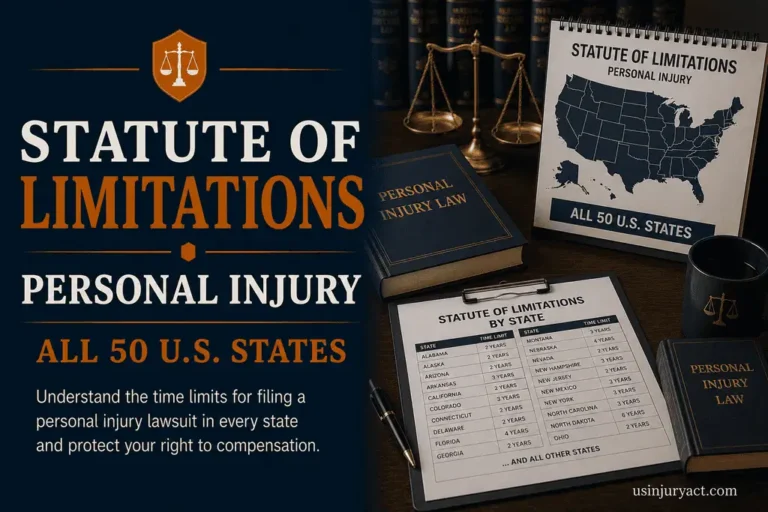
This article gives you the complete, state-by-state personal injury statute of limitations for all 50 states plus the District of Columbia, updated for 2026.
You will also find a clear explanation of how these deadlines work, which exceptions can pause the clock, and what you should do if your deadline is approaching.
Every figure in this list traces back to the official state statutes so you can verify the law directly.
What is Statute of Limitations in a Personal Injury Case
A statute of limitations is a law that sets the maximum period of time after an event within which legal proceedings can be brought. In the personal injury context, that event is typically the accident or incident that caused your injury.
Once the deadline passes, the defendant gains what is called an “affirmative defense.” If they raise it in court, the judge must dismiss your case without ever looking at the merits of your claim.
The rationale behind these deadlines goes back centuries in common law, courts and legislatures have long recognized that allowing claims to be filed years after an injury creates serious problems because evidences would have deteriorate and witnesses might have forgotten details or become unavailable.
Defendants deserve some certainty that they will not face old claims long after an incident occurred. Balancing these interests against the rights of injured people is what produces the varying time limits you see across the country.
Why Filing on Time Matters More Than Most People Realize
Many injured people assume they have “plenty of time” after an accident before they need to take legal action. That assumption leads to lost cases every year.
In states like Kentucky, Louisiana, and Tennessee, the personal injury filing deadline is only one year. That means if you were injured in a car accident in Nashville and did not file a lawsuit within 365 days, you forfeit your right to sue, even if the other driver ran a red light, even if your medical bills exceed $100,000, and even if the at-fault driver had no dispute about liability.
Even in states with two year or three year windows, the time passes faster than most injured people expect. Medical treatment, insurance negotiations, and the emotional weight of recovery all pull attention away from the legal calendar.
This is precisely why experienced personal injury attorneys routinely advise clients to consult a lawyer well before any deadline approaches.
When Does the Clock Actually Start Running?
In most states, the statute of limitations clock begins on the date the injury occurred. If you were involved in a car crash on March 10, 2025, and your state has a two-year limit, you generally have until March 10, 2027, to file a lawsuit in civil court.
Note that this is the date you must file the lawsuit, not the date you must complete settlement negotiations or finish treatment.
However, this default rule has important exceptions. The delayed discovery rule allows the clock to start running on the date you discovered, or reasonably should have discovered, that you were injured and that someone else’s conduct caused the injury.
This doctrine applies most frequently in medical malpractice cases, toxic exposure cases, and defective product injuries where the harm was not immediately apparent.
Personal Injury Statute of Limitations for All 50 States and D.C. (2026)
The table below provides the general personal injury statute of limitations for each state. Keep in mind that these are the standard deadlines, and special case types, such as medical malpractice, wrongful death, claims against government entities, and cases involving minors, often carry different deadlines.
Always confirm the specific rule that applies to your case type and circumstances with a licensed attorney in your state.
Note on recent changes:
Colorado extended its motor vehicle accidents deadline from two years to three years effective July 1, 2022.
Florida reduced its general personal injury deadline from four years to two years, effective March 24, 2023, under HB 837.
Kentucky extended to 2 years for motor vehicle accidents.
Mississippi reduced medical malpractice and other professional healthcare malpractice claim to 1 year
Exceptions That Can Toll or Extend the Statute of Limitations
“Tolling” is the legal term for pausing or suspending the statute of limitations clock. Several well-established doctrines allow tolling, and knowing about them can make the difference between a viable claim and a barred one.
The Minor Tolling Rule
Virtually every state tolls the statute of limitations for injured minors. When a child under the age of 18 is injured, the clock does not typically start running until the child turns 18. In most states, once the child reaches 18, the standard adult deadline kicks in and begins counting down.
So if a 10 year old child is injured in New York, which has a three-year limit, that child would generally have until age 21 to bring a personal injury suit.
Parents or guardians can typically file a claim on behalf of the child before the child reaches adulthood. In many cases, doing so sooner is advantageous because evidence is fresher and liability is easier to establish.
But the tolling protection exists as a backstop to make sure children are not permanently barred from compensation simply because their caregivers failed to act.
Defendant Absence or Concealment
Most states provide that if the defendant leaves the state after causing an injury, the time during which they were absent does not count toward the statute of limitations.
Similarly, if the defendant actively conceals the injury or fraudulently prevents the plaintiff from learning about it, many states toll the clock for that period.
This doctrine, sometimes called fraudulent concealment tolling, requires the plaintiff to show that the defendant deliberately misled them.
Legal Disability and Mental Incapacity
When the injured person is under a legal disability at the time of the injury, such as being declared mentally incompetent, most states toll the statute of limitations for the duration of the disability. Once the disability is removed, the standard deadline begins.
This protection ensures that people who lack the legal capacity to bring a claim are not penalized for their incapacity.
Government Entity Claims and Notice Requirements
One of the most important and frequently overlooked deadline issues in personal injury law involves claims against government entities. If your injury was caused by a city bus, a county vehicle, a state-owned facility, or a federal employee acting in the scope of their duties, entirely different rules apply.
Under sovereign immunity principles, suing the government requires following specific administrative procedures, including filing a notice of claim within a much shorter window, often 30 to 180 days after the injury.
For federal employees and federal agencies, the Federal Tort Claims Act (FTCA) requires an administrative claim to be filed with the appropriate federal agency within two years.
You cannot file suit until the agency denies your claim or six months pass without a decision. Missing the administrative claim requirement is fatal to the case, even if the regular statute of limitations has not expired.
States With the Shortest Personal Injury Filing Windows
If you live in or were injured in one of the following states, you face the shortest windows in the country and must act with particular urgency.
One-Year Deadline States
Kentucky (KRS § 413.140), Louisiana (La. Civ. Code art. 3492), and Tennessee (Tenn. Code Ann. § 28-3-104) all impose a one-year deadline on general personal injury claims.
Louisiana’s one-year prescriptive period is among the most aggressive in the nation and applies to most tort claims.
Tennessee’s one-year limit has caught many out-of-state travelers off guard when they are injured within the state’s borders and fail to account for the shorter deadline.
In Kentucky, the one-year window applies to many personal injury claims, but the state has a separate longer period for certain claims, including five years for written contracts.
The distinction matters because some injury scenarios, like breach of warranty cases, may be governed by a different clock. These nuances are exactly the kind of thing that an experienced personal injury attorney will identify immediately.
Two-Year Deadline States
The majority of states fall into the two-year category. This group includes California, Florida, Georgia, Illinois, Indiana, Nevada, New Jersey, Ohio, Pennsylvania, Texas, and Virginia, among others.
Two years sounds like a comfortable window, but it frequently is not. Serious injury cases involve lengthy medical treatment, complex damages calculations, and extensive investigation.
Attorneys often need about six months or more to prepare a case properly before filing, so starting the process early is always the better approach.
States With the Most Generous Deadlines
Maine and North Dakota stand apart from the rest of the country with six-year personal injury statutes of limitations.
Missouri allows five years.
Nebraska, Utah, and Wyoming provide four-year windows.
These longer periods give injured people more breathing room to recover, obtain complete medical records, and make informed decisions about litigation.
Even so, waiting to act until the last possible moment is never advisable, because evidence can disappear and witnesses can become unavailable long before any legal deadline arrives.
What You Should Do Before Your Deadline Arrives
The single most important step you can take is to consult with a licensed personal injury attorney in the state where your injury occurred. Most personal injury attorneys offer free initial consultations, and many work on a contingency fee basis, so that you pay nothing unless they recover money for you.
An attorney will identify the correct statute of limitations for your specific claim, investigate tolling arguments if your deadline has passed, and ensure that any required pre-suit notices to government defendants are filed on time.
You should also document your injuries thoroughly from day one. Preserve every medical record, photograph every injury, keep a journal of your symptoms and limitations, and save all communications with insurance companies.
This documentation builds the foundation of your personal injury damages claim and is far easier to assemble right after the incident than months or years later.
If you believe your deadline may have already passed, do not assume your case is over before speaking with an attorney. Several tolling doctrines can breathe new life into claims that appear time-barred.
The discovery rule, fraudulent concealment, and tolling for legal disability are all worth examining before concluding that the door has closed.
The law exists to protect you, but only if you use it in time. The personal injury statute of limitations in your state is a fixed feature of the legal landscape, and it will not move to accommodate your schedule.
Knowing the deadline that applies to your situation, and acting well before it arrives, is the foundation of any successful personal injury claim.