
Based on recent data from the Illinois Department of Transportation, there were 303,913 motor vehicle crashes recorded in 2024 alone, resulting in thousands of serious injuries and fatalities.
That number does not account for slip and fall accidents in Chicago retail stores, workplace injuries in Rockford manufacturing plants, or medical errors at hospitals throughout the state.
If you were hurt in any of these situations, you need to understand that Illinois has its own specific personal injury laws that govern whether you can recover compensation, how much you can recover, and for how long you have to act.
Generic legal advice from national websites does not cut it here.
This guide walks you through everything you need to know about personal injury law in Illinois from the foundational legal concepts to the specific statutes that control your case, the types of damages available, how to navigate the claims process, and how to find the right legal representation.
Personal injury law is a branch of civil law that allows an injured person to seek financial compensation from the party responsible for causing their harm.
Contrast to criminal law, which is prosecuted by the government, a personal injury case is a private legal action brought by the injured party, known as the plaintiff, against the at-fault party, known as the defendant.
The legal foundation of nearly every personal injury case is negligence. To establish negligence under Illinois law, you must prove four distinct elements.
In Illinois, these four elements must all be present. If any one of them cannot be proven, the claim fails. This is why the quality of evidence collected immediately after an accident matters so much and why legal counsel is so valuable from the start.
Illinois has a distinct legal framework that controls every personal injury case filed in the state.
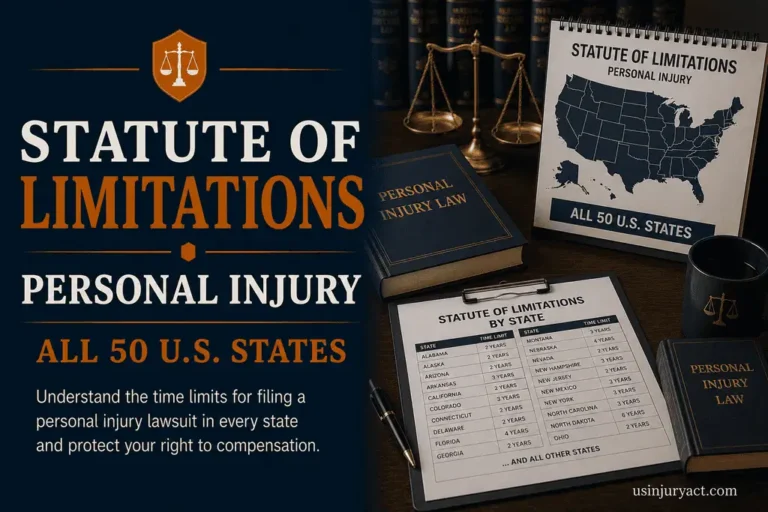
The most important deadline you face is the statute of limitations. Under 735 ILCS 5/13-202, the standard Illinois statute of limitations personal injury deadline is two years from the date the injury occurred.
If you miss this window, you lose the right to file a lawsuit permanently, regardless of how serious your injuries are or how clear the defendant’s fault may be.
However, several important exceptions apply.
Illinois follows the Illinois modified comparative negligence rule, codified at 735 ILCS 5/2-1116. This law determines what happens when the injured party is partially responsible for the accident that caused their harm.
Under this rule, your compensation is reduced by your percentage of fault. If you are found to be 20 percent at fault for a car accident that caused you $100,000 in damages, you recover $80,000.
The critical threshold is 51 percent. If you are found to be 51 percent or more at fault, you are completely barred from recovering any compensation.
Here is a clearer instance: A driver runs a stop sign and strikes your vehicle, but investigators determine you were speeding at the time. A jury assigns 30 percent of fault to you and 70 percent to the other driver. Your total proven damages are $200,000. Your recovery would be reduced to $140,000. You still recover because you are under the 51 percent threshold.
Had the jury assigned you anywhere from 51 percent of the fault for instance, your entire claim would be barred.
Insurance adjusters and defense attorneys are trained to shift fault onto injured parties to reduce or eliminate liability. This is one of the strongest reasons to retain an Illinois personal injury attorney early. Not a requirement but strongly recommended.
Illinois operates under an at-fault auto insurance system, also called a tort liability system. This means the driver who caused the accident is financially responsible for the resulting damages.
Injured parties typically file a claim with the at-fault driver’s liability insurance, file a claim with their own uninsured or underinsured motorist coverage if the at-fault driver lacks adequate coverage, or file a personal injury lawsuit directly against the at-fault driver.
Illinois law requires all drivers to carry minimum liability insurance of $25,000 per person and $50,000 per accident for bodily injury, along with $20,000 for property damage. In serious injury cases, these limits are often exhausted quickly, making underinsured motorist coverage essential.
Illinois does not impose a general cap on personal injury damages. Injured plaintiffs may seek full compensation for all economic and non-economic losses.
Historically, Illinois enacted caps on medical malpractice damages, but the Illinois Supreme Court struck those caps down as unconstitutional in Lebron v. Gottlieb Memorial Hospital (2010), finding they violated the separation of powers doctrine. Today, no enforceable cap exists for medical malpractice non-economic damages in Illinois.
Punitive damages in Illinois are reserved for cases involving intentional misconduct or a deliberate indifference to the safety of others. They are not available in every personal injury case, and courts scrutinize requests for punitive awards closely.
File a personal injury lawsuit in Illinois begins with grasping that the formal lawsuit is often the last step in a longer process. Most cases are resolved through insurance negotiations before trial. Here is how the process unfolds in practice.
Your health is the priority, but your medical records are also the backbone of your legal claim. Emergency room reports, physician diagnoses, imaging results, and treatment notes all document the nature and severity of your injuries in a way that is difficult to dispute later.
Do not delay medical treatment, even if your injuries seem minor. Soft tissue injuries such as whiplash and traumatic brain injuries can have delayed onset symptoms.
Gaps in medical treatment give insurance companies ammunition to argue that your injuries were not serious or were caused by something other than the accident.
Preserve everything you can from the scene and the immediate aftermath.
You are generally required to notify your own insurer of an accident within a reasonable time, even if you were not at fault. However, you should be extremely cautious about what you say to the at-fault party’s insurer.
Insurance adjusters record statements and are trained to elicit admissions of partial fault. You are not legally required to provide a recorded statement to an opposing insurer.
Most personal injury lawyers in Illinois offer free consultations and work on a contingency fee basis, meaning you pay nothing unless they recover compensation for you.
An attorney will evaluate the strength of your claim, calculate the full value of your damages, handle all communication with insurers, gather expert testimony if needed, and file suit if a fair settlement cannot be reached.
The earlier you involve an attorney, the better. Evidence degrades, witnesses become harder to locate, and deadlines approach faster than most injured people expect.
If your case does not resolve through settlement, your attorney will file a formal complaint in the appropriate Illinois circuit court before the two-year statute of limitations expires. In Cook County, this means filing in the Circuit Court of Cook County. Your attorney will also serve the defendant, who then has a set period to respond before discovery and litigation begin.
Let’s imagine you slip and fall on an unmarked wet floor at a large grocery chain in Naperville on March 1, 2026. You have until March 1, 2028 to file a lawsuit. If the chain’s insurer refuses to offer a fair settlement, your attorney files suit in the DuPage County Circuit Court before that date. Discovery begins, and the case proceeds toward trial or a negotiated resolution.
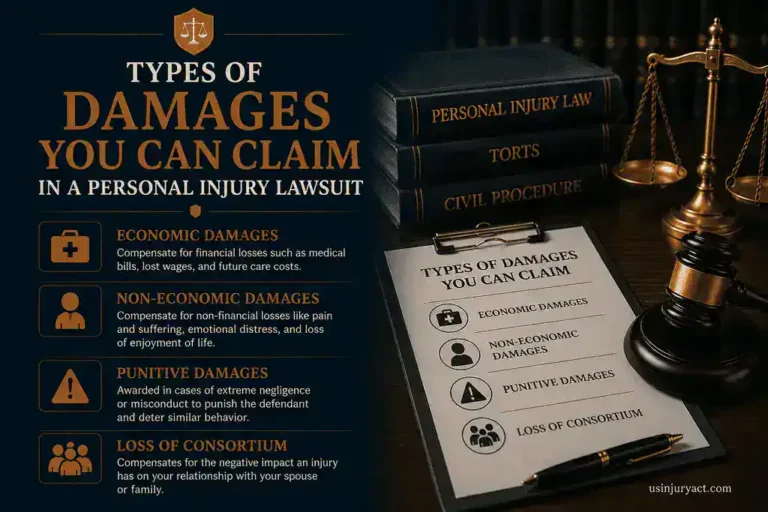
Illinois allows injured plaintiffs to seek two primary categories of damages: economic and non-economic. In certain limited cases, punitive damages are also available.
Economic damages are quantifiable financial losses directly caused by the injury. They include past and future medical expenses, rehabilitation and physical therapy costs, lost wages during recovery, loss of future earning capacity if the injury is permanent or disabling, property damage, and out-of-pocket expenses such as transportation to medical appointments or home care assistance.
Illinois courts require documented proof of economic damages. Bills, pay stubs, employer statements, and expert vocational testimony are used to establish these losses.
Non-economic damages compensate for losses that are real but not easily measured by a dollar figure. They include pain and suffering, emotional distress, loss of enjoyment of life, disfigurement or permanent scarring, and loss of consortium, which is the impact on the plaintiff’s relationship with their spouse.
Because Illinois has no statutory cap on non-economic damages in standard personal injury cases, juries have broad discretion. These awards vary significantly based on the severity of the injury, the credibility of the plaintiff, and the skills of the trial attorney presenting the case.
Punitive damages go beyond making the plaintiff whole. They are meant to punish defendants whose conduct was willful, wanton, or fraudulent and to deter similar behavior in the future.
Illinois courts rarely award punitive damages in standard accident cases, but they are available in situations such as drunk driving accidents, intentional assault and battery claims, and product liability cases where a manufacturer knowingly concealed a defect.
Different categories of injury claims carry different legal standards, procedural requirements, and strategic considerations. Here is how Illinois law applies to the most common types of cases.
Illinois car accident claims are built on the at-fault framework. The injured party must prove the other driver’s negligence, which requires establishing that the driver owed a duty of care, violated a traffic law or standard of care, and caused the crash and resulting damages.
The Illinois comparative negligence rule applies in every car accident case. Defense attorneys will scrutinize your driving behavior, speed, cell phone records, and any prior traffic violations to assign you partial fault. Even a small shift in fault percentage can meaningfully reduce a settlement or verdict.
Illinois also requires all motorists to report accidents resulting in injury or more than $1,500 in property damage to law enforcement and the Illinois Department of Transportation.
Under Illinois premises liability law, property owners and occupiers owe a duty of reasonable care to lawful visitors, including customers in retail stores. To succeed on a slip and fall claim, you must prove that the property owner knew or should have known about the dangerous condition, failed to correct it or warn visitors, and that this failure caused your injury.
The notice requirement is critical. If a store employee created the hazard, notice may be presumed. If the hazard developed naturally, such as rainwater tracked in by customers, you may need to show how long it existed before you fell. Security footage is often the most powerful piece of evidence in these cases and should be preserved immediately.
Most workplace injuries in Illinois are governed by the Illinois Workers’ Compensation Act, which provides benefits regardless of fault but generally limits recovery to medical costs and a portion of lost wages. You cannot sue your employer for pain and suffering under the workers’ compensation system.
However, if a third party caused or contributed to your workplace injury, such as a negligent driver who hit you while you were making a delivery, or a subcontractor whose equipment malfunctioned on a construction site, then you may file a separate Illinois personal injury claim against that third party while still receiving workers’ compensation benefits.
These third-party claims can recover the full range of damages including pain and suffering that workers’ compensation does not cover.
Medical malpractice cases in Illinois are among the most complex and costly personal injury matters to litigate. Illinois law under 735 ILCS 5/2-622 requires that before filing a malpractice suit, the plaintiff’s attorney must obtain a written report from a qualified healthcare professional affirming that the claim has merit. Failure to file this certificate of merit results in dismissal.
There are no damages caps on non-economic awards in medical malpractice cases in Illinois, following the Illinois Supreme Court’s decision invalidating such caps. Cases require expert testimony on the applicable standard of care, the deviation from that standard, and the causal link to the plaintiff’s injuries.
The statute of limitations for medical malpractice under 735 ILCS 5/13-212 is two years from the date the plaintiff knew or should have known of the injury, but no longer than four years from the date the act or omission occurred, with limited exceptions for minors and the fraudulent concealment of the malpractice.
Illinois imposes strict liability on dog owners under the Illinois Animal Control Act (510 ILCS 5/16). This means an owner is liable for damages if their dog attacks or injures another person, regardless of whether the owner knew the dog had any prior history of aggression.
The injured person does not need to prove the owner was negligent. They only need to show they were lawfully present at the location of the attack and did not provoke the animal.
This is a meaningful distinction from states that operates on ‘one bite’ rule. In Illinois, a first-time attack creates full liability.
When a person dies as a result of another party’s negligence or intentional act, surviving family members may bring a claim under the Illinois Wrongful Death Act (740 ILCS 180). Only the personal representative of the deceased’s estate may file the lawsuit, but the damages recovered are distributed to the surviving spouse and next of kin.
Recoverable wrongful death damages in Illinois include grief and sorrow experienced by the surviving family, loss of the deceased’s society and companionship, financial support the deceased would have provided, and funeral and burial expenses. The two-year statute of limitations runs from the date of death.
Illinois law is uniform statewide, but the practical outcomes of personal injury cases vary significantly depending on where the case is filed, heard, and tried. Appreciating local court culture is not a minor detail, it can directly affect the value of your claim.
Chicago handles the highest volume of personal injury litigation in the state. The sheer density of traffic, pedestrians, and commercial activity produces enormous numbers of car accidents, slip and falls, and construction site injuries.
Cook County juries have historically been regarded as plaintiff-friendly, and Chicago’s larger jury pools tend to include individuals who are more familiar with the realities of serious injury.
Average settlement values in Chicago tend to run higher than downstate, particularly for catastrophic injury and wrongful death cases. However, the court system is also heavily docketed, meaning cases can take longer to reach trial.
A skilled Chicago personal injury attorney who knows the local judges and has tried cases before Cook County juries brings measurable strategic value.
Cook County’s Circuit Court is the busiest in Illinois and has developed a reputation among defense bar and plaintiff’s attorneys alike as a jurisdiction where substantial verdicts are possible.
That reputation creates its own settlement pressure, defendants and their insurers often prefer to settle rather than take their chances before a Cook County jury.
Leveraging that dynamic is part of what a seasoned Cook County trial attorney does.
Springfield’s proximity to state government means a higher proportion of cases involving state agencies, public employees, and government-owned vehicles or property.
Claims against Illinois state entities must comply with the Illinois Court of Claims Act, which creates a separate administrative process with different deadlines.
A notice requirement and a one-year filing window under the Court of Claims Act apply in many government-related injury claims.
Peoria juries tend to reflect more conservative Midwestern values, which can translate to more moderate damages awards compared to Chicago or Cook County.
Plaintiffs with strong liability facts and well-documented injuries still recover significant compensation, but inflated demands unsupported by evidence are scrutinized more heavily here.
Local attorneys understand how to present cases in ways that resonate with Peoria-area jurors.
Rockford’s industrial and manufacturing history means that workplace injury cases, including third-party industrial accident claims, are disproportionately common in Winnebago County courts.
Cases often involve product liability claims against equipment manufacturers, premises liability against plant owners, and complex questions about the interplay between workers’ compensation and civil litigation.
Attorneys practicing in Rockford develop particular expertise in these overlapping legal frameworks.
Wherever your case arises in Illinois, you benefit from working with a local Illinois personal injury lawyer who knows the judges, the local jury pool, and the tactics used by insurers in that jurisdiction.
The attorney you choose will have more impact on the outcome of your case than almost any other factor. Here is what to look for and what to avoid.
Nearly all personal injury attorneys in Illinois work on a contingency fee agreement, that means their fee is a percentage of the compensation they recover for you. You pay nothing upfront.
Standard contingency fees in Illinois range from 33% for cases that settle before trial to 40% for cases that proceed through litigation or appeal. Some attorneys charge higher percentages for particularly complex matters.
Contingency arrangements align the attorney’s financial interest with yours which means they only get paid if you win. Before signing, review what expenses such as court filing fees, expert witness costs, and deposition costs will be charged against your recovery, and whether the attorney’s fee is calculated before or after those expenses are deducted.
Every reputable Illinois personal injury firm offers a free consultation. Use that meeting to ask direct questions.
Be wary of attorneys who guarantee specific outcomes, pressure you to settle quickly without adequate investigation, are unresponsive during the consultation phase, lack trial experience and settle every case regardless of merit, or cannot clearly explain the basis for their fee structure.
Trial experience matters even if most cases settle. Defendants and insurers know which attorneys are willing to try cases and which are not. An attorney with a credible trial reputation commands higher settlements because the threat of a jury verdict is real.
Personal injury law in Illinois is not a forgiving system for the unprepared as we have the two-year statute of limitations, the modified comparative negligence rule which can eliminate your right to recover entirely if fault is allocated poorly. Local court dynamics affect the value of your claim in ways that no national legal website accounts for.
What you do in the hours, days, and weeks after an injury shapes the entire arc of your legal case. Seek medical care. Preserve evidence. Avoid giving recorded statements to opposing insurers. And speak with an experienced Illinois personal injury attorney before making any decisions about your claim.
A qualified attorney evaluates your case for free, works on contingency so there is no financial risk to you, and brings the legal knowledge and courtroom experience necessary to pursue full compensation. The complexity of Illinois law is precisely why professional guidance is not optional.
Learn and Connect with the best injury attorneys based on specific injury type
Stay ahead with our resources on personal injury laws across the U.S.