If you were hurt in a car accident, time is not just a factor in your recovery, it is a controlling legal variable that can permanently eliminate your right to any compensation at all.
The question of how long after a car accident you can sue or file a claim does not have one universal answer, but this article gives you every answer you need based on where you live, what kind of claim you are filing, and the specific facts of your situation.
The Statute of Limitations for Car Accident Lawsuits
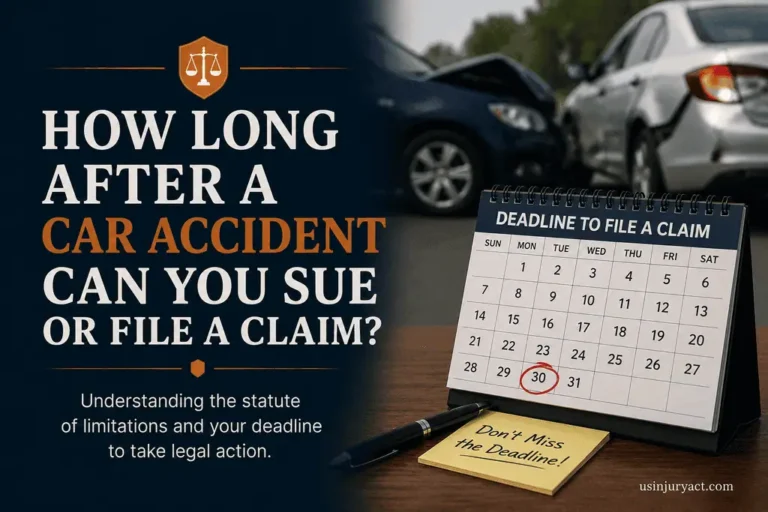
The statute of limitations for car accident lawsuits is the law-imposed deadline by which you must file a lawsuit in court. If you miss it, the defendant’s attorney will file a motion to dismiss your case, and in virtually every instance, the judge will grant it.
It does not matter how clear-cut liability is or how severe your injuries are, a missed statute of limitations ends your case permanently in most situations.
Each state sets its own deadline, and those deadlines vary meaningfully.
Here is a complete state-by-state breakdown of personal injury statute of limitations that generally governs most car accident lawsuits:
State-by-State Statute of Limitations for Car Accident Lawsuits
One year
Kentucky, Louisiana, Tennessee
Two years
Alabama, Alaska, Arizona, California, Colorado, Connecticut, Delaware, Georgia, Hawaii, Idaho, Illinois, Indiana, Iowa, Kansas, Michigan, Minnesota, Nevada, New Jersey, Ohio, Oregon, Pennsylvania, Texas, Virginia, West Virginia, Wisconsin
Three years
Arkansas, Maryland, Massachusetts, Mississippi, Montana, New Hampshire, New Mexico, New York, North Carolina, Rhode Island, South Carolina, Vermont, Washington
Four years
Florida, Nebraska, Wyoming, Utah
Five years
Missouri
Six years
Maine, North Dakota
These figures are the general personal injury deadline and apply to lawsuits against private parties.
Government entities, insurance policy deadlines, and cases involving minors operate under different rules, which this article addresses below.
When the Clock Starts
The statute of limitations clock typically starts on the date of the accident, which means in a straightforward rear-end collision on a Tuesday afternoon, the clock starts that day.
If you are in California, you generally have two years from that date to file suit, in Tennessee, you have one year and so on.
However, the delayed discovery rule can shift the start date, under the discovery rule, the statute of limitations does not begin until you knew or reasonably should have known about your injury.
This doctrine is most relevant in cases involving delayed-onset conditions, such as a traumatic brain injury that was not diagnosed for several weeks, or internal injuries that did not become symptomatic immediately.
Courts in states like California, New York, and Florida have applied the delayed discovery rule in car accident cases where injuries were not immediately apparent.
Filing an Insurance Claim vs. Filing a Lawsuit: Two Different Clocks
Many people confuse filing an insurance claim with filing a lawsuit but they are not the same thing, and they operate on entirely different timelines.
Insurance Claim Deadlines
When you file an insurance claim, you are submitting a request for payment under an insurance policy, either your own or the at-fault driver’s.
Insurance policies impose their own reporting deadlines, separate from and often shorter than the legal statute of limitations.
Most auto insurance policies require prompt notice of a car accident claim, and some policies interpret that to mean within 24 to 72 hours for certain coverage types.
Your own uninsured or underinsured motorist coverage may have a strict reporting deadline written directly into the policy and missing it can be grounds for the insurer to deny your claim entirely, even if you are still within the state’s statute of limitations for a lawsuit.
Always read your policy and report accidents promptly to preserve all coverage.
The Lawsuit Filing Deadline
The lawsuit deadline, set by the statute of limitations, gives you the maximum time to initiate formal legal proceedings by filing a complaint in court.
Filing the complaint stops the clock because you do not need a trial date or a resolution by that deadline, you only need to have the lawsuit filed.
In practical terms, if the insurance company drags out negotiations until one week before your statute of limitations expires, you need to file a lawsuit immediately to preserve your rights.
Many experienced personal injury attorneys file suit proactively before the deadline even when settlement talks are ongoing and that’s best practice.
Special Situations That Change the Deadline
Several specific circumstances can shorten or extend the standard deadline, and knowing which ones apply to your situation can mean the difference between a valid claim and no claim at all.
Claims Against Government Entities
If the car accident was caused by a government vehicle, a city bus, a state employee driving on official business, or road defects maintained by a government agency, you are dealing with a claim against a government entity.
These claims operate under government tort claims act deadlines, which are almost always shorter than the standard statute of limitations.
- In California, you must file a tort claim with the government agency within six months of the injury date under the California Government Claims Act – Government Code Section 911.2.
- In Texas, you must give notice within six months under the Texas Tort Claims Act.
- In New York, a notice of claim against a municipality must generally be filed within 90 days under General Municipal Law Section 50-e.
Missing these administrative deadlines typically bars any lawsuit, regardless of how strong your case is.
Injuries Involving Minors
When the injured party is a minor, most states toll, meaning pause, the statute of limitations until the child reaches the age of majority, which is 18 in most states.
In practice, this means a child injured in a car accident at age 10 in California would have until age 20 to file suit, since the two-year clock starts at 18.
However, claims against government entities often do not get this benefit, so a parent should still file administratively on behalf of a minor to preserve those claims.
When the Defendant Leaves the State
Several states toll the statute of limitations during any period when the defendant is outside the state and thus cannot be personally served with a lawsuit.
If the at-fault driver moved to another state after the accident and you were unable to track them down, you may have more time than the standard deadline suggests.
This varies significantly by state and is worth discussing with an attorney if you have had trouble locating the defendant.
Death Resulting from Car Accident Injuries
When a car accident results in the death of a victim, the claim transforms into a wrongful death car accident lawsuit, which operates under its own statute of limitations. Most states give the surviving family or estate representative two years from the date of death, not the date of the accident, to file a wrongful death claim.
In Texas and California for instance, the deadline is two years from death.
If the victim survived the accident but died later from their injuries, these two deadlines can diverge, creating a situation where some claims are time-barred and others are not.
An attorney can help sort out which claims remain viable.
No-Fault States and the PIP Threshold
In no-fault states, including Florida, Michigan, New York, New Jersey, Kentucky, and others, your first stop for compensation after a car accident is your own Personal Injury Protection (PIP) coverage, regardless of fault.
In these states, you are generally prohibited from suing the at-fault driver unless your injuries meet a certain threshold, either a monetary threshold or a verbal threshold involving serious injury categories such as permanent disfigurement, bone fractures, or significant limitation of a body system.
PIP claims in no-fault states often have their own deadlines. In Florida, for example, PIP benefits must generally be claimed within 14 days of the accident according to the Florida Statute 627.736, and failure to seek treatment within that window can forfeit your benefits entirely.
This however is separate from and shorter than the four-year statute of limitations for a Florida car accident lawsuit.
How Insurance Company Tactics Affect Your Timing
Understanding the statute of limitations is necessary since insurance companies are fully aware of these deadlines, and adjusters use them strategically.
The Classic Delay-and-Deny Strategy
A common adjuster tactic is to engage you in extended negotiations, give you the impression that a settlement is near, and then let the clock run out.
Once your statute of limitations expires, the insurer has no legal obligation to pay you anything, regardless of how clearly their driver caused the accident.
This is one of the strongest reasons to consult a car accident attorney early in the process.
An attorney tracking your deadline ensures you are never caught in this trap, if settlement talks are dragging, they file suit before the deadline to preserve your rights while continuing to negotiate.
Reservation of Rights Letters
If you receive a reservation of rights letter from an insurance company, it means the insurer is investigating the claim but is not yet committing to coverage.
This is not a reason to stop the clock, a reservation of rights letter does not extend the statute of limitations, and you should treat the legal deadline as if no letter had been received.
What Happens If You Miss the Deadline
If you file a lawsuit after the statute of limitations has expired, the defendant will almost certainly raise the deadline as an affirmative defense. Courts grant motions to dismiss on this basis regularly, with very limited exceptions.
The doctrine of equitable tolling can save a few cases where the defendant fraudulently concealed the cause of action, or where the plaintiff was genuinely prevented from discovering their injury through no fault of their own.
Equitable tolling however is a narrow exception and courts in states like California, Illinois, and New York apply it sparingly, and arguing it successfully is an uphill battle.
In practice, a missed statute of limitations means no recovery which is why every attorney in the personal injury field treats deadline tracking as a non-negotiable priority.
How Long Should You Wait Before Calling an Attorney?
The honest answer is: you should not wait at all. Contacting a personal injury attorney in the days or weeks immediately following a car accident does not commit you to filing a lawsuit. It simply ensures that someone is tracking your deadlines, preserving evidence before it disappears, and advising you on what your claim may actually be worth.
Evidence can degrade fast. Including overwritten surveillance footage, cleared skid marks, forgotten details, and repaired accident vehicle. The sooner you start building your case, the stronger it will be.
The time window for a car accident claim is both longer than most people think and shorter than it feels.
Two years passes quickly when you are focused on recovering from your injuries, dealing with medical bills, and managing insurance correspondence. The legal system will not grant you an extension simply because life got in the way.
Know your state’s deadline, know the exceptions, and treat every day after an accident as a day that matters for your legal rights.