Not all negligence is created equal, and if you have been injured and are exploring your legal options, the distinction between gross negligence vs. ordinary negligence may be the single most consequential legal question in your case.
The type of negligence that applies determines not only whether you can recover compensation but also how much you can recover and what defenses the defendant may raise against your claim.
Most people understand negligence in a general sense: someone was careless and you got hurt. But the law draws a sharp line between two entirely different categories of careless conduct, each with its own legal definition, its own evidentiary requirements, and its own set of legal consequences.
And that is exactly what you’ll learn in this article as it breaks down both categories in depth, explains the practical differences that play out in real courtrooms, and shows you through concrete examples what it means for your personal injury claim.
What Is Ordinary Negligence?
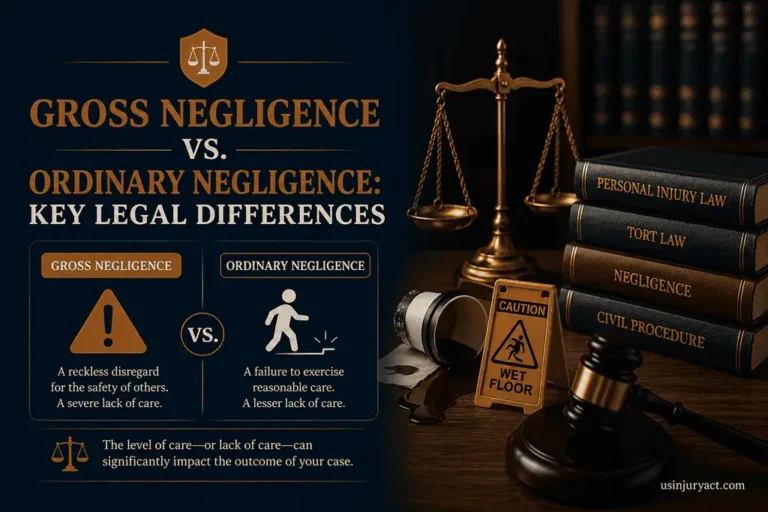
Ordinary negligence, sometimes called simple negligence, is the baseline category of civil fault in personal injury law. It occurs when a person or entity fails to exercise the standard of care that a reasonable person would exercise under the same circumstances.
There is no intent involved, no recklessness, and no conscious disregard for the safety of others. Ordinary negligence is, in essence, a mistake or the failure to be as careful as an average, prudent person would be.
To establish ordinary negligence in a personal injury case, a plaintiff must prove four elements of negligence.
First one being that the defendant owed the plaintiff a duty of care.
Secondly, the defendant breached that duty by failing to act as a reasonable person would.
Third, that breach caused the plaintiff’s injuries.
And lastly, the plaintiff suffered actual, provable damages as a result.
This is the standard that governs the vast majority of personal injury claims like car accidents caused by inattention, slip and falls due to unmaintained premises, medical errors resulting from lapses in protocol, and dog bites where an owner failed to keep a pet secured.
We’ve written extensively about the four elements of negligence here
Real Example of Ordinary Negligence
A pharmacy technician is filling a prescription and misreads the dosage on the prescription label. The patient receives twice the prescribed dose and suffers a dangerous adverse reaction requiring hospitalization.
The technician did not intend to harm the patient and was not recklessly disregarding safety protocols. They simply made an error in reading the label.
This is ordinary negligence. It’s a failure to exercise reasonable care in a situation where the risk of harm was foreseeable.
The patient can bring a personal injury claim and, upon proving the four elements of negligence, recover compensatory damages for medical bills, lost wages, and pain and suffering.
Punitive damages would not typically be available in this scenario because the conduct, while harmful, was not egregious or deliberate.
What Is Gross Negligence?
Gross negligence is a fundamentally different level of culpability. It involves conduct that goes far beyond a mere failure to be careful. Gross negligence is characterized by a conscious, reckless, or wanton disregard for the safety, rights, or life of another person.
It is not simply doing something carelessly, It is doing something with an extreme indifference to the consequences for others, or failing to act when the failure is so extreme that it demonstrates complete indifference to risk.
Courts across the United States describe gross negligence in various ways.
Some jurisdictions define it as the intentional failure to perform a manifest duty in reckless disregard of the consequences.
Others describe it as such utter want of care that it would raise the presumption of conscious indifference to consequences.
What all of these definitions share is a recognition that gross negligence crosses the threshold from mere carelessness into something far more culpable.
Gross negligence does not require proof of intent to harm. But it does require proof that the defendant was aware of the risk they were creating and proceeded anyway with complete indifference to the danger.
Real Example of Gross Negligence
A commercial trucking company discovers through internal maintenance records that the brakes on one of its fleet vehicles are severely deteriorated and need immediate replacement.
A regional manager decides to defer the repair to avoid the cost and schedule disruption. The driver takes the truck out on a highway route. When traffic ahead suddenly slows, the truck cannot stop in time and plows into a line of vehicles, killing two people and severely injuring three others.
This scenario illustrates gross negligence.
The company did not simply overlook a maintenance issue. It knew, with documented certainty, that a dangerous condition existed and made a deliberate decision to ignore it for financial reasons.
That decision displays a conscious, reckless disregard for the safety of every other motorist on that road.
fThe families of the victims and the injured survivors have grounds not only for compensatory damages but likely for punitive damages as well, precisely because the conduct was so far below the acceptable duty of care that punishment and deterrence are warranted.
The Critical Legal Differences Between Gross and Ordinary Negligence
1. Punitive Damages
The most significant legal consequence of gross negligence is the availability of punitive damages. In most U.S. states, punitive damages are not available in ordinary negligence cases.
A defendant who simply made a mistake, no matter how costly, is not subject to punishment beyond compensating the victim. Punitive damages exist to punish extreme conduct and discourage others from indulging in same conduct.
Gross negligence, because it involves conscious indifference or reckless disregard, typically meets the threshold required for a punitive damages claim.
The specific language varies by state: some states require proof of malice, fraud, or oppression, while others use gross negligence or reckless disregard as the trigger.
But the practical result is the same, establishing gross negligence opens the door to potentially significant additional compensation beyond the plaintiff’s actual losses.
2. Liability Waivers and Release Agreements
Another critical legal distinction involves the enforceability of liability waivers and release agreements.
Many businesses, recreational facilities, and service providers ask customers to sign waivers releasing the company from liability for injuries. Courts in virtually every state enforce these waivers with respect to ordinary negligence.
If you signed a liability waiver before participating in a rock climbing event and you are injured due to the gym’s ordinary negligence, the waiver may bar your claim.
Gross negligence is different.
Courts have consistently held that public policy prevents parties from using liability waivers to insulate themselves from responsibility for grossly negligent conduct.
A waiver cannot release a defendant from liability for their own gross negligence. If the rock climbing gym knowingly allowed customers onto equipment it knew was structurally compromised, the waiver wouldn’t protect them.
3. Governmental Immunity
In cases involving government entities, the distinction between ordinary and gross negligence can determine whether a lawsuit is even permitted.
Many states provide governmental immunity protections that shield government agencies and employees from liability for ordinary negligence in certain situations.
However, these immunity provisions are frequently inapplicable when the conduct rises to the level of gross negligence or willful misconduct.
For example, a city might claim immunity from a negligence lawsuit arising from a road maintenance decision. But if evidence shows that city engineers received multiple warnings about a dangerous road defect, documented those warnings internally, and consciously chose not to address them, gross negligence may strip the city of its immunity defense.
4. Comparative Fault Implications
In some states, the type of negligence involved affects how comparative fault is calculated and applied. When a plaintiff’s own ordinary negligence contributed to their injuries, their recovery may be proportionally reduced under comparative fault rules.
But in certain states and under certain circumstances, if the defendant’s conduct constitutes gross negligence, a plaintiff’s contributory negligence may be weighted differently or may not bar recovery at all.
This reflects a broader legal principle: courts are reluctant to allow a defendant whose conduct was shockingly indifferent to human safety to escape liability simply because the plaintiff also made a minor error.
How Attorneys Prove Gross Negligence at Trial
Building a gross negligence case requires substantially more than proving the basic elements of negligence. Your attorney must demonstrate a pattern or instance of extreme conduct that goes beyond a mistake.
It typically involves unearthing internal documents, prior incident reports, communications, maintenance logs, inspection records, and regulatory violations that paint a picture of deliberate indifference.
Discovery is particularly powerful in gross negligence cases.
Depositions of corporate executives and managers, subpoenas for internal communications, and expert testimony about industry safety standards can reveal that a defendant was not only aware of a risk but made a conscious business decision to ignore it.
Courts and juries respond strongly to this type of evidence because it shifts the narrative from “accident” to “choice.”
States Where Gross Negligence Plays a Special Role
Texas is one of the states where gross negligence has the most clearly defined statutory role.
Under the Texas Civil Practice and Remedies Code, a plaintiff seeking exemplary damages must prove by clear and convincing evidence that the harm resulted from the defendant’s gross negligence, fraud, or malice.
Texas defines gross negligence as an act or omission involving objective extreme risk of serious injury and in which the defendant had actual subjective awareness of the risk but proceeded with conscious indifference to the rights, safety, or welfare of others.
California similarly requires malice, oppression, or fraud for punitive damages, and California courts have found that reckless conscious disregard for the safety of others satisfies the malice requirement.
Florida statute section 768.72 requires the plaintiff to prove gross negligence by clear and convincing evidence before punitive damages are available.
Summary Of Gross Negligence vs. Ordinary Negligence
The distinction between gross negligence vs. ordinary negligence is one of the most practically important concepts in personal injury law.
Ordinary negligence involves a failure to exercise reasonable care and supports claims for compensatory damages. Gross negligence involves conscious, reckless indifference to risk, and it supports claims for punitive damages, may override liability waivers, and can override certain government immunity defenses.
If you suspect that the conduct that injured you went beyond a simple mistake, that the responsible party knew about the danger and chose to ignore it, that evidence of egregious indifference exists in documents and records, you owe it to yourself to consult with a personal injury attorney who can evaluate whether your case rises to the level of gross negligence and what additional remedies that may entitle you to pursue.