When a personal injury case goes to trial, one of the most fundamental questions a jury must answer is deceptively simple, did the defendant behave the way a reasonable person would have in the same situation?
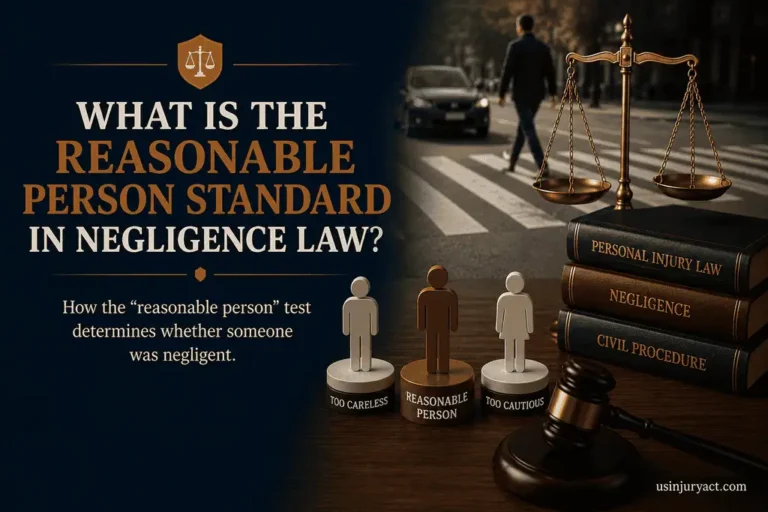
The reasonable person standard in negligence law is the foundational benchmark that courts across the United States use to measure whether a defendant’s conduct crossed the line into legal fault.
It is neither about perfection nor about what any particular individual would have done. It is about what an objectively reasonable person, in possession of ordinary care and good judgment, would have done under the same or similar circumstances.
This post explains reasonable person standard in depth, explores how courts apply it across different types of personal injury cases, and walks through real scenarios that show why this legal concept has endured as one of the most important doctrines in American tort law.
The Origin and Purpose of the Reasonable Person Standard
The reasonable person standard has deep roots in English common law and was adopted wholesale into American negligence jurisprudence. The standard emerged because courts needed an objective external measure of conduct, not a subjective one.
Judging people solely by their own intentions, habits, or personal beliefs would make negligence law unworkable.
A defendant who honestly believed they were driving safely would never be liable, regardless of how recklessly they actually drove.
By anchoring the analysis to what a reasonable person would do, courts create a community standard of care. The jury, representing the community, decides what level of care ordinary life demands in a given situation.
This objective approach protects plaintiffs who are genuinely harmed by careless conduct and gives defendants fair notice of the standard they are expected to meet.
The Restatement (Second) of Torts, one of the most authoritative legal references in American tort law, defines the standard as the conduct of a person of ordinary prudence under the same or similar circumstances.
Courts throughout the country have adopted and refined this definition across decades of litigation.
What Does “Reasonable” Actually Mean in Legal Terms?
The term “reasonable” in law does not mean perfect, ideal, or flawless, it means ordinary care.
It means the kind of caution and attention that an average, prudent adult would exercise given the risks involved. Courts evaluating the reasonableness of conduct weigh several interconnected factors.
Foreseeability
Courts consider the foreseeability of harm. A defendant is expected to take precautions against risks that a reasonable person would foresee as likely to result in injury.
If a reasonable person in the defendant’s position would have recognized that their action or inaction posed a foreseeable danger to others, the law expects them to act accordingly.
Magnitude Of The Potential Harm
Courts consider the magnitude of the potential harm which means the greater the potential injury, the more care a reasonable person should exercise.
A driver carrying a tanker of flammable fuel on a public highway bears a higher standard of practical caution than someone carrying groceries, because the potential consequences of an error are catastrophically greater.
The Burden Of Taking Precautions
Courts weigh the burden of taking precautions, the reasonable person is not required to take heroic or impossibly burdensome steps to prevent every conceivable harm, the precaution must be proportionate to the risk.
If placing a simple warning sign could prevent a serious injury and costs virtually nothing, a reasonable person would do it. If building a hundred-foot barrier might theoretically prevent a freak accident but would cost millions with no realistic benefit, a reasonable person would not.
How Courts Apply the Reasonable Person Standard In Real World
The Distracted Driver
A driver sends a text message while traveling at 45 miles per hour on a city street. She runs a red light and strikes a cyclist who was lawfully crossing the intersection, causing the cyclist to suffer a broken pelvis and severe head trauma.
Applying the reasonable person standard, the jury asks: would a reasonable person have sent a text message while driving at speed in an active traffic area? The answer is plainly no.
A person of ordinary prudence knows that taking their eyes off the road for even a few seconds creates a serious risk of collision. The defendant’s conduct falls below what a reasonable person would do, the standard is satisfied, and the defendant is negligent.
The Homeowner’s Icy Steps
A homeowner in Minnesota knows from a weather forecast that temperatures will drop overnight and that rain is expected, which will freeze on exterior surfaces by morning. He does not salt or sand his front steps before going to bed. The next morning, his mail carrier slips on the icy steps and fractures her wrist.
The reasonable person standard asks: would a reasonable homeowner who knows about the freezing conditions take some precaution to address the ice risk on steps that others are expected to use? In most jurisdictions, the answer is yes.
Salting steps is a low-burden and low-cost precaution against a foreseeable and serious risk of slip and fall injury. The homeowner’s failure to act is a deviation from the reasonable person standard.
The Medical Professional
It is important to note that the reasonable person standard is adjusted for professionals. When a defendant is a licensed professional, such as a physician, nurse, engineer, or attorney, courts do not ask what a layperson would have done. Instead, courts ask what a reasonable professional in that same specialty would have done under similar circumstances.
A surgeon who leaves a surgical instrument inside a patient’s abdomen is not just judged by ordinary reasonableness. The jury considers what a reasonable, competent surgeon with similar training and under similar conditions would have done.
This adjusted standard, sometimes called the professional standard of care, is the foundation of medical malpractice cases.
Children and the Reasonable Person Standard
The law treats children differently from adults when applying the reasonable person standard. Courts recognize that children are not miniature adults and do not possess adult judgment or life experience. Instead of holding a child to the standard of a reasonable adult, courts apply the standard of a reasonable child of similar age, intelligence, and experience.
This child-specific variation means that a seven-year-old who runs into the street chasing a ball is judged by what a reasonable seven-year-old might do, not what a reasonable adult would do.
However, when children engage in inherently adult activities, such as driving a car, operating a motorboat, or piloting a personal watercraft, courts apply the adult reasonable person standard regardless of the child’s age.
The rationale is that society expects anyone engaging in a dangerous adult activity to meet the adult standard of care.
Persons With Disabilities and the Reasonable Person Standard
Courts also adjust the reasonable person standard for individuals with physical disabilities.
A person who is blind is judged by the standard of a reasonable person who is blind. The law does not expect a visually impaired person to perceive their environment exactly as a sighted person would.
Instead, it asks what an ordinarily careful blind person would have done in that situation, recognizing the adjustments in perception and navigation that blindness requires.
Importantly, the law does not extend this adjustment to mental illness or cognitive limitations in the same way. Courts generally hold mentally ill adults to the standard of a reasonable person without the mental illness, which is a contested area of tort law that reflects the difficulty in setting consistent standards for a wide range of mental health conditions.
How the Reasonable Person Standard Intersects With Comparative Negligence
In most states, personal injury cases are governed by comparative negligence rules that allow a jury to assign a percentage of fault to each party involved.
The reasonable person standard applies to both the plaintiff and the defendant. If a plaintiff also failed to act as a reasonable person would have, thereby contributing to their own injury, their recovery may be reduced proportionally.
For instance, if a pedestrian crosses a street mid-block instead of using a crosswalk and is struck by a negligent driver, the jury might find that the driver was 75% at fault for speeding but that the pedestrian was 25% at fault for jaywalking.
The pedestrian’s damages would be reduced by 25% in a pure comparative negligence state. In a modified comparative negligence state, if the pedestrian was found 50% or more at fault, they would recover nothing at all.
The reasonable person standard drives both calculations. The jury asks: what would a reasonable person in the driver’s position have done? And separately: what would a reasonable pedestrian have done?
The Reasonable Person Standard and Evidence at Trial
Establishing deviation from the reasonable person standard at trial requires building a careful evidentiary record. Personal injury attorneys use expert witnesses, accident reconstructionists, industry safety standards, regulatory codes, and internal corporate records to demonstrate that a defendant fell short of what reasonableness required.
For example, in a premises liability case involving a restaurant patron who slipped on an uneven floor tile, the plaintiff’s attorney might introduce the building code standards specifying acceptable floor surface conditions, an expert in premises safety who testifies that the uneven tile was a documented hazard, and evidence that the restaurant had received prior complaints about that floor section.
The evidence paints a picture of what a reasonable property owner would have known and done, and demonstrates that the defendant fell short.
The Reasonable Person Standard In Summary
The reasonable person standard in negligence law is the cornerstone of civil liability in the United States. It creates a fair, community-based benchmark that holds individuals and businesses accountable for conduct that falls below the ordinary care an average, prudent person would exercise.
It is flexible enough to account for professionals, children, and individuals with physical disabilities, while remaining grounded in an objective community standard that avoids the pitfalls of purely subjective evaluation.