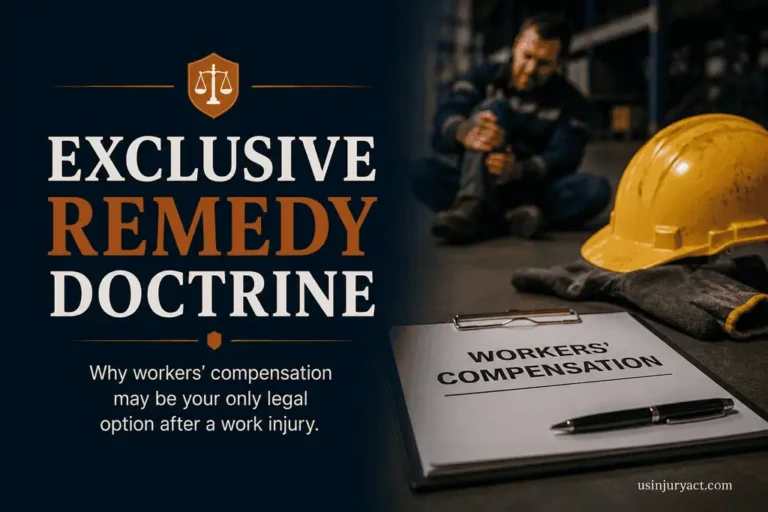
As someone who had been injured at work, your first instinct might be to file a lawsuit against your employer. However, in nearly every state across the country, the exclusive remedy doctrine blocks that path. This legal rule, embedded in workers compensation statutes, forces injured workers to accept workers’ comp benefits as their sole legal remedy against an employer, regardless of how serious the injury is.
But the exclusive remedy doctrine is not absolute and there are critically important exceptions that allow injured workers to step outside the workers compensation system and pursue full civil damages in court. Knowing these exceptions, and knowing the states where courts have expanded or restricted them, can mean the difference between a modest disability payment and a seven figure jury verdict.
The Origins and Purpose of the Exclusive Remedy Rule
Workers’ compensation was born from a grand compromise struck in the early twentieth century between labor and industry. Before workers’ comp laws, injured employees had to sue their employers in civil court to receive any compensation. Employers defended these suits using the fellow servant rule, assumption of risk, and contributory negligence, which made it extremely difficult for workers to recover anything.
The new system offered injured workers guaranteed compensation for medical expenses and lost wages without having to prove negligence. In exchange, employers received protection from civil lawsuits. Workers give up the right to sue, employers give up the right to contest fault, and the mutual surrender of rights became known as the workers compensation bargain.
The exclusive remedy doctrine is the legal mechanism that enforces the employer’s side of that bargain. It is codified in every state’s workers compensation statute. In California, for example, Labor Code Section 3602 expressly provides that workers compensation is the exclusive remedy against an employer for a work-related injury.
How the Exclusive Remedy Defense Works in Practice
When a worker sues an employer in civil court after a workplace injury, the employer’s first line of defense is almost always the exclusive remedy doctrine. The employer argues that the injured worker’s claim falls within the workers compensation system, that compensation is available under that system, and that civil liability is therefore barred.
Courts generally accept this defense quickly when the injury arose in the course of and within the scope of employment. The challenge comes when the worker argues that their injury does not fit neatly within those parameters, or that one of the recognized exceptions applies.
States With Particularly Strong Exclusive Remedy Protections
California
California’s workers compensation system is among the largest and most detailed in the country as the exclusive remedy rule is vigorously enforced. California courts rarely allow civil suits against employers for workplace injuries unless a specific statutory exception applies. However, California also allows suits against third parties, such as equipment manufacturers or contractors, who contributed to the injury.
Texas
Texas is unique because it is the only state that allows employers to opt out of the workers compensation system entirely. Employers who subscribe to workers’ comp receive exclusive remedy protection.
Non-subscribing employers face civil lawsuits and cannot use the traditional defenses of contributory negligence, assumption of risk, or the fellow servant rule. This makes Texas a jurisdiction where an employer’s insurance decision profoundly affects an injured worker’s legal options.
New York
New York’s exclusive remedy rule under Workers Compensation Law Section 11 is robust and detailed. However, New York maintains important exceptions for serious injuries and serious disfigurement, which allow injured workers to pursue civil actions against employers under certain statutory conditions.
New York also allows Labor Law Section 240 and 241 claims, which create additional employer liability for specific construction-site hazards regardless of workers’ comp.
Florida
Florida’s exclusive remedy provision is contained in Section 440.11 of the Florida Statutes. Florida courts have held that employers are generally immune from civil suits. However, Florida recognizes an intentional tort exception that allows civil suits when an employer deliberately intended to injure the worker or engaged in conduct virtually certain to cause injury.
Illinois
Illinois enforces the exclusive remedy rule firmly under the Illinois Workers Compensation Act. Courts have consistently held that even gross negligence by an employer does not override the exclusive remedy bar. Illinois workers must rely on third-party claims or intentional tort exceptions to access civil courts.
Critical Exceptions to the Exclusive Remedy Doctrine
The Intentional Tort Exception
The intentional tort exception which is the most widely recognized exception across the country is triggered when an employer deliberately intends to harm an employee, or when the employer’s conduct is substantially certain to cause injury, civil liability may attach. However, the challenge is proving intent and it’s worth noting that courts apply varying standards.
Some states, like West Virginia, apply the “deliberate intent” standard, requiring workers to prove that the employer actually knew the specific unsafe working condition existed, that the condition violated a safety standard, that the employer specifically knew of the violation, and that the worker was exposed to the specific condition and suffered serious injury as a result. This burden of proof is an extremely high bar.
Other states apply a lower threshold, accepting proof that the employer’s conduct was virtually certain to cause injury even without proving specific intent to harm.
The Dual Capacity Doctrine
The dual capacity doctrine applies when an employer occupies two distinct roles in relation to the injured worker. If an employer also functions as a product manufacturer, a medical provider, or a property owner toward the same employee, the worker may be able to sue the employer in that separate capacity despite the exclusive remedy bar.
Suppose a worker is injured by a machine manufactured and sold by the same company that employs them. The worker could potentially sue the employer in its capacity as product manufacturer, stepping outside the exclusive remedy protection. California recognized this doctrine in cases like Duprey v. Shane, though courts have applied it inconsistently across jurisdictions.
The Fraudulent Concealment Exception
When an employer conceals an occupational disease or a known hazard from employees, some states allow civil suits for that concealment. The theory is that the employer’s deception prevented the worker from seeking timely treatment or exercising their right to pursue an appropriate legal remedy.
Asbestos exposure cases frequently involve this exception. Workers who developed mesothelioma decades after exposure have argued that their employers fraudulently concealed the known dangers of asbestos, allowing civil claims to proceed despite the exclusive remedy bar.
The Third-Party Exception
The exclusive remedy rule only bars claims against the employer but it does not protect other parties who contributed to the injury. Equipment manufacturers, property owners, staffing agencies, subcontractors, and other third parties can all be sued in civil court even while a workers’ comp claim is ongoing.
This is a critically important point in complex workplace accidents involving multiple parties as identifying every potentially liable third party can dramatically increase the compensation available to an injured worker.
Real-World Instance Of The Exclusive Remedy Doctrine
Consider a scenario in a manufacturing plant where a worker operates heavy machinery. The employer has received multiple OSHA citations for failing to install proper safety guards on the machine. Despite these warnings, the employer takes no corrective action. The worker’s hand is caught in the machine and he suffers a severe crush injury requiring partial amputation.
Under the exclusive remedy doctrine, the worker’s immediate path is a workers compensation claim. However, his attorney investigates and discovers that the machine was manufactured by a separate company that installed a defective guard design. The attorney also finds that the employer was cited three times for the same hazard before the accident.
With the information available, two parallel legal tracks are opened. The worker files a product liability suit against the machine manufacturer as a third-party claim. The attorney also evaluates the intentional tort exception given the employer’s repeated knowledge of the hazard and deliberate inaction.
The civil suit against the manufacturer alone may recover damages far exceeding what workers’ comp would ever pay, including pain and suffering and punitive damages.
What You Give Up Under Workers Compensation
It is important to be transparent about what the exclusive remedy doctrine actually costs injured workers. Workers’ compensation pays medical expenses and a portion of lost wages, typically two-thirds of the average weekly wage, subject to state caps. It does not pay for pain and suffering. It does not compensate for emotional distress or loss of consortium. It cannot award punitive damages. It does not provide full wage replacement in most states.
This is precisely why identifying exceptions to the exclusive remedy rule is so vital. When a civil suit becomes available, the injured worker can pursue the full range of damages, including non-economic damages that workers’ comp categorically excludes.