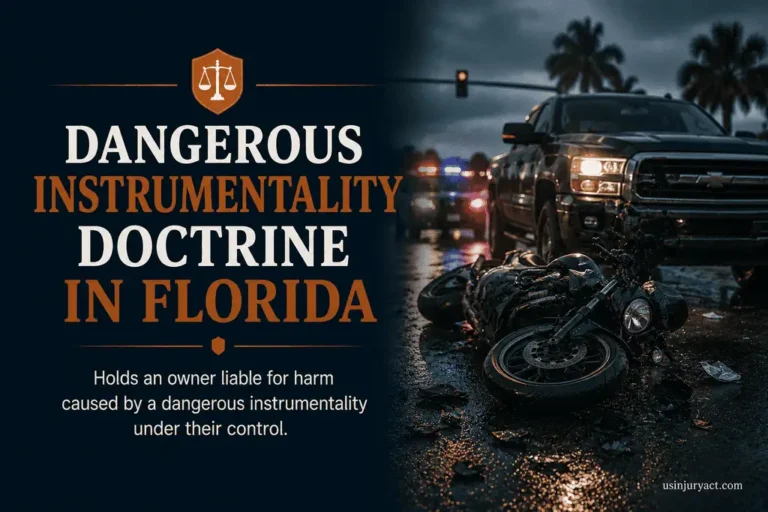
Florida’s dangerous instrumentality doctrine is a liability rules that says if you own a vehicle in Florida and someone borrows it, you may be legally responsible for any accidents that driver causes, even if you were nowhere near the scene and had nothing to do with the crash.
This doctrine surprises many vehicle owners who assume their liability ends the moment they hand over the keys. Florida law treats motor vehicles as inherently dangerous instruments, and the courts have consistently held that owners who voluntarily allow others to operate their vehicles take on responsibility for how those vehicles are used.
This post elaborate precisely on how the dangerous instrumentality doctrine operates in Florida, who it applies to, what the limits are, and what defenses vehicle owners can raise. If you own a car, a truck, a boat, or other motorized vehicle in Florida, this information directly affects your legal exposure.
Florida’s Dangerous Instrumentality Doctrine
Florida’s dangerous instrumentality doctrine is a judicially created rule, not a statute. The Florida Supreme Court established the doctrine in Southern Cotton Oil Co. v. Anderson, 86 Fla. 629 (1923). In that foundational case, the court held that an owner who entrusts a vehicle to another person retains liability for the driver’s negligence because the vehicle is an inherently dangerous instrument in the hands of someone who is not competent or careful.
The doctrine operates on the principle of vicarious liability, meaning the vehicle owner is held accountable for the driver’s acts without requiring proof that the owner was personally negligent. Ownership alone, combined with the voluntary entrustment of the vehicle, creates liability.
This is a significant departure from how most states handle third-party vehicle liability. In the majority of states, an owner is liable only if they were negligent in entrusting the vehicle to the driver, for example, by lending a car to someone with a known history of reckless driving. Florida requires no such showing of negligence by the owner.
What Vehicles Fall Under the Doctrine
Florida courts have applied the dangerous instrumentality doctrine broadly. It is not limited to automobiles. Over the years, Florida courts have extended the doctrine to:
- Motorcycles
- Commercial trucks and tractor-trailers
- Motorboats and watercraft
- Airplanes in some circumstances
- Forklifts and other heavy industrial equipment
The unifying principle is that the vehicle or instrumentality is inherently capable of causing serious harm when operated, and that the owner voluntarily placed it under the control of another person.
How Liability Is Established Under the Doctrine
To establish liability under Florida’s dangerous instrumentality doctrine, a plaintiff must prove two things.
- The defendant owned the vehicle or had a proprietary interest in it at the time of the accident.
- The defendant gave expressed or implied consent to the driver to operate the vehicle.
Proving ownership is straightforward in most cases. Consent however, can be expressed through explicit permission or implied through a pattern of conduct.
If you regularly allow a family member to use your car without asking each time, a court may find implied consent even if you did not specifically give permission on the day of the accident.
Once ownership and consent are established, the owner is vicariously liable for any negligent or wrongful act the driver commits while operating the vehicle, even if the owner had no reason to expect the driver would be negligent.
The Statutory Cap on Owner Liability
Florida law does place a statutory ceiling on an owner’s vicarious liability under the dangerous instrumentality doctrine. Under Florida Statute Section 324.021(9)(b)2, the owner’s liability for bodily injury or property damage is limited to $100,000 per person and $300,000 per incident when the vehicle is operated by a permissive driver who is not the owner’s employee or agent.
This cap does not apply if the owner was personally negligent, such as by knowingly entrusting the vehicle to an incompetent driver. In that case, the owner faces full liability for all damages, that’s to say the cap also does not limit the driver’s own liability, only the owner’s vicarious exposure.
It is important to note that if the vehicle is used in the course of a business enterprise, or if the driver was acting as the owner’s employee, the cap may not apply and the owner could face significantly greater exposure.
Employer Liability: The Dangerous Instrumentality Doctrine in Commercial Fleets
The dangerous instrumentality doctrine has profound implications for Florida businesses that operate vehicle fleets. When an employer provides a company vehicle to an employee and the employee causes an accident, the employer may be liable both under the dangerous instrumentality doctrine and under respondeat superior, the legal principle that makes employers responsible for employees’ acts performed within the scope of employment.
Florida courts have found employer liability even in cases where the employee was running personal errands after work hours under the frolic and detour doctrine, if the employee was using the company vehicle with the employer’s permission.
Businesses operating delivery trucks, company cars, contractor vehicles, or any motorized commercial fleet should ensure they carry adequate liability coverage and maintain stringent driver vetting and supervision programs.
Defenses Available to Vehicle Owners
Theft or Unauthorized Use
The most powerful defense a vehicle owner can assert is that the vehicle was taken without permission. If someone steals your car and causes an accident, the dangerous instrumentality doctrine does not apply because you did not consent to the driver’s use of the vehicle.
Florida courts have consistently held that the doctrine requires voluntary entrustment. Absent consent, there is no basis for vicarious liability.
However, the owner must be able to prove the unauthorized nature of the use, meaning evidence of a police report, contemporaneous documentation, and credible testimony about the circumstances of the vehicle’s absence.
Exclusion of Family Members in Insurance
Some vehicle owners attempt to limit their liability exposure by structuring insurance policies to exclude specific drivers.
Florida courts have examined these exclusions carefully and named driver exclusions can limit insurance coverage for certain individuals, but they do not eliminate the owner’s underlying tort liability under the dangerous instrumentality doctrine.
That means the exclusion affects the insurance coverage, not the legal liability.
Sale of the Vehicle
If the vehicle’s title has been properly transferred before the accident, the former owner is not liable under the doctrine.
Florida courts look to the title transfer as the definitive indicator of when ownership changed hands.
A handshake deal or an informal agreement to sell the car, without an actual title transfer, may not protect the original owner from liability.
Real-World Instance: Loaned Vehicle Crash
Consider a situation where a Florida parent lends their pickup truck to a college-aged child for a weekend trip, the parent hands over the keys without asking questions. The child, driving late at night, runs a red light and strikes another vehicle, seriously injuring the other driver.
The injured driver sues both the college student and the parent but the student has minimal assets and a $25,000 auto insurance policy. The parent argues they should not be held responsible because they did nothing wrong, but under Florida’s dangerous instrumentality doctrine, the parent’s liability is triggered the moment they voluntarily gave consent to the child to drive the truck.
The statutory cap limits the parent’s vicarious liability to $100,000 per person in this scenario since the child is a permissive driver and not an employee. However, if the child’s driving record revealed prior DUI convictions and the parent knew about them, the parent could be independently liable for negligent entrustment, which would pierce the cap entirely.
How the Doctrine Interacts with Florida’s No-Fault Insurance System
Florida operates under a no-fault automobile insurance system for minor injuries. Each driver’s personal injury protection, commonly called PIP, covers their own medical expenses regardless of fault for the first $10,000.
However, for serious injuries involving significant or permanent loss of a bodily function, scarring, or death, Florida allows victims to step outside no-fault and sue the responsible parties directly.
In serious injury cases, the dangerous instrumentality doctrine becomes highly relevant because it allows the injured victim to pursue the vehicle owner as a defendant in addition to the driver. This is particularly important when the driver has minimal or no insurance coverage, because the owner’s policy or assets may provide additional resources for recovery.
Florida’s Dangerous Instrumentality Doctrine In Essence
Florida’s dangerous instrumentality doctrine creates liability exposure that vehicle owners across the state frequently underestimate or overlook entirely. The moment you hand over your keys, you become legally connected to whatever happens next, even if you acted in good faith and had no reason to anticipate an accident.
This doctrine underscores the critical importance of carrying adequate liability coverage on every vehicle you own. It also highlights the need to exercise genuine care before lending your vehicle to anyone, whether a family member, a friend, or an employee.
If you have been injured by a negligent driver in Florida and the driver has limited insurance, exploring a claim against the vehicle owner may significantly change your legal outcome.