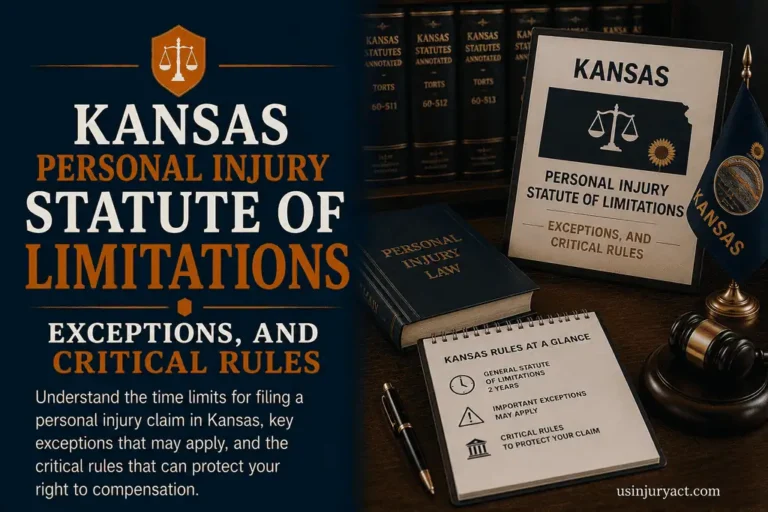
The Kansas personal injury statute of limitations sets the outer boundary on how long you have to file a civil lawsuit after you are hurt due to someone else’s negligence.
In most personal injury situations, Kansas gives you two years from the date of the injury to file your claim in district court. This deadline is not a suggestion, a guideline, or an opening position for negotiation; It is a statutory cutoff. When it passes, the defendant’s attorney will file a motion to dismiss, and in nearly every case, the court will grant it.
This article walks you through the governing statute, the specific rules for different types of claims, every recognized exception that can toll or extend the deadline, and the most costly mistakes Kansas injury victims make when handling their own timeline.
The Governing Law: K.S.A. 60-513 and What It Actually Says
The primary statute governing personal injury filing deadlines in Kansas is K.S.A. 60-513. This provision establishes a two-year limitation period for “an action for injury to the rights of another, not arising on contract, and not herein enumerated.”
That language is broad enough to cover the vast majority of personal injury claims, including car accidents, slip and fall incidents, dog bites, assault and battery claims, and general negligence actions.
K.S.A. 60-513 also contains a critical provision that is often misunderstood, it says that the cause of action does not accrue until the act giving rise to the cause of action first causes substantial injury, or, if the fact of injury is not reasonably ascertainable until some time after the initial act, then the period of limitation shall not commence until the fact of injury becomes reasonably ascertainable to the injured party.
This is Kansas’s statutory codification of the discovery rule, and it is embedded directly in the two-year limitations statute itself.
What “Substantial Injury” Means Under Kansas Law
Kansas courts have interpreted “substantial injury” to mean more than a trivial or de minimis harm. In practice, this matters most in cases where the initial incident seemed minor but later revealed itself to be serious.
A person who is involved in a low-speed collision and initially declines medical care, for example, may later discover that they suffered a herniated disc. Kansas courts look at when the injury was reasonably ascertainable, not necessarily when the full extent of the injury became known.
The Kansas Supreme Court has addressed this distinction in numerous decisions and holds that the clock begins when a plaintiff knows or should have known of both the fact of the injury and that it was caused by the defendant’s conduct.
Discovering only that you are injured, without connecting that injury to a specific negligent act, may not be sufficient to start the clock under Kansas law.
The Distinction Between Accrual and Discovery in Kansas
Kansas applies what courts call the discovery rule in Kansas personal injury cases, which means the two-year clock does not always start on the date of the accident. For injuries that are latent, hidden, or not immediately apparent, the clock begins on the date the plaintiff discovered or should have discovered the injury.
This is particularly important in medical malpractice cases, toxic tort claims, and defective product cases involving delayed-onset conditions.
For example, if a person is exposed to a toxic chemical at a Kansas workplace and develops a respiratory disease several years later, the two-year clock will generally begin running when the disease was diagnosed, or when the person reasonably should have connected the disease to the workplace exposure.
The plaintiff still bears the burden of proving that the injury was not reasonably ascertainable earlier.
Kansas Personal Injury Statute of Limitations by Case Type
The two-year general rule in K.S.A. 60-513 does not apply uniformly across all categories of personal injury claims.
Kansas law provides different deadlines for specific case types, and knowing which rule applies to your situation is essential.
Car Accident Claims in Kansas
Car accident personal injury claims in Kansas fall under the general two-year rule of K.S.A. 60-513. The clock begins on the date of the crash, assuming your injuries were immediately apparent. If you were involved in an accident but the full extent of your injuries did not manifest until later, the discovery rule may extend your deadline.
Kansas is a fault-based state for auto accidents, which means the at-fault driver bears liability for the injured person’s damages. Kansas also requires that drivers carry personal injury protection (PIP) coverage as part of their auto insurance, under the Kansas Automobile Injury Reparations Act.
PIP benefits are available on a no-fault basis regardless of who caused the accident, but they do not eliminate your right to sue the at-fault driver for damages beyond PIP limits.
Medical Malpractice in Kansas
Kansas medical malpractice claims are governed by a separate statute, K.S.A. 60-513(c), which imposes a two-year limit that runs from the date the patient “discovers or should have discovered” the malpractice.
In addition to the two-year discovery rule, Kansas imposes an absolute Kansas medical malpractice statute of repose of four years from the date of the negligent act or omission.
This means that even if you did not discover the malpractice until year three, if the negligent act itself occurred more than four years ago, your claim is barred under the repose period.
The repose period applies regardless of the discovery rule. It is not a tolling provision; it is a hard cutoff tied to the date of the negligent act.
The only statutory exception in Kansas is for a foreign object left in the body during surgery, where a different calculation applies. Courts have consistently enforced the four-year repose period strictly.
Wrongful Death Claims in Kansas
Wrongful death claims in Kansas are governed by K.S.A. 60-1902, which imposes a two-year statute of limitations from the date of the decedent’s death.
This is a separate and distinct clock from any personal injury claim the decedent may have had while alive. The wrongful death statute runs from the time of death, not from the time of the underlying accident or injury that led to the death.
Wrongful death claims in Kansas can only be brought by the heirs at law of the decedent. These include the surviving spouse and children, and if none exist, then the parents or other heirs under Kansas intestate succession laws.
The claim belongs to the heirs, not to the decedent’s estate, which is an important legal distinction that affects how damages are distributed.
Claims Against Kansas Government Entities
If your injury was caused by a state or local government entity in Kansas, the Kansas Tort Claims Act (KTCA), K.S.A. 75-6101 et seq., imposes additional procedural requirements. The KTCA waives sovereign immunity for certain government negligence claims but requires that you file a written notice of claim with the appropriate government entity before filing a lawsuit.
Under K.S.A. 12-105b, claims against a municipality require written notice to the governing body of the municipality within 60 days of the injury. The notice must state the time, place, and circumstances of the injury, the name and address of the claimant, and the damages being sought.
Failure to provide timely notice or suing the government directly without notice is a complete bar to recovery against the municipality in most cases, even if your substantive claim is strong.
The two-year statute of limitations under K.S.A. 60-513 still applies to KTCA claims, but the 60-day notice requirement effectively compresses your real practical deadline to within two months of the injury.
If you have been injured by a city vehicle, hurt on a public sidewalk, or harmed at a county facility, contact a Kansas personal injury attorney as soon as possible.
Product Liability Claims in Kansas
Product liability claims in Kansas, including claims for defective design, manufacturing defects, and failure to warn, are governed by K.S.A. 60-513’s two-year limitation period, subject to the discovery rule.
Kansas also has a product liability statute of repose under K.S.A. 60-3303, which bars claims more than ten years after the date the product was first sold for use or consumption.
The repose period has exceptions for situations involving fraudulent concealment or cases where the manufacturer continued making representations about the safety of the product.
Tolling Provisions – When the Kansas Deadline Can Be Paused
Several statutory and judicially recognized doctrines can pause or toll the Kansas statute of limitations, giving injured people additional time to bring their claims. These provisions exist to protect people who, through no fault of their own, could not comply with the standard deadline.
Tolling for Minors and Persons Under Legal Disability
K.S.A. 60-515 provides that if a person entitled to bring an action is at the time the cause of action accrues under the age of 18, or mentally incapacitated, the statute of limitations does not begin to run until the disability is removed.
For a minor, the clock begins when they turn 18 and then runs for the standard period applicable to the claim. So a minor injured in a car accident would generally have until their 20th birthday to file a personal injury lawsuit in Kansas.
This tolling provision applies to the disability existing at the time the cause of action accrues. If a person becomes disabled after the clock has already started running, the Kansas Supreme Court has held that the tolling provision does not apply to re-start or pause an already running limitations period.
Fraudulent Concealment Tolling in Kansas
Kansas recognizes equitable tolling based on fraudulent concealment, which means if a defendant takes active steps to conceal the existence of a claim, conceals the defendant’s identity, or fraudulently prevents the plaintiff from bringing a timely claim, Kansas courts will toll the limitations period for the duration of the concealment.
The plaintiff must demonstrate that the concealment was intentional and that they exercised reasonable diligence to discover the claim.
The Absent Defendant Rule
K.S.A. 60-517 tolls the limitations period during any time the defendant is absent from the state, provided the absence makes it impossible or significantly more difficult to serve process.
Once the defendant returns to Kansas, the limitations clock resumes. This provision prevents defendants from escaping liability by simply leaving Kansas after causing an injury.
The Most Costly Mistakes Kansas Injury Victims Make With Deadlines
Personal injury attorneys in Kansas consistently report seeing the same patterns of deadline-related mistakes. Knowing these pitfalls is the first step toward avoiding them.
Assuming the Insurance Company Will Handle the Lawsuit
Many Kansas accident victims spend their entire two-year window negotiating with the at-fault driver’s insurance company. When those negotiations break down close to the deadline, they discover there is not enough time to find an attorney, investigate the claim, and file a lawsuit.
Insurance companies have no obligation to warn you when your filing deadline is approaching. In fact, delay works in their favor because it gives them more leverage in negotiations and, if the deadline passes, eliminates the lawsuit threat entirely.
Misidentifying the Government Entity Involved
Kansas injury victims often fail to realize they are dealing with a government defendant. A school bus, a water department truck, a city-maintained road, or a county-run facility all trigger the KTCA’s 60-day notice requirement.
People often spend weeks or months in medical care before consulting an attorney and then discover the 60-day window has already passed. Once that window closes, the ability to pursue a government entity claim is severely compromised.
Relying on a Different State’s Deadline
If you live in Missouri but were injured in Kansas, or if you are an out-of-state trucker involved in a highway accident near Wichita, Kansas law applies to your personal injury claims. In that situation, your home state’s deadline is irrelevant and the two-year Kansas statute controls.
Some states have longer periods, which makes this mistake especially dangerous, because you may believe you still have time when you actually do not.
Protecting Your Rights Before Time Runs Out
If you have been injured in Kansas and are unsure about your deadline, the best action you can take today is to consult a Kansas personal injury lawyer.
Most offer free consultations and can immediately identify the correct limitation period, advise you on any tolling arguments, and begin building your case. You lose nothing by consulting an attorney early and potentially lose everything by waiting too long.
Gather and preserve your evidence now because medical records, accident reports, photographs of the scene, witness contact information, and communications with insurance companies are the building blocks of your claim.
The longer you wait to compile this information, the greater the risk that critical evidence disappears or becomes harder to obtain.
The Kansas personal injury statute of limitations is a legislative judgment that two years is sufficient time for most injured people to evaluate their situation and bring a claim.
The law acknowledges that some injuries take longer to discover through the built-in discovery rule. But neither the courts nor the legislature will simply excuse a missed deadline because filing felt overwhelming or inconvenient.
If your rights under Kansas law matter to you, act within the time the law provides.