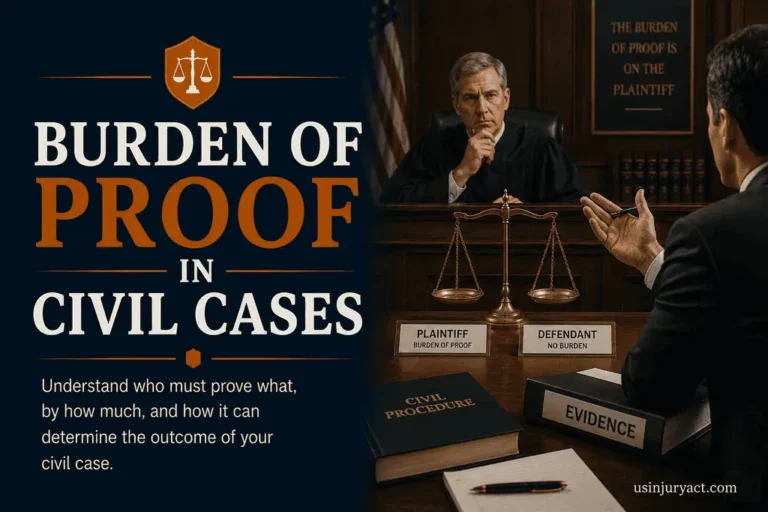
The burden of proof in civil cases is one of the most important and frequently misunderstood concepts in American law. It determines who must prove what, to what degree, and what happens when the evidence is close to equal.
If you are pursuing a personal injury lawsuit, a breach of contract claim, or any civil action, grasping this concept shapes every decision from case strategy to settlement negotiation to jury instruction.
So let’s go through the layer of the burden of proof in civil litigation so you can walk into any legal conversation fully informed.
What Is the Burden of Proof in Civil Cases?
The burden of proof is the legal obligation to produce sufficient evidence to support a claim or defense. In a civil lawsuit, the burden tells the court who bears the responsibility of proving each element of their case.
In the American adversarial legal system, courts do not investigate facts on their own, they instead rely on the parties to present evidence and arguments. Burden of proof is the mechanism that allocates that responsibility.
The party who bears the burden on a particular issue must produce enough evidence to satisfy the applicable legal standard. If they fail to meet that standard, they lose on that issue regardless of what the opposing party does or does not prove.
Civil burden of proof standards are intentionally different from the criminal standard of beyond a reasonable doubt. Civil law is primarily concerned with compensating injured parties and resolving private disputes, not imposing punishment, and the standards are calibrated accordingly.
The Difference Between Burden of Production and Burden of Persuasion
Lawyers and courts distinguish between two separate burdens that fall under the general heading of burden of proof.
- The burden of production refers to the obligation to introduce or come forward with enough evidence on a claim or defense to require the other party to respond. If you fail to meet this threshold, the court can dismiss your case before it even reaches the jury, through a directed verdict or summary judgment motion.
- The burden of persuasion refers to the standard of certainty you must meet with that evidence. Even if you introduce sufficient evidence to survive a motion to dismiss, you must still persuade the trier of fact, whether a judge or jury, that your version of events meets the applicable standard of proof.
Both burdens operate simultaneously throughout a civil trial. Your attorney must constantly manage both – ensuring enough evidence is on the record and ensuring the jury is persuaded by it.
The Three Standards of Proof Used in Civil Cases
Preponderance of the Evidence: The Standard Civil Plaintiffs Must Meet
The preponderance of the evidence is the default standard in American civil litigation. It applies in personal injury cases, contract disputes, property claims, negligence actions, and most other civil lawsuits unless a statute or rule specifies a different standard.
Preponderance of the evidence means more likely than not. If you imagine a scale, the plaintiff’s evidence must tip the scale even slightly in their favor, more than 50 percent probability. Courts often describe it as whether it is more likely true than not true that the defendant’s conduct caused the plaintiff’s injury.
This is a deliberately accessible standard. Civil plaintiffs are not required to eliminate all doubt or prove their case with mathematical certainty. They simply need to show that their version of events is the more probable one.
In situations like this, a 51 to 49 percent probability satisfies the standard.
In a car accident case for example, the plaintiff does not need to prove beyond any doubt that the defendant ran the red light. They need to show that it is more probable than not that the defendant did so and that this caused the crash.
Eyewitness testimony, traffic camera footage, physical evidence, and expert reconstruction can all contribute to meeting this standard.
Clear and Convincing Evidence: The Elevated Civil Standard
Some civil claims require a higher standard than preponderance of the evidence. Clear and convincing evidence requires a substantially greater degree of probability than the more likely than not standard. Courts often describe it as evidence that produces a firm belief or conviction in the truthfulness of the facts asserted.
Clear and convincing evidence applies in specific categories of civil litigation. Punitive damages claims in many states require clear and convincing proof that the defendant acted with malice, fraud, or oppression.
Fraud claims require clear and convincing evidence in several jurisdictions. Civil commitment proceedings, termination of parental rights cases, and cases involving allegations of undue influence over a will frequently use this elevated standard.
The clear and convincing standard sits between the civil preponderance standard and the criminal beyond a reasonable doubt standard.
It demands more than a slight tipping of the scale but does not require the near-certainty that criminal convictions demand.
Beyond a Reasonable Doubt – Its Limited Role in Civil Cases
Beyond a reasonable doubt is the burden of proof in criminal prosecutions that requires that the evidence to be so strong that no reasonable juror could have a reasonable doubt about the defendant’s guilt.
However, this standard does not apply in standard civil litigation but a handful of civil situations come close to requiring this level of proof.
Certain civil fraud cases, civil RICO actions, and quasi-criminal civil contempt proceedings can approach this threshold. More commonly, the phrase appears in civil cases when attorneys argue about the strength of evidence rather than the formal legal standard.
Understanding where the criminal and civil standards diverge also explains why someone can be acquitted of criminal charges but still found liable in civil court for the same conduct.
O.J. Simpson’s acquittal on criminal murder charges in 1995 followed by his 1997 civil liability verdict for wrongful death is the most cited American example of this principle in action.
The different outcomes resulted from different burdens of proof, not contradictory findings of fact.
Who Bears the Burden of Proof and When Does It Shift?
The Plaintiff’s Initial Burden
In virtually all civil cases, the plaintiff bears the initial burden of proof. The person bringing the lawsuit must prove the elements of their claim.
In a negligence case, that means proving duty, breach, causation, and damages. In a breach of contract case, that means proving the existence of a valid contract, the defendant’s breach, and resulting harm.
The plaintiff must meet this burden by a preponderance of the evidence on each element. If the plaintiff fails to prove any single element, the claim fails even if all other elements are proven.
Affirmative Defenses and the Shifting Burden
When a defendant raises an affirmative defense, the burden of proof on that defense typically shifts to the defendant.
An affirmative defense admits the basic facts alleged by the plaintiff but asserts a legal justification or excuse that bars recovery. Examples include assumption of risk, comparative fault, contributory negligence, statute of limitations, and release.
If the defendant claims that the plaintiff assumed the risk of injury, the defendant must prove that claim by a preponderance of the evidence. The plaintiff does not need to disprove it.
This allocation makes logical sense because the party asserting the special defense is in the best position to produce the evidence supporting it.
Burden Shifting in Employment and Discrimination Cases
Employment discrimination cases under Title VII and related statutes follow a specialized burden-shifting framework developed by the U.S. Supreme Court in McDonnell Douglas Corp. v. Green (1973)
The plaintiff first establishes a prima facie case of discrimination, which shifts the burden to the employer to articulate a legitimate non-discriminatory reason for the adverse employment action.
Once the employer provides a reason, the burden shifts back to the plaintiff to show that the stated reason is a pretext for discrimination.
This swquential burden shifting ensures both parties have an opportunity to present their evidence before any final determination is made.
It also prevents summary dismissal of discrimination claims while requiring plaintiffs to ultimately shoulder the burden of persuasion.
Burden of Proof in Specific Civil Claim Types
Personal Injury and Negligence
In a standard personal injury lawsuit, the plaintiff must prove by a preponderance of the evidence that: the defendant owed a duty of care to the plaintiff, the defendant breached that duty, the breach caused the plaintiff’s injury, and the plaintiff suffered quantifiable damages.
Each element must be individually proven with proofs like expert testimony on causation, medical records documenting injury, and evidence of the defendant’s conduct and so on.
In medical malpractice cases, the burden is the same but requires expert medical testimony to establish both the standard of care and the deviation from it. Without a qualified medical expert, a medical malpractice plaintiff generally cannot meet their burden on breach and causation.
Products Liability
In a strict products liability claim, the plaintiff does not need to prove negligence. They need to prove the product was defective, the defect existed when the product left the manufacturer’s control, and the defect caused the injury.
This reduced burden reflects the policy decision that manufacturers should bear the risk of placing defective products into commerce.
Example Of How Burden of Proof Operates at Trial
Consider a slip and fall case where a customer slips on a wet floor in a retail store. The plaintiff claims the store knew about the spill and failed to clean it or warn customers. The store claims it had no notice of the spill and reasonable inspection procedures were in place.
The plaintiff bears the burden of proving the store knew or should have known about the wet floor. They present evidence like surveillance footage showing the spill existed for 45 minutes before the fall, testimony from a store employee who walked past the area, and the absence of wet floor signs. The store counters with testimony about its inspection log and training procedures.
The jury is instructed to apply the preponderance standard. They conclude from the 45-minute duration that the store should have discovered the spill through reasonable inspection.
The plaintiff’s evidence tips the scale past 50 percent, the plaintiff wins on the breach element. This is the burden of proof operating exactly as designed.
Jury Instructions and the Burden of Proof
At the end of every civil trial, the judge provides the jury with instructions about the applicable legal standards, including the burden of proof. In a preponderance case, the instruction typically tells jurors to find for the plaintiff if the evidence in the plaintiff’s favor outweighs the evidence against it, even slightly.
The way these instructions are phrased can determine outcomes. Studies on jury behavior have consistently found that jurors apply the standard differently depending on how it is explained.
Clear instructions that the civil burden of proof requires only more probable than not, not certainty, tend to produce more plaintiff-favorable verdicts in marginal cases.
Defense attorneys often push for more demanding language in the instructions when they sense the evidence is close.
Challenging jury instructions on burden of proof issues is a preserved appellate argument in virtually every state, if the judge gives an incorrect instruction on the applicable standard, that error can form the basis for a new trial on appeal.