It is one of the most common questions personal injury attorneys hear from clients who have been hurt in accidents involving government vehicles, on government property, or at the hands of government employees is: Can I actually sue the government for negligence?
The answer is yes, but with important qualifications. The government is not sued the same way a private individual or corporation is sued. Special rules, strict deadlines, and specific procedural requirements apply.
Ignoring any one of them means your right to compensation may be permanently extinguished. This piece is written to walk you through every critical dimension of how suing the government for negligence work in the United States and how to actually sue the government for negligence.
Sovereign Immunity and Its Limits
Historically, the legal doctrine of sovereign immunity prevented citizens from suing their government without the government’s express consent. Rooted in the old English principle that the crown could do no wrong, this doctrine insulated governments at every level from civil liability for their negligent acts.
That era is largely over, but it has not ended completely.
Today, both the federal government and all fifty states have enacted statutes that waive sovereign immunity to some degree, allowing personal injury suits to proceed under defined conditions. These statutes are the legal gateways through which your lawsuit must pass.
The key is knowing which statute applies to your situation and following its requirements precisely.
Suing the Federal Government for Negligence
Your primary legal vehicle for suing the federal government is the Federal Tort Claims Act of 1946. Under the FTCA, the United States waives immunity for negligent acts committed by federal employees acting within the scope of their employment and it covers an enormous range of situations.
Federal employees include postal workers, military personnel in non-combat roles, VA healthcare providers, agents of the FBI, DEA, and Border Patrol, employees of the Social Security Administration, and workers in virtually every federal department and agency.
When any of these individuals negligently injures you in the course of their official duties, the FTCA may provide a path to compensation.
Common Federal Government Negligence Cases
Vehicle accidents involving federal government cars, trucks, or postal vehicles are among the most frequently filed FTCA claims. When a mail carrier rear-ends you while making deliveries, or when an immigration agent causes a collision while on duty, the federal government bears potential liability for the resulting injuries.
Medical malpractice at federal healthcare facilities is another major category. Veterans who receive care at VA hospitals and military personnel treated at military medical facilities may have FTCA claims if negligent treatment causes harm.
Similarly, patients treated at federally qualified health centers, which receive federal funding and grant their employees federal employee status for liability purposes under the Federally Supported Health Centers Assistance Act, may also pursue FTCA claims.
Slip-and-fall accidents on federal property, injuries caused by federal law enforcement misconduct, and harm caused by defective federal government equipment are additional bases for FTCA suits.
The FTCA Administrative Claim Process
Before you can file a lawsuit against the federal government in court, you must first exhaust the administrative claims process. This is mandatory, not optional. File a Standard Form 95 (SF-95) with the federal agency responsible for the negligent act within two years of the date of your injury.
Describe the circumstances of the incident, the nature of your injuries, and the amount of compensation you are seeking.
The agency has six months to investigate and respond. If it denies your claim, or if six months pass without a decision, you may then file suit in the appropriate federal district court.
The amount you sought in the administrative claim caps your court recovery, so it is critical to accurately calculate your full damages before filing.
Suing State Governments for Negligence
Every state has its own framework for sovereign immunity and its own waiver statute. These statutes vary considerably in their scope, procedural requirements, and damages limits. It is essential to know the specific rules in the state where your injury occurred.
Notice of Claim Requirements at the State Level
Most states require you to file a formal notice of claim with the responsible government entity within a short window after your injury. This is not the lawsuit itself. It is a preliminary notice that alerts the government to your intent to seek compensation and gives it an opportunity to investigate and potentially settle.
The deadlines for these notices vary dramatically.
In New York, the notice of claim must generally be filed within 90 days of the incident for claims against municipalities.
In California, the deadline is six months under the Government Claims Act.
In Georgia, it is 12 months, though shorter periods may apply to specific entities.
Missing these deadlines almost always results in the permanent loss of your right to sue, regardless of the merits of your claim.
Damages Caps on State Government Claims
Many states place caps on the amount of money you can recover from a state government entity. These caps are often lower than what you might recover in a comparable claim against a private defendant.
In Florida, recovery against the state or its agencies is capped at $200,000 per person and $300,000 per occurrence. Larger amounts require a legislative claim bill, a special act of the legislature appropriating additional funds, which is a difficult and unpredictable process.
In Texas, claims against local government entities are capped at $250,000 per person and $500,000 per occurrence.
In Colorado, total recovery from a public entity is capped at $505,000 per person starting from January 1st 2026 all the way down to 2030, with adjustments for inflation.
These caps can significantly affect the practical value of a government negligence claim, especially in cases involving catastrophic injuries. An experienced attorney will evaluate the applicable caps and advise you on whether alternative theories of recovery, such as claims against private parties who share liability, can supplement what the government claim alone might yield.
Suing Local Governments, Counties, and Municipalities
Cities, counties, school districts, transit agencies, and other local governmental bodies are also potential defendants in personal injury cases, and they too enjoy varying levels of immunity protection.
Government Vehicles and Local Employee Negligence
One of the most common paths to local government liability is a traffic accident involving a city or county vehicle. Police cars, fire trucks, public buses, sanitation trucks, and city maintenance vehicles are all on the roads every day, and when their operators drive negligently, the employing government entity can be held liable under the doctrine of respondeat superior, which makes an employer responsible for the negligent acts of an employee acting within the scope of employment.
However, emergency vehicles responding to active calls often receive additional protections under state law. Many states provide immunity to police and fire departments for accidents that occur during emergency responses, provided the operator was not acting with gross negligence or reckless disregard for public safety.
These nuances require careful analysis to determine how much protection applies in your specific situation.
Dangerous Conditions on Government Property
Government entities that own or maintain public property, including roads, sidewalks, parks, public buildings, and bridges, have a duty to keep those properties in a reasonably safe condition.
When a defective road causes an accident, a broken sidewalk causes a fall, or a poorly maintained public building causes an injury, the property-owning government entity may be liable.
In many states, government entities must have had actual or constructive notice of the dangerous condition before liability attaches. Constructive notice means the condition existed long enough that the government should have known about it through reasonable inspection.
If a pothole existed for months and was reported multiple times before causing an accident, the government’s failure to address it despite notice can support liability.
The Discretionary Function Defense: The Government’s Strongest Shield
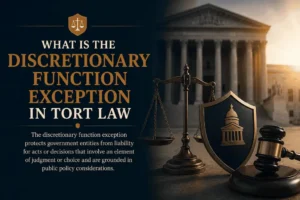
Even when a government entity cannot claim general sovereign immunity, it may still escape liability by invoking the discretionary function exception. This defense protects government decisions that involve the exercise of judgment or policy-making discretion.
Courts distinguish between ministerial acts, which are routine tasks governed by established rules or protocols and which do not require policy judgment, and discretionary acts, which involve choices among alternatives based on policy considerations.
Governments are generally not liable for discretionary acts even if those acts turn out to be unwise or harmful.
For example, a government decision about how many potholes to repair in a given fiscal year involves budget priorities and policy judgment. A court might find this discretionary and immune. But a maintenance worker’s failure to follow an established protocol for marking a known road hazard is ministerial.
Failure at the ministerial level can give rise to liability.
Example Of How Suing the Government Works: Sidewalk Injury
An elderly man is walking to his physician’s office on a city sidewalk. A large section of concrete has buckled due to tree root growth and has been in this condition, by city records, for over a year.
A neighbor submitted a 311 service request about the condition nine months before the accident. The man trips, falls, and suffers a fractured pelvis requiring surgery and extended rehabilitation.
His attorney files a timely notice of claim with the city within the required window. The claim details the specific location of the defect, the documented history of prior notice, the date of the injury, and an itemized demand for compensation including medical costs, lost mobility, home care expenses, and pain and suffering.
The city denies the claim and then litigation follows. The attorney presents the 311 request records to establish constructive notice and hires an engineering expert to testify that the sidewalk defect was unreasonably dangerous.
The jury awards damages within the applicable state cap.
Key Differences Between Suing Government vs. Private Defendants
Suing the government for negligence is procedurally more complex and in some ways more restrictive than suing a private party.
The administrative claim requirement creates an additional step that private party lawsuits do not require.
- The shortened notice deadlines are far more unforgiving than standard statutes of limitations.
- The absence of punitive damages at the federal level and in many states limits the total potential recovery.
- Damage caps that apply to government defendants do not apply to private defendants in most states.
At the same time, government defendants cannot declare bankruptcy to avoid judgments, and the financial resources of government entities mean that judgments, once obtained, are collectible.
An experienced attorney can help you navigate these differences strategically.
Can You Sue the Government for Negligence?
Yes, you can sue the government for negligence, but doing so successfully requires a precise command of procedural rules that are unique to government defendants. The Federal Tort Claims Act, state tort claims acts, municipal liability statutes, and the judicial doctrines surrounding sovereign immunity create a little bit complex but navigable framework than suing private defendants.
If you were injured through the negligence of a government employee, on government property, or as a result of a government entity’s failure to maintain a safe condition, your right to compensation is real. But it is only preserved if you act quickly, comply with every notice requirement, and work with an attorney who knows this area of law.
The clock starts running the moment you are hurt so it’s only best you consult with a personal injury lawyer within your jurisdiction.