After a car accident, you will almost certainly receive a call from an insurance adjuster, and that call will happen sooner than you expect, often within 24 to 48 hours of the crash, while you are still in pain, still processing the trauma, and still trying to figure out your next steps.
What you say during that conversation can have a profound impact on your claim. The right words protect your rights. The wrong ones can be used to reduce or deny your compensation.
This article tells you exactly what you should say to insurance adjusters, what you must never say, and why each of these guidance points matters from a legal standpoint.
Insurance Adjusters: who they are and what they do
Why the Adjuster Is Calling You So Quickly
The speed of an insurance adjuster’s initial contact is not a courtesy, it is strategy. Adjusters know that accident victims are most vulnerable in the immediate aftermath of a crash: physically hurt, emotionally shaken, financially worried, and often not yet represented by an attorney.
They also know that people’s memories of the accident are fresh and that injured people are more likely to make statements they later wish they had not made.
The adjuster’s goal in that first call is to gather information, establish rapport, and if possible, lock you into a version of events and a description of your injuries that limits the insurer’s exposure.
Every question they ask is purposeful. Every answer you give is recorded and preserved.
What You Should Say To Insurance Adjusters: The Safe Responses
Your Basic Identifying Information
You are generally required to provide basic contact information when dealing with your own insurer. When contacted by the at-fault driver’s insurer, you can provide your name, address, and the fact that you were involved in the accident.
That is essentially the limit of what you are obligated to share voluntarily.
A Short Confirmation That the Accident Occurred
You can confirm that an accident occurred on a particular date and that you were present. You do not need to provide any detail beyond that at this early stage.
Your Attorney’s Contact Information
If you have already retained a personal injury attorney, simply provide the adjuster with your attorney’s name and phone number and let the adjuster know that all further communications should go through your legal representative.
This is entirely appropriate and adjusters are required to respect it.
A Statement That You Are Still Receiving Medical Treatment
If asked about your injuries, a truthful and safe response is simply that you are still under medical care and that the full extent of your injuries has not yet been determined.
This is honest, it sets appropriate boundaries, and it avoids the trap of minimizing injuries that may turn out to be far more serious than they initially seem.
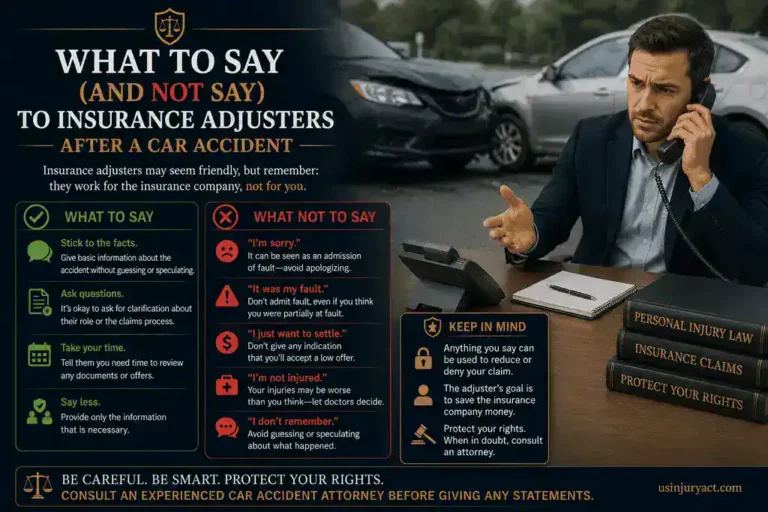
The safest thing you can say to the other driver’s adjuster in those early days is: “I am still receiving medical treatment and my injuries have not yet been fully evaluated. I will have more information to provide as my treatment progresses.”
What You Should NOT Say: The Statements That Damage Claims
Never Say “I’m Fine” or “I Was Not Badly Hurt”
This is the single most damaging statement an accident victim can make to an insurance adjuster. Adrenaline and shock can mask pain for hours after a crash.
Soft tissue injuries, concussions, spinal injuries, and internal bleeding often have delayed symptom onset.
Telling an adjuster you are fine before a complete medical evaluation is complete creates a documented record that the insurer will use against you if your injuries turn out to be serious.
Here’s a real case scenario:
A driver rear-ended on the freeway told the adjuster during a same-day phone call that she felt “okay, just a little shaken up.” When she sought treatment three days later and was diagnosed with two herniated cervical discs, the insurer immediately pulled the recorded statement and used it to argue that her injuries were either pre-existing or caused by something else after the crash. Months of additional litigation were required to overcome that single statement.
Never Apologize or Admit Any Fault
Social conditioning leads many people to apologize after accidents even when they bear no responsibility.
At the scene, an apology feels like basic human decency. To an insurance adjuster and a defense attorney, an apology is an admission of fault. Even a partial admission, “I probably could have braked sooner” or “I was distracted for just a second,” can significantly alter the fault allocation in your case.
In states using modified comparative fault, being found even slightly more than the 50 or 51 percent threshold bars your recovery entirely. In states using contributory negligence, any admission of fault can extinguish your entire claim.
Never Speculate About What Happened
If an adjuster asks you to guess, estimate, or reconstruct the sequence of events leading to the crash, resist the temptation to fill in the blanks.
Say to insurance adjusters clearly that you can only describe what you directly observed and experienced, and that you prefer not to speculate about events you did not directly witness or about cause and effect.
Speculative statements like “The other car must have been going at least 50 mph” or “I think the sun was in my eyes” create problems that can be very difficult to walk back.
Accident reconstruction is a scientific process, not a guessing exercise. Leave the technical analysis to the experts.
Never Give a Recorded Statement to the Other Driver’s Insurer Without an Attorney
The at-fault driver’s insurer will often request a recorded statement, framing it as a necessary step in processing your claim.
You are under no legal obligation to provide one. The request may be made to sound routine or urgent, but you have the right to decline. Politely tell the adjuster that you prefer to consult with an attorney before providing any recorded statement.
Your own insurer may have a policy provision requiring your cooperation, which could include a recorded statement. Even in that case, you are entitled to have an attorney present or advising you before and during the statement.
Review your policy and consult an attorney before complying.
Never Discuss Your Medical History in Detail
Adjusters may ask questions designed to elicit information about pre-existing conditions. Common questions include: “Have you ever had back problems before?” or “Were you being treated for anything before the accident?”
These questions aim to build a record of pre-existing conditions that the insurer can later use to argue that your current injuries are not accident-related.
If you have a genuine pre-existing condition that was aggravated by the accident, that does not eliminate your right to compensation.
The eggshell plaintiff doctrine, recognized in California and throughout most of the United States, holds that a defendant takes the plaintiff as they find them. If the accident aggravated a pre-existing condition, the defendant is liable for that aggravation.
However, you do not need to present this information on a preliminary phone call with an adjuster. Your medical history and its relationship to your current injuries should be developed carefully with your attorney’s guidance.
Never Discuss Policy Limits
Do not ask the adjuster about the at-fault driver’s policy limits during early conversations, and do not volunteer information about your own coverage.
Policy limit discussions are part of the legal and negotiation process, handled strategically and at the appropriate time.
Early, uninformed policy limit discussions can set a ceiling on negotiations before your claim value is fully developed.
Never Accept the First Settlement Offer Without Legal Review
An adjuster who calls you within the first week after a crash and offers a settlement figure is not doing you a favor. They are capitalizing on your vulnerability and your incomplete knowledge of your own damages.
Early settlement offers almost never reflect the full value of a serious injury claim.
Accepting a settlement and signing the accompanying release ends your claim permanently and completely. If you later discover you need surgery, extended physical therapy, or time away from work, you have no further recourse.
The release you signed covered all future claims, known and unknown.
The Recorded Statement: A Deeper Look
Because the issue of recorded statements comes up so frequently and is so consequential, it deserves extended discussion. When an adjuster asks for a recorded statement, they follow a structured interview format designed to elicit specific information.
Questions often begin broadly and warmly to build rapport, then funnel toward more pointed inquiries about fault, injuries, and the sequence of events.
Adjusters are trained interviewers. They listen for inconsistencies between your statement and the police report, between your description of injuries and prior medical records, and between what you say and what other witnesses have reported.
Inconsistencies, even minor ones explained by the stress and confusion of the post-accident period, become arguments against your credibility.
If you are ever in a situation where you feel you must provide a recorded statement, prepare beforehand with an attorney, stick to what you directly observed and know for certain, avoid estimating speeds, distances, or timing unless you are confident in those figures, and say “I don’t know” or “I can’t recall” when that is genuinely accurate.
These are not evasions. They are truthful responses that protect you from being held to uncertain approximations.
Dealing With Your Own Insurance Company
The guidance above primarily addresses interactions with the at-fault driver’s insurer. Your own insurer is different in important ways, but that does not mean communications with your own insurer carry no risk.
Your policy likely requires you to cooperate with your insurer, provide timely notice of the accident, and possibly submit to examinations under oath in disputed claims.
These obligations are real and failure to comply can jeopardize your own first-party coverage, including uninsured motorist and MedPay claims.
That said, cooperation with your own insurer does not mean providing a detailed recorded statement without preparation. Request that your attorney be present or advise you before any recorded statement to your own insurer.
This is a standard practice and legitimate insurers will not penalize you for it.
Additionally, insurers sometimes conduct independent medical examinations (IMEs) by physicians of their choosing when disputing the nature or extent of your injuries.
IME physicians are paid by the insurer and some have financial incentives to minimize injury findings. Your attorney can prepare you for an IME, accompany you if permitted, and challenge IME findings with independent medical evidence.
Social Media: The Silent Claim Killer
Your interactions with insurance adjusters are not the only communications that can damage your claim.
Social media is a rapidly growing source of evidence that insurers use to challenge personal injury claims. Adjusters and defense investigators routinely monitor claimants’ social media accounts looking for posts, photographs, and check-ins that contradict injury claims.
A Facebook photo of you smiling at a family gathering, an Instagram post from a hiking trip, or even a tweet about feeling good can be taken out of context and used to argue that your injuries are exaggerated or fabricated.
The safest approach during the course of your claim is to refrain from posting about your health, activities, or the accident at all. Set your accounts to the strictest privacy settings, but understand that privacy settings are not foolproof and that past public posts may already be captured.
A Practical Script: How to Handle That First Phone Call
When the adjuster calls and you have not yet retained an attorney, here is a practical approach.
- Answer the call.
- Confirm your name.
- Confirm that you were involved in an accident on the date in question.
- Tell the adjuster that you are currently receiving medical treatment and that your injuries have not been fully evaluated.
- Politely decline to provide a recorded statement at this time, stating that you prefer to consult with an attorney first.
- Take the adjuster’s name, phone number, and claim number.
- End the call professionally and then contact a personal injury attorney.
This approach fulfills your basic obligation to communicate, avoids making damaging statements, and positions you to handle all subsequent communications correctly.
To Summarize
What you say to insurance adjusters after a car accident matters enormously. The right approach is measured, truthful, and strategically restrained.
You confirm basic facts, decline to speculate, avoid minimizing your injuries, and exercise your right to legal representation before making any formal statements.
Insurance adjusters are professionals trained to obtain information that serves the insurer’s interests. Your best protection is knowledge of how the process works and the guidance of a personal injury attorney who can help you navigate it.
Most personal injury attorneys offer free initial consultations, so there is no financial barrier to getting that guidance early, when it matters most.