When the Government Can’t Be Sued
Filing a personal injury claim against a government entity is never simple.
Beyond the procedural hurdles of notice requirements and shortened filing deadlines, injured plaintiffs face a substantive legal barrier that can completely foreclose a lawsuit before it even begins, it is called the discretionary function exception.
If your injury involves the conduct of a federal, state, or local government agency or employee, the discretionary function exception in personal injury claims may determine with finality whether you have any legal recourse at all.
This doctrine is one of the most powerful and least well-known limitations in American tort law.
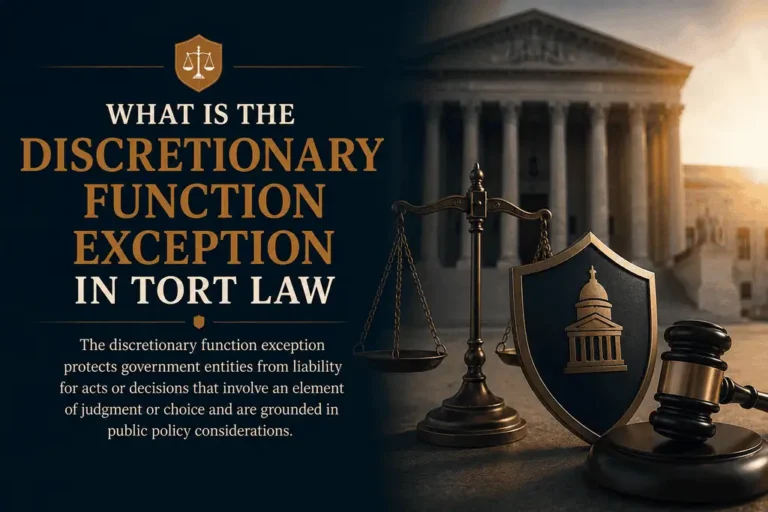
It is like a carve-out from governmental liability that shields certain government decisions from lawsuit, even when those decisions cause serious, documented harm to private individuals.
Sovereign Immunity and the Federal Tort Claims Act
To understand the discretionary function exception, you must first understand sovereign immunity. Sovereign immunity is the inherited legal doctrine that the government cannot be sued without its own consent.
It was from the English common law and carried into American jurisprudence from the nation’s founding, sovereign immunity originally meant that citizens had no right to sue the government for its wrongs.
The Federal Tort Claims Act of 1946, commonly called the FTCA, was Congress’s landmark waiver of sovereign immunity for the federal government. For the first time in American history, the FTCA allowed private citizens to sue the United States government for personal injury, property damage, or death caused by the negligent or wrongful acts of federal employees acting within the scope of their employment, under the same law that would apply to a private person in the same circumstances.
But Congress did not create a blanket waiver, it included several important exceptions to governmental liability, and the most consequential of these is the discretionary function exception, codified in 28 U.S.C. section 2680(a).
Under this provision, the FTCA’s waiver of immunity does not apply to claims based on the performance of or failure to perform a discretionary function or duty on the part of a federal agency or an employee of the government, even if the discretion involved is abused.
That final phrase, “even if the discretion involved is abused,” is significant.
Congress was not merely protecting decisions that were made wisely. It was protecting the decision making process itself, even when the decision was a bad one.
The Two-Part Berkovitz Test – How Courts Apply the Exception
The modern framework for evaluating the discretionary function exception comes from two landmark U.S. Supreme Court decisions – United States v. Varig Airlines, decided in 1984, and Berkovitz v. United States, decided in 1988.
Together, these cases established a two-part test that courts continue to apply today.
Part One: Was the Conduct Discretionary?
The first inquiry is whether the government employee’s conduct involved an element of judgment or choice. The discretionary function exception only protects conduct that is truly discretionary, meaning the employee had room to make a judgment call.
If a statute, regulation, or mandatory policy prescribed a specific course of action for the employee to follow, and the employee failed to follow it, the exception does not apply and the government can be sued.
The distinction between mandatory and discretionary conduct is critical. If a federal food inspector is required by a specific regulation to conduct an inspection in a particular way and they deviate from that requirement, causing harm, the deviation is not protected by the discretionary function exception.
But if the same inspector has broad authority to determine how to prioritize inspections and how to allocate resources, the exercise of that broad authority is discretionary.
Part Two: Is the Discretion Grounded in Policy Considerations?
Even if the conduct was discretionary, courts apply a second inquiry: is the discretion the kind that the exception was designed to protect?
The Supreme Court has made clear that the discretionary function exception was specifically designed to prevent judicial second-guessing of legislative and administrative decisions grounded in social, economic, and political policy.
Not every judgment call qualifies. The government employee must be making a decision that is susceptible to policy analysis, meaning a decision that involves the balancing of competing public interests, the allocation of limited resources, or the weighing of regulatory priorities.
Purely operational decisions made in the field, even if they involve some degree of judgment, may not qualify for protection.
When the Exception Applies and When It Does Not
Scenario 1: Highway Design Decisions
The Federal Highway Administration and state departments of transportation make countless decisions about highway design including speed limits, guardrail placement, sight line clearance, lane configurations, and intersection design.
These decisions involve the balancing of safety considerations against cost constraints, traffic flow requirements, environmental impact, and federal funding allocations.
Courts have generally held that these design decisions are discretionary because they require the weighing of competing policy considerations.
A driver who is injured at an intersection and claims the intersection was negligently designed may find their lawsuit barred by the discretionary function exception if the design was the result of a deliberate engineering and policy judgment by transportation officials.
The government cannot be sued simply because in retrospect a different design might have been safer.
Scenario 2: Failure to Follow Mandatory Safety Regulations
A pharmaceutical company applies for approval of a new medication. Under federal regulations, the Food and Drug Administration is required to follow specific procedures in reviewing clinical trial data before granting approval.
An FDA employee fails to conduct the mandatory review of a particular safety data set, the drug is approved, and patients suffer serious side effects.
In this case, the discretionary function exception would likely not protect the government because the employee did not exercise discretion, they failed to follow a mandatory procedural requirement.
The FTCA waiver of immunity would apply, and the United States government could potentially be held liable for the resulting injuries.
Scenario 3: National Park Service Trail Maintenance
A hiker is severely injured when a footbridge in a national park collapses. The National Park Service manages thousands of trail structures across the country and must make ongoing decisions about how to prioritize inspection and maintenance of bridges, trails, and facilities given limited funding and personnel.
The decision about when and how to inspect a particular bridge involves policy judgments about resource allocation.
However, if the Park Service had a specific written mandatory protocol requiring annual inspection of all footbridges and the collapsed bridge had not been inspected in five years, the failure to follow that mandatory protocol takes the conduct outside the protection of the discretionary function exception.
The mandatory requirement eliminates the element of choice, and the plaintiff may have a viable claim against the government.
State Law Equivalents of the Discretionary Function Exception
The discretionary function exception is not limited to federal government claims.
Every state has its own sovereign immunity doctrine, and most states have enacted their own tort claims acts that similarly carve out protection for discretionary governmental conduct.
The specific language varies by state, but the core principle is consistent with the fact that governments retain immunity for policy-level decisions while waiving immunity for operational failures that deviate from mandatory duties.
California’s Government Claims Act provides immunity for government acts or omissions that constitute a discretionary act or omission, and California courts apply a test similar to the federal framework.
Texas Government Code similarly protects government employees and agencies from liability for discretionary acts, while allowing claims arising from mandatory non-discretionary conduct.
New York’s Court of Claims Act and the accompanying case law distinguish between planning-level decisions, which are immune, and operational level decisions, which are not.
Understanding the specific sovereign immunity and discretionary function rules in your state is essential before bringing any claim against a government entity.
The rules and procedures vary considerably, and missing procedural deadlines or failing to file the required notice of claim can result in permanent loss of your right to sue.
Procedural Requirements for Claims Against the Government
Beyond the substantive hurdle of the discretionary function exception, personal injury claims against government entities face additional procedural requirements that differ substantially from claims against private parties.
Under the FTCA, a plaintiff must file an administrative claim with the relevant federal agency within two years of the date the injury occurred. The agency then has six months to investigate and respond. Only after the agency denies the claim, or six months pass without a decision, can the plaintiff file suit in federal court.
State tort claims acts impose analogous requirements, often with shorter deadlines. Many states require notice of a claim to be filed with the relevant government entity within 90 days to 180 days of the injury. This notice requirement is strictly enforced in most jurisdictions, and failure to file a timely notice of claim can permanently bar an otherwise valid personal injury lawsuit.
This is why it is absolutely critical that anyone injured by the conduct of a government agency or employee consult with a personal injury attorney immediately. The condensed timelines for government claims leave little room for delay, and the procedural requirements are not so plain.
How to Tell If the Discretionary Function Exception Might Bar Your Claim
If you were injured as a result of a government agency’s action or failure to act, your attorney will need to answer several threshold questions before proceeding.
- Was the government conduct that caused your injury the result of a deliberate judgment call involving competing policy considerations? Or was it a failure to follow a specific mandatory duty that the agency had no discretion to ignore?
- Was the decision made at the planning or policy level, involving resource allocation and regulatory priorities? Or was it a purely operational implementation of a non-discretionary directive?
- Were there written regulations, policies, or protocols that prescribed a specific course of conduct, and did the government employee deviate from those requirements?
Answering these questions requires a thorough review of the agency’s enabling legislation, applicable federal and state regulations, internal agency policies and manuals, and the specific facts of the incident.
This is specialized legal work that demands experience with government liability law and administrative procedure.