
When you suffer injuries because of someone else’s negligence, the law gives you the right to seek financial compensation for everything that injury has cost you and everything it will cost you going forward.
These financial awards are called damages, and in American personal injury law, they come in several distinct categories, each designed to address a different type of harm.
What Damages Can You Recover in a Personal Injury Case?
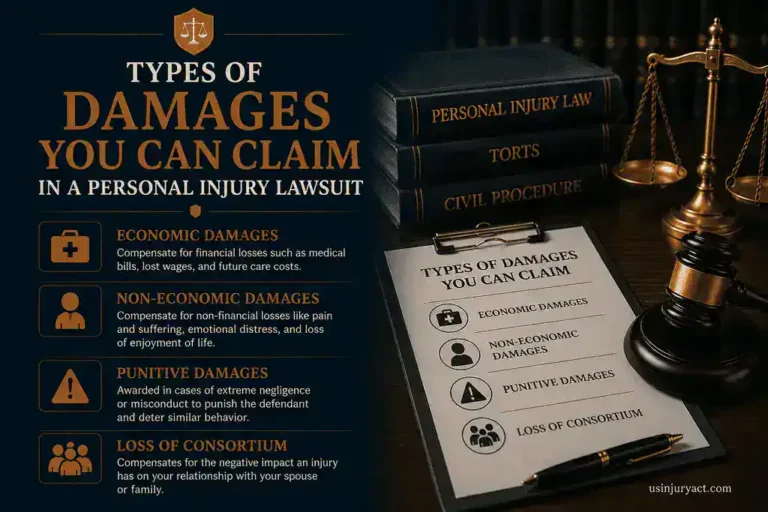
Personal injury damages cover far more than your initial hospital bill. They include Economic Damage which is every economic loss you have suffered and will suffer in the future. Non-Economic Damage which is every element of physical and emotional pain, every relationship harmed, and in appropriate cases, Punitive Damage which is punishment for the defendant’s egregious conduct.
Knowing what types of damages you can claim is not just an academic exercise. It directly shapes how your attorney builds your case, which experts are retained, what evidence is gathered, and ultimately how much money you may recover.
Many injury victims leave significant compensation on the table simply because they did not know what they were entitled to claim.
This article covers every major category of damages available in a personal injury lawsuit, with detailed explanations of what qualifies, how damages are calculated, and real scenarios that show how these categories play out in actual cases.
Economic Damages: Measurable Financial Loss
Economic damages, sometimes called special damages, are the quantifiable financial losses caused by your injury. These are losses that can be documented with bills, pay stubs, receipts, tax records, and expert calculations. They represent actual out-of-pocket costs and measurable income losses tied directly to the defendant’s negligence.
Medical Expenses: Past and Future
Medical expenses are typically the largest category of economic damages in a serious personal injury claim.
Past medical expenses include every dollar you have spent on treatment from the date of the accident through the time of trial or settlement.
It encompasses emergency room visits, ambulance transportation, hospitalization, surgery, anesthesia, radiology, laboratory testing, physical therapy, occupational therapy, chiropractic care, prescription medications, medical equipment, and any other treatment necessitated by your injuries.
Future medical expenses are projected costs for care you will need beyond the date of settlement or verdict.
If your injuries are permanent or require ongoing treatment, a life care planner, typically a registered nurse or rehabilitation specialist with forensic expertise, prepares a detailed document projecting your medical needs over your lifetime.
This life care plan itemizes every expected treatment, its frequency, and its cost, giving the jury or insurance adjuster a concrete number to award.
For a person who sustains a spinal cord injury at age 35, future medical costs including hospitalizations, attendant care, medications, adaptive equipment, home modifications, and physician visits can exceed $5 million over a lifetime.
Getting this number right requires expert testimony and aggressive advocacy.
Lost Wages and Loss of Earning Capacity
If your injuries prevented you from working, you can recover the income you lost while you were unable to work. Documentation comes from your employer in the form of pay stubs, W-2s, or letters confirming your hourly rate and hours missed.
For self employed individuals, tax returns and business records establish income loss.
Loss of earning capacity is a broader, forward-looking claim. If your injuries permanently affect your ability to work at your previous level, you can recover the difference between what you would have earned over your remaining work life and what you are now capable of earning given your limitations.
A vocational rehabilitation expert evaluates your ability to return to work, and an economist calculates the present value of the income difference using factors such as your age, education, career trajectory, and statistical work life expectancy.
For instance, a 40 year old nurse who sustains a back injury that prevents her from returning to bedside nursing. Her vocational expert establishes she can now only perform sedentary work at a significantly lower wage.
The economist calculates a $700,000 loss of earning capacity over her 25 remaining work years. This is fully recoverable as an economic damage.
Property Damage
If your personal property was damaged in the accident, particularly your vehicle in a car crash, you can recover the cost of repair or, if the vehicle is totaled, its fair market value at the time of loss.
You may also recover rental car expenses incurred while your vehicle was being repaired or replaced. Personal property inside the vehicle, such as a laptop or equipment destroyed in the crash, is also recoverable.
Out of Pocket Expenses
Beyond formal medical bills and lost wages, injury victims often incur many additional costs that are fully compensable.
These include transportation to and from medical appointments, home nursing care, domestic services you could perform before the injury but can no longer handle such as cleaning, lawn care, or childcare, costs of adaptive equipment, and modifications to your home or vehicle to accommodate a disability.
Keep receipts and records for every expense related to your injury.
Non-Economic Damages: The Human Cost of Your Injury
Non-economic damages, also called general damages, compensate for the intangible but very real human losses that do not come with a receipt.
These are the losses that affect your quality of life, your emotional health, and your relationships. While harder to quantify than economic damages, non-economic losses are often the largest component of a serious injury verdict.
Pain and Suffering
Pain and suffering damages compensate you for the physical pain and discomfort caused by your injuries, both the pain you have already endured and the pain you will experience in the future if your condition is permanent or chronic.
Courts and juries consider the nature and severity of the pain, the duration, and the impact on daily activities.
There is no precise formula for calculating pain and suffering in most states. Two approaches are commonly used in negotiations and at trial.
The multiplier method multiplies your total economic damages by a factor, typically between 1.5 and 5, based on the severity of the injury.
The per diem method assigns a daily dollar value to your suffering and multiplies it by the number of days you have suffered or are expected to suffer.
A plaintiff with a permanent back injury who experiences daily pain rated at 6 out of 10, limiting their ability to sit, stand, walk long distances, and sleep comfortably, presents a compelling pain and suffering case that can support a substantial award.
Emotional Distress and Mental Anguish
Serious physical injuries frequently cause significant psychological harm including anxiety, depression, post-traumatic stress disorder, sleep disturbances, and fear related to the accident itself or to medical procedures.
Emotional distress damages compensate for this psychological suffering.
They are typically supported by treating therapist or psychiatrist records, expert testimny from mental health professionals, and plaintiff testimony about how the injury has affected their emotional life.
In cases involving particularly traumatic accidents, such as a catastrophic crash with prolonged entrapment, a pedestrian struck by a vehicle or a burn injury requiring repeated skin grafting procedures, emotional distress damages can be substantial and are often the subject of dedicated expert testimony.
Loss of Consortium
Loss of consortium is a damage claim typically brought by the spouse of an injured plaintiff to compensate for the loss of companionship, affection, support, and intimate relations that result from a serious injury.
The spouse must show that the injury has materially impaired the marital relationship. In some states, domestic partners and, in limited circumstances, children or parents of an injured person may also bring consortium claims.
Loss of consortium is a separate legal claim from the injured person’s own claims and is valued independently. In severe injury cases where the plaintiff is permanently disabled, disfigured, or cognitively impaired, consortium damages can be significant.
Loss of Enjoyment of Life
Separate from pain and suffering, loss of enjoyment of life compensates for the activities, hobbies, and pleasures that you can no longer participate in because of your injury.
If you were an avid runner who can no longer run, a musician whose hand injury ended your ability to play, or a parent whose back injury prevents you from picking up your children, these losses are compensable in most states.
Your attorney will gather evidence of your pre-injury activities through photographs, testimony from friends and family, social media records, and memberships in clubs, sports leagues, or recreational organizations to document what your injury has taken from you.
Punitive Damages: Punishing Egregious Conduct
Punitive damages, also called exemplary damages, are awarded not to compensate the plaintiff but to punish the defendant for conduct that is grossly negligent, reckless, malicious, or fraudulent, and to deter similar conduct in the future.
They are available in addition to compensatory damages when the defendant’s behavior exceeds ordinary negligence and rises to a level of conscious disregard for the safety of others.
Examples of conduct supporting punitive damages include a drunk driver with a blood alcohol content far above the legal limit, a trucking company that continued to employ a driver after multiple DUI convictions, a pharmaceutical manufacturer that concealed known safety risks from regulators and consumers, or a property owner who deliberately falsified inspection records while knowing of dangerous conditions.
Punitive damages are subject to constitutional limits. The U.S. Supreme Court’s decisions in BMW of North America, Inc. v. Gore and State Farm Mutual Automobile Insurance Co. v. Campbell established that punitive damages must bear a reasonable relationship to the compensatory damages awarded, with ratios exceeding 9:1 typically being constitutionally suspect.
Many states also impose statutory caps on punitive damages.
Wrongful Death Damages: When an Injury Proves Fatal
When a personal injury causes death, surviving family members may pursue wrongful death damages under their state’s wrongful death statute.
Available damages vary by state but typically include the deceased’s lost future earnings and financial support to the family, medical and funeral expenses, the family’s loss of guidance and companionship, and in some states, the pre-death pain and suffering experienced by the decedent through a survival action.
Wrongful death cases frequently involve significant economic damages because they project lost income over what would have been the decedent’s full remaining work life.
The loss of a 35 yearold professional with 30 years of work ahead of them represents an enormous economic loss to surviving dependents and must be rigorously documented and quantified by economic experts.
Damage Caps: When the Law Limits What You Can Recover
Many states impose statutory caps on certain categories of damages, most commonly non-economic damages in medical malpractice cases.
California, for example, recently raised its medical malpractice non economic damages cap to $350,000 for non-death cases with the cap increasing annually. Texas caps non-economic damages in medical malpractice at $250,000 per healthcare provider and $500,000 total. Ohio, Maryland, and several other states also have caps.
Damage caps do not apply in most stanndard personal injury cases outside of medical malpractice, but you and your attorney must always check your state’s specific rules. Some states also cap punitive damages and impose different standards for their recovery.
How an Attorney Maximizes Your Damage Recovery
Building a compelling damages case requires more than simply sending a bill to the insurance company.
Your attorney must retain the right experts: life care planners for future medical costs, vocational experts for earning capacity losses, economists for present value calculations, and treating physicians who can testify credibly about the permanence and severity of your injuries.
Compelling plaintiff testimony about your daily life, your limitations, and your losses before and after the injury is also critical. Jurors award damages based on how well they understand the human impact of the injury and not just the stack of medical bills
Work with an experienced personal injury attorney from the beginning of your case to ensure that every category of damages is identified, documented and aggressively pursued on your behalf.