

You were injured through someone else’s negligence. Medical bills are mounting, you missed work, and you’re in pain. Now you’re asking: can I make a personal injury claim myself without hiring a lawyer?
The short answer is yes, there is no law in the United States that requires you to have an attorney to file or negotiate a personal injury claim. But the real question is whether doing so is in your best interest, and the answer depends heavily on the severity of your injuries, the liability picture, and how the insurance company responds.
This guide covers every aspect of the self-represented personal injury claim so you can decide what approach fits your situation.
When Making a Personal Injury Claim Yourself Is a Realistic Option
Not every personal injury claim requires an attorney, in fact, for minor injuries with clear liability and limited financial stakes, handling your own claim can save you the 33 to 40 percent contingency fee that most personal injury lawyers charge.
The types of cases where self-representation tends to work reasonably well share a set of common characteristics.
If your injuries were minor and fully resolved within a few weeks, meaning no surgery, no ongoing treatment, no permanent effects, and you have documented all your medical expenses and lost wages clearly, you are in a better position to negotiate directly with the insurance adjuster.
If liability is not seriously disputed, meaning the other party clearly caused the accident and there is a police report or other documentation confirming it, you have a stronger foundation for a self-negotiated settlement.
Property damage claims and minor soft tissue injuries, like a mild whiplash that resolved within four to six weeks, are among the most commonly self-negotiated personal injury matters in the country. Insurance companies process thousands of these claims every year without litigation.
When You Should Strongly Consider Hiring an Attorney Instead
Before you decide to go it alone, be honest about the severity of your situation. If any of the following apply to your case, self-representation carries significant risk of leaving substantial money on the table or making legally binding mistakes.
- You suffered serious injuries requiring surgery, hospitalization, or extended treatment.
- You have a long-term or permanent disability resulting from the accident.
- You are dealing with an uninsured or underinsured motorist.
- Liability is disputed and the other party blames you in whole or in part.
- Multiple parties may be responsible for the accident.
- The insurance company has made a lowball offer or denied your claim outright.
- A government entity is involved, such as a municipal vehicle or government-owned property.
In these situations, the value of a skilled personal injury lawyer almost always exceeds their fee, because experienced attorneys understand how to value cases fully and how to push back against insurance tactics effectively.
How to File a Personal Injury Claim Without a Lawyer
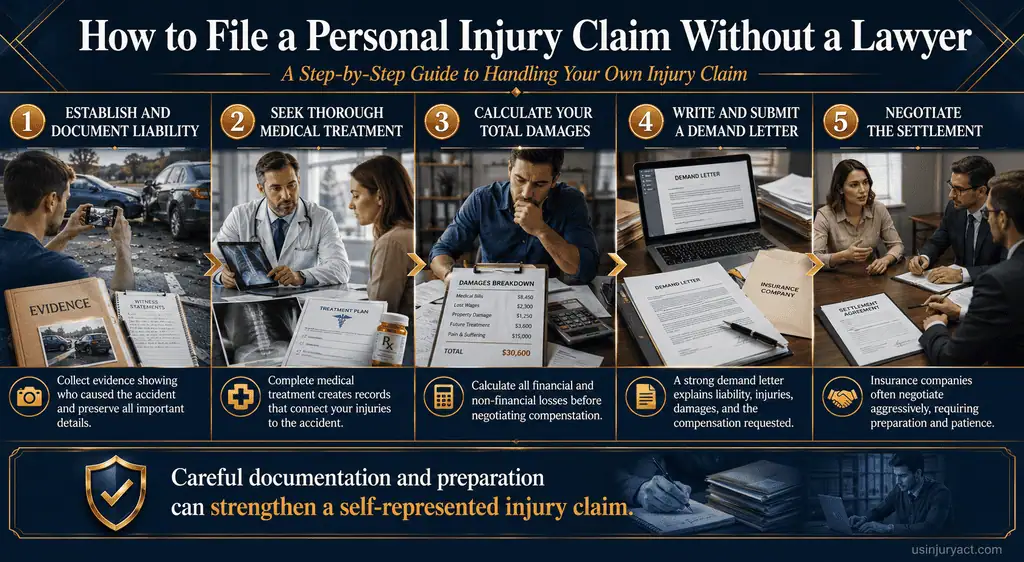
Establish and Document Liability
Before you can recover compensation, you must be able to show the other party caused your injury through negligence. This requires evidence, so gather the police report from the accident, collect photographs of the scene, your injuries, property damage, and any contributing conditions like broken pavement, missing signage, or poor lighting.
Obtain witness statements and contact information and preserve any physical evidence related to the accident.
Liability documentation is the foundation of your claim. Insurance adjusters are trained to find gaps in liability arguments. The more airtight your evidence, the less room they have to minimize your claim.
Seek Thorough Medical Treatment
You cannot negotiate a personal injury claim credibly if you do not have complete medical records documenting your injuries and treatment. See a doctor as soon as possible after the accident, follow all treatment recommendations, attend every appointment, and keep records of every medical interaction including prescriptions, referrals, and therapy sessions.
Gaps in treatment are one of the first things insurance companies use to argue your injury was not serious or was caused by something other than the accident. Consistent medical documentation eliminates that argument.
Calculate Your Total Damages
One of the biggest mistakes self-represented claimants make is undervaluing their claim. Before you negotiate with any insurance company, calculate every category of damages you are entitled to pursue.
Economic damages include all medical expenses already incurred, estimated future medical costs if ongoing treatment is expected, lost wages for every day missed from work, and any out-of-pocket expenses directly related to the injury such as transportation to medical appointments or household help you needed during recovery.
Non-economic damages cover pain and suffering, emotional distress, loss of consortium, and loss of enjoyment of life. These are harder to quantify without legal experience. A common starting point used in pre-litigation negotiations is a multiplier of one to five times your economic damages, depending on the severity and duration of your pain.
More serious and long-lasting injuries command higher multipliers.
Write and Submit a Demand Letter
The demand letter is the formal opening of your negotiation, it should be professional, factual, and comprehensive. A strong demand letter includes a clear description of how the accident occurred and why the other party is liable, a complete account of your injuries and treatment, an itemized list of all economic damages with supporting documentation, a description of your pain and suffering with specific examples from your daily life, and a specific dollar amount you are demanding in settlement.
Address the letter to the insurance adjuster handling the claim and give them a reasonable deadline to respond, typically 30 days.
Keep your tone professional and your facts precise. Emotional appeals are less effective than documented facts in insurance negotiations.
Negotiate the Settlement
Insurance adjusters will almost always counter your initial demand with a lower offer and it is standard practice. Do not accept the first offer, respond in writing and address each point in their counteroffer, also explain why your valuation is supported by the evidence.
The negotiation may take several rounds. Stay organized, keep every communication in writing, and do not allow the adjuster to pressure you into a quick decision.
Remember that once you accept a settlement and sign a release, your claim is final, you cannot go back for more money if your injuries worsen or if new expenses arise.
Realistic Instance – Minor Car Accident with Soft Tissue Injury
Suppose you are rear-ended at a stop sign and the driver who hit you is clearly at fault, as confirmed by the police report. You went to urgent care and were diagnosed with soft tissue strain in your neck and shoulder, you attended six weeks of physical therapy and missed four days of work making your total medical bills $4,000, your lost wage $1,200, and your physical therapy $1,800.
You write a demand letter documenting all expenses totaling seven thousand dollars in economic damages, and you add a non-economic damages figure of ten thousand five hundred dollars based on a 1.5x multiplier for moderate pain that resolved fully within six weeks. Your total demand is $17,500.
The adjuster counters at $9k and you respond with a written counter of $15k, providing additional documentation of how the injury affected your daily activities.
The parties settle at $12k, you retain the full amount, paying no attorney’s fee. This outcome is realistic for minor, fully resolved soft tissue cases with clean liability and complete documentation.
Here is an in-depth article on filing a personal injury claim yourself without a lawyer
Key Legal Rules You Must Know When Representing Yourself
Statute of Limitations
Every state imposes a deadline on personal injury claims, if you miss this deadline, you permanently lose the right to sue, regardless of how valid your claim is.
Common statutes of limitations for personal injury include two years in California, Texas, and many other states, three years in New York and Massachusetts, and shorter deadlines for claims against government entities, which can be as brief as 60 to 180 days in some jurisdictions.
Start the clock from the date of the accident or, in some cases, from the date you discovered your injury.
Check your state’s specific statute of limitation and do not rely on informal estimates.
Comparative Negligence Rules
Most states apply some form of comparative negligence, which means your compensation is reduced if you were partly at fault for the accident.
In pure comparative fault states like California, New York, and Florida, you can still recover even if you were 99 percent at fault, though your recovery is reduced by your percentage of fault.
In modified comparative fault states like Texas and Illinois, you can only recover if your fault is 50 percent or less. A few states still use the older contributory negligence rule, which bars any recovery if you were even one percent at fault.
Knowing your state’s rule matters because insurance adjusters will use comparative fault arguments to reduce their offer.
If they argue you were 30 percent at fault, that directly affects your recovery.
Releases and Settlement Agreements
Any settlement agreement you sign with an insurance company will include a release of all future claims related to the accident, therefore you need to read every word before signing and make sure you fully understand what you are releasing
Confirm that the amount covers your anticipated future expenses, and that the agreement does not contain any provisions that could create unexpected obligations for you.
Once signed, a release is almost never reversible, and courts will generally enforce them even if you later regret the amount.
Can You Make A Personal Injury Claim Yourself?
Yes, you can make a personal injury claim yourself, and for minor cases with clear liability and limited damages, it can be a practical and cost-effective decision.
The key is thorough documentation, accurate damage calculation, disciplined negotiation, and a firm grasp of the legal deadlines and rules in your state.
However, for cases involving serious injuries, disputed liability, or aggressive insurance resistance, the risk of undervaluing your claim or making a procedural mistake that damages your case is real.
In those situations, a consultation with a personal injury attorney, most of whom offer free initial consultations, is worth every minute of your time.