
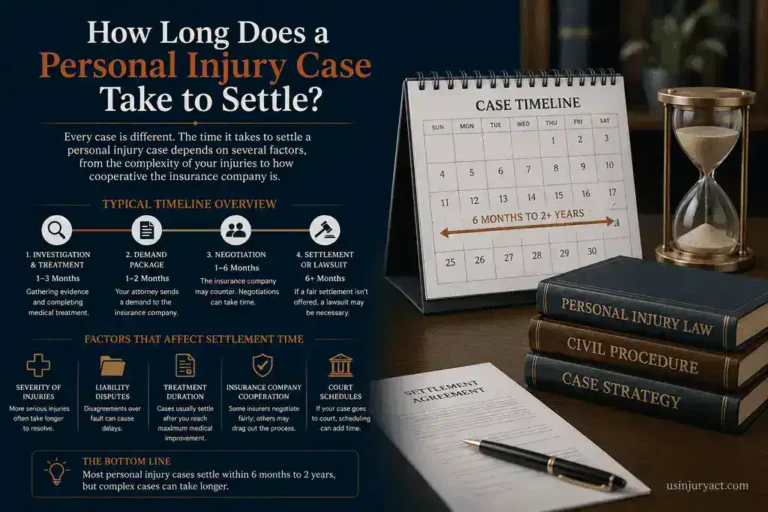
If you have been injured in an accident and you’ve hired an attorney, one question almost certainly keeps you up at night: how long does a personal injury case take to settle?
The honest answer is that there is no single timeline. Some cases resolve in a matter of weeks. Others take years. The difference comes down to factors you can control, factors you cannot, and the decisions you make throughout the process.
This article gives you a complete, realistic picture of the personal injury settlement timeline, from the day of your accident to the day you receive your check.
You will learn what drives the process, what stalls it, when you should push for settlement, and when patience serves your interests better.
The Foundation: Maximum Medical Improvement and Why It Controls Everything
The single most important concept in personal injury case timing is maximum medical improvement, commonly called MMI. This is the point at which your treating physicians determine that your condition has stabilized to the best it is likely to get, with or without further treatment.
Your attorney should not attempt to settle your case until you reach MMI, and you should resist any pressure to do so before that point. Here is why: until you reach MMI, your total damages are unknown. You do not yet know whether you will need future surgeries, ongoing physical therapy, pain management, or assistive devices.
If you settle before these needs are established, you will almost certainly accept far less than your injuries are worth, because the insurance company will exploit your uncertainty.
Once you reach MMI, your medical team can provide a clear prognosis. Your attorney can then work with life care planners and economic experts to calculate future damages with precision. That analysis forms the foundation of a demand letter that reflects the full scope of your losses.
Phase One: Investigation and Medical Treatment (Weeks to Many Months)
The first phase of a personal injury case begins immediately after your accident. It involves gathering evidence, preserving documents, and most importantly, getting the medical treatment you need.
Your attorney will send preservation letters to anyone who might have relevant records or footage. Police reports are obtained. Witness statements are taken. Accident reconstruction experts may be engaged. Subpoenas or records requests are sent to employers, medical providers, and electronic data sources.
During this phase, your primary obligation is to follow your doctor’s treatment plan consistently. Gaps in treatment are one of the most damaging things that can happen to a personal injury case.
Insurance adjusters and defense lawyers point to any missed appointments or unexplained gaps as evidence that your injuries were not as serious as you claim. Consistent treatment creates a clean medical record that tells the story of your injuries accurately.
This phase can last anywhere from a few weeks for minor soft-tissue injuries to 18 months or more for severe injuries requiring multiple surgeries and extended rehabilitation.
Broken bones, herniated discs, traumatic brain injuries, and burn injuries all require extended treatment timelines before MMI is reached.
Phase Two: Demand Letter and Initial Negotiations (Weeks to Months)
Once you reach MMI, your attorney compiles a comprehensive demand package. This document lays out your entire case: the facts of the accident, the applicable legal theories, the medical records and bills, expert opinions, wage loss documentation, and a detailed argument for the damages you deserve. The demand letter concludes with a specific dollar amount the attorney demands as settlement.
Insurance companies typically have 30 to 45 days to respond to a demand letter, though some take longer. The response is almost always a counteroffer well below your demand. The gap between your demand and the initial offer is where negotiations begin.
Simple, well-documented cases with modest injuries and clear liability can sometimes settle during this phase within two to four months after the demand is sent.
More complex cases with disputed liability, significant damages, or stubborn insurance companies will not resolve here. The negotiations stall, and your attorney will advise you that litigation is necessary to achieve a fair result.
Phase Three: Filing a Lawsuit and the Discovery Process (One to Three Years)
Filing a complaint in civil court does not mean your case will go to trial. The overwhelming majority of personal injury lawsuits filed in the United States settle before reaching a jury.
According to data compiled by the Department of Justice’s Bureau of Justice Statistics, approximately 95 percent of civil cases settle before trial.
Filing is often a strategic tool that changes the dynamics of negotiation by demonstrating your attorney’s commitment to pursuing full compensation.
After filing, the case enters discovery, a formal process during which both sides exchange evidence, take depositions of witnesses and experts, submit written interrogatories, and issue document requests. Discovery is time-consuming and can last a year or more in complex cases.
Depositions, in particular, are critical milestones. When your case is deposed and the defendant is deposed, both sides gain a clearer picture of how the case will look at trial.
If your deposition goes well, it often accelerates settlement. If weaknesses are revealed, those issues need to be addressed before settlement discussions can proceed productively.
Mediation: A Key Settlement Gateway
Most courts require parties to attempt mediation before proceeding to trial. Mediation is a structured negotiation facilitated by a neutral third party. A skilled mediator meets with each side, probes the strengths and weaknesses of each position, and works to bridge the gap between the parties.
A very high percentage of personal injury cases settle at or shortly after mediation. Even when mediation does not produce an immediate agreement, it often narrows the issues and sets the stage for final settlement negotiations.
Expect mediation to occur somewhere between 12 and 30 months after filing, depending on your court’s docket.
Phase Four: Trial (Rare, But Possible)
If your case does not settle, it goes to trial.
Trial is expensive, emotionally demanding, time-consuming, and carries inherent uncertainty. A jury that seemed sympathetic during selection might be skeptical of your experts. Verdicts can exceed your wildest expectations or fall short of what any reasonable person would call fair.
The decision to go to trial should be made collaboratively by you and your attorney, with clear-eyed analysis of the risks and benefits. Sometimes the defendant’s final offer is so inadequate that trial is the only path to justice. Other times, the risks of trial make a slightly lower settlement the wiser choice.
A full civil trial can take anywhere from two days to several weeks.
After the verdict, there may be post-trial motions and appeals that add months or even years to the final resolution. Factor all of these possibilities into your expectations.
Factors That Speed Up or Slow Down Settlement
Several variables have an outsized impact on how long your personal injury case takes to settle.
Severity of Injuries
The more serious your injuries, the longer your case typically takes. Catastrophic injuries require exended treatment, generate enormous damages, and are fought over aggressively by insurers. A case involving a traumatic brain injury or paraplegia can take three to five years or longer to resolve through litigation.
Clarity of Liability
When liability is crystal clear, such as a rear end collision with video evidence and a police report citing the defendant, settlement happens faster. Contested liability cases require more time to investigate, more expert witnesses, and more litigation before either side has the confidence to settle.
Insurance Company Behavior
Some insurance carriers operate in bad faith, deploying delay tactics to outlast injured claimants and depress settlements. Others evaluate claims fairly and settle reasonable cases promptly. Your attorney’s familiarity with the specific insurer’s practices can help predict and manage this factor.
Court Docket Congestion
Courts in major metropolitan areas are often severely congested. A case filed in a busy jurisdiction might not reach trial for three to four years but rural and suburban courts on the other hand often move faster.
The court’s scheduling practices will significantly influence your timeline if your case proceeds into litigation.
Timeline Scenarios: One Year Vs Five Years Case
One Year Scenario
A man is rear-ended at a stop sign and suffers soft-tissue neck and back injuries. He completes physical therapy within four months, reaches MMI, and has no permanent impairment. His attorney sends a demand letter, the insurer counters, and the parties reach an agreement within six months of the accident. Total timeline: under one year.
Five Years Scenario
A woman suffers a severe spinal fracture in a premises liability accident. She requires spinal fusion surgery, spending two years in recovery before reaching MMI. Her attorney files suit against the property owner, and extensive discovery takes 14 months. Mediation is unsuccessful.
The case goes to trial three and a half years after the accident, resulting in a substantial jury verdict. The defense appeals, adding another 14 months before the award is finalized and paid. Total timeline: nearly five years.
Conclusion: How Long Does a Personal Injury Case Take to Settle
How long a personal injury case takes to settle depends on the severity of your injuries, the clarity of liability, the conduct of the insurance company, and the efficiency of the court system. Minor cases with clear liability can resolve within months. Catastrophic injury cases may take years of litigation to achieve the full compensation you deserve.
The best thing you can do is follow your medical treatment plan, cooperate fully with your attorney, and resist the temptation to settle too early for too little. Patience, combined with strategic and aggressive representation, consistently produces better results than rushing to close a case before your full losses are known.