If you were injured in a car accident in Los Angeles, the question of how much time you have to pursue legal action is not a formality. It is a hard legal deadline that, if missed, ends your ability to seek compensation permanently, regardless of how serious your injuries are or how clearly the other driver was at fault.
The deadline to file a car accident lawsuit in Los Angeles is called the statute of limitations, and every Los Angeles car accident victim needs to know exactly how it works.
This article covers California’s statute of limitations for car accident lawsuits in detail, explains every exception and special circumstance that might shorten or extend your window, and gives you a clear picture of the real-world consequences of waiting too long to act.
California’s General Statute of Limitations for Car Accident Claims
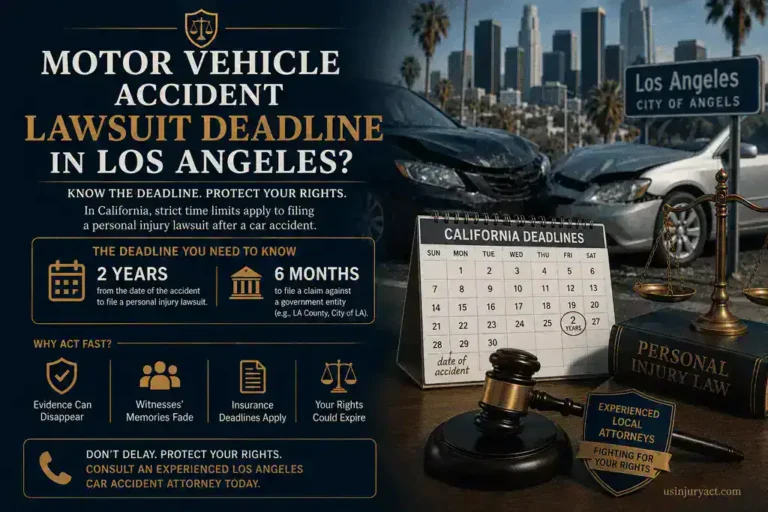
Under the California Code of Civil Procedure Section 335.1, the statute of limitations for personal injury claims, including those arising from car accidents, is two years from the date of the injury. This means you have two years from the date of your Los Angeles car accident to file a lawsuit in the appropriate court against the at-fault party.
If you miss this two-year deadline, the defendant will almost certainly file a motion to dismiss your case.
California courts will grant that motion with extremely rare exceptions. Your claim will be permanently barred, and no amount of compelling evidence, serious injury, or sympathetic circumstances will revive it.
Two years may sound like a long time. Accident victims frequently discover that it passes faster than expected, particularly when they are focused on medical treatment, returning to work, and managing the disruption to their daily lives.
The Separate Deadline for Property Damage Claims
If your car accident caused only property damage and no personal injury, the applicable statute of limitations is different. California Code of Civil Procedure Section 338 provides a three-year limitations period for property damage claims.
So if you are seeking only vehicle repair or replacement costs and no bodily injury compensation, you have an extra year.
In practice, most significant car accident cases involve both personal injury and property damage. The shorter two-year personal injury deadline controls. Do not let the three-year property damage window create a false sense that you have additional time for your full claim.
Claims Against Government Entities: A Much Shorter Deadline
If your accident involved a government-owned vehicle, a government employee driving on duty, or a dangerous road condition that a government entity failed to maintain, your deadlines are drastically shorter and the process is fundamentally different.
Under the California Government Claims Act, before you can sue any California state or local government entity, including the City of Los Angeles, Los Angeles County, or Caltrans, you must file an administrative government claim first. This administrative claim must be filed within six months of the date of the accident.
If the government denies your claim or fails to respond within 45 days, you then have six months from the rejection to file your lawsuit in court. If the government accepts the claim and offers compensation, you can choose to negotiate or proceed to litigation.
If a government vehicle or a road defect contributed to your Los Angeles car accident, you have only six months to file your administrative claim. If you miss this window, your entire case against the government will be lost.
Identifying government liability is not always straightforward. A pothole, a malfunctioning traffic signal, inadequate signage, or a road design defect can all create government liability.
An experienced personal injury attorney will investigate your crash for government involvement as a standard step, not an afterthought.
Special Rules for Minors Injured in Car Accidents
When the accident victim is a minor, meaning under 18 years of age at the time of the crash, California law provides a special tolling provision. The two-year statute of limitations does not begin to run until the minor turns 18. This means a child injured in a car accident at age 10 theoretically has until age 20 to file a personal injury lawsuit.
However, this tolling provision does not apply to claims against government entities. If a minor’s accident involved government liability, the six-month government claim deadline applies regardless of the victim’s age.
Parents and guardians of injured children should not delay in consulting an attorney about claims involving any potential government involvement.
Additionally, while tolling preserves the minor’s legal rights, early action remains strongly advisable because evidence deteriorates, witnesses relocate and become unavailable, and surveillance footages gets overwritten with time.
Building a strong case years after an accident is far more difficult than doing so promptly.
The Discovery Rule: When Does the Clock Start?
In most car accident cases, the statute of limitations begins to run on the date of the crash, because the injury and its cause are immediately apparent. However, California recognizes a legal doctrine called the discovery rule, which delays the start of the limitations period in cases where the injury was not immediately discoverable.
The discovery rule provides that the statute of limitations begins to run when the plaintiff discovered, or reasonably should have discovered, the injury and its connection to the defendant’s conduct.
The doctrine most often arises in cases involving latent injuries, such as a traumatic brain injury whose symptoms emerge gradually, or cases where a misdiagnosis initially prevented the victim from connecting their health problems to the accident.
A Realistic Application of the Discovery Rule
Consider a Los Angeles resident who is rear-ended in moderate-speed traffic. She feels shaken at the scene but has no obvious injuries. Over the following months, she experiences persistent headaches, cognitive difficulties, and memory problems.
She attributes these symptoms to stress until, fourteen months after the crash, a neurologist diagnoses her with a mild traumatic brain injury directly caused by the accident impact.
Under a strict ‘date of accident’ rule, her two-year window would have started running the day of the crash. Under California’s discovery rule, she can argue that her limitations period began running at the point of diagnosis, since that is when she discovered her injury and its cause.
Whether a court accepts this argument depends on the specific facts and the persuasiveness of her medical evidence. This is precisely the kind of nuanced legal argument that requires skilled representation.
Tolling for Defendant’s Absence or Concealment
California law also tolls the statute of limitations in certain circumstances where the defendant is unavailable to be served or has concealed themselves.
Under California Code of Civil Procedure Section 351, if the defendant is absent from California for a period of time after the cause of action arises, that period of absence does not count toward the limitations period.
Similarly, if a defendant fraudulently conceals their identity or involvement in an accident, the limitations period may be tolled until the plaintiff discovers or reasonably should have discovered the defendant’s identity. This provision is relevant in hit-and-run cases where identifying the at-fault driver takes time.
Why Waiting Until the Last Minute Is Dangerous
Many accident victims make the mistake of assuming that because they have two years, they can wait to pursue their claim. This is one of the most damaging misconceptions in personal injury law. The reasons to act promptly are practical, not just procedural.
Evidence Disappears Quickly
Surveillance camera footage from businesses, traffic cameras, and dashcams is typically overwritten within days to weeks. Skid marks on the road surface fade or are obliterated by weather and traffic. Witnesses forget details, move away, or become difficult to locate. The physical condition of the vehicles changes once repairs are made. Every day of delay puts valuable evidence at greater risk.
Medical Records Must Be Connected to the Accident
Building a strong personal injury claim requires establishing a clear causal chain between the accident and your injuries. This is easier when treatment begins promptly and medical records document the progression of your injuries from the date of the crash forward.
Gaps in treatment, delayed diagnosis, or long intervals between the crash and initial medical evaluation all create arguments for insurers and defense attorneys that your injuries were pre-existing or unrelated to the accident.
Insurance Negotiations Take Time
Most car accident cases resolve through insurance negotiation rather than trial. This process involves demand letters, back-and-forth negotiation, requests for additional documentation, and often multiple rounds of offers and counteroffers. Experienced attorneys typically do not rush this process, because patience produces better settlements.
However, this negotiation must take place with enough runway before the statute of limitations expires to allow for litigation if negotiations fail. Retaining an attorney with only weeks remaining before the deadline leaves virtually no negotiating leverage.
What Happens If You File a Lawsuit Just Before the Deadline?
Filing a lawsuit with the statute of limitations clock nearly expired is not ideal, but it does preserve your legal rights. The key is that the lawsuit must be filed, meaning the complaint must be submitted to the appropriate court and the filing fees paid, before the deadline expires.
Service of process on the defendant can come shortly afterward in most cases.
In Los Angeles, car accident lawsuits are generally filed in Los Angeles Superior Court. The specific courthouse depends on where the accident occurred, where the defendant resides, or where the plaintiff resides.
An attorney familiar with the Los Angeles court system will know the appropriate venue and the fastest way to get your complaint on file.
The Practical Timeline: Why Two Years Fills Up Faster Than You Expect
- Month one: emergency treatment, diagnostic imaging, initial recovery.
- Month two and three: follow-up appointments, specialist consultations, physical therapy begins.
- Month four through six: reaching maximum medical improvement or ongoing treatment, beginning to understand the full extent of permanent impairment.
- Month six: retaining an attorney, investigation begins, accident reconstruction engaged if needed.
- Month seven through twelve: attorney gathers all medical records, bills, employment records, and builds demand package.
- Month thirteen through eighteen: demand letter sent, negotiations with insurer begin.
- Month nineteen through twenty-one: negotiations may continue or break down. If no settlement, attorney files lawsuit.
- Month twenty-two through twenty-four: lawsuit filed, defendant served, litigation begins.
This timeline illustrates why two years is not as generous as it first appears. Work through each phase carefully and the deadline arrives with urgency. Start late and you compress the entire process, weakening your negotiating position and your case.
In A Nutshell
The statute of limitations for a car accident lawsuit in Los Angeles is generally two years for personal injury claims, but exceptions and special circumstances can significantly alter this timeline, sometimes extending it and sometimes shortening it dramatically.
Claims involving government entities require action within six months. Claims involving minors have special tolling rules. The discovery rule may apply in latent injury cases.
The safest approach after any serious car accident in Los Angeles is to consult with a personal injury attorney as soon as possible after receiving necessary medical attention as it protects your legal rights, maximizes your ability to build a strong case, and ensures that procedural deadlines never become the reason you lose a case you deserved to win.