If you have been involved in an accident or injured at work and are pursuing a personal injury or workers’ compensation claim, few medical terms will shape your case. Amongst them is the MMI which stands for maximum medical improvement.
What Is MMI In Personal Injury And Workers Compensation Claim?
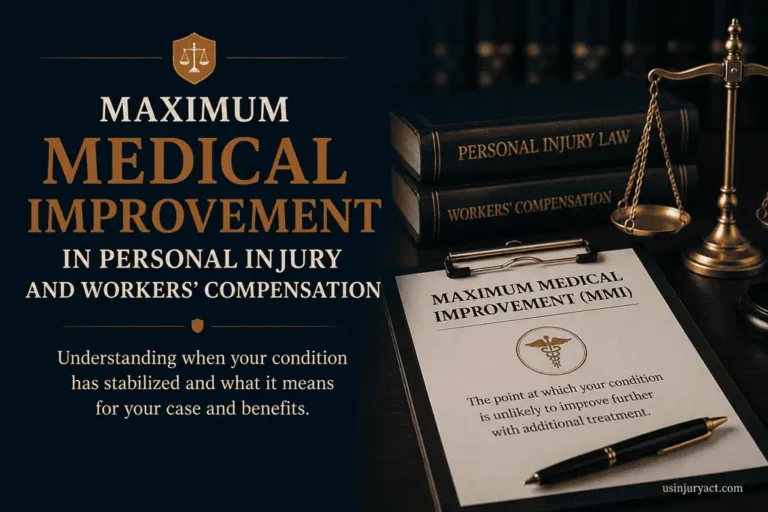
Maximum medical improvement – MMI in personal injury or workers’ compensation is the point at which your treating physician determines that your condition has stabilized and is unlikely to improve further with continued medical treatment.
It does not mean you are fully healed. It means your recovery has plateaued, and any remaining symptoms or limitations are expected to be permanent or long-term.
Insurance adjusters, defense attorneys, and courts all pay close attention to when you reach MMI because this milestone directly influences how much your claim is worth.
Until you hit this threshold, the full scope of your damages is often unknown. Settling too early, before MMI is reached, can cost you tens of thousands of dollars or more.
This article breaks down exactly what MMI means, how it is determined, how it affects every category of your compensation, and what strategic decisions you need to make around this milestone.
How Maximum Medical Improvement Is Determined
The Role of Your Treating Physician
Your attending physician or a specialist involved in your care makes the MMI determination based on a clinical evaluation of your progress over time. The doctor reviews your diagnostic imaging, treatment history, response to therapy, and current functional limitations.
Once the physician concludes that additional treatment will not result in meaningful improvement, they document MMI in your medical records and often issue a formal impairment rating.
In some cases, the defense or the insurance company will request an Independent Medical Examination. This is where a doctor chosen by the opposing party evaluates you and issues their own MMI opinion.
These IME doctors are frequently paid by insurance carriers and may reach MMI conclusions faster or at lower impairment ratings than your own treating physician.
Having an experienced personal injury attorney who knows how to challenge IME findings is critical when this happens.
Impairment Ratings and Their Role
After MMI is reached, your physician often assigns a whole person impairment rating, expressed as a percentage. This rating follows guidelines published by the American Medical Association in its Guides to the Evaluation of Permanent Impairment.
A 15% whole person impairment for a spinal injury, for example, tells courts, insurers, and attorneys how significantly your body has been permanently affected.
This number feeds directly into calculations for permanent disability compensation and future medical costs.
Why MMI Is a Critical Turning Point in Your Personal Injury Claim
Before MMI, your medical situation is still evolving. Settling before this point means you are accepting compensation based on incomplete information. Once you settle, you cannot reopen the claim if your condition worsens or new complications arise.
Many injury victims who settle too early discover years later that they needed additional surgeries, chronic pain management, or long term rehabilitation that was never accounted for in their settlement.
After MMI, however, your legal team and medical experts can calculate the full picture: what you have already lost, what you will continue to lose, and what your future care will cost. This is when building maximum compensation becomes possible.
How MMI Affects Each Category of Personal Injury Damages
Medical Expenses: Past and Future
Once MMI is established, your attorney works with medical professionals and life care planners to project your future medical needs.
If you have reached MMI with a permanent lumbar spine injury, you may need pain management appointments, physical therapy sessions, prescription medications, and possibly additional surgical procedures over your lifetime.
These projected costs are documented and presented as part of your damages claim.
Without MMI, these future costs are speculative. After MMI, they are calculable and legally recoverable.
A strong demand package submitted after MMI will include a life care plan that outlines the cost of your ongoing care in detail, often backed by expert testimony.
Lost Wages and Loss of Earning Capacity
If your injuries affect your ability to work, MMI becomes the foundation for calculating wage-related damages. Before MMI, you may only recover wages already lost. After MMI, if you have a permanent condition that limits your ability to perform your job or work at your previous capacity, you can claim loss of future earning capacity.
This can be one of the largest components of a personal injury verdict.
For example, a construction worker who reaches MMI with a 30% permanent impairment of his dominant arm may no longer be able to perform his trade.
A vocational expert and an economist can calculate the difference between what he would have earned over his remaining work life and what he can now realistically earn, producing a quantified economic loss figure that can run into hundreds of thousands of dollars.
Pain and Suffering After MMI
Non-economic damages such as pain and suffering, loss of enjoyment of life, and emotional distress are also shaped by MMI. When a physician formally documents that your pain and limitations are permanent, the value of these damages increases substantially. A temporary injury that heals fully carries far less non-economic value than one that leaves you with chronic pain, scarring, or permanent functional loss.
Courts and juries are instructed to consider the duration of suffering when awarding non-economic damages. A permanent condition means a lifetime of suffering, and that is reflected in trial verdicts and settlement negotiations after MMI is established.
MMI in Practice
Scenario One: The Premature Settlement Trap
Maria is injured in a rear end collision and suffers a herniated disc at L4-L5. Three months after the accident, the at-fault driver’s insurer offers her $45,000. Her pain has improved somewhat with physical therapy, but she has not yet reached MMI.
She accepts the offer, not realizing that surgery is forthcoming. Six months later, her condition deteriorates, and she requires a spinal fusion costing $85,000. Because she settled before MMI, she has no recourse. Her case is closed.
Had she waited until MMI was confirmed and the need for surgery was established, her case value would have exceeded $300,000 when accounting for the surgery, recovery, lost wages, and permanent functional limitations.
Scenario Two: Maximum Recovery After MMI
James is a 42-year-old software engineer injured in a slip and fall at a commercial property. He sustains a shoulder injury requiring rotator cuff surgery. His treatment continues for 14 months before his orthopedic surgeon declares MMI with a 20% permanent impairment of the shoulder.
His attorney retains a life care planner who projects $180,000 in future medical costs and an economist who calculates $220,000 in diminished earning capacity based on James’s limitations with prolonged computer work.
His total settlement, reached after MMI, is $680,000.
MMI in Workers’ Compensation vs. Personal Injury Cases
MMI appears in both personal injury and workers’ compensation contexts, but it functions differently in each. In workers’ compensation, MMI triggers the shift from temporary disability benefits to permanent disability ratings, which determine your final benefit award. The process is heavily regulated and often limits your recovery to a schedule of benefits regardless of your actual losses.
In personal injury tort claims, MMI is not governed by a statutory schedule. Your attorney can argue for the full economic and non-economic impact of your permanent condition without the caps that workers’ compensation systems impose.
This is one reason why workers injured through third-party negligence are often advised to pursue both a workers’ comp claim and a personal injury lawsuit simultaneously.
Challenging an Unfair MMI Determination
If the defense’s IME doctor declares MMI prematurely or assigns a low impairment rating, your attorney has several tools to fight back.
- First, your own treating physician’s opinion carries significant weight and may be used to rebut the IME findings.
- Second, second opinions from qualified specialists can be obtained to support your position.
- Third, in litigation, your attorney can depose the IME doctor and expose the financial relationship between that doctor and the insurance carrier, which can undermine the credibility of their findings before a jury.
Courts have repeatedly recognized that IME doctors hired by insurance companies have an inherent incentive to minimize claims.
An experienced personal injury attorney knows how to use this dynamic to your advantage.
Strategic Decisions You Must Make Around MMI
The decision of when to pursue settlement negotiations relative to MMI is one of the most strategically important choices in your case.
In general, you should not accept any settlement offer until you have reached MMI and your full damages picture is clear. The only exception is if your case involves a defendant with limited insurance coverage and the medical evidence of permanence is already compelling before formal MMI is declared.
Your attorney should also be communicating regularly with your treating physicians to ensure MMI documentation is thorough, timely, and strategically useful.
Medical records are legal documents in a personal injury case. How your physician documents your condition, your complaints, your functional limitations, and your prognosis will influence the outcome of your claim as much as the legal arguments your attorney makes in court.
Maximum Medical Improvement
Maximum medical improvement is not just a medical milestone. It is the foundation upon which the true value of your personal injury claim is built.
Reaching MMI before settling ensures that every category of your damages, from future medical costs to permanent pain and suffering, is fully documented and recoverable. Settling before MMI is one of the most costly mistakes an injury victim can make.
If you have been seriously injured, work with a qualified personal injury attorney from the beginning of your case and commit to reaching MMI before entertaining any settlement offers. The difference in recovery can be life changing.