If you’ve been hurt on someone elses property and were told that you should have seen it coming, you have likely encountered the open and obvious defense. This legal doctrine is one of the most commonly used tools property owners and their insurers deploy to escape financial responsibility after someone gets injured on their premises.
Knowing how this defense works, when courts accept it, and when it fails can make or break your premises liability case.
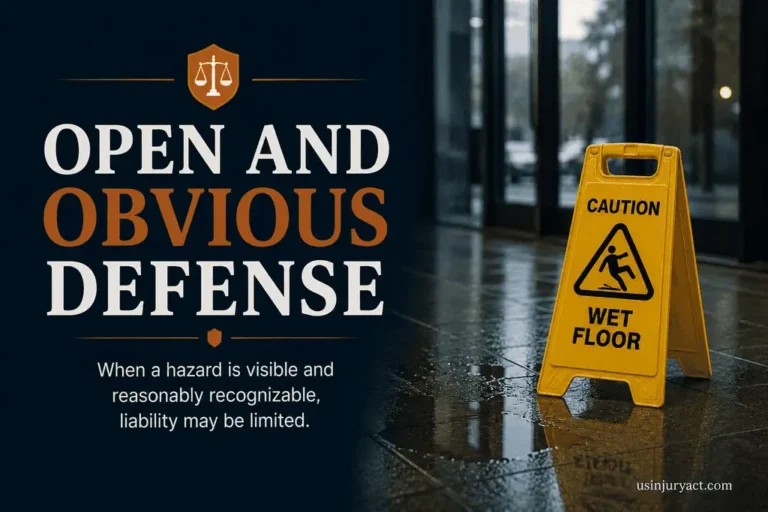
The open and obvious defense essentially argues that a dangerous condition on the property was so visible and apparent that any reasonable person would have noticed it and taken steps to avoid it. If that standard is met, the property owner claims they had no duty to warn you or fix the hazard because you should have protected yourself.
This is a post for a quick breakdown of the open and obvious doctrine in precise legal detail, including which states apply it most aggressively, and the critical exceptions that allow injured victims to recover compensation even when a hazard appeared visible.
The Legal Foundation of the Open and Obvious Defense
Premises liability law requires property owners to maintain reasonably safe conditions for visitors. The specific duty of care owed depends on the visitor’s status, which courts typically classify as invitee, licensee, or trespasser. Invitees, such as customers in a retail store, receive the highest level of protection. Property owners must inspect their premises and repair or warn about known hazards.
The open and obvious doctrine carves out an exception to that duty. The Restatement (Second) of Torts, Section 343A, which many states have adopted, provides that a property owner is not liable for physical harm caused to invitees by a condition that is known or obvious unless the owner should anticipate harm despite the obvious nature of the condition.
The key phrase here is “should anticipate harm despite the obvious nature.” Courts have debated this language for decades. Some states interpret it narrowly, giving property owners strong protection the moment a hazard appears visible. Other states weigh whether the landowner had reason to believe that even a careful person might fail to avoid the danger.
What Makes a Condition “Open and Obvious”
A condition is legally open and obvious when a person exercising reasonable care and ordinary attention to their surroundings would recognize both the condition and the potential risk it creates. The test is objective, meaning courts do not ask what you personally noticed. They ask what a reasonable person in the same situation would have observed.
Courts have found the following types of conditions to be open and obvious in various cases:
- A snow-covered parking lot with visible ice patches
- A raised door threshold at a business entrance
- Construction materials or debris on a job site that workers could plainly see
- A swimming pool with no diving board but a shallow depth marking
- Wet floor areas near known water sources like produce misters in grocery stores
However, the obvious nature of a hazard is not always as straightforward as it appears. Courts frequently examine whether distractions, poor lighting, or other conditions made a technically visible hazard effectively invisible to a reasonable person.
States That Most Aggressively Apply the Open and Obvious Defense
Florida
Florida courts have applied the open and obvious defense in slip and fall cases for decades. Under Florida law, when a hazard is deemed open and obvious, it can negate the property owner’s duty to warn or remedy.
However, Florida’s adoption of comparative negligence means that even if a hazard is open and obvious, courts can still apportion some fault to the property owner if they created the condition.
The Florida Supreme Court’s decision in Rocamonde v. Marshalls of MA, Inc., and subsequent decisions, confirm that obviousness goes to comparative fault rather than completely eliminating the owner’s duty in all situations.
Ohio
Ohio is one of the stricter states in applying the open and obvious doctrine. Ohio courts have repeatedly held that an open and obvious danger relieves the landowner of any duty to warn.
The Ohio Supreme Court in Armstrong v. Best Buy Company, Inc., 2003, made clear that the doctrine serves as a complete bar to negligence claims if the condition was open and obvious. This makes Ohio a particularly difficult jurisdiction for injured plaintiffs when the hazard was visible.
Texas
Texas applies the open and obvious defense within its premises liability structure. Texas courts distinguish between conditions and activities on property.
For conditions, if the hazard is open and obvious, the property owner may have no duty to warn. Texas courts have cited the Restatement framework extensively, and while comparative fault principles apply, an obvious condition can significantly limit a defendant’s liability exposure.
Illinois
Illinois has incorporated the open and obvious rule into premises liability law, often finding that property owners owe no duty to warn of obvious conditions.
However, Illinois courts recognize the deliberate encounter exception, meaning that even if a condition is obvious, property owners may still be liable when they know that visitors will likely proceed despite the risk.
New York
New York courts apply the open and obvious doctrine but balance it with the property owner’s ongoing duty to maintain safe premises.
New York’s comparative negligence system allows recovery even when the injured party bears some fault. Courts scrutinize whether the hazard was truly open and obvious or merely a condition that someone could have noticed if they were paying maximum attention.
The Exceptions That Can Override the Open & Obvious Defense
The Distraction Exception
One of the most powerful tools for overcoming the open and obvious defense is the distraction exception.
Courts recognize that a hazard may technically be visible yet still dangerous because the property owner created conditions that diverted the visitor’s attention.
A retail store that places attractive merchandise displays near a wet floor, for instance, may not successfully invoke the open and obvious defense if the display was designed to capture customer attention.
The distraction exception appears in numerous state court decisions and aligns with the Restatement’s recognition that property owners must anticipate harm when they have reason to believe visitors will be distracted.
The Deliberate Encounter Exception
The deliberate encounter exception applies when a property owner knows that a visitor will likely proceed past an obvious hazard due to economic necessity or other compelling reasons.
Courts have applied this exception most often in employment contexts, where an employee has no practical choice but to confront a known danger in order to do their job.
Suppose a delivery worker must carry packages through a known icy path to complete a delivery.
Even if the ice is visible, the property owner may still be liable because they could reasonably foresee that the worker would encounter the hazard regardless of its obviousness.
The Negligent Design or Creation Exception
A property owner who negligently designs or constructs a feature of the property cannot always escape liability simply because the resulting danger is obvious.
Courts in multiple jurisdictions have held that when the defendant is responsible for creating the dangerous condition, the open and obvious doctrine does not automatically bar recovery.
The rationale is that a property owner should not profit from their own negligence in creating a hazard.
How Comparative Negligence Affects the Defense
Many states have moved toward comparative negligence systems, which allow courts to divide fault between the property owner and the injured party. In these jurisdictions, the open and obvious defense does not result in a complete dismissal of a claim.
Instead, a jury may determine that the injured person was, for example, 40 percent at fault for failing to avoid a visible hazard while the property owner was 60 percent at fault for failing to remedy or warn about the condition.
Pure comparative fault states like California and New York allow plaintiffs to recover even if they are more than 50 percent at fault.
Modified comparative fault states like Texas and Colorado bar recovery when the plaintiff’s fault exceeds 50 or 51 percent. Understanding which system governs your state is essential to evaluating the strength of your premises liability claim.
Retail Store Wet Floor As An Instance
Imagine a grocery store that has a produce section near the entrance. The store uses overhead misters that regularly drip onto the floor tile. A customer walks in on a busy Saturday morning when the main entrance is crowded. A promotional display at eye level draws customers’ attention away from the floor andthe customer slips on a puddle of water that has accumulated near the misting system.
The store’s insurer argues the wet floor was open and obvious because the misters were visible and running. The customer’s attorney counters that the promotional display created a distraction, the store created the very condition that caused the fall through its misting system, and that reasonable customers could not realistically look at the floor and the display simultaneously in a crowded entrance.
This type of scenario illustrates why the open and obvious defense is rarely the end of the story. Courts look at the full picture, not just whether the condition was technically visible.
What Property Owners Must Do Despite the Defense
Even when property owners believe a condition is open and obvious, prudent risk management requires taking action because reasonable remediation of hazards, even obvious ones, demonstrates good faith and reduces liability exposure.
Property owners who identify a potential hazard and do nothing may find that a jury views their inaction unfavorably even if the condition would otherwise qualify as open and obvious.
Warning signs, barriers, and prompt repair remain best practices for property owners regardless of how visible a condition appears.