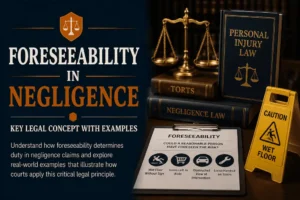
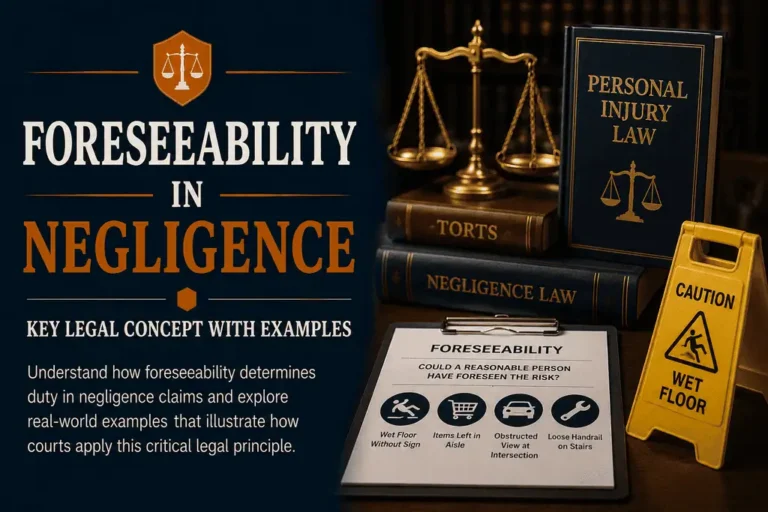
Foreseeability in negligence is the legal doctrine that determines how far a defendant’s responsibility extends after a negligent act. If a court finds that a reasonable person could not have anticipated the type of harm that occurred, the defendant may escape liability entirely, even if their conduct was careless.
If foreseeability is present, the defendant is potentially liable for all damages that flow from the foreseeable risk. This concept sits at the heart of nearly every personal injury claim in the United States, shaping both the duty of care a defendant owes and the proximate cause analysis that limits or expands liability.
If you want to evaluate the strength of a negligence claim, you must start with foreseeability, and this guide explains precisely how courts analyze it, where it becomes contested, and how it has been applied in high-stakes litigation across the country.
The Role of Foreseeability in the Four Elements of Negligence
Negligence law requires a plaintiff to establish four elements: duty, breach, causation, and damages. Foreseeability appears in at least two of these elements, and its influence can be felt in the others.
In the duty analysis, courts ask whether the defendant owed a legal duty of care to the plaintiff. The primary method for answering this question is foreseeability:
Was the plaintiff a foreseeable victim of the defendant’s negligent conduct?
This is the so-called zone of danger inquiry, developed most famously in Palsgraf v. Long Island Railroad Co. as far back as 1928, in which Judge Benjamin Cardozo held that duty extends only to those plaintiffs whose injury could reasonably be anticipated.
In the proximate cause analysis, courts use foreseeability again to decide whether the specific type of harm that occurred was within the general range of risks created by the defendant’s negligence.
Even if the defendant owed a duty to the plaintiff and breached it, liability only attaches to harms that were reasonably foreseeable at the time of the negligent act.
This dual application makes foreseeability in negligence arguably the most far-reaching concept in American tort law.
Recommended: Actual cause vs. proximate cause with examples
How Courts Define “Foreseeable”
Courts consistently define foreseeability by reference to the reasonable person standard. A harm is foreseeable if a reasonably prudent person in the defendant’s position, at the time of the act or omission, could have anticipated that their conduct created a risk of that type of harm to that type of plaintiff.
Courts are careful to emphasize that foreseeability does not require predicting the exact injury or the precise sequence of events. The Restatement (Third) of Torts makes clear that liability extends to all injuries within the scope of the risk, meaning the general category of harm that made the defendant’s conduct negligent in the first place.
If a defendant’s negligence creates a risk of physical injury, any physical injury of the type that risk contemplated is foreseeable, even if the specific mechanism of injury was slightly unusual.
The Reasonable Person as the Foreseeability Meter
The reasonable person in foreseeability analysis is not an actual person but an objective legal standard. Courts ask what a typical, prudent adult with ordinary knowledge and judgment could have anticipated.
This standard is not adjusted for the defendant’s personal beliefs, ignorance, or unusual characteristics, unless the defendant possesses professional expertise, in which case they are held to the foreseeability standard of a professional in their field.
A surgeon, for example, is held to the foreseeability standard of a reasonable surgeon, not merely a reasonable layperson. A commercial truck driver is held to the foreseeability of a trained professional driver. This professional foreseeability standard is critically important in medical malpractice, professional negligence, and premises liability cases involving commercial operators.
Foreseeability and Duty of Care: How Courts Decide Who Is Owed Protection
Not every person in the world is owed a duty of care by every actor. Foreseeability limits the scope of duty to those who are reasonably at risk from the defendant’s conduct. Courts across the U.S. use several tests to define foreseeable plaintiffs.
The Cardozo test, dominant in New York and broadly influential nationwide, limits duty to plaintiffs within the foreseeable zone of danger.
The Andrews test, from the dissent in Palsgraf, holds that duty extends to the world at large, and foreseeability limits only proximate cause.
California has adopted a broad foreseeability-based duty test articulated in Rowland v. Christian in 1968, requiring courts to weigh foreseeability of harm against the burden of imposing a duty and the policy consequences of doing so.
Texas applies a relationship-based duty analysis supplemented by foreseeability factors under cases like Nabors Drilling v. Escoto of 2009
Florida, Illinois, Pennsylvania, Ohio, Georgia, and most other states apply similar foreseeability-based duty analyses with subtle jurisdictional variations in how broadly or narrowly they define the class of foreseeable plaintiffs.
These differences can make or break a claim depending on where your accident occurred and who was harmed.
Foreseeability in Proximate Cause Analysis
Once a duty is established, foreseeability does its second major job in the proximate cause determination. Even if the defendant clearly owed a duty to the plaintiff and breached it, liability does not extend to every possible harm that follows.
Proximate cause limits liability to harms that were reasonably foreseeable consequences of the negligent act.
Courts apply the “scope of the risk” test derived from the Restatement (Third) to ask whether the harm that materialized was of the same general type as the risk that made the defendant’s conduct negligent.
If a landlord negligently fails to install smoke detectors and a fire kills a tenant, the death is within the scope of the risk created by the absence of a smoke detector. But if the same landlord’s failure to install smoke detectors caused a maintenance worker to trip on the uninstalled detector left on the floor, the tripping injury may or may not be within the scope of the risk, depending on how broadly or narrowly the court defines the foreseeable risk.
Foreseeability and Intervening Causes
When a third party’s act or a natural event intervenes between the defendant’s negligence and the plaintiff’s injury, foreseeability determines whether the intervening act breaks the chain of proximate liability.
A foreseeable intervening cause does not relieve the original defendant of liability. An unforeseeable intervening cause, called a superseding cause, does break the chain.
More about intervening and superseding causes under actual vs proximate cause
The foreseeability of third-party criminal conduct is one of the most litigated sub-issues in this area. Property owners, businesses, and security companies face liability when criminal attacks on their premises are foreseeable.
Courts ask whether prior similar incidents, the nature of the property, or other circumstances put the defendant on notice that criminal conduct was a foreseeable risk. This is the cornerstone of negligent security litigation in states like Florida, Georgia, Texas, and New York.
Example: Foreseeability in Negligent Security Litigation
A hotel in a high-crime area has experienced three armed robberies in its parking garage over the prior 18 months. The hotel’s management is aware of these incidents through police reports but declines to install security cameras or hire a security guard. A guest is subsequently robbed and physically assaulted in the same garage.
A court analyzing this case would likely find that the criminal attack was foreseeable given the documented history of similar crimes on the property. The hotel’s failure to implement reasonable security measures is both a breach of duty and a proximate cause of the guest’s injury because the type of harm that occurred was squarely within the foreseeable risk the hotel failed to address.
Critical Distinction Between Foreseeability And Probability
Many people confuse foreseeability with probability. These are not the same concepts, and confusing them leads to serious errors in legal analysis.
Foreseeability means that a type of harm was a recognizable possibility, not that it was likely or even common.
A harm does not need to be probable to be foreseeable, it only needs to be the kind of harm that a reasonable person would recognize as a possible consequence of their conduct.
This is why courts have found liability in cases involving unusual or unlikely chains of events, as long as the general type of harm was foreseeable. A rare allergic reaction to a negligently administered medication may be statistically improbable but still legally foreseeable if a reasonable physician would know such reactions exist.
A freak accident caused by a structural defect that rarely causes injuries is still foreseeable if the defect created an identifiable risk of that type of accident.
Foreseeability in Product Liability Cases
Product liability law integrates foreseeability in the design defect analysis. Under the risk-utility test adopted by many states, courts weigh the foreseeable risks of a product design against its utility.
A design is defective if the foreseeable risks of harm could have been reduced by a reasonable alternative design.
The consumer expectations test, used in California and other states, asks whether the product’s danger exceeded what the ordinary consumer would have anticipated.
This is fundamentally a foreseeability inquiry of what risks a reasonable consumer would anticipate, and if the product’s actual behavior fall outside those anticipated risks?
The National Highway Traffic Safety Administration’s vehicle safety standards are partly built around foreseeable crash scenarios and foreseeable injury patterns.
Example: Foreseeable Misuse in Products Liability
A power tool manufacturer designs a saw without a blade guard. The manufacturer argues that the guard was unnecessary because the product was labeled for professional use only. A homeowner purchases the saw through a retail store and is seriously injured when the unguarded blade contacts her hand.
Courts in California, Texas, and New York have always held that selling power tools through retail channels makes foreseeable use by non-professionals a question the manufacturer must address in its design.
The foreseeable misuse doctrine holds manufacturers liable when they can anticipate that consumers will use products in ways different from the intended purpose, if that misuse is a recognizable possibility.
Foreseeability Across U.S. Jurisdictions: Key Variations
While foreseeability is a universal element of negligence law in all 50 states and Washington D.C., its precise application varies meaningfully across jurisdictions.
California applies a broad foreseeability-based duty test under Rowland v. Christian (1968), weighing multiple policy factors including the foreseeability of harm, the closeness of the connection between the defendant’s conduct and the injury, and the moral blame attached to the defendant’s conduct.
New York uses the Palsgraf zone of danger test, limiting duty and proximate cause to foreseeable plaintiffs within the range of apprehensible danger.
Texas takes a relationship-centric approach supplemented by foreseeability as articulated in Nabors Drilling, USA, Inc. v. Escoto (Tex. 2009), requiring both a legal relationship or special circumstance and foreseeable harm before imposing a duty.
Florida applies foreseeability broadly in negligence claims, particularly in premises liability cases governed by the 2010 amendments to Florida Statutes Section 768.0755, which restored the traditional foreseeability standard for slip-and-fall cases in commercial establishments.
Illinois, Pennsylvania, Ohio, Michigan, and Georgia all apply the reasonable foreseeability standard to both duty and proximate cause, with variations in how courts treat professional duty cases, negligent entrustment, and third-party criminal acts.
Foreseeability in negligence is not a peripheral concept in negligence law but a threshold question that determines whether a claim can succeed at all, and it runs through both the duty analysis and the proximate cause determination in every negligence case.
Courts use it to balance the legitimate interest of injured plaintiffs in compensation against the equally legitimate interest of defendants in not being held responsible for every conceivable consequence of their actions.