Most personal injury victims know they have a limited time to file a lawsuit, but far fewer know what happens when an injury is not immediately apparent.
The delayed discovery rule, also called the discovery rule or the discovery doctrine, is one of the most significant exceptions to the standard statute of limitations in American tort law. It protects injured people who had no reasonable way of knowing they were hurt, or no way of knowing that someone else caused the harm, until well after the injuring event took place.
This rule is a judicially and legislatively recognized doctrine grounded in fundamental fairness. Penalizing a person for failing to file a lawsuit about an injury they did not know they had would be absurd as a matter of basic justice, and American courts have recognized this for decades.
But the delayed discovery rule has limits, conditions, and nuances that vary significantly by state and by case type, and that’s why we explain in this article exactly how the rule works, where it applies, what its boundaries are, and how to use it effectively if you believe it applies to your situation.
The Legal Foundation and History of the Discovery Rule
The modern discovery rule in personal injury law traces its formal origins to the United States Supreme Court’s 1949 decision in Urie v. Thompson 337 U.S. 163 (1949). In that case, the Court addressed the situation of a railroad worker who had contracted silicosis from decades of occupational dust exposure. The disease did not manifest until years after the exposure began.
The Court held that applying the standard accrual rule, which would have started the clock at the time of the initial exposure, would lead to the “harsh and unjust” result of time-barring the worker’s claim before he could possibly have known he had one.
The Supreme Court in Urie applied what it called an “occurrence” or “discovery” approach, holding that the statute of limitations does not begin to run until the plaintiff knows or has reason to know of the injury and its cause.
This decision established the intellectual foundation for the modern discovery rule and has since been adopted, in various forms, by every state in the country.
The Standard Accrual Rule vs. the Discovery Rule
To grasp why the discovery rule matters, you first need to know the default rule it modifies.
Under the standard “occurrence” or “accrual” rule, the statute of limitations begins running on the date the harmful act occurred, regardless of when the injured person became aware of the injury. This rule works well when injuries are immediately apparent, such as in a car accident where the victim sustains a broken leg at the scene.
The problem arises when the injury is latent, which means it develops or becomes detectable only over time. Under a strict accrual rule, a person harmed by a toxic chemical might have their claim time-barred before they even develop symptoms.
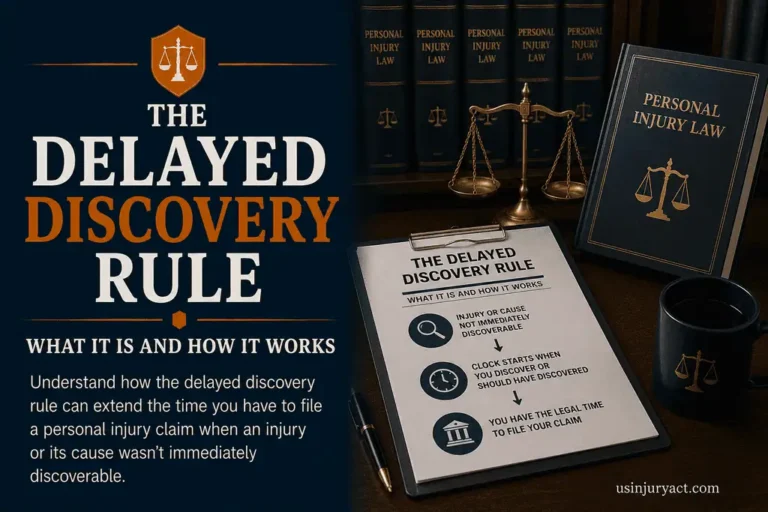
The delayed discovery rule modifies this result by starting the clock on the date the plaintiff discovered, or through the exercise of reasonable diligence should have discovered, the injury and its cause.
The Two-Prong Test Courts Apply
In most jurisdictions, the discovery rule requires the plaintiff to demonstrate two things before the court will apply it.
- The plaintiff must show that the injury itself was not reasonably discoverable through ordinary diligence at the time it occurred.
- The plaintiff must show that they did not have knowledge of, and could not reasonably have discovered, the causal connection between the injury and the defendant’s conduct.
Both prongs are tested on an objective standard. The question is not what this particular plaintiff actually knew, but what a reasonable person in the same situation would have known.
If a reasonably attentive person in your position would have investigated and found the injury or its cause, the court will likely hold that the delayed discovery rule does not extend your deadline, even if you personally remained unaware.
Case Types Where the Delayed Discovery Rule Most Commonly Applies
The discovery rule does not apply equally across all personal injury scenarios. Courts and legislatures have developed the doctrine most extensively in case categories where latent injury is a known, recurring problem.
Medical Malpractice Cases
Medical malpractice is the case type most strongly associated with the delayed discovery rule. Medical malpractice discovery rule applications arise frequently because patients often have no way to evaluate the quality of the medical care they receive.
If a surgeon makes a technical error that causes internal scarring for instance, a patient may live with the consequences for years before symptoms manifest or before another doctor identifies the original error.
Holding that the clock ran from the date of surgery, when the patient had no knowledge and no reason to know anything was wrong, would eliminate virtually all such claims.
Most states with medical malpractice statutes of limitations have either codified the delayed discovery rule or apply it judicially. The clock runs from the date the patient knew or should have known of the malpractice.
However, almost every state also imposes a separate “statute of repose” for medical malpractice that creates an absolut outer deadline, typically ranging from two to ten years from the date of the alleged negligent act.
The repose period can cut off a claim even if the discovery rule would otherwise extend the limitations period.
Toxic Exposure and Occupational Disease
Toxic tort claims and occupational disease cases are the other primary domain of the discovery rule. In these cases, the harmful exposure often occurs over months or years, and the resulting disease can take decades to develop.
Asbestosis and mesothelioma, for example, typically do not appear until 20 to 40years after asbestos exposure. Applying a strict occurrence-based accrual rule to these cases would mean that virtually every asbestos victim’s claim was time-barred before they ever felt sick.
Courts in asbestos litigation have consistently applied the discovery rule, holding that the limitations period begins on the date of diagnosis, or on the date the plaintiff knew or should have known of both the disease and its occupational cause.
The practical result is that many mesothelioma and asbestosis claims remain timely for decades after the initial exposure, as long as they are filed within the applicable period following diagnosis.
Childhood Sexual Abuse Cases
One of the most important expansions of the delayed discovery rule in recent decades involves childhood sexual abuse statute of limitations claims.
Courts and legislatures have recognized that victims of childhood sexual abuse frequently repress memories of the abuse, experience psychological barriers to disclosure, and often do not connect their adult psychological and physical problems to the abuse they suffered until they are well into adulthood, sometimes through therapy or when triggered by another life event.
Many states have enacted “window legislation” or expanded discovery rule protections specifically for childhood sexual abuse claims.
California, New York, New Jersey, and numerous other states have passed laws reviving previously time-barred abuse claims for a limited period, acknowledging that the standard limitations periods were inadequate to protect victims.
The legislature’s willingness to extend and even revive these claims signals a broad social recognition that the discovery rule in this context serves an essential function.
Defective Product Injuries
Product liability claims often involve the discovery rule when a product’s defect causes harm that only becomes apparent over time.
Examples include pharmaceutical drugs that cause internal organ damage after prolonged use, medical devices that fail gradually, and building materials that release toxic substances slowly over years.
In these cases, the discovery rule starts the limitations clock on the date the plaintiff knew or should have known of the injury and its connection to the product.
Product liability cases also frequently involve statutes of repose, similar to medical malpractice. A product liability statute of repose creates an absolute outer limit, often measured from the date the product was sold, regardless of when the injury became apparent.
Navigating the discovery rule as well as the statute of repose simultaneously requires careful legal analysis.
Case Study – How the Discovery Rule Operates In Real Word
Seeing how courts actually apply the discovery rule in practice illustrates the doctrine far better than abstract description alone.
The Industrial Worker and Latent Lung Disease
Consider the situation of a factory worker who spent 15 years working in a plant where asbestos insulation was used extensively. The worker never received warnings about asbestos exposure and was not aware of the health risks, and 22 years after leaving the job, the worker is diagnosed with mesothelioma.
Under a strict occurrence-based rule, the 2 or 3 year statute of limitations would have run out roughly 19 to 20 years before the diagnosis, when the worker had no symptoms, no diagnosis, and no reasonable basis for knowing a legal claim existed.
Under the discovery rule, the limitations period begins on the date of diagnosis, or on the date the worker should reasonably have connected the diagnosis to the workplace exposure.
If the worker files a lawsuit within the applicable period after learning of the diagnosis and its industrial cause, the claim is timely. This is the discovery rule operating at its most significant, protecting a victim who had absolutely no practical ability to file earlier.
The Surgical Retained Object Scenario
Retained surgical objects are a well-documented medical malpractice scenario with important discovery rule implications. Suppose a patient undergoes abdominal surgery and the surgical team inadvertently leaves a small instrument or gauze inside the body.
The patient is discharged, recovers from the operation, and over the following 18 months experiences vague abdominal discomfort that is attributed to other causes. Two years after the surgery, imaging taken for an unrelated reason reveals the retained object.
Under a strict occurrence rule, the statute of limitations would have started on the day of surgery and may have already expired by the time the patient learned of the retained object.
Most states apply the discovery rule here, starting the clock on the date the patient discovered or should have discovered the retained object. Some states have specific statutory provisions that address this exact scenario, as the foreign object scenario has been litigated extensively in medical malpractice law.
The Pharmaceutical Harm Case
A person prescribed a medication for a chronic condition takes it as directed for three years. During those years, the drug gradually causes damage to the liver. When the person eventually develops liver failure and is tested, doctors trace the damage to the medication.
A class action lawsuit later reveals that the pharmaceutical company had internal studies showing the risk years earlier but failed to disclose them adequately to the FDA or to patients.
The discovery rule in this scenario starts the limitations clock on the date the patient learned or should have learned of the liver damage and its causal connection to the medication.
The fact that the company concealed evidence may also give rise to a fraudulent concealment tolling argument, further extending the available filing window.
This layering of legal doctrines, discovery rule plus fraudulent concealment, is common in pharmaceutical and toxic tort litigation.
The Limits and Boundaries of the Delayed Discovery Rule
The discovery rule is a powerful tool, but it is not unlimited. Courts and legislatures have imposed meaningful constraints on its application that every injury victim and attorney needs to know.
The Objective Reasonable Diligence Standard
The most important limitation on the discovery rule is the reasonable diligence standard in the discovery rule. The rule does not protect willful blindness or unreasonable inattention.
Courts ask what a reasonably diligent person in the plaintiff’s position would have known. If there were warning signs, symptoms, or information that should have prompted investigation, and the plaintiff ignored them, the court may hold that the discovery rule does not extend the deadline.
For example, if a person was experiencing significant pain and limitation of movement for 18 months after an accident but never sought medical attention and never consulted a lawyer, a court might conclude that a reasonably diligent person would have investigated sooner.
The subjective fact that this particular plaintiff waited does not by itself invoke the discovery rule. Reasonable diligence is the key, and plaintiffs who cannot show they acted with reasonable care in investigating their injury will struggle to invoke the doctrine.
Statutes of Repose As Hard Outer Limits
As noted in the medical malpractice and product liability sections above, statutes of repose operate as absolute outer limits that the discovery rule cannot overcome.
A statute of repose says that regardless of when you discovered the injury, if the underlying act occurred more than a certain number of years ago, you cannot bring a claim. This is the legislature’s deliberate choice to protect defendants from indefinitely long potential liability.
The practical lesson is that the discovery rule can extend a statute of limitations, but it cannot override a statute of repose. If you are dealing with a medical malpractice claim, a product liability claim, or any other claim that may involve a repose period, identify the repose deadline as well as the limitations deadline.
Running out both clocks simultaneously is essential to knowing your true filing window.
States That Have Rejected Broad Discovery Rule Application
Not every state applies the discovery rule broadly, some jurisdictions limit it to specific case types, such as medical malpractice or fraud, and refuse to extend it to general negligence cases.
Courts in these states reason that the legislature has spoken by setting a specific limitations period, and judicially extending it through a broadly applied discovery rule would be legislative overreach.
If you are relying on the discovery rule in a state where it has not been broadly adopted, you face a significant legal obstacle that requires thorough research and careful argument.
But most of that burden should be on your personal injury representative.
How to Invoke the Discovery Rule in Your Personal Injury Case
If you believe the discovery rule applies to your situation, the first step is to speak with a personal injury attorney experienced with the discovery rule.
The attorney will need to evaluate when you actually discovered the injury and its cause, and, critically, when a reasonably diligent person in your position should have discovered it.
Note that these two dates are not always the same, and the court will use the earlier of the two. That means if you discovered three years later than when a reasonable person should have discovered, you claim may be barred in a two years statute of limitation state.
secondly, document the timeline of your discovery carefully. Note when you first experienced symptoms, when you sought medical care, when a diagnosis was made, when you first connected the diagnosis to a potential negligent act, and why you did not make that connection earlier.
Each of these dates and the reasoning behind them may become evidence in a tolling argument.
Lastly, be prepared for the defendant to argue aggressively against the discovery rule. Defendants in delayed discovery cases routinely argue that the plaintiff should have known about the injury earlier and that reasonable diligence would have led to earlier discovery.
Your attorney will need to rebut these arguments with specific evidence about what was knowable when and why discovery was not reasonably possible before the date you are claiming.
In summary, the discovery rule represents one of laws most direct responses to the reality that harm does not always announce itself immediately.
It exists because justice requires that people have a meaningful opportunity to seek redress for the wrongs done to them, and a limitations period that runs before a person could reasonably know they have a claim offers no meaningful opportunity at all.
So if you think you may have a time-barred claim that the discovery rule might revive, then act as soon as you can by consulting with an attorney, because even the extended deadline also has its own expiration.