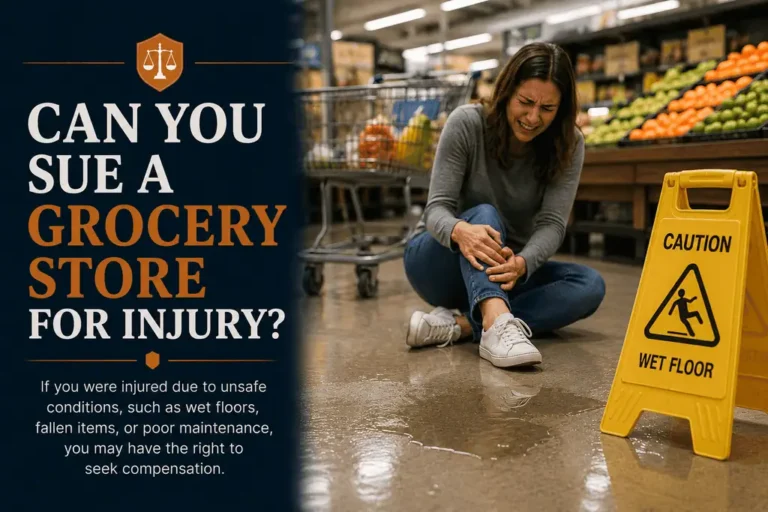
If you slipped on a wet floor, tripped over a misplaced pallet, or were injured by a falling product at a supermarket, and you’re wondering if you can sue a grocery store for injury, The answer is yes, and thousands of Americans sue grocery stores for injury every year with successful outcomes.
Grocery stores carry a significant legal duty to maintain safe conditions for customers, and when they fail to meet that duty, the law allows injured shoppers to hold them financially accountable.
Let’s dive in exactly how grocery store injury claims work, what you need to prove, how much these cases are worth, and what you must do after an accident to protect your legal rights.
The Legal Foundation – Premises Liability and the Duty of Care
Grocery store injury lawsuits are governed by premises liability law, a branch of personal injury law that applies whenever someone is injured on another party’s property. Under premises liability principles, property owners and business operators owe a legal duty of care to customers, who are classified as “invitees” in legal terms.
As an invitee, you are owed the highest level of care that premises liability law recognizes because you entered the store with the owner’s express or implied invitation and for a purpose that benefits the business.
Grocery stores profit from customer traffic and in exchange for that economic benefit, the law requires them to maintain reasonably safe conditions throughout the property.
This duty extends to the parking lot, entrance and exit areas, aisles, restrooms, loading zones, and any other area customers are reasonably expected to use. It applies to the store itself and to third-party vendors or contractors whose conduct on the property the store has authority to oversee.
What “Reasonable Care” Requires of a Grocery Store
A grocery store acting with reasonable care must regularly inspect the premises for hazards, promptly clean up or correct known dangers, warn customers of hazards that cannot be immediately fixed, train employees to identify and report unsafe conditions, maintain adequate lighting in all customer-accessible areas, and keep walkways free of obstructions.
The failure to do any of these things, when that failure results in a customer injury, is the core of a premises liability claim.
Courts in states including Florida, California, Texas, Georgia, Illinois, Pennsylvania, and New York have all affirmed these obligations in reported decisions.
Common Grocery Store Injuries and How They Happen
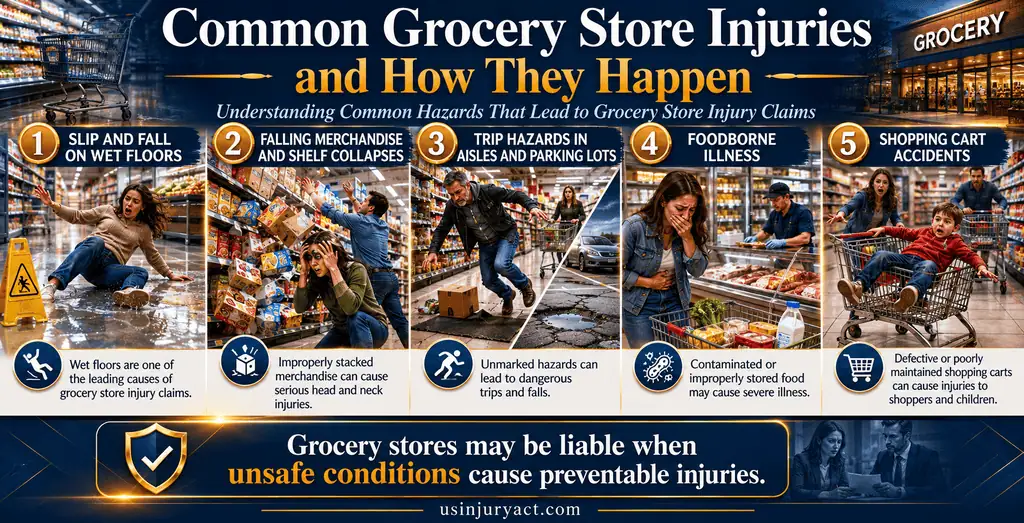
Slip and Fall on Wet Floors
This is the most frequently litigated grocery store injury scenario in the United States. Wet floors arise from product spills, mopping, refrigeration leaks, and tracked-in rainwater near entrances.
The key legal issue is whether the store knew or should have known about the wet condition and failed to address it within a reasonable time before you slip and fall.
Courts have consistently held that a spill present for more than a few minutes without a warning sign or cleanup effort is strong evidence of negligence. If an employee walked past the spill without acting, that evidence is even more powerful.
Falling Merchandise and Shelf Collapses
Improperly stocked shelves, overloaded displays, and faulty shelving units have caused serious injuries including head trauma, broken bones, and spinal damage.
These cases often involve product liability theories in addition to premises liability, particularly if a defective shelf unit was involved.
Trip Hazards in Aisles and Parking Lots
Pallets left in aisles, damaged flooring, torn mats, raised thresholds, potholes in parking lots, and protruding fixtures all create foreseeable trip hazards.
When a customer is injured by a hazard that the store created or allowed to persist, the store can be liable for all resulting damages.
Foodborne Illness
Grocery stores that sell contaminated, expired, or improperly stored food products can face personal injury lawsuits from customers who suffer food poisoning or allergic reactions. These cases often involve product liability law and may implicate multiple parties in the food supply chain.
Shopping Cart Accidents
Cart-related injuries happen when carts are defective, when employees push carts carelessly through parking lots, or when stores allow carts to accumulate in areas that block exits and create hazards. These injuries are especially common among elderly customers and young children.
What You Must Prove to Win a Grocery Store Injury Case
Winning a grocery store injury lawsuit requires proving four legal elements, similar in structure to any negligence claim but with specific applications to premises liability.
Duty
The store owed you a duty of care as an invitee on the premises which is almost always easy to establish in a grocery store context because your status as a paying customer or prospective customer gives you invitee status automatically.
Breach
The store breached that duty by failing to maintain reasonably safe conditions, failing to warn of known hazards, failing to conduct regular inspections, or allowing an unsafe condition to persist for an unreasonable time.
Evidence supporting breach includes store surveillance footage, incident reports, witness testimony from other customers or employees, and maintenance logs.
Causation
The store’s breach directly caused your injury. You must show a direct link between the hazardous condition and the harm you suffered. For instance, if you slipped on a spill the store failed to clean up, causation is typically straightforward.
If the causation chain is less obvious, medical expert testimony may be required.
Damages
You suffered real, quantifiable losses as a result of the injury. It includes medical bills, lost wages, reduced earning capacity, physical pain and suffering, emotional distress, and in severe cases, permanent disability or disfigurement.
Realistic Instance – Slip and Fall on Unmarked Wet Floor
Imagine you are shopping at a large supermarket chain, an employee finished mopping an aisle about ten minutes before you walked through it. No wet floor sign was placed, no barriers were set up. The floor looks dry under the store’s lighting but remains slippery. You slip, fall, and break your wrist requiring surgery and physical therapy.
Your attorney would first subpoena the store’s surveillance footage, which shows no sign was placed and no employee remained in the area to warn customers. A maintenance log shows the employee clocked a cleaning task in that aisle ten minutes before the incident. Your medical records document the injury, treatment, and recovery. Witnesses who walked past the area also confirm no warning was present.
This type of case has strong liability indicators and a well-documented damages picture. Settlements in cases like this regularly reach five figures and can extend into six figures when surgery and extended recovery are involved.
What Compensation Can You Recover?
If your grocery store injury claim succeeds, you may be entitled to recover a range of economic and non-economic damages.
Economic Damages
These are your out-of-pocket financial losses, and they can be calculated with precision. They include all medical expenses from emergency treatment, hospitalization, surgery, physical therapy, prescription medication, and future care if the injury has long-term consequences. They also include lost wages for every day of work you missed during recovery, and lost earning capacity if the injury permanently affects your ability to perform your job.
Non-Economic Damages
These damages compensate for intangible losses that do not come with a receipt but are very real. Pain and suffering, loss of enjoyment of life, emotional distress, and in cases involving permanent impairment, loss of consortium claims by a spouse may all be recoverable. Several states cap non-economic damages in personal injury cases, so the applicable limits in your state matter.
Punitive Damages
In cases where the store’s conduct was not merely negligent but reckless or deliberate, a jury may award punitive damages. These are relatively rare in grocery store cases but can arise when a store systematically ignores documented safety hazards or destroys evidence after an accident.
Steps to Take After a Grocery Store Injury
What you do in the hours and days after a grocery store injury can make or break your claim, follow these steps to protect your legal rights.
- Report the injury immediately to the store manager and ask for an incident report, get a copy before you leave.
- Photograph the hazard, the surrounding area, your injuries, and any wet floor signs that were or were not present.
- Collect names and contact information for any witnesses who saw the accident.
- Seek medical attention the same day, even if you feel only moderate pain because delayed treatment is used by defense attorneys to argue the injury was not serious.
- Do not give a recorded statement to the store’s insurance company without first consulting an attorney.
- Contact a personal injury attorney as soon as possible to preserve evidence and meet filing deadlines.
Can You Sue a Grocery Store for Injury?
Absolutely, you can sue a grocery store for injury when you can show the store breached its duty of care as a property owner and that breach caused your harm. The strength of your claim depends on the quality of evidence you gather, the documentation of your damages, and the skill of your legal representation.
Grocery store chains and their insurers have experienced legal teams working to minimize payouts, which is why having an experienced premises liability attorney on your side levels the playing field.