
Personal injury law in Virginia governs your right to seek compensation when someone else’s negligence causes you harm. According to the Virginia Judicial System, tens of thousands of civil cases are filed in Virginia courts each year, with personal injury claims representing a substantial portion of that docket.
What separates Virginia from most other states is its uncompromising legal structures like the strict deadlines, a contributory negligence rule that can wipe out your entire claim, and procedural requirements that leave very little room for error.
This guide covers everything you need to know about pursuing a personal injury claim in Virginia. You will learn exactly how the statute of limitations works, why even a small percentage of fault can end your case before it starts, how the at-fault insurance system affects your recovery, and the precise steps involved in filing a lawsuit.
Personal injury law is the body of civil law that allows injured individuals to seek financial compensation from parties whose negligent, reckless, or intentional conduct caused their injuries. Unlike criminal law, personal injury cases are pursued by the injured party directly and result in monetary damage.
Every personal injury claim, regardless of the type of accident, rests on four legal elements that must all be proven:
Virginia courts apply these elements rigorously. The plaintiff carries the burden of proving each one by a preponderance of the evidence, meaning it is more likely than not that the defendant’s conduct caused the harm. Failure to establish even one element results in dismissal of the claim.
Virginia also applies a strict negligence standard that differs significantly from most other states. The state does not follow comparative negligence, which would reduce your damages proportionally if you share some fault. Instead, Virginia uses contributory negligence, which is covered in detail in the next section.
Virginia has several laws that directly affect your ability to recover compensation. Ignoring any of them can result in losing your right to sue entirely. These are not technicalities but the core rules that will determine the outcome of your case.
The Virginia statute of limitations personal injury deadline is set by Va. Code 8.01-243. Most personal injury claims must be filed within two years from the date of injury. If you miss this deadline, the court will almost certainly dismiss your case and you will be permanently barred from recovery, regardless of how strong your evidence is.
This two-year clock typically starts running on the date the injury occurs. Virginia follows what is known as the occurrence rule, meaning the limitations period begins when the harmful event takes place, not when you discover it or connect it to a defendant’s conduct.
Wrongful death claims are also governed by a two-year statute of limitations, but the clock in those cases starts on the date of death rather than the date of the underlying accident or injury.
There are limited exceptions that can pause, or toll, the limitations period:
These exceptions are limited and courts interpret them narrowly. You should never count on an exception to save a late filing. Consulting a Virginia personal injury attorney as early as possible after an injury is the only reliable way to protect your right to sue.
The Virginia contributory negligence rule is one of the most hostile legal standards to plaintiffs in the country. Virginia is one of only a handful of states that still applies pure contributory negligence, and it operates as an absolute bar to recovery.
Under this doctrine, if you are found to be even one percent at fault for the accident that caused your injuries, you are completely barred from recovering any compensation from the other party. There is no sliding scale or any proportional reduction, your claim is gone.
Here’s an example
You are stopped at a red light and a distracted driver rear-ends you at highway speed. You were not wearing your seatbelt at the time. The defense argues that your failure to wear a seatbelt contributed to the severity of your injuries. If a jury finds you even one percent responsible for your own harm, you recover nothing, despite the other driver being 99 percent at fault.
This rule applies across virtually all personal injury cases in Virginia, including car accidents, slip and falls, and premises liability claims. The practical consequence is that defendants and their insurers will routinely argue contributory negligence as a defense strategy. Building a case that eliminates or minimizes any argument of plaintiff fault is critical from the very first day.
There is a narrow exception called the last clear chance doctrine, which allows a contributorily negligent plaintiff to recover if the defendant had the final opportunity to avoid the accident and failed to take it. However, this doctrine is difficult to apply and rarely outcome-determinative.
Virginia operates as an at-fault state for automobile accidents, this means that the driver who caused the accident bears financial responsibility for the resulting injuries and property damage.
As an injured party, you have the right to file a claim directly against the at-fault driver’s liability insurance policy, file a claim with your own insurer if applicable, or file a personal injury lawsuit against the at-fault driver in civil court.
Virginia requires all motor vehicle owners to carry minimum liability insurance or pay an uninsured motor vehicle fee to the state. The minimum required coverage is $30,000 per person and $60,000 per accident for bodily injury, along with $20,000 for property damage, though these minimums are frequently insufficient to cover serious injuries.
Uninsured and underinsured motorist coverage is available in Virginia and can be essential when the at-fault driver lacks adequate insurance. If you were injured by an uninsured driver or a hit-and-run, your own uninsured motorist coverage may be your primary route to compensation.
Virginia does not impose a general cap on compensatory damages in most personal injury cases. Economic damages, such as medical bills and lost income, and non-economic damages, such as pain and suffering, are not limited by statute in standard personal injury claims.
However, Virginia does impose a cap on punitive damages which is under Va. Code 8.01-38.1, punitive damages are capped at $350,000. Punitive damages are only available in cases involving willful or wanton conduct, meaning the defendant acted with conscious disregard for another’s rights or safety.
Medical malpractice claims are subject to a separate cap on total damages under Va. Code 8.01-581.15. This cap applies to all damages, including both compensatory and punitive amounts, and has been adjusted upward with $50k yearly top-up over time through legislative changes.
Before filing a personal injury claim in Virginia, you need to understand the insurance landscape. Liability coverage is the primary source of compensation in most cases. When the at-fault party’s coverage is insufficient, your own underinsured motorist coverage becomes critically important.
Virginia also permits individuals to pay an annual uninsured motor vehicle fee as an alternative to purchasing liability insurance. This means you may encounter an at-fault driver who has no insurance policy at all, making your own uninsured motorist coverage your only practical recourse outside of a direct judgment against the individual.
Knowing how to file a personal injury lawsuit in Virginia requires following a specific sequence of actions that protects your legal rights at every stage. Each step is connected. Skipping one or delaying any part of this process can cost you compensation.
Your health comes first, and your medical records will become the foundation of your legal claim. See a doctor immediately after any accident, even if your injuries seem minor. Many serious injuries, including concussions, soft tissue damage, and internal trauma, are not immediately apparent.
Gaps in medical treatment are one of the most damaging facts a defense attorney can use against you. Insurance adjusters and juries interpret delays in treatment as evidence that your injuries are not serious or that they were caused by something other than the accident.
Document everything as soon as you are physically able. Take photographs of the accident scene, your injuries, vehicle damage, and any relevant hazards. Collect contact information from witnesses. Obtain a copy of the police or incident report. Preserve any physical evidence, including damaged clothing or defective products.
Evidence degrades quickly as security camera footage is overwritten within days. Skid marks fade and witnesses forget details. Acting fast to preserve evidence gives your attorney the best possible foundation for your claim.
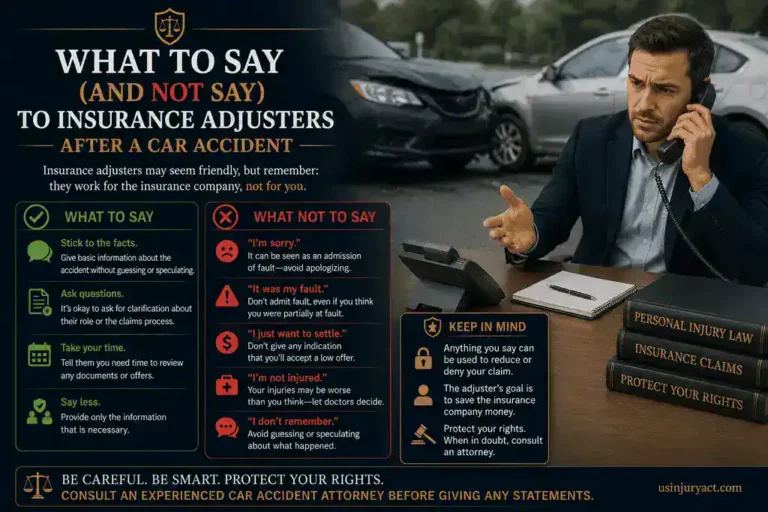
You are generally required to notify your own insurance company of an accident promptly, even if you were not at fault. Review your policy for specific reporting requirements. However, you should be extremely careful about what you say to the at-fault driver’s insurance company.
Insurance adjusters are trained to extract statements that can later be used to reduce your claim or invoke contributory negligence.
Do not give a recorded statement to the adverse insurer without first consulting a Virginia personal injury attorney. A single poorly worded sentence can hand the defense the contributory negligence argument they need to bar your recovery entirely.
Hiring a Virginia personal injury attorney early in the process significantly increases your chances of a favorable outcome. An experienced attorney will investigate the accident, identify all liable parties, engage expert witnesses, handle insurance negotiations, and file suit if a fair settlement cannot be reached.
Most personal injury attorneys in Virginia handle cases on a contingency fee basis, meaning you pay nothing unless and until you recover compensation. This arrangement allows injured individuals to access quality legal representation regardless of their financial situation.
The Virginia statute of limitations personal injury deadline under Va. Code 8.01-243 is firm. If your case cannot be resolved through settlement before the two-year deadline, your attorney must file a lawsuit in circuit court to preserve your right to recover. Filing is not a last resort; it is a strategic tool that signals seriousness to the opposing side and forces the case into the formal litigation process.
To illustrate the process: suppose you are injured in a rear-end collision in Richmond in March 2024. You seek treatment immediately and retain an attorney in April 2024. Your attorney sends a demand letter to the at-fault driver’s insurer in August 2024. Negotiations stall. By February 2026, your attorney files suit in Richmond Circuit Court, well within the two-year window. The case proceeds to discovery and ultimately settles on the courthouse steps.
Damages in a Virginia personal injury case fall into three categories. The amount you can recover depends on the severity of your injuries, the strength of your liability evidence, and the availability of insurance coverage.
Economic damages compensate you for financial losses that can be calculated with precision. They include past and future medical expenses, lost wages and earning capacity, costs of rehabilitation and ongoing care, and property damage.
These damages are supported by bills, pay stubs, tax records, and expert testimony from medical and vocational professionals.
Non-economic damages compensate you for losses that are real but not easily reduced to a number. Pain and suffering, emotional distress, loss of enjoyment of life, loss of consortium, and disfigurement all fall into this category.
Virginia does not cap non economic damages in standard personal injury cases, allowing juries to award amounts that reflect the true impact of the injury on your life.
Punitive damages are available only in exceptional cases involving willful, wanton, or malicious conduct. They are not designed to compensate the plaintiff but to punish the defendant and deter similar conduct.
Virginia caps punitive damages at $350,000 under Va. Code 8.01-38.1. Because of this cap and the high standard required to obtain them, punitive damages are the exception, not the rule, in Virginia personal injury litigation.
The general principles of negligence apply across all personal injury cases, but each category of claim carries its own Virginia-specific nuances that can affect strategy, damages, and outcome.
Car accident claims are the most common type of personal injury case in Virginia. As an at-fault state, Virginia law allows you to pursue compensation directly from the responsible driver’s liability insurer.
The contributory negligence rule is especially prominent in car accident litigation, where defense attorneys routinely argue that the plaintiff was speeding, failed to avoid the collision, or was not wearing a seatbelt.
Virginia also has specific rules governing accidents involving uninsured drivers, rideshare vehicles, and commercial trucks. If the at-fault driver was working at the time, the employer may also bear vicarious liability under Virginia common law.
Property owners in Virginia owe a duty of care to lawful visitors. To prevail on a premises liability claim, you must prove that the property owner knew or should have known about the dangerous condition and failed to remedy it or warn you in time. Virginia courts are strict about the notice requirement, and contributory negligence is frequently argued when a plaintiff failed to observe an obvious hazard.
The duty of care owed varies by the visitor’s status.
Most Virginia workplace injuries are governed by the Virginia Workers’ Compensation Act rather than personal injury law. Workers’ compensation is a no-fault system that provides medical benefits and wage replacement but limits the damages available.
Importantly, it also bars most lawsuits against your employer directly.
However, if a third party caused your workplace injury, such as a contractor, equipment manufacturer, or negligent driver, you may be able to pursue both a workers’ compensation claim and a separate personal injury lawsuit against that third party.
An experienced attorney can help you identify all available avenues of recovery.
Virginia medical malpractice claims require proof that a healthcare provider deviated from the accepted standard of care and that deviation caused your harm. These cases are among the most complex in civil litigation, requiring expert testimony from qualified medical professionals who can speak to both the standard of care and the causal connection.
Virginia imposes a damages cap on medical malpractice claims under Va. Code 8.01-581.15. The cap on total damages, including both compensatory and punitive amounts, has been adjusted by the legislature over time and applies per occurrence rather than per plaintiff.
Virginia also requires that medical malpractice claims be reviewed by a medical malpractice review panel before proceeding to trial, unless the parties agree to bypass this requirement. This process adds time and strategic considerations to the litigation.
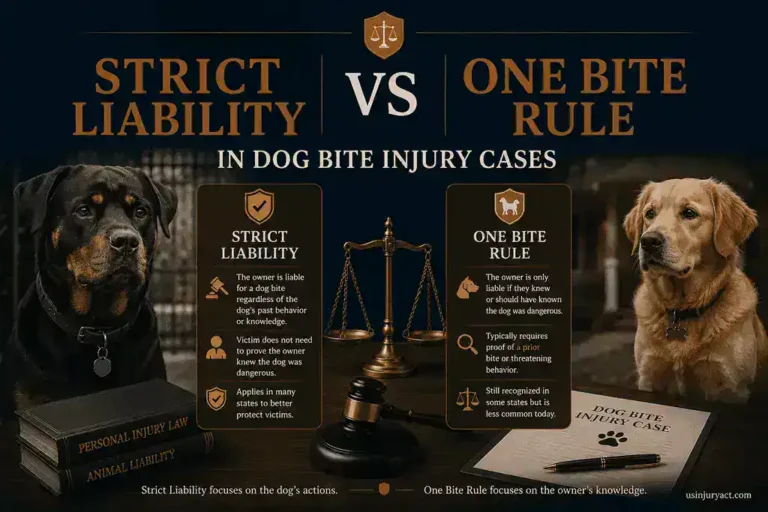
Virginia does not follow a strict liability rule for dog bites the way some states do. Instead, Virginia applies a one-bite rule, meaning the dog’s owner is liable only if the owner knew or should have known of the dog’s dangerous propensities, typically evidenced by a prior bite or aggressive behavior.
However, Virginia has exceptions. If a dog owner violates a leash law or local ordinance, that violation may constitute negligence per se, making it easier to establish liability without proving prior knowledge of the dog’s dangerousness.
When negligence causes a person’s death, the personal injury claim transforms into a wrongful death action under Va. Code 8.01-50. Only specific family members, acting through a personal representative, may bring this claim. Beneficiaries typically include a surviving spouse, children, parents, and siblings, in a priority order established by the statute.
Wrongful death damages include medical and funeral expenses, lost income the deceased would have provided, sorrow, mental anguish, and loss of comfort and companionship.
The statute of limitations for wrongful death is two years from the date of death, not the date of the underlying accident. This distinction matters significantly when someone survives an accident for weeks or months before passing.
Where your case is filed and tried can influence its outcome. Virginia’s circuit courts are separate entities with different judges, jury pools, and local procedural rules. Understanding the landscape of the jurisdiction where your case will be heard is a legitimate strategic consideration.
Virginia Beach is one of the most populous jurisdictions in the state and has a high volume of personal injury cases, particularly those involving car accidents, rideshare incidents, and tourist-related premises liability claims.
The Virginia Beach Circuit Court handles a large civil docket, and local juries tend to be diverse in background and experience. Cases involving summer tourism and high-traffic coastal areas are especially common.
Richmond, as the state capital, sits at the center of Virginia’s legal and political activity. The Richmond Circuit Court handles complex civil litigation and has a well developed body of local precedent.
Personal injury cases in Richmond often involve urban traffic accidents, commercial premises, and government entities. The proximity to the Virginia Supreme Court also means that attorneys here are highly attuned to appellate strategy.
Norfolk’s economy is heavily influenced by the military and maritime industry. Personal injury claims in Norfolk frequently involve car accidents, pedestrian incidents, and premises liability cases in and around commercial and entertainment districts. The Norfolk Circuit Court has an active personal injury docket, and local juries often reflects the area’s working class character.
Alexandria is adjacent to Washington, D.C., and handles a high volume of cases involving government contractors, federal employees, and a well-educated suburban population.
Personal injury verdicts in Alexandria can be substantial as a result of the higher income levels and damages expectations of the local jury pool. Cases here often involve complex liability theories and large corporate defendants.
Arlington sits in Northern Virginia with one of the wealthiest and most highly educated populations in the state. The Arlington Circuit Court sees personal injury cases involving car accidents, pedestrian injuries, and construction site incidents. Jury awards in Arlington can be among the highest in Virginia, making defendant-side insurers particularly motivated to settle cases before trial.
Selecting the right Virginia personal injury attorney is one of the most consequential decisions you will make in your case. The quality of your representation directly affects your odds of winning and the amount you recover. Do not choose based on advertising alone.
Most Virginia personal injury attorneys work under a contingency fee agreement, meaning you pay no upfront legal fees. The attorney receives a percentage of your recovery only if you win. Standard contingency fees in Virginia range from 33 percent for pre-litigation settlements to 40 percent or higher if the case goes to trial.
Ask about case costs as well, since litigation expenses like expert witness fees, court filing costs, and deposition transcripts are usually advanced by the firm and deducted from your settlement.
A free consultation with a Virginia personal injury attorney is your opportunity to evaluate the attorney as much as they evaluate your case. Ask the following:
Be cautious of any attorney who guarantees a specific outcome, pressures you to settle quickly, or lacks trial experience. Virginia’s contributory negligence rule makes litigation strategy particularly important, and an attorney who never takes cases to trial has less leverage in negotiations.
You should also be wary of firms that treat you as a case number rather than a client.
An attorney who has appeared before the specific judge assigned to your case has a meaningful advantage. They know the judge’s preferences, procedural tendencies, and the local jury pool.
In a state with contributory negligence, where one unfavorable jury instruction can end your case, local experience is essential.
Personal injury law in Virginia is demanding, unforgiving, and full of procedural traps that can eliminate your right to compensation before your case even begins. The two-year statute of limitations under Va. Code 8.01-243 leaves no room for delay.
The contributory negligence rule means that a finding of even minimal fault on your part ends your recovery entirely. And the at-fault insurance system, combined with minimum coverage limits that often fall far short of serious injury costs, makes legal strategy critical from day one.
The stakes are too high to navigate this system alone. Virginia’s legal structure heavily favors defendants and insurers who understand these rules and know how to use them.
The best thing you can do after suffering an injury caused by someone else’s negligence is to consult a licensed Virginia personal injury attorney as soon as possible. Protect your evidence, preserve your rights, and make sure the person responsible for your harm is held legally accountable.
If you or a family member has been injured due to another party’s negligence, speak with a qualified Virginia personal injury attorney for a free consultation and learn exactly where you stand under Virginia law.
Learn and Connect with the best injury attorneys based on specific injury type
Stay ahead with our resources on personal injury laws across the U.S.