If a dog has bitten you or someone you love, the amount of compensation you can recover, and how difficult it will be to prove your case, depends largely on which legal standard applies in your state.
Some states hold dog owners automatically responsible for any bite injury their dog causes. Others require you to prove that the owner already knew their dog was dangerous before the attack.
These two approaches are known as strict liability and the one bite rule, and the gap between them is enormous.
With this post, you’ll learn both legal standards in detail, identifies which states use each approach, compares how they play out in real injury cases, and tells you exactly what evidence matters most in each type of jurisdiction.
If you or a family member has been injured in a dog attack, what follows could determine the outcome of your legal claim.
Strict Liability in Dog Bite Cases
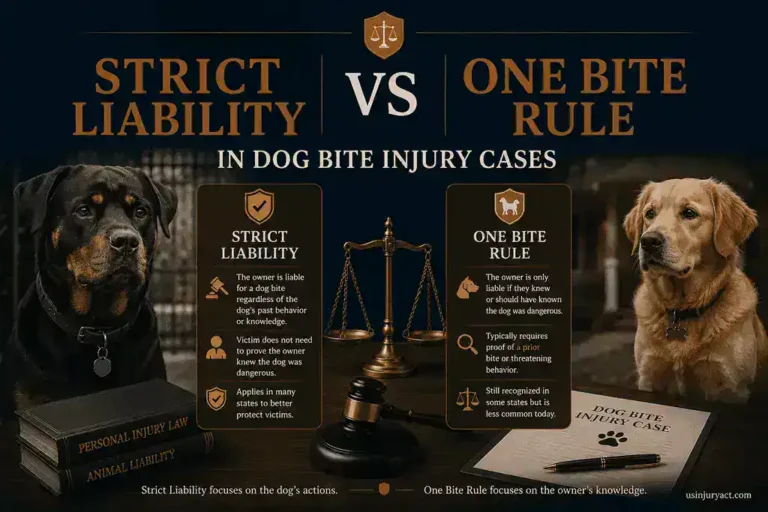
Under strict liability, a dog owner is legally responsible for injuries their dog causes even if the owner had no prior reason to believe the dog was dangerous.
The injured victim does not need to prove the owner was careless or that the dog had a history of aggression. The mere fact that the dog bit and caused injury is enough to establish liability, subject to limited exceptions.
The policy rationale is that since dog owners choose to keep animals capable of causing serious injury, then they are in the best position to prevent attacks through training, confinement, and supervision.
Placing the cost of dog bite injuries on owners regardless of prior knowledge encourages responsible ownership and properly compensates victims who did nothing to provoke the attack.
Strict liability is now the majority rule in the United States, adopted by the majority of states through legislation.
The plaintiff’s burden of proof under strict liability is significantly lighter than under the one bite rule, which makes these cases easier to pursue and more likely to result in full compensation.
Common Exceptions to Strict Liability
Even in strict liability states, certain defenses and exceptions limit the owner’s responsibility. The most common are provocation and trespassing.
If the victim provoked the dog through physical abuse, teasing, or torment that would cause a reasonable dog to react aggressively, many strict liability statutes reduce or eliminate the owner’s liability.
Courts look at what the victim actually did, not simply whether the owner claims provocation. Young children who approach dogs without understanding the risk are generally not found to have provoked an attack.
Most strict liability statutes also limit liability when the victim was trespassing on private property at the time of the bite. The protection is for lawful visitors, not unauthorized entrants.
However, children may be treated differently under attractive nuisance principles, and social guests, mail carriers, utility workers, and delivery personnel are typically protected even when accessing private property in the course of their duties.
Some states also carve out exceptions for law enforcement dogs acting in the course of their duties, provided the handler was not negligent in directing the animal.
States That Use Strict Liability for Dog Bites
The following states apply strict liability in dog bite cases, meaning the owner is liable for the first bite without requiring proof of prior dangerous propensity:
- California (Civil Code Section 3342)
- Florida (Section 767.04)
- Illinois (510 ILCS 5/16)
- New York (hybrid: strict liability for medical damages only)
- Texas (common law strict liability in some circumstances)
- Ohio
- Pennsylvania
- Michigan
- New Jersey
- Washington
- Colorado
- Connecticut
- Arizona
- Minnesota
- Wisconsin
- Massachusetts
- Rhode Island
- Indiana
- Kentucky
- Louisiana
- Nebraska
- Nevada
- New Hampshire
- New Mexico
- South Carolina
- Utah
- West Virginia
This list is illustrative and the precise contours of each state’s statute vary. Always consult the specific language of your state’s dog bite statute and applicable case law, and retain an attorney licensed in your jurisdiction.
The One Bite Rule
The one bite rule is a common law doctrine that predates statutory reform. Under this rule, a dog owner is liable for a bite injury only if they knew or should have known that their dog had previously displayed dangerous tendencies or a propensity to bite.
The owner’s prior knowledge of the dog’s dangerousness is the pivotal element that the plaintiff must prove.
The name “one bite rule” is somewhat misleading. It does not literally mean the dog gets a free first bite. Prior knowledge can be established through evidence of any dangerous behavior before the actual bite, including growling at people, snapping without making contact, lunging aggressively at passersby, chasing people in a threatening manner, or any incident that would put a reasonable owner on notice that their dog posed a risk.
A single prior bite is simply the most common and clearest form of notice.
Proving the One Bite Rule Case: What Evidence You Need
In a one bite rule state, your case lives or dies on the evidence of the owner’s prior knowledge and this makes investigation and discovery critical.
Your attorney should immediately pursue the following evidence sources.
Animal Control Records
Animal control records are public records in most jurisdictions and may show prior complaints about the dog, prior incidents investigated by animal control officers, previous citations issued to the owner, or records of the dog being impounded for dangerous behavior.
These records can be subpoenaed in litigation and are among the most powerful evidence available.
Neighbors And Nearby Residents
Neighbors and nearby residents who interacted with the dog before the attack may have witnessed aggressive behavior.
Systematic canvassing of the neighborhood can uncover witnesses who saw the dog behave dangerously but never reported it formally.
Social media posts by the owner about the dog’s aggression, or posts by neighbors describing incidents with the animal, can also be compelling evidence.
Veterinary Records
Veterinary records may reveal prior bite injuries to people or animals treated at the same practice, or notes from the vet about the dog’s aggressive temperament.
Prior lawsuits or insurance claims involving the dog or owner should also be investigated through court records searches.
States That Use the One Bite Rule
The following states primarily apply the one bite rule or a knowledge-based negligence standard in dog bite cases, requiring the plaintiff to prove the owner’s prior knowledge of dangerous propensity:
- Alaska
- Hawaii
- Idaho
- Kansas
- Oregon
- Georgia
- Missouri
- Montana
- Arkansas
- Mississippi
- North Carolina
- North Dakota
- South Dakota
- Tennessee
- Texas (common law; statutory claims also available in some circumstances)
- Virginia
- Wyoming
Several states operate hybrid systems that combine elements of strict liability and one bite or negligence standards.
Maryland, for instance, applies strict liability to pit bull breeds under a court decision that has been modified by subsequent legislative action.
New York applies strict liability only to medical expenses and requires proof of prior vicious propensity for other damages. These nuances make jurisdiction-specific legal advice essential.
Examples Of Strict Liability vs. One Bite Rule
First Time Biter in a Strict Liability State
A girl is playing in her neighbor’s yard in Illinois when the neighbor’s Labrador Retriever, which has never bitten anyone before and has always been described as friendly, suddenly bites her on the face. The child sustains deep lacerations requiring reconstructive surgery and is left with permanent scarring.
In Illinois, a strict liability state, the parents bring a claim against the neighbor under the Animal Control Act. The fact that the dog had never bitten before is legally irrelevant and the neighbor is automatically liable for the injuries.
The Same Attack in a One Bite Rule State
The identical attack occurs in Virginia, a one bite rule state. The parents must now prove that the neighbor knew or should have known the dog was dangerous before the bite but the dog has no prior history of biting.
However, thorough investigation reveals that three months before the attack, a neighbor witnessed the dog growling and snapping at a mail carrier and mentioned it to the owner, who dismissed it. Another neighbor recalls the owner commenting that the dog “gets aggressive with kids sometimes.”
In that case, these facts establish prior knowledge, and the case will proceeds to a successful recovery.
Without this evidence of prior knowledge, the claim would have failed under the one bite rule despite identical injuries.
The investigation makes all the difference.
The Mixed Jurisdiction and Multiple Claims
In Tennessee, a one bite rule state, a postal carrier is attacked by a dog at a residential address during mail delivery. She sustains deep puncture wounds to her arm and hand.
Investigation reveals no prior bites, but her attorney pursues the claim on two parallel theories: common law one bite rule negligence based on the owner’s knowledge that the dog behaved aggressively toward uniformed service workers, supported by a neighbor’s account, and a negligence per se claim based on the owner’s violation of a local leash ordinance that required dogs to be restrained when workers accessed the property.
The leash ordinance violation establishes negligence without requiring proof of prior viciousness, providing an alternative path to recovery.
This scenario illustrates that in one bite rule states, creative pleading that incorporates negligence, negligence per se, and statutory theories can overcome the prior knowledge requirement in many cases.
Homeowner’s Insurance and Dog Bite Claims
The great majority of dog bite claims are resolved through the dog owner’s homeowner’s or renter’s insurance policy. These policies typically provide personal liability coverage for bodily injury caused by the insured’s animals.
Policy limits commonly run $100,000 to $500,000, and umbrella policies may provide additional coverage.
However, insurers increasingly exclude certain breeds from coverage. Pit bulls, Rottweilers, Doberman Pinschers, German Shepherds, and Akitas are commonly excluded under many homeowner’s policies.
In these situations, the claim proceeds against the owner personally, and asset investigation becomes important to assess collectability.
A personal injury attorney conducts asset searches and explores all available insurance coverage before advising a client on litigation strategy.
It is also important to note that in strict liability states, the insurance company cannot successfully argue that its insured was not negligent as a defense to the claim.
The strict liability standard means coverage is triggered by the attack itself, not by proof of owner fault.
Damages Available in Dog Bite Cases
Dog bite injuries can be devastatingly severe as attacks cause deep puncture wounds, torn muscles, nerve damage, tendon injuries, and disfiguring facial lacerations.
Victims, especially children, frequently require multiple reconstructive surgeries, experience significant emotional trauma, and develop post-traumatic stress disorder that affects their relationship with animals and their overall psychological health for years.
Compensable damages in dog bite cases include all emergency medical treatment, hospitalization, surgery, reconstructive procedures, physical and occupational therapy, psychological counseling, lost wages for adult victims, loss of earning capacity if nerve or tendon damage causes permanent functional limitations, and significant pain and suffering damages that account for the trauma, scarring, and long-term psychological impact of the attack.
In cases involving extremely reckless owner conduct, such as an owner who knowingly keeps a dog that has previously attacked multiple people, or who uses a dog as a weapon, punitive damages may be available to punish the owner’s conduct and deter others from similar behavior.