Personal injury law in New Jersey governs your right to seek financial compensation when someone else’s negligence causes you physical, emotional, or economic harm.
According to the New Jersey Courts, tens of thousands of civil cases are filed annually across the state, with personal injury claims representing a substantial portion of that docket.
What most injured people do not realize is that New Jersey imposes strict filing deadlines, unique comparative fault rules, and special procedural requirements that can permanently eliminate your right to recover, even when liability is clear.
New Jersey’s legal framework is a little complex than many states. You must navigate a 2-year statute of limitations, a modified comparative negligence system, and, if a government entity is involved, a 90 day Notice of Claim requirement that catches injured parties off guard. Miss any of these and your case may be barred forever.
This post covers everything you need to know about personal injury law in New Jersey: the governing statutes, the step-by-step claims process, how damages are calculated, injury-specific legal nuances, local court dynamics, and how to select the right attorney.
Peradventure you were hurt in a car accident, on someone’s property, at work, or by a negligent doctor, this resource gives you the legal roadmap to protect your claim.
Personal injury law is the body of civil law that allows a person who has been harmed by another party’s wrongful conduct to seek monetary compensation. Unlike criminal law, which punishes offenders on behalf of the state, personal injury law is remedial.
Its purpose is to restore the injured person, known as the plaintiff, to the financial position they occupied before the injury.
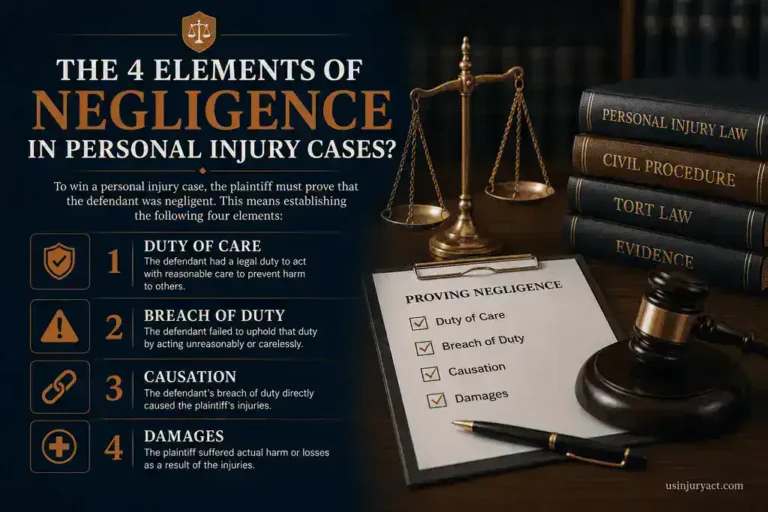
The legal foundation of virtually every personal injury case is negligence. To establish negligence in New Jersey, a plaintiff must prove four elements.
New Jersey applies these principles through a combination of statutory law, court rules, and decades of case precedent developed in its Superior Court, Appellate Division, and Supreme Court.
Each element must be established by a preponderance of the evidence, meaning it is more likely than not that the defendant’s negligence caused the harm.
Before you take any action following an injury, you need to understand the legal rules that will govern your case. These are not technicalities. They are the structural pillars of New Jersey personal injury law, and missing any of them can be fatal to your claim.
N.J.S.A. 2A:14-2 establishes the New Jersey statute of limitations personal injury deadline: two years from the date of the injury. This means that if you were injured on May 1, 2025, you must file a complaint in Superior Court no later than May 1, 2027.
Courts in New Jersey are strict about this deadline. If you file one day late, the defendant can file a motion to dismiss and win, regardless of how strong your evidence is.
The discovery rule is a narrow exception to the two-year limitation. It applies when a plaintiff did not immediately know, and could not reasonably have known, that they were injured or that the injury was caused by another party’s negligence.
In such cases, the statute of limitations begins running when the plaintiff discovers, or reasonably should have discovered, the injury and its cause. This rule most commonly arises in medical malpractice cases where a surgical error is not apparent for months or years.
If the injured person is under 18 at the time of the incident, the statute of limitations is tolled until their 18th birthday, at which point the two-year period begins.
Similarly, individuals who are mentally incapacitated at the time of the injury may have the limitations period tolled during the period of incapacity. These exceptions do not apply automatically in every circumstance, and a New Jersey personal injury attorney should be consulted to confirm how they apply in your specific case.
New Jersey follows the New Jersey modified comparative negligence rule under N.J.S.A. 2A:15-5.1 through 5.3. This rule has two critical components.
First, a plaintiff can recover damages only if their percentage of fault is less than 50 percent. If you are found to be 50 percent or more at fault, you are completely barred from recovering anything.
Second, if you are found to be partially at fault but less than 50 percent, your damages are reduced in proportion to your fault percentage.
Here is how this works in practice:
Suppose you are involved in a car accident and a jury determines your total damages are $100,000. The jury also finds that you were 30 percent at fault because you were slightly speeding. Under New Jersey’s modified comparative negligence rule, your $100,000 award is reduced by 30 percent, leaving you with $70,000. However, if the jury had found you 50 percent or more at fault, you would receive nothing.
This rule makes fault allocation a contested battlefield in New Jersey personal injury litigation. Insurance companies routinely attempt to inflate your percentage of fault to reduce their exposure. Having an experienced New Jersey personal injury attorney who can challenge fault attributions is critical.
If your injury was caused by a government employee, a municipal vehicle, a dangerous condition on public property, or any other act of a government entity, standard civil filing rules do not apply. Under the New Jersey Tort Claims Act (N.J.S.A. 59:1-1 et seq.), you must file a written Notice of Claim within 90 days of the date of the accrual of the claim.
This 90-day notice requirement is separate from and additional to the two-year statute of limitations. The Notice of Claim must contain specific information, including the claimant’s name and address, the circumstances of the occurrence, the name of the government entity involved, a description of the injury, and the damages claimed.
Failure to file a timely and compliant Notice of Claim will bar your claim entirely, with very limited exceptions. Courts have granted relief only in the most extreme circumstances.
If you are injured due to any government action or property, you should consult an attorney immediately given how quickly this 90-day deadline arrives.
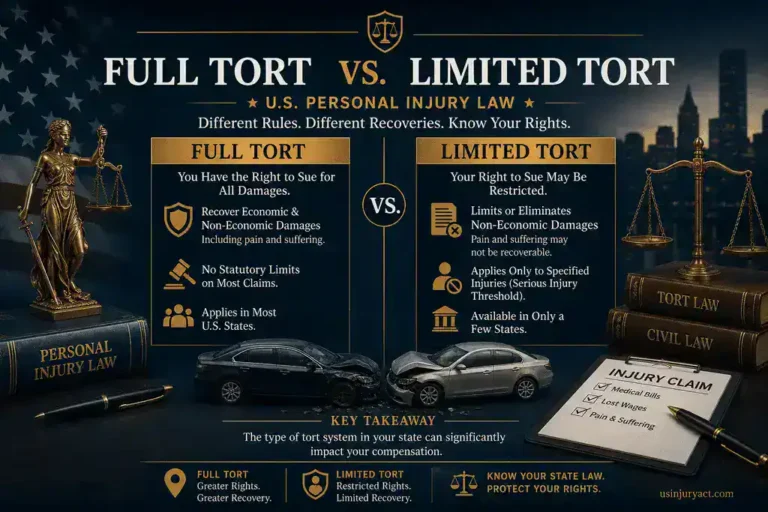
New Jersey is a choice no-fault state. Drivers can choose a standard policy or a basic policy. The standard policy provides the option to retain your right to sue in tort for non-economic damages like pain and suffering.
The basic policy typically limits your right to sue only for injuries resulting in death, dismemberment, significant disfigurement, displaced fractures, or permanent injury.
Understanding which policy covers you, or the at-fault driver, directly affects the damages you can claim in a personal injury lawsuit arising from a car accident.
New Jersey does not impose a general cap on compensatory damages in most personal injury cases. You can recover the full value of your economic and non-economic losses. However, punitive damages are subject to caps under N.J.S.A. 2A:15-5.14. Punitive damages cannot exceed five times the compensatory damages awarded or $350,000, whichever is greater.
Punitive damages are only available in cases involving actual malice or willful and wanton disregard for the rights of others.
New Jersey requires all drivers to carry minimum liability insurance. These minimums directly impact your recovery options in an auto accident case. When the at-fault driver carries only minimum coverage and your damages exceed those limits, you may need to turn to your own underinsured motorist coverage. A skilled attorney will identify all available insurance sources to maximize your recovery.
How to file a personal injury lawsuit in New Jersey is one of the most searched questions by injured residents, and for good reason.
The process is procedurally demanding and legally unforgiving. Here is the sequence of actions you should take to protect your rights.
Your first obligation after an injury is to get medical treatment, even if you think your injuries are minor. Many serious injuries, including traumatic brain injuries and internal trauma, do not produce obvious symptoms immediately.
Beyond protecting your health, a prompt medical evaluation creates a documented record linking your injuries to the incident. Insurance adjusters and defense attorneys routinely argue that a delay in treatment means the injuries are not serious or were not caused by the accident.
Evidence is the currency of personal injury litigation. Preserve everything you can, as quickly as you can. In a car accident, photograph the scene, the vehicles, and your injuries before anything is moved. In a slip and fall, document the hazardous condition with photographs or video. Collect contact information from all witnesses.
If a surveillance camera captured the incident, contact the property owner or law enforcement to preserve the footage before it is overwritten, which can happen within 24 to 72 hours.
Keep all medical records, bills, prescription receipts, and documentation of missed work. These form the financial backbone of your economic damages claim.
You are typically required to notify your own insurance company of an accident within a reasonable time, and sometimes within a specific period defined by your policy. Reporting the incident is not the same as accepting liability or waiving any rights.
Be factual and brief. Do not give a recorded statement to the other party’s insurance company without legal counsel. Adjusters are trained to ask questions that can later be used to minimize your claim or deny it entirely.
The single most important step you can take is to consult a New Jersey personal injury attorney as early as possible. An attorney can identify all potentially liable parties, calculate your full damages, handle communications with insurance companies, gather and preserve expert testimony, and ensure that every procedural deadline is met.
Most personal injury attorneys in New Jersey offer a free consultation and handle cases on contingency, meaning you pay nothing upfront.
If settlement negotiations fail, or if the insurer is acting in bad faith, your attorney will file a Complaint in the Superior Court of New Jersey. The complaint must be filed in the correct vicinage (county), must name all defendants properly, and must be served on defendants within the time required by the Rules of Court.
For cases involving government entities, the Notice of Claim must have been filed first. Filing before the statute of limitations expires is non-negotiable. Once that window closes, your claim is gone.
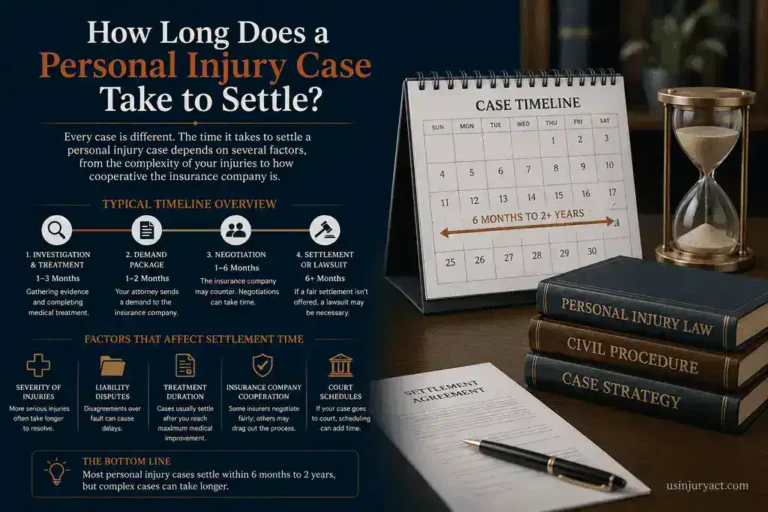
To illustrate the process: a truck driver runs a red light and strikes your car on Route 1 in Middlesex County. You sustain a herniated disc and fractures. You receive emergency treatment, photograph the scene, and obtain the police report. Within days, you retain a personal injury attorney. The attorney opens an investigation, sends preservation letters to the trucking company for dashcam footage, and files suit within the two-year limitations period after negotiations break down.
This is the model process.
New Jersey personal injury law allows injured plaintiffs to recover three broad categories of damages. The strength of your evidence determines how much you can actually collect within each category.
Economic damages compensate you for quantifiable financial losses. These include past and future medical expenses, rehabilitation costs, lost wages from missed work, diminished earning capacity if your injuries prevent you from returning to your previous occupation, and property damage. Future economic damages require expert testimony from economists and medical professionals to project long-term costs.
Non-economic damages compensate for losses that do not have a clear monetary value. These include pain and suffering, emotional distress, loss of enjoyment of life, loss of consortium for a spouse or domestic partner, and permanent disability or disfigurement. New Jersey juries have substantial discretion in valuing these damages. Serious, permanent injuries with strong medical documentation command the highest non-economic awards.
As noted above, punitive damages are available only in cases involving actual malice or egregious misconduct. They are designed to punish the defendant and deter similar conduct, not to compensate the plaintiff.
New Jersey caps punitive damages at five times compensatory damages or $350,000, whichever is greater. While punitive damages are relatively rare in routine negligence cases, they arise in cases involving drunk drivers with prior convictions, pharmaceutical companies that concealed known dangers, or employers who knowingly exposed workers to hazardous conditions.
Motor vehicle accidents are the most common source of personal injury claims in New Jersey. The state’s highways, including the New Jersey Turnpike, Garden State Parkway, and densely populated urban corridors, see high volumes of serious collisions annually.
As a choice no-fault state, your recovery path depends on your insurance policy selection. Under a standard policy with the full tort option, you can sue for pain and suffering regardless of injury severity. Under a basic or limited tort policy, you can only sue for non-economic damages if your injury meets specific thresholds: death, dismemberment, significant scarring, displaced fractures, or permanent injury certified by a treating physician.
Trucking accident claims follow federal regulations in addition to state law, creating additional layers of potential liability. Rideshare accidents involving Uber or Lyft require analysis of which insurance policy applies based on the driver’s status at the time of the crash.
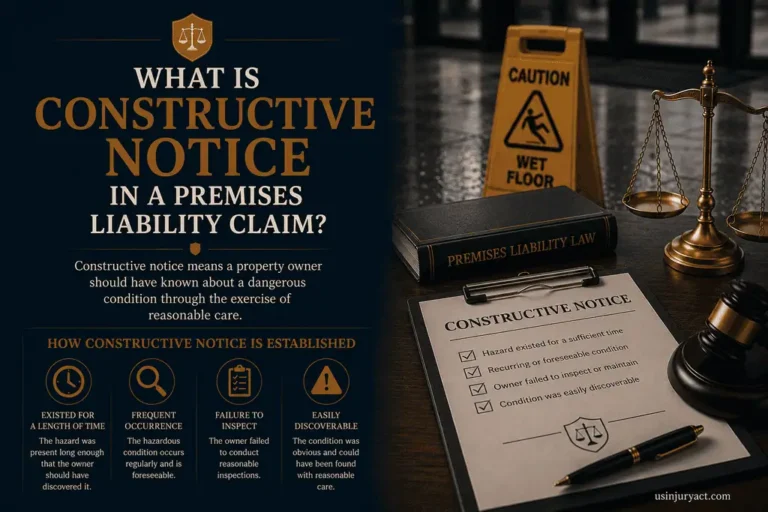
Property owners in New Jersey owe a duty of reasonable care to lawful visitors under the premises liability doctrine. If you slip and fall due to a wet floor, uneven pavement, inadequate lighting, or a failure to repair a known hazard, the property owner may be liable for your injuries.
New Jersey courts apply a multi-factor test to determine the property owner’s liability, examining factors including the foreseeability of the harm, the relationship between the parties, the nature of the risk, and the burden of guarding against it.
Comparative negligence is frequently asserted in slip and fall cases, with defendants arguing the plaintiff was not paying attention or was wearing inappropriate footwear. Prompt evidence gathering is especially critical in these cases because hazardous conditions are often remediated quickly.
Most workplace injuries in New Jersey are governed by the New Jersey Workers’ Compensation Act, which provides a no-fault system of benefits including medical treatment and wage replacement. Workers’ compensation is generally the exclusive remedy against your employer.
However, if a third party other than your employer caused or contributed to your injury, you can pursue a personal injury lawsuit against that third party while simultaneously collecting workers’ compensation benefits. Common third-party defendants in workplace injury cases include manufacturers of defective equipment, subcontractors, property owners, and vehicle operators.
This third-party claim route is frequently the only path to full compensation for pain and suffering, since workers’ compensation does not cover non-economic damages.
Medical malpractice cases in New Jersey are among the most complex and expensive personal injury claims. To succeed, the plaintiff must establish that a licensed medical professional deviated from the accepted standard of care and that this deviation directly caused the plaintiff’s injury.
New Jersey requires an affidavit of merit in medical malpractice cases, filed within 60 days of the defendant’s answer. This affidavit must be executed by a qualified medical expert in the same field as the defendant, attesting that the claim has merit. Failure to file a timely affidavit of merit results in dismissal of the case. The statute of limitations is two years, subject to the discovery rule when the malpractice is not immediately apparent.
New Jersey follows a strict liability standard for dog bites under N.J.S.A. 4:19-16. A dog owner is liable for damages suffered by any person bitten by the dog in a public place or while lawfully in a private place, regardless of the dog’s prior history of aggression and regardless of the owner’s knowledge of such history. This is a significant departure from the common law one-bite rule that applies in many other states.
Comparative negligence can reduce the plaintiff’s recovery in dog bite cases. If the plaintiff provoked the dog or was trespassing, the defendant will assert those facts to reduce or eliminate liability.
When a person’s death is caused by another party’s negligence, the surviving family members may pursue a wrongful death claim under N.J.S.A. 2A:31-1 et seq. The wrongful death statute of limitations in New Jersey is two years from the date of death.
Wrongful death claims are brought by the administrator or executor of the decedent’s estate on behalf of surviving heirs. Recoverable damages include funeral and burial expenses, medical expenses incurred before death, loss of the financial support the decedent would have provided, and loss of services and companionship.
A separate survival action may also be filed to recover damages the decedent suffered personally before death, including their pain and suffering.
New Jersey is a densely populated, legally sophisticated state. Where your case is litigated matters. Court culture, jury composition, local claim patterns, and the experience of judges in handling specific case types all vary significantly by county and city. Here is what you should know about the state’s major population centers.
Newark is the largest city in New Jersey and home to Essex County Superior Court, one of the most active civil litigation venues in the state. Essex County juries are drawn from a population with direct experience of the real-world economic and physical consequences of serious injuries.
Verdicts in Essex County can be substantial in catastrophic injury cases. Newark’s high population density and heavy traffic volume produce a significant volume of pedestrian accident and motor vehicle claims.
The city also has numerous high-rise commercial and residential properties, generating active premises liability and elevator accident litigation.
Jersey City, in Hudson County, has experienced dramatic commercial growth over the past decade, including substantial construction activity. Hudson County Superior Court sees a meaningful volume of construction accident and workplace injury claims arising from this development. The county’s proximity to New York City attracts commuter traffic and rideshare activity, contributing to a steady stream of motor vehicle accident claims. Hudson County juries tend to be fact-sensitive and are receptive to well-documented economic loss claims.
Paterson, the seat of Passaic County, is one of New Jersey’s most economically challenged areas. Passaic County Superior Court handles a high volume of automobile accident claims.
Paterson’s aging infrastructure contributes to premises liability and trip-and-fall claims on public sidewalks and municipal property, making awareness of the New Jersey Tort Claims Act notice requirement particularly important for residents injured on city-owned property.
Elizabeth anchors Union County and sits adjacent to Newark Liberty International Airport and one of the nation’s busiest port complexes. Union County sees a significant number of workplace injury and industrial accident claims tied to port operations, warehousing, and logistics.
Truck accident claims involving commercial vehicles operating near the port are a notable claim category. Union County Superior Court is an efficient venue with experienced judges in civil litigation.
Trenton is the state capital and the seat of Mercer County Superior Court. As the home of the New Jersey Legislature and numerous state agencies, Trenton generates a notable share of claims under the New Jersey Tort Claims Act involving state employees and state-owned property.
Mercer County’s civil court is experienced in handling government entity claims, making procedural compliance, particularly the 90-day Notice of Claim deadline, especially critical for injured parties in this jurisdiction.
Selecting the right attorney is one of the most consequential decisions you will make after a serious injury. The legal market in New Jersey is competitive and crowded, and not every attorney who advertises personal injury services has the depth of experience your case demands.
Nearly all personal injury attorneys in New Jersey handle cases on a contingency fee agreement. This means the attorney collects no fee unless you recover compensation. Contingency fees in New Jersey typically range from 33% to 40% of the gross recovery, with fees often scaling upward if the case proceeds to trial or appeal.
New Jersey Court Rule 1:21-7 governs attorney fee arrangements in contingency cases. You should receive a written contingency fee agreement that clearly sets out the percentage, what expenses are deducted, and how costs are handled if the case does not result in recovery.
Most personal injury firms offer a free consultation and you should use that opportunity to evaluate the attorney rigorously. Productive questions include:
Be cautious of any attorney who guarantees a specific outcome, pressures you to settle quickly, cannot name specific verdicts or settlements they have achieved, or appears unfamiliar with New Jersey-specific procedural rules such as the affidavit of merit requirement or the Tort Claims Act notice procedure. Also be wary of firms that advertise heavily but immediately refer cases out to other attorneys without disclosure.
New Jersey’s 21 counties each have their own Superior Court vicinages, local rules, and judicial cultures.
An attorney who regularly appears before the judges in the county where your case will be filed has an inherent advantage because they know how individual judges handle discovery disputes, what evidentiary arguments succeed locally, and how local juries in similar cases have responded to particular types of evidence.
When evaluating a New Jersey personal injury attorney, ask specifically about their experience in your county’s court.
Personal injury law in New Jersey rewards preparation and punishes delay. The state’s two-year statute of limitations, the 90-day Notice of Claim requirement for government entity cases, and the modified comparative negligence rule all create traps that can permanently destroy an otherwise valid claim.
New Jersey law also provides no cap on most compensatory damages, meaning a case built well with strong evidence of serious, permanent injury can yield significant compensation.
The key takeaways from this guide are straightforward: get medical treatment immediately, preserve all evidence, comply with every filing deadline, and consult a qualified New Jersey personal injury attorney before speaking with any insurance company. New Jersey’s legal system rewards injured plaintiffs who act promptly and strategically.
If you or someone you know has been injured due to another party’s negligence in New Jersey, consult with a licensed New Jersey personal injury attorney. Most offer a free consultation with no obligation, and you pay nothing unless you recover compensation.
Learn and Connect with the best injury attorneys based on specific injury type
Stay ahead with our resources on personal injury laws across the U.S.