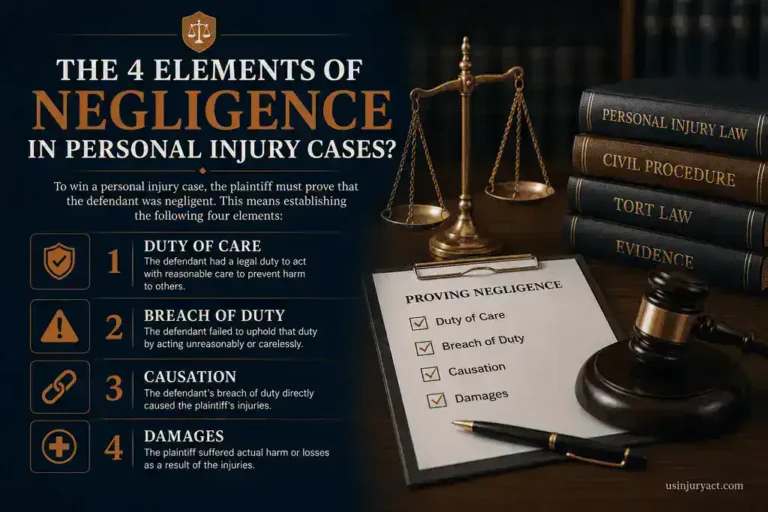
If you were hurt because someone else acted carelessly, you may be entitled to financial compensation. But to win a personal injury lawsuit in the United States, you cannot simply show that someone behaved badly. You must prove the four elements of negligence, and every single one of them must be established by a preponderance of the evidence, meaning it is more likely true than not.
These four elements are the legal backbone of virtually every personal injury claim, from car accidents to slip-and-falls, medical malpractice, and product liability. This guide plainly explains each element with real world scnarios that show exactly how courts apply them.
Why the Four Elements of Negligence Matter
Negligence is a legal theory, not just a word for careless behavior. The American legal system requires injured plaintiffs to prove four specific things before a defendant can be held liable.
Courts across the country, guided by the Restatement (Second) of Torts and decades of common law, have settled on this four-part framework as the standard for negligence claims. If you cannot prove even one of the four elements, your case fails, regardless of how badly you were hurt.
Understanding what these four elements are and how they interact puts you in a far stronger position when working with a personal injury attorney. It also helps you evaluate the strength of your own claim before you file.
Element 1: Duty of Care
The first element asks a simple question: Did the defendant owe you a legal duty of care at the time of the incident? A duty of care is a legal obligation to act with reasonable caution so as not to cause harm to others who could foreseeably be affected by your conduct.
Duty is not a moral concept here. It is a legal one defined by the relationship between the parties and the circumstances. Courts ask what a reasonable person in the defendant’s position would have recognized as a foreseeable risk of harm.
For Example: The Duty of a Driver
Every licensed driver in the United States owes a duty of care to other motorists, cyclists, and pedestrians on public roads. This duty is established both by common law and by state traffic statutes.
When you get behind the wheel, you accept an obligation to drive at a safe speed, obey traffic signals, and avoid distractions. You do not need a special relationship with the injured person. Strangers on the road are owed the same duty as passengers in your car.
Real-World Example: Property Owners and Visitors
A grocery store owner owes a duty of care to customers who enter the premises. Under premises liability law, the store must maintain reasonably safe conditions, inspect the floors for hazards, and warn visitors of dangers that are not immediately obvious.
This duty was the center of the landmark case Rowland v. Christian (1968), in which the California Supreme Court moved away from rigid classifications of visitors and toward a general standard of reasonable care.
Element 2: Breach of Duty
Once a duty is established, the next question is: Did the defendant fail to meet that duty? A breach occurs when someone falls below the standard of care that a reasonable person would have exercised in the same situation.
Courts do not require perfection, they ask what a reasonably prudent person would have done. If the defendant’s conduct falls short of that standard, a breach has occurred. The breach can be an act, such as running a red light, or an omission, such as failing to put up a warning sign near a wet floor.
The Reasonable Person Standard Explained
The reasonable person is a legal fiction, a hypothetical average citizen who exercises ordinary care and judgment. This standard is objective, meaning courts do not ask what the specific defendant thought was reasonable, they ask what a typical prudent person would have done given the same facts.
Professionals are held to a higher standard. A surgeon, for example, is measured against a reasonably competent surgeon, not against the average layperson.
Real World Example: Distracted Driving as a Breach
Imagine a delivery driver who is sending a text message while operating a company vehicle. At the moment he looks down at his phone, he drifts into a bike lane and strikes a cyclist. The duty of care is clear because he is a driver on a public road. The breach is equally clear because a reasonable driver would not text behind the wheel.
Most states have laws expressly prohibiting handheld device use while driving, which makes proving breach even more straightforward through the doctrine of negligence per se.
Element 3: Causation
Proving duty and breach is not enough. You must also show that the defendant’s breach actually caused your injuries.
Causation in negligence law has two separate components: actual cause and proximate cause. Both must be satisfied.
Actual Cause: The “But For” Test
Actual cause, also called cause-in-fact, is analyzed using the “but for” test. You ask: But for the defendant’s breach, would the plaintiff’s injury have occurred?
If the answer is no, actual cause is established. If the injury would have happened anyway, regardless of the defendant’s conduct, then the defendant’s breach did not cause it.
For example, if a driver rear-ends your car at a stoplight, you would not have suffered whiplash but for that collision. The driver’s breach of duty directly produced your injury.
Proximate Cause: Foreseeability and Legal Limits
Proximate cause, sometimes called legal cause, limits liability to harms that were a foreseeable result of the defendant’s conduct. Courts use it to prevent defendants from being held responsible for every conceivable consequence of their actions, no matter how remote or bizarre.
The foundational proximate cause case in American law is Palsgraf v. Long Island Railroad Co. (1928), where Judge Benjamin Cardozo held that a defendant can only be liable for injuries to plaintiffs who are within the zone of foreseeable danger created by the negligent act.
This ruling still shapes how courts analyze causation today.
Real-World Example: Causation in a Slip-and-Fall
A restaurant fails to mop up a spill near the entrance and a customer slips, falls, and breaks her wrist. She was already in good health before the fall. The broken wrist would not have occurred but for the restaurant’s failure to clean the floor.
The injury is also a foreseeable result of leaving a wet floor unattended in a high traffic area. In this case, both actual and proximate cause are met.
Element 4: Damages
Even if you prove duty, breach, and causation, you cannot recover compensation without demonstrable damages. Damages are the actual harm you suffered as a result of the defendant’s negligence. Without damages, there is no compensable claim.
Types of Damages in Personal Injury Cases
Personal injury damages fall into two broad categories: economic damages and non-economic damages.
Economic damages are measurable financial losses. They include medical bills, lost wages, future medical expenses, rehabilitation costs, and property damage. These are calculated using bills, pay stubs, tax records, and expert testimony from medical professionals or economists.
Non-economic damages cover intangible harms. They include pain and suffering, emotional distress, loss of enjoyment of life, and loss of consortium. These are harder to quantify and are often the subject of negotiation and jury determination.
Some states impose caps on non-economic damages, particularly in medical malpractice cases. California’s Medical Injury Compensation Reform Act, for example, has historically limited non economic damages in malpractice claims, though recent voter initiatives have adjusted those caps.
In rare cases involving intentional or reckless misconduct, punitive damages may also be available. These are not intended to compensate the plaintiff but to punish the defendant and deter similar future conduct.
Here’s An Example: Damages in a Workplace Injury
A construction worker falls from scaffolding because his employer failed to provide required safety harnesses in violation of OSHA regulations. He suffers a fractured spine requiring surgery, months of rehabilitation, and ultimately cannot return to his trade.
His economic damages include every medical bill, every day of lost income, and projected future earning losses. His non-economic damages include the chronic pain he will live with and the emotional trauma of permanently altered physical capabilities.
Together, these damages form the measure of compensation his attorney will pursue.
How All Four Elements Work Together
The four elements of negligence function as interlocking pieces, remove any one of them and the plaintiff’s case collapses.
A defendant might owe a duty and even breach it, but if the breach did not cause the plaintiff’s harm, there is no liability.
A defendant might have caused an accident, but if the plaintiff suffered no damages, there is nothing to recover.
This is why skilled personal injury attorneys gather evidence meticulously at every stage.
- Duty is established through legal analysis of the relationship between the parties.
- Breach is proven with witness testimony, surveillance footage, police reports, and expert opinions.
- Causation is built with medical records and accident reconstruction.
- Damages are documented with bills, records, and expert economic projections.
Affirmative Defenses That Can Counter Negligence Claims
Even when all four elements are established, defendants can raise affirmative defenses. Contributory negligence argues the plaintiff was also at fault. In pure contributory negligence states like Virginia and Maryland, any fault by the plaintiff can bar recovery entirely.
Most states follow comparative negligence, either pure comparative fault or modified comparative fault, which reduces the plaintiff’s recovery by their percentage of fault rather than eliminating it completely.
Assumption of risk is another defense, arguing the plaintiff voluntarily accepted a known danger. These defenses require the defendant to raise and prove them, which is why the plaintiff’s legal team must anticipate and counter them from the start.
Summary: The Four Elements Of Negligence
The four elements of negligence are duty, breach, causation, and damages and are the foundation of every personal injury claim in the United States.
Proving all four by a preponderance of the evidence is what separates a successful lawsuit from a dismissed complaint.
Peradventure your injury happened in a car crash, on someone’s property, in a hospital, or at work, your right to compensation depends entirely on building a case around these four pillars.
If you believe you have been injured due to someone else’s negligence, consulting with an experienced personal injury attorney is the most important step you can take toward protecting your rights and your financial future.