When you purchase auto insurance, one of the most consequential decisions you will ever make happens quietly inside a policy form. In states that offer a choice, you must select between full tort and limited tort coverage.
This choice does not affect how your car gets repaired or how your medical bills get paid. It determines your legal right to sue for pain and suffering after a car accident.
Most drivers focus on premiums and deductibles, but very few fully grasp that their tort election can mean the difference between receiving full compensation for injuries and walking away with nothing beyond a few medical bills reimbursed.
This guide breaks down the full tort vs limited tort debate in the simplest way possible and covers how each option works, which states offer the choice, what exceptions exist, and how real accident victims have been affected by this critical decision.
What Does Full Tort vs Limited Tort Mean in Auto Insurance?
Layperson Explanation
A tort is a civil wrong that causes harm to another person. In the context of auto insurance, your tort election controls what you can legally pursue if another driver causes an accident and injures you.
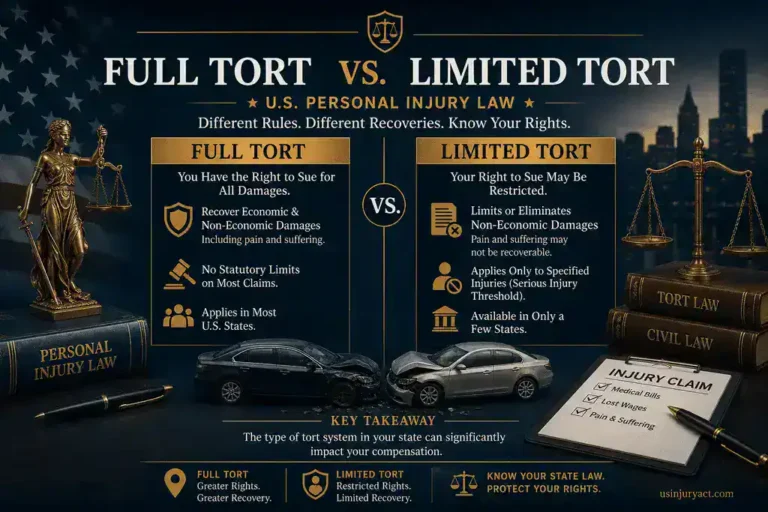
Under full tort coverage, you retain the complete right to file a lawsuit against the at-fault driver. You can seek compensation for all your losses, including both economic damages such as medical bills and lost wages, and non-economic damages such as pain and suffering, emotional distress, and reduced quality of life.
Under limited tort coverage, you trade away a portion of those legal rights in exchange for a lower insurance premium. Specifically, you surrender the right to sue for pain and suffering unless your injuries cross a legally defined serious injury threshold.
The Legal Definition of Tort
In civil law, a tort is any wrongful act, other than a breach of contract, that results in injury to another person and for which courts impose liability.
Negligent driving is one of the most common torts in the United States. When a driver runs a red light and injures you, they have committed a tort. Your insurance coverage election determines your ability to seek full redress for that tort.
The Core Difference in Lawsuit Rights
The most direct way to describe the difference is this:
- Full tort: You keep every legal right you have. If someone injures you, you can pursue the full range of available damages regardless of severity.
- Limited tort: You surrender the right to sue for non-economic damages unless your injuries meet a specific standard. Minor to moderate injuries typically fall below that threshold.
How Does Full Tort Coverage Work After a Car Accident?
Legal Rights Retained Under Full Tort
When you elect full tort on your auto insurance policy, you retain unrestricted access to the civil court system after an accident caused by another driver. You do not need to prove that your injuries are catastrophic or permanent before pursuing a claim for pain and suffering.
Even if you suffer a soft tissue injury, a neck strain, a back sprain, or a concussion, you have the legal right to pursue compensation for the physical pain, the disruption to your daily life, and the emotional distress those injuries caused.
The full tort election keeps that door open regardless of injury severity.
Types of Damages Recoverable
Under full tort coverage, accident victims can pursue two broad categories of damages:
- Economic damages: These are the documented, calculable financial losses directly caused by the accident. They include medical expenses, future medical costs, lost wages, loss of future earning capacity, property damage, and out-of-pocket expenses.
- Non-economic damages: These are the personal, intangible losses that do not appear on a receipt. They include physical pain, emotional suffering, loss of enjoyment of life, anxiety, depression, and loss of consortium for a spouse or family member.
Full tort coverage ensures you can seek compensation across both categories. This is significant because in many accident cases, non-economic damages represent a substantial portion of the total claim value, often exceeding economic damages when injuries are serious or chronic.
How a Full Tort Claim Flows
After an accident where another driver is at fault, a full tort claimant can:
- File a third-party claim directly against the at-fault driver’s liability insurance.
- Pursue a personal injury lawsuit in civil court if settlement negotiations fail.
- Seek full compensation for all economic and non-economic losses without a severity threshold.
- Negotiate from a position of strength because the threat of litigation is credible and unrestricted.
How Does Limited Tort Coverage Restrict Your Legal Rights?
What Rights Are Surrendered
Choosing limited tort auto insurance is a legal election with lasting consequences. When you sign on the limited tort line, you are formally agreeing to restrict your own right to sue for non-economic damages in the event of a future accident.
This means that if you are injured in an accident that was not your fault, you are generally prohibited from suing the at-fault driver for pain and suffering, emotional distress, loss of enjoyment of life, or similar non-economic losses, provided your injuries do not reach the serious injury threshold defined by your state’s law.
You retain the right to recover economic damages such as medical bills and lost wages. However, since pain and suffering claims can represent a large portion of injury case value, limited tort holders typically receive substantially lower settlements for the same type of accident when compared to full tort holders.
The Serious Injury Threshold Explained
Each state that offers a limited tort option defines what level of injury is severe enough to allow a limited tort policyholder to sue for pain and suffering. This is called the serious injury threshold.
Injuries that fall below the threshold leave the accident victim with only economic damage recovery. Injuries that meet or exceed the threshold restore the right to sue for non-economic damages, effectively giving the limited tort holder the same legal options as a full tort holder for that claim.
The critical problem is that many common accident injuries, including whiplash, soft tissue damage, herniated discs, and even nerve damage, are frequently disputed by defense attorneys and insurance adjusters as failing to meet the threshold.
This forces limited tort victims into a preliminary legal battle just to establish their right to sue for full damages.
Limited tort generally blocks claims for pain and suffering unless injuries meet defined serious conditions such as death, permanent disfigurement, or significant impairment of body function. Many moderate injuries fall below this threshold.
What Counts as a Serious Injury Under Limited Tort Laws?
Legal Definition of Serious Injury
The legal definition of serious injury is statute-specific and varies somewhat by state, but common elements appear across Pennsylvania, New Jersey, and Kentucky, the three states with elective tort systems.
In Pennsylvania, the Motor Vehicle Financial Responsibility Law defines serious injury as one resulting in death, serious impairment of body function, or permanent serious disfigurement.
New Jersey law defines serious injury as death, dismemberment, significant disfigurement or scarring, displaced fractures, loss of a fetus, or a permanent injury within reasonable medical probability other than scarring.
Serious injury typically includes death, permanent disfigurement, or significant impairment of a body function. These are the injuries that allow a limited tort policyholder to cross the threshold and pursue pain and suffering damages.
How Courts Interpret the Threshold
Courts in limited tort states have developed substantial case law around the serious injury threshold. In general, courts look at several factors when evaluating a threshold claim:
- The nature and extent of the injury as documented by medical professionals.
- The impact of the injury on the person’s daily activities and quality of life.
- The permanence of the injury or its expected long term effects.
- Medical evidence supporting the severity classification, including imaging results, specialist diagnoses, and surgical records.
Courts have ruled both ways on herniated discs, torn ligaments, and spinal injuries. The outcome often depends heavily on the quality of medical documentation and the persuasiveness of expert testimony.
This inherent uncertainty is one of the strongest arguments for electing full tort coverage from the outset.
Examples of Injuries and Their Typical Threshold Status
| Injury Type | Typically Meets Threshold | Commonly Disputed |
| Death | Yes | No |
| Traumatic brain injury | Yes | Sometimes |
| Permanent paralysis | Yes | No |
| Severe fracture (displaced) | Yes | Sometimes |
| Permanent disfigurement | Yes | Sometimes |
| Soft tissue injury (whiplash) | No | Yes |
| Herniated disc (non-surgical) | Contested | Yes |
| Nerve damage (documented) | Contested | Yes |
| Minor fracture | Usually No | Yes |
| Emotional trauma only | No | Yes |
Which States Offer Full Tort vs Limited Tort Options?
The Three Elective Tort States
Most states in the United States use a traditional at-fault tort system where all injured parties retain full lawsuit rights regardless of their insurance election.
However, three states have created elective systems that give drivers the option to choose between full tort and limited tort coverage. These states are Pennsylvania, New Jersey, and Kentucky.
Pennsylvania, New Jersey, and Kentucky are the three states that allow drivers to choose between full tort and limited tort auto insurance options at the time of policy purchase.
Pennsylvania
Pennsylvania is the state where the full tort vs limited tort election is most prominently featured in auto insurance policy purchases. Under the Pennsylvania Motor Vehicle Financial Responsibility Law – 75 Pa.C.S. Section 1705, drivers must affirmatively choose between full tort and limited tort when purchasing personal auto insurance. If no selection is made, limited tort is the default.
The serious injury threshold in Pennsylvania includes death, serious impairment of body function, and permanent serious disfigurement.
Pennsylvania courts have generated extensive case law interpreting what qualifies as serious impairment of body function, with outcomes that vary considerably based on individual circumstances.
New Jersey
New Jersey operates under a no-fault insurance system with a tort threshold election.
Drivers in New Jersey choose between the Limitation on Lawsuit Option (limited tort equivalent) and the Unlimited Right to Sue Option (full tort equivalent) at the time of policy purchase. The New Jersey Automobile Insurance Cost Reduction Act governs these elections.
In New Jersey, the Limitation on Lawsuit threshold requires that injuries involve death, dismemberment, significant disfigurement, displaced fractures, loss of a fetus, or a permanent injury other than scarring to restore full lawsuit rights. The premium difference between the two options in New Jersey can be significant.
Kentucky
Kentucky is a unique case. It is a no-fault state that offers drivers the option to opt out of the no-fault system entirely and remain in the traditional tort system.
A driver who rejects no-fault coverage in Kentucky retains the full right to sue for all damages, including pain and suffering, without any threshold requirement.
Drivers who remain in the no-fault system face restrictions on their ability to sue for non-economic damages until a monetary threshold of medical expenses is reached.
All Other States
Drivers in the remaining 47 states operate under either a traditional at-fault tort system, which preserves full lawsuit rights by default, or a mandatory no-fault system, which restricts lawsuits to serious injuries without offering the choice between coverage levels.
If you live outside Pennsylvania, New Jersey, or Kentucky, the full tort vs limited tort election does not directly apply to your policy, though understanding no-fault thresholds in your state is equally important.
How Do Costs Compare Between Full Tort and Limited Tort Insurance?
Premium Differences
The insurance premium trade-off is the primary reason many drivers choose limited tort coverage. Limited tort policies are consistently less expensive than full tort policies because insurers know that limiting your legal rights reduces the likelihood and value of claims made against their insured drivers.
In Pennsylvania, the premium savings for choosing limited tort can range from roughly 15 percent to 40 percent depending on the insurer, vehicle type, geographic area, and driving record. For some households, this can translate to hundreds of dollars annually.
Simply put, limited tort policies are typically cheaper but significantly reduce compensation potential after a serious accident. The upfront savings may be far outweighed by the financial exposure created by restricted lawsuit rights.
The Risk Versus Savings Analysis
The cost comparison between full tort and limited tort is not simply a matter of premium dollars. It requires evaluating the potential financial exposure created by each option.
Consider a scenario where you pay an extra 200 dollars per year for full tort coverage. Over ten years, that amounts to 2,000 dollars in additional premiums.
Now consider that a moderate injury claim involving chronic back pain, missed work, and diminished quality of life could yield tens of thousands of dollars in non-economic damages under full tort, and nothing in non-economic damages under limited tort.
The math strongly favors full tort when evaluated over a claim horizon instead of a premium horizon. The one-time nature of a serious accident means that the rights surrendered under limited tort can never be recovered after the accident has occurred.
What Insurers Know That Many Policyholders Do Not
Insurance companies are sophisticated actuarial institutions. They price limited tort discounts based on statistical models that account for claim frequency, injury severity distributions, and average claim values. The discount they offer for limited tort is calibrated to ensure profitability.
In other words, if the insurer is willing to give you a 200-dollar annual discount for choosing limited tort, they expect to save far more than that on reduced claim payments.
What Damages Can You Recover Under Each Tort Option?
Economic Damages
Economic damages are quantifiable financial losses directly caused by the accident. Both full tort and limited tort policyholders can generally pursue economic damages from at-fault drivers. These include:
- Medical bills, including emergency room, hospitalization, surgery, physical therapy, and medication.
- Future medical expenses projected for ongoing treatment or rehabilitation.
- Lost wages for time missed from work due to injuries.
- Loss of future earning capacity if injuries impair long-term employment.
- Property damage including vehicle repair or replacement costs.
- Out-of-pocket expenses such as transportation to medical appointments.
Non-Economic Damages
Non-economic damages compensate for the personal toll of an injury. Under full tort, these are fully recoverable. Under limited tort, they are recoverable only if the serious injury threshold is met. Non-economic damages include:
- Physical pain and suffering, both past and future.
- Emotional distress and psychological trauma.
- Loss of enjoyment of life and inability to engage in previously enjoyed activities.
- Scarring and permanent disfigurement.
- Loss of consortium, which compensates a spouse for loss of companionship and intimacy.
- Embarrassment, humiliation, and reduced social quality of life.
Side-by-Side Comparison
| Damage Category | Full Tort | Limited Tort |
| Medical bills | Recoverable | Recoverable |
| Lost wages | Recoverable | Recoverable |
| Future medical costs | Recoverable | Recoverable |
| Property damage | Recoverable | Recoverable |
| Pain and suffering | Always recoverable | Only if serious injury threshold met |
| Emotional distress | Always recoverable | Only if serious injury threshold met |
| Loss of enjoyment of life | Always recoverable | Only if serious injury threshold met |
| Loss of consortium | Always recoverable | Only if serious injury threshold met |
| Permanent disfigurement damages | Always recoverable | If classified as serious injury |
| Full compensation for minor injuries | Yes | No |
What Exceptions Allow Limited Tort Drivers to Sue for Pain and Suffering?
Limited tort is not an absolute bar to pain and suffering claims. State law provides specific exceptions that restore the full lawsuit right to limited tort policyholders in certain circumstances. These exceptions are important, but relying on them involves legal complexity and uncertainty.
Exceptions to limited tort can restore the right to sue for pain and suffering even when the injury threshold has not been met. These exceptions apply based on the nature of the at-fault driver’s conduct or status.
Exception 1: The At-Fault Driver Was Under the Influence
In both Pennsylvania and New Jersey, if the driver who caused the accident was operating under the influence of alcohol or drugs, limited tort restrictions are lifted.
The injured party can sue for full non-economic damages regardless of injury severity. This exception reflects public policy that drunk or impaired drivers should not benefit from the injured party’s limited tort election.
Exception 2: The At-Fault Driver Was Uninsured
If the driver who caused your accident was uninsured at the time of the collision, limited tort restrictions typically do not apply. The rationale is that your limited tort election was a compromise made within the insurance system, and an uninsured driver exists outside that system.
This exception allows you to pursue full damages through your own uninsured motorist coverage or directly against the at-fault driver.
Exception 3: The At-Fault Driver Was From Out of State
In Pennsylvania, if the at-fault driver is not a Pennsylvania resident and was not insured under a Pennsylvania policy, the limited tort restriction does not apply.
This exception recognizes that your tort election was a Pennsylvania-specific insurance decision and should not limit your rights against a party who was not subject to the same system.
Exception 4: The Injury Meets the Serious Injury Threshold
As discussed in earlier sections, if the injuries sustained in the accident meet the state’s statutory definition of serious injury, the limited tort restriction is lifted regardless of other factors.
This is the most commonly litigated exception and often requires medical expert testimony and legal argument to establish.
Exception 5: Intentional Acts
In cases where the at-fault driver acted intentionally in contrast to negligently, including road rage incidents, vehicular assault, or other deliberate harmful conduct, limited tort restrictions may not apply.
The courts generally hold that the limited tort election was designed to manage claims arising from negligent driving, not from intentional misconduct.
What Are Real World Examples of Full Tort vs Limited Tort Outcomes?
Scenario A: Minor Soft Tissue Injury (Rear-End Collision)
A driver is stopped at a traffic light and is struck from behind by another vehicle. The impact causes whiplash and cervical strain. Medical treatment costs 4,500 dollars.
The driver misses one week of work, representing 1,200 dollars in lost wages. The driver experiences neck pain and headaches for several months.
| Outcome Component | Full Tort Recovery | Limited Tort Recovery |
| Medical expenses | $4,500 | $4,500 |
| Lost wages | $1,200 | $1,200 |
| Pain and suffering | $15,000 to $25,000 | $0 (below threshold) |
| Total recovery estimate | $20,700 to $30,700 | $5,700 |
In this scenario, the full tort policyholder receives four to five times the total compensation for the same accident simply because they retained lawsuit rights.
The soft tissue injury would very likely fail to meet the serious injury threshold under limited tort.
Scenario B: Moderate Disc Injury (Intersection Collision)
A driver is T-boned at an intersection. The collision causes a herniated disc at L4-L5 that requires epidural steroid injections and six months of physical therapy. Medical costs total 22,000 dollars. Lost wages amount to 8,000 dollars. The injury causes chronic back pain affecting daily activities.
Under full tort, the driver could reasonably pursue and potentially recover $60,000 to $100,000 in total damages, including significant non-economic damages for chronic pain and lifestyle limitation.
Under limited tort, the outcome is uncertain. The herniated disc may or may not meet the serious injury threshold depending on the state, the specific medical evidence presented, and the court’s interpretation.
If the threshold is not met, non-economic damages are barred entirely. If it is met, recovery may approach what a full tort holder would obtain, but only after expensive threshold litigation.
Scenario C: Catastrophic Injury
For injuries that clearly meet the serious injury threshold, such as traumatic brain injury, spinal cord injury, or loss of limb, the practical difference between full tort and limited tort narrows significantly because both options allow full damage recovery.
However, the full tort holder avoids the preliminary legal battle over threshold qualification, saving time, legal fees, and uncertainty.
Questions People Ask About Full Tort vs Limited Tort?
The following are the most commonly searched questions about full tort and limited tort auto insurance, with direct and legally grounded answers.
Can You Sue With Limited Tort?
Yes, but your right to sue for pain and suffering is limited. Under limited tort, you can always pursue economic damages such as medical bills and lost wages. You can only sue for non-economic damages such as pain and suffering if your injuries meet the serious injury threshold defined by your state, or if one of the recognized exceptions applies (DUI driver, uninsured driver, out-of-state driver, intentional conduct).
Is Full Tort Worth the Extra Cost?
For most drivers, yes. The additional premium cost for full tort coverage is modest relative to the potential value of non-economic damages in a serious accident. Since accidents are unpredictable and injuries cannot be forecast, retaining full lawsuit rights provides a financial safety net that is difficult to replicate after the fact. The premium savings from limited tort rarely justify the exposure created for anything more than a minor fender-bender.
What Happens After a Serious Injury With Limited Tort?
If your injuries qualify as serious under your state’s law, your limited tort restriction is lifted and you can pursue full non-economic damages. However, you will typically need to litigate the threshold question first, which means additional legal proceedings, expert testimony, and delay before your full claims can be addressed. Full tort holders avoid this preliminary step entirely.
Can You Switch Tort Options Later?
You can change your tort election at policy renewal. However, the election in effect at the time of the accident governs your legal rights for that accident. Switching to full tort after an accident has already occurred does not retroactively restore your rights for that claim. It is important to review your tort election at every renewal period.
Does Limited Tort Affect Settlement Value?
Yes, significantly. Insurance adjusters and defense attorneys are aware of your tort election before any settlement negotiation begins. Limited tort policyholders routinely receive lower settlement offers because the insurer knows the victim cannot threaten a viable pain and suffering lawsuit without first proving the serious injury threshold. This asymmetry in negotiating leverage directly depresses settlement values for limited tort holders.
What Is the Default Tort Election If You Do Not Choose?
In Pennsylvania, limited tort is the default election if you fail to affirmatively select full tort. Many policyholders do not realize they were enrolled in limited tort because they signed a policy without fully reviewing the tort election section. Always verify your current tort election with your insurance agent.
Does Tort Election Apply to All Vehicles?
The tort election applies to the insured vehicle and the named insured on the policy. If you drive multiple vehicles insured under separate policies, each policy carries its own tort election. Household members named as insureds on the same policy are typically covered by that policy’s tort election as well.
Does Limited Tort Affect Uninsured Motorist Claims?
In most cases, the limited tort election also affects uninsured motorist claims. If you are hit by an uninsured driver, your limited tort election may limit your uninsured motorist claim for pain and suffering unless the uninsured driver exception applies. Review your policy carefully and consult an attorney if an uninsured driver has injured you.
Can a Passenger Be Affected by the Driver’s Tort Election?
Passengers are typically governed by their own insurance policy’s tort election, not the driver’s. However, the specific rules can depend on the relationship between the passenger and the vehicle owner, the state’s law, and policy language. Passengers injured in accidents should consult their own insurer and a personal injury attorney to understand which policy governs their claim.
What Should I Do If I Have Limited Tort and Was Injured?
If you have limited tort coverage and have been injured in an accident caused by another driver, consult a personal injury attorney immediately. An attorney can evaluate your injuries against the serious injury threshold, identify applicable exceptions, assess the at-fault driver’s insurance status, and build the strongest possible case for your full recovery. Many personal injury attorneys offer free consultations and work on contingency.