Food poisoning is miserable, and in severe cases, it is life-threatening. If you ate at a restaurant and became seriously ill, you have every right to ask whether you can sue a restaurant for food poisoning and actually win.
The answer is yes, but winning a food poisoning lawsuit requires more than pointing to your lunch receipt and a hospital discharge summary. It requires evidence, legal strategy, and a clear grasp of how product liability and negligence law apply to your situation.
This blogpost breaks down the legal theories that support food poisoning lawsuits against restaurants, the evidence you need to build a winning case, the common defenses restaurants use and how to defeat them, and the damages you can recover.
By the end, you will know exactly what it takes to hold a negligent restaurant legally accountable.
The Legal Theories Behind a Restaurant Food Poisoning Lawsuit
You have multiple legal avenues when pursuing a food poisoning claim against a restaurant. The strongest cases invoke more than one theory simultaneously, which strengthens your position at every stage from negotiation to trial.
Negligence
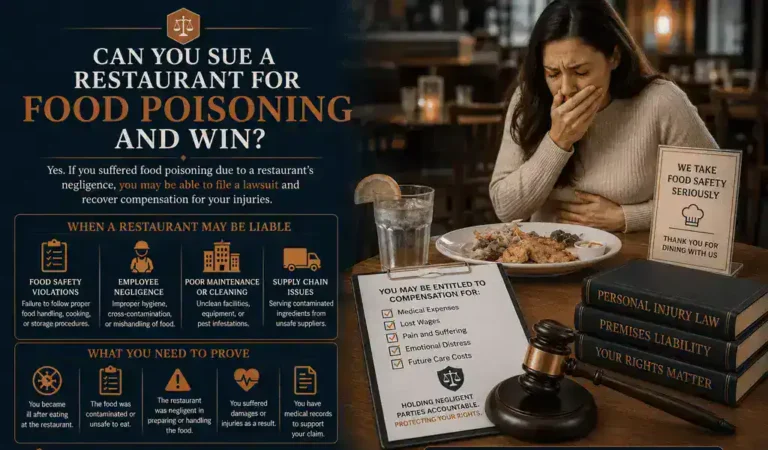
Negligence is the most commonly used theory in food poisoning cases. To succeed, you must show that the restaurant owed you a duty of care, breached that duty, and that the breach caused your illness and damages.
Restaurants owe their customers a duty of reasonable care in the preparation, handling, and storage of food. This duty is well established and rarely disputed.
Breach occurs when a restaurant deviates from accepted food safety standards. Serving chicken cooked below the FDA-recommended internal temperature of 165 degrees Fahrenheit, failing to refrigerate perishable ingredients at or below 40 degrees, using the same cutting boards for raw poultry and ready-to-eat foods, or employing a kitchen worker who is ill and contagious are all examples of conduct that constitutes a breach of the duty of care.
The most challenging element is causation, you must establish that the restaurant’s food specifically caused your illness, not something else you ate, drank, or were exposed to before or after your meal. This requires medical and scientific evidence that connects the dots definitively.
Strict Product Liability
Under strict product liability, a seller or manufacturer of a defective product can be held liable for harm caused by that defect, even without proof of negligence. Food is a product under this doctrine, which means if the food you consumed at a restaurant was contaminated, it was defective.
The beauty of strict liability in the food poisoning context is that you do not need to prove the restaurant was careless. You only need to prove the food was contaminated, you consumed it, and it made you sick.
Courts across the country, from California to New York, have applied strict liability to contaminated restaurant food with great consistency.
The Restatement Second of Torts and the Restatement Third of Torts both provide frameworks that courts use to evaluate product liability claims involving defective food products.
The consumer expectation test, applied in many states, asks whether a reasonable consumer would expect to encounter the dangerous condition in the food. A reasonable person does not expect their restaurant meal to contain Salmonella, E. coli O157:H7, Listeria, Campylobacter, or Hepatitis A.
Breach of Implied Warranty
Under the Uniform Commercial Code, which has been adopted in some form by every state, there is an implied warranty of merchantability that attaches to the sale of goods, including food.
This warranty guarantees that food sold to consumers is fit for human consumption. When a restaurant sells you contaminated food, it breaches this implied warranty, entitling you to damages.
This theory is particularly useful in states where strict liability for sellers is limited, because the warranty theory reaches the same result through contract law principles and not tort law.
Proving Causation in a Food Poisoning Case
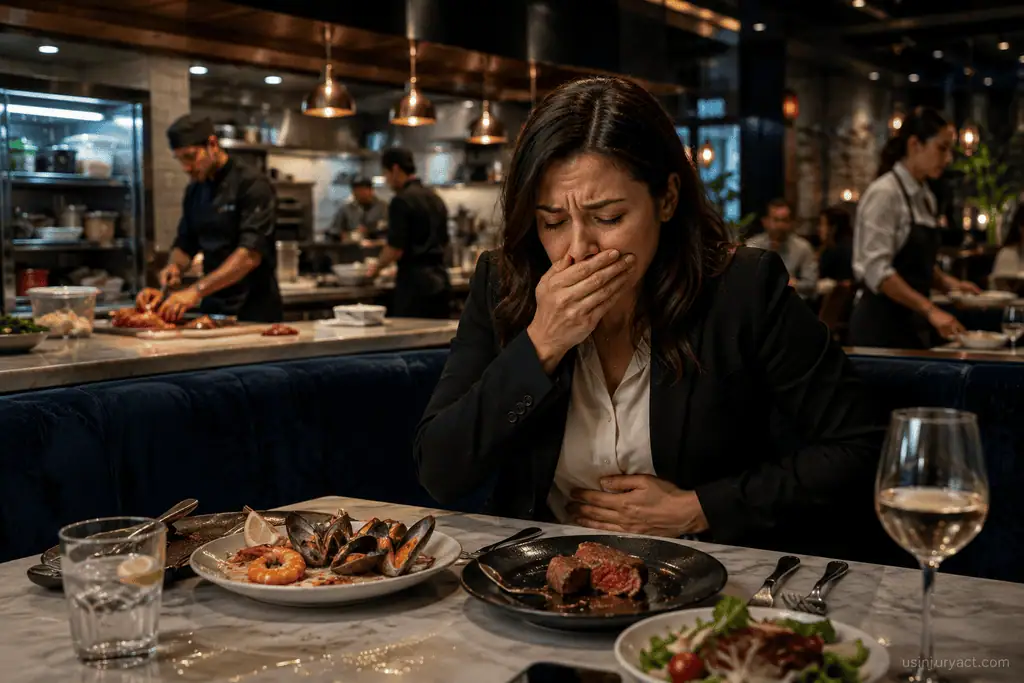
Causation is the battleground in virtually every food poisoning lawsuit. Defense attorneys will challenge your claim that their client’s food caused your illness at every opportunity, and they will have expert witnesses who raise alternative explanations.
The most powerful evidence you can have is a positive stool culture or blood test identifying the specific pathogen that made you sick, combined with laboratory or health department testing linking that same pathogen to the restaurant’s food or kitchen environment.
When the strain of bacteria or virus found in your body matches the strain found in the restaurant, causation becomes nearly unassailable.
Public health investigations by local or state health departments often produce this type of matching evidence. The Centers for Disease Control and Prevention tracks food poisoning outbreaks nationally through its surveillance systems.
When your illness is part of a documented outbreak traced to a specific restaurant, you are in an exceptionally strong legal position because the causation evidence has essentially been developed for you by government scientists.
Evidence That Wins Food Poisoning Cases Against Restaurants
Building a winning case requires assembling multiple categories of evidence that together tell a clear and compelling story.
- Medical records documenting your diagnosis, the pathogen identified, the treatment you received, and your prognosis
- Stool or blood culture results confirming the specific bacterial or viral strain responsible for your illness
- Health department inspection reports for the restaurant, particularly any violations involving improper food storage, inadequate cooking temperatures, or employee hygiene failures
- Receipts, credit card statements, or reservation records confirming you ate at the restaurant and what you ordered
- Witness statements from others who ate at the restaurant and became ill with similar symptoms around the same time
- Social media posts, Google reviews, or Yelp complaints from other customers reporting illness after eating at the same establishment
- Leftover food samples tested by a private laboratory, if you still have any of the meal at home
- Records of prior health code violations or prior illness complaints against the restaurant from health department databases
Common Defenses Restaurants Use and How to Defeat Them
Restaurants and their insurance companies do not roll over in food poisoning cases. They deploy specific defenses routinely, and you need to be prepared for each one.
The “You Could Have Gotten Sick Anywhere” Defense
This is the most common defense. The restaurant will argue that you cannot prove their food caused your illness because you may have eaten something contaminated elsewhere in the 24 to 72 hours before your symptoms appeared.
This is why a detailed food diary documenting everything you ate and drank in the 72 hours before your illness is invaluable.
If other people who ate at the same restaurant around the same time also became ill with the same pathogen, this defense collapses.
Multiple plaintiffs with the same pathogen strain pointing to a single common food source is exactly the kind of epidemiological evidence that wins these cases.
The “Your Symptoms Are Consistent With Many Things” Defense
If your diagnosis is nonspecific, such as a general gastrointestinal illness without an identified pathogen, the defense will argue that your symptoms could have resulted from stress, a pre-existing condition, or another cause unrelated to their food.
This is why prompt medical attention and comprehensive testing are so critical. A confirmed laboratory diagnosis with a specific pathogen dramatically narrows the argument space for the defense.
The “We Follow All Health Codes” Defense
Even if a restaurant passed its most recent health inspection, that does not mean the specific meal you ate was prepared safely. Health inspections are snapshots taken on specific days. A kitchen that passed inspection last month may have stored raw chicken improperly the day you visited.
Your attorney can request kitchen logs, temperature records, employee illness records, and food delivery documentation to look for deviations from proper protocol that may not show up on a periodic inspection report.
What Damages Can You Recover in a Food Poisoning Lawsuit
The damages available in a food poisoning lawsuit depend on the severity of your illness. Most food poisoning cases involve an unpleasant but relatively brief gastrointestinal episode.
However, severe cases can cause kidney failure, neurological damage, hemolytic uremic syndrome, miscarriage, or death, particularly in vulnerable populations such as the elderly, young children, and immunocompromised individuals.
Economic damages cover medical expenses including emergency room visits, hospitalization, specialist consultations, medications, and follow-up care. They also include lost wages for any time you missed work due to illness or recovery, as well as future medical expenses if you develop chronic complications.
Non economic damages cover pain and suffering, which in a severe food poisoning case can be very significant. Surviving kidney failure, Guillain-Barre syndrome triggered by Campylobacter infection, or the neurological damage caused by Listeria monocytogenes represents a profound and lasting physical ordeal that courts and juries recognize with substantial awards.
In cases where the restaurant had actual knowledge of a food safety problem and continued serving potentially contaminated food, punitive damages may be available to punish the conduct and deter similar behavior in the future.
Realistic Food Poisoning Lawsuits That Illustrate These Principles
Imagine A family of four eats at a local Mexican restaurant. Within 24 hours, all four family members develop severe gastrointestinal symptoms. The parents take their 7-year-old to the emergency room when she develops bloody diarrhea.
Stool cultures confirm E. coli O157:H7 in all family members. The local health department investigates and finds the same E. coli strain in the restaurant’s ground beef and in a reach-in cooler holding temperatures 15 degrees above the safe threshold.
The restaurant’s most recent inspection report, obtained through a public records request, shows a prior violation for improper cold storage. The family’s attorney files suit under both negligence and strict liability theories, supported by the health department findings.
The case settles before trial for a substantial six-figure amount.
Here is another scenario to drive the point home:
A 68-year-old man with diabetes eats at an upscale seafood restaurant and orders raw oysters. He develops Vibrio vulnificus infection, a rare but life-threatening bacterial illness particularly dangerous in people with liver disease or diabetes.
He is hospitalized for two weeks and requires amputation of two toes due to necrotizing fasciitis. Oyster traceability records obtained in discovery link the specific oysters served at the restaurant to a harvesting operation that had recent water quality violations.
The plaintiff’s attorney files a product liability claim against the restaurant and the oyster supplier. The jury awards compensatory and punitive damages against the restaurant and suppliers under joint and several liability.
Statute of Limitations for Food Poisoning Claims
Personal injury claims, including food poisoning lawsuits, are subject to statutes of limitation that vary by state. In most states, you have two years from the date of your injury to file a lawsuit.
However, some states allow only one year, and a few allow three. Do not assume you have time, consult an attorney promptly after any serious food poisoning incident.
The discovery rule may apply in cases where the connection between the food and the illness was not immediately apparent. Under this doctrine, the limitations period may not begin running until you knew, or reasonably should have known, that the restaurant’s food caused your illness.
This can be particularly relevant in Hepatitis A cases, where symptoms appear weeks after exposure.
So Can You Sue a Restaurant for Food Poisoning and Win
Yes, you can absolutely sue a restaurant for food poisoning and win. The legal theories are strong, the regulatory framework supports your case, and the damages can be substantial, particularly if your illness was severe.
The key is evidences are confirmed laboratory diagnosis, a documented connection to the restaurant, medical records showing the extent of your illness, and ideally, evidence that other customers suffered the same fate.
Food safety is a legal obligation, not a marketing slogan. Restaurants that cut corners on food handling, storage, or employee health standards expose themselves to serious civil liability.
If a restaurant’s negligence sent you to the hospital, a qualified personal injury attorney can help you hold them accountable and secure the compensation you deserve.