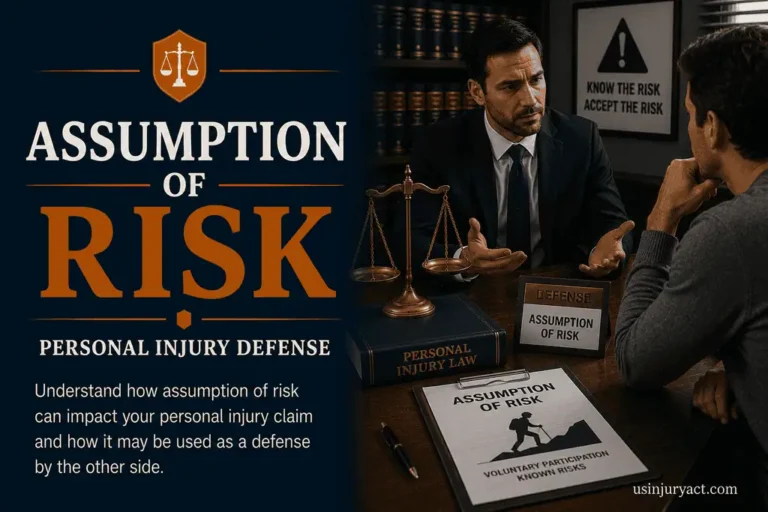
Let’s say you were injured while doing something inherently risky, such as skiing, playing contact sports, or working at a construction site, the defendant in your personal injury case may argue that you assumed the risk of that injury.
Assumption of risk is a frequently raised defenses in personal injury litigation across the United States and can reduce or completely eliminate your ability to recover compensation, depending on your state and the specific facts of your case.
What Is Assumption of Risk?
Assumption of risk is a legal doctrine that bars or limits recovery for a plaintiff who knowingly and voluntarily exposed themselves to a known danger that resulted in their injury.
The underlying principle is that a person who recognizes a risk, appreciates its nature, and freely chooses to encounter it anyway has, in effect, consented to bear the consequences of that risk.
The doctrine is ingrained in common law and traces its origins to the Latin maxim “volenti non fit injuria” which means no wrong is done to one who consents. American courts have applied this principle for over a century, though its scope and effect have evolved significantly with the adoption of comparative fault systems in most states.
Assumption of risk operates as both a complete defense and a partial defense depending on jurisdiction and the type of assumption involved. It is a fundamentally different concept from contributory negligence and comparative fault, though courts frequently address all three doctrines together when analyzing injury claims.
Key Elements That Must Be Present
For assumption of risk to apply, courts generally require proof of three elements.
- The plaintiff must have had actual knowledge of the specific risk that caused their injury. General awareness that an activity is dangerous is not enough, the plaintiff must have known about the particular hazard.
- The plaintiff must have appreciated the nature and extent of that risk, meaning they understood what could happen and how serious it could be.
- The plaintiff must have voluntarily chosen to encounter the risk. That means consent obtained through coercion, financial pressure, or lack of meaningful alternatives is not considered truly voluntary in many courts.
The Two Primary Types of Assumption of Risk
Express Assumption of Risk
Express assumption of risk occurs when the plaintiff explicitly agrees, either in writing or verbally, to accept the risks of an activity. The most common vehicle for express assumption of risk is the liability waiver or release of liability.
When you sign a waiver before going skydiving, using a gym, or participating in a marathon, you are expressly assuming the risks described in that document.
A waiver must be clear, unambiguous, and specific about the risks being assumed, and even at that courts still assess the enforceability of written waivers carefully.
Courts in most jurisdictions will not enforce a waiver that releases a defendant from liability for gross negligence or intentional misconduct.
The waiver must also be entered into voluntarily, if a party has no meaningful choice, such as signing a waiver to receive emergency medical care, courts may refuse to enforce it on grounds of unequal bargaining power or public policy.
California, Florida, New York, and Texas each have substantial bodies of case law on when express waivers are enforceable.
Virginia, on the other hand, has been more receptive to broad liability waivers than many other states, the enforceability question is always state-specific and fact-specific.
Implied Assumption of Risk
Implied assumption of risk arises not from an explicit agreement but from the plaintiff’s conduct and the circumstances. The plaintiff’s knowing, voluntary participation in a risky activity implies their acceptance of the risks inherent in it.
Courts look at what the plaintiff knew and what a reasonable person in the same situation would have understood.
Implied assumption of risk subdivides into two important categories that courts across the country have developed through decades of case law: primary assumption of risk and secondary assumption of risk.
Primary Assumption of Risk
Primary assumption of risk applies when the defendant owed no duty of care to the plaintiff with respect to the specific risk that caused injury.
The idea is that certain activities carry inherent risks that are simply part of the nature of the activity, and participants accept those risks as a condition of participation.
In primary assumption of risk, the defendant did not breach any duty, the harm resulted from a risk the plaintiff accepted as a known feature of the activity and not from any negligence.
A classic application is co-participant liability in contact sports. When two players collide during a soccer match for instance and and one is injured, the injured player generally cannot sue the other for negligence arising from the inherent physical contact of the game.
Courts in California, following the landmark Knight v. Jewett (1992) decision, recognized that co-participants in active sports owe each other only a duty to refrain from conduct that is intentionally harmful or reckless, not a general duty of ordinary care.
Primary assumption of risk functions as a complete defense so that if it applies, the plaintiff’s claim is extinguished at the threshold.
There is no comparative reduction; the claim simply does not exist because no duty was breached.
Secondary Assumption of Risk
Secondary assumption of risk applies when the defendant did owe a duty of care to the plaintiff and did breach that duty, but the plaintiff knowingly and voluntarily chose to encounter the resulting danger.
Secondary assumption of risk involves a plaintiff who takes a risk they know has been created or increased by the defendant’s negligence.
An example: a property owner negligently leaves a large hole uncovered on a walking path. A visitor notices the hole, appreciates the danger, and decides to walk across the path anyway rather than take an alternate route, and then falls in.
The property owner was negligent, but the visitor knowingly chose to encounter the hazard. Secondary assumption of risk applies to this scenario.
Unlike primary assumption of risk, secondary assumption of risk in most modern jurisdictions is folded into the comparative fault analysis instead of operating as a complete bar to recovery.
The plaintiff’s decision to knowingly encounter the known risk is treated as one form of contributory conduct and reduces their recovery proportionally.
It is also recognized to be synonymous with the open and obvious defense in mostly premises liability personal injury cases across the U.S.
How Assumption of Risk Operates as a Defense in Modern Litigation
Assumption of Risk in Comparative Fault States
The vast majority of U.S. states now operate under some form of comparative fault, either pure comparative fault or modified comparative fault. The adoption of comparative fault systems significantly changed how assumption of risk functions as a defense.
In most comparative fault jurisdictions, secondary assumption of risk is merged into the comparative fault analysis. The jury considers all of the plaintiff’s fault-related conduct, including their voluntary assumption of a known risk, and assigns a percentage of fault to each party.
This merged approach is used in California, New York, Florida (under modified comparative fault following 2023 legislative changes), Texas, and most other major states.
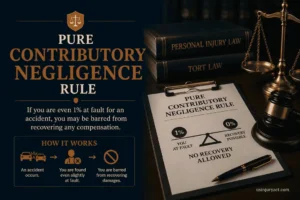
Pure contributory negligence states, including Virginia, Maryland, Alabama, North Carolina, and the District of Columbia, retain a harsher rule: any contributory negligence by the plaintiff, including voluntary assumption of risk, may completely bar recovery.
This is one reason why the assumption of risk defense has considerably more force in contributory negligence states than in comparative fault states.
The Fireman’s Rule and Professional Risk Takers
A specialized application of assumption of risk affects first responders and other professionals whose job duties require them to encounter hazardous situations.
The Fireman’s Rule is a doctrine recognized in several states that bars firefighters and police officers from suing property owners or others for negligence in creating the very conditions that necessitated the professional’s response.
The rule is grounded in assumption of risk principles, for instance a firefighter who enters a burning building to fight a fire has assumed the risks inherent in that task.
The property owner whose negligence started the fire does not owe a conventional negligence duty to the firefighter for risks that are the inherent hazards of firefighting.
The rule has been modified or rejected in some states, including New York and California to varying degrees, but it remains influential in others including Florida and New Jersey.
Inherent Risk Statutes in Recreational Activities
Many states have enacted specific statutes that codify assumption of risk for particular recreational activities. These laws are designed to protect businesses and operators from lawsuits arising from the inherent dangers of activities like skiing, equestrian sports, and mixed martial arts.
Colorado’s Ski Safety Act, for example, establishes that skiers assume the inherent risks of skiing and limits the liability of ski area operators for injuries resulting from those inherent risks. Similar statutes exist in Vermont, Utah, and other major ski states. The statutes generally carve out exceptions for operator negligence that goes beyond the inherent risks of the activity.
Equine liability statutes similarly protect horse owners and operators. More than 40 states have enacted some form of equine activity liability act that limits liability for injuries resulting from the inherent risks of equine activities.
These statutes vary in their scope, exceptions, and required signage or notice to participants.
Assumption of Risk: Applications and Instances
Sports Injuries and Co-Participant Liability
Consider a recreational softball league where a player at second base is injured when a runner slides aggressively into the base, causing a collision that fractures the fielder’s leg. The runner was playing within the normal rules of the game, but the injured fielder brings a negligence claim against the runner.
In California and similar jurisdictions following primary assumption of risk principles, the claim would very likely fail at the threshold because the risks of aggressive baserunning, including hard slides at second base, are inherent in softball.
A co-participant does not owe a duty to avoid all contact during the ordinary course of play. The fielder assumed the inherent physical risks of the sport by choosing to play, therefore no breach of duty occurred because the runner did not act recklessly or with intent to injure.
Gym Liability Waivers and Express Assumption
A gym member signs a standard liability waiver before beginning personal training sessions, and the waiver specifically states that the member assumes the risk of injuries arising from exercise activities, including those supervised by staff.
The member then suffers a torn ligament during a training session when the trainer demonstrates an exercise incorrectly and the member follows the faulty demonstration.
The analysis turns on the scope of the waiver and the degree of fault. A court in most jurisdictions would ask if the waiver cover negligent instruction by gym staff.
If the waiver’s language is broad enough and the jurisdiction enforces such waivers, express assumption of risk may bar the claim.
However, if the trainer’s conduct crossed into gross negligence or the waiver language was ambiguous about staff supervision, a court might refuse to enforce it.
This is precisely why the language and specificity of liability waivers matter so much.
Workplace Assumption of Risk
In the employment context, workers’ compensation systems in all U.S. states have largely displaced personal injury assumption of risk analysis for on-the-job injuries.
An injured worker typically files a workers’ compensation claim and not a tort lawsuit under the exclusive remedy doctrine. However, assumption of risk still arises in third-party lawsuits by injured workers against parties other than their employer.
A construction worker injured by defective scaffolding may sue the scaffolding manufacturer even if the worker knew the scaffolding was old and potentially unstable.
Whether the worker’s knowledge of the deteriorated condition constitutes assumption of risk sufficient to bar the claim against the manufacturer is a fact-intensive inquiry that varies by jurisdiction and the nature of the assumed risk.
The principle of voluntary assumption of a known risk requires courts to distinguish between a worker who knew of a danger and chose to ignore safe alternatives versus a worker who had no practical choice but to use the defective equipment.
How Courts Evaluate Assumption of Risk Claims
Assumption of risk is rarely resolved on the pleadings alone, as courts typically allow the case to proceed and evaluate the defense through summary judgment motions or jury instructions.
The factual questions of what the plaintiff knew, what they appreciated, and how voluntary their choice was are central to every assumption of risk analysis.
Defendants bear the burden of proving assumption of risk as an affirmative defense. They must introduce evidence showing the plaintiff had specific knowledge of the risk, not just general awareness that the activity was dangerous.
Courts are skeptical of sweeping claims that a plaintiff assumed all risks simply by entering a dangerous location or agreeing to do a dangerous job.
The distinction between inherent risks and enhanced risks created by a defendant’s negligence is critical. Courts across the country consistently hold that assumption of risk does not bar claims arising from risks that go beyond what is inherent in the activity.
A spectator at a baseball game assumes the risk of a foul ball entering the stands; they do not assume the risk that the stadium’s protective netting was negligently installed.
This boundary between inherent and negligently created risk is where most assumption of risk litigation is ultimately decided.