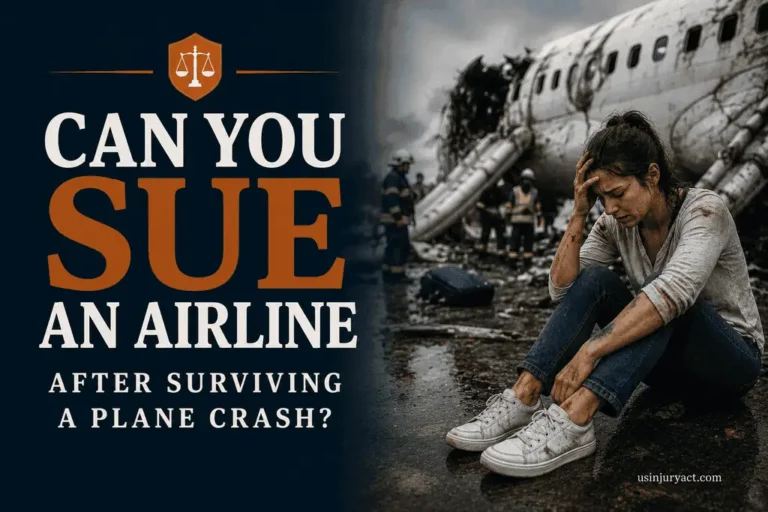
Surviving a plane crash is one of the most traumatic events a human being can experience. If you walked away from a commercial aviation accident or survived with serious injuries, you have the right to sue an airline after surviving a plane crash, and in most cases, the legal presumption of liability is already in your favor before your attorney files a single document.
Airline crash litigation is among the most sophisticated areas of personal injury law in the United States, governed by a layered set of federal statutes, international treaties, regulatory frameworks, and common law doctrines that differ significantly from standard car accident or premises liability claims.
This guide explains who is liable in a plane crash, how international and domestic law governs your right to sue an airline, the damages you can recover as a crash survivor, the specific procedural steps that apply to aviation claims, the treaty rules that govern international flights, and the real-world factors that determine settlement value in these cases.
So that by the time you finish reading, you will know exactly what legal rights you have and what your next steps should be.
The Legal Basis To Sue an Airline After a Crash
Negligence and the Duty of Care Owed by Common Carriers
Airlines operating commercial passenger flights are classified as common carriers under U.S. law. Common carriers owe the highest duty of care recognized in tort law to their passengers.
This elevated standard means that an airline cannot simply argue it acted reasonably in the way that an ordinary property owner or motorist might. Instead, it must demonstrate that it exercised the utmost care and diligence for the safe carriage of its passengers.
This common carrier duty pervades every aspect of aviation operations; It applies to maintenance of the aircraft, training and supervision of crew members, pre-flight inspections, adherence to Federal Aviation Administration airworthiness directives, fuel management, air traffic control coordination, and emergency response protocols.
A failure in any of these areas that contributes to a crash creates liability.
Strict Liability vs. Negligence in Domestic Aviation Cases
Domestic aviation accident claims in the United States are generally based on negligence, which means you must show that the airline or another party breached its duty of care and that the breach caused your injuries.
However, plaintiffs in aviation cases benefit enormously from the doctrine of res ipsa loquitur, which translates from Latin as the thing speaks for itself.
Under this doctrine, a court may infer negligence from the very fact that a crash occurred, because aircraft do not simply fall from the sky absent some negligence in operation, maintenance, or design.
The res ipsa inference shifts the burden of coming forward with evidence toward the defendant. The airline must effectively explain why the crash was not its fault rather than you having to prove every element of negligence from scratch.
This is a substantial procedural advantage in aviation litigation.
The Montreal Convention for International Flights
If your crash occurred on an international flight, the Montreal Convention of 1999 governs your claim. The United States ratified the Montreal Convention, which replaced the older Warsaw Convention.
The Montreal Convention applies to any flight where the point of departure or destination is in a signatory country, which includes virtually every commercial aviation nation in the world.
Under Article 17 of the Montreal Convention, a carrier is strictly liable for death or bodily injury to a passenger resulting from an accident on board the aircraft or during the process of boarding or disembarking.
Strict liability means you do not need to prove negligence for damages up to the Special Drawing Rights limit, which is periodically updated and was approximately $175,000 USD in 2026.
Above that threshold, the airline can escape liability only by proving that the damage was not due to its negligence or wrongful act, or that it was solely due to the negligence of a third party.
In practice, airlines rarely succeed in this defense in crash cases.
For Instance
A passenger on a transatlantic flight suffers severe spinal injuries when a sudden, unexplained structural failure causes the aircraft to pitch violently.
Under the Montreal Convention, the airline is strictly liable for the first tier of damages without any need to prove fault. For the full extent of her medical costs, lost income, and pain and suffering exceeding the SDR threshold, her attorneys proceed under the Article 21 second-tier claim demonstrating the airline’s maintenance records showed deferred inspections of the relevant component.
Who Can Be Sued Beyond the Airline
Aircraft Manufacturer Liability Under Products Liability Law
If the crash resulted from a defective aircraft component, an improperly designed system, or a failure in the aircraft’s structure, the aircraft manufacturer and any component manufacturer can be named as defendants under products liability theory.
Products liability in aviation cases can proceed under three theories:
- Manufacturing defect (the specific part that failed was produced incorrectly)
- Design defect (the entire product line had an inherent flaw)
- Failure to warn (the manufacturer did not adequately alert operators about a known risk).
Aviation products liability cases have generated some of the largest verdicts in U.S. legal history.
Litigation surrounding specific aircraft models with documented system failures has involved simultaneous state and federal court actions, consolidated multi-district litigation, and international arbitration proceedings against manufacturers headquartered abroad.
The FAA and Air Traffic Control
Air traffic control in the United States is operated by the Federal Aviation Administration, a federal government agency. If an ATC error contributed to your crash, you can sue the federal government under the Federal Tort Claims Act.
However, suing the federal government involves unique procedural requirements including a mandatory administrative claim filed with the FAA within two years of the incident and a six-month waiting period before a lawsuit can be filed.
FTCA claims are litigated in federal district court without a jury, meaning a federal judge decides both liability and damages. The discretionary function exception to the FTCA may shield certain government decisions from liability, but operational failures in ATC do not generally fall within this protection.
Maintenance Companies and Third-Party Contractors
Many airlines outsource heavy maintenance, engine overhaul, and avionics work to third-party MRO (maintenance, repair, and overhaul) companies. If a crash traces to negligent work by one of these contractors, the MRO company can be independently liable.
Airlines frequently attempt to shift blame to MRO contractors in litigation, which is why comprehensive investigations that subpoena all maintenance contracts, work orders, and inspection records are essential in airline crash cases.
Damages You Can Recover as a Plane Crash Survivor
Physical Injury Damages
Plane crash survivors often suffer catastrophic injuries including traumatic brain injuries, spinal cord damage, severe burns, crush injuries, fractures of multiple bones, and internal organ damage.
Your economic damages include all past and future medical expenses, rehabilitation costs, in-home nursing care, adaptive equipment, and housing modifications required by permanent disabilities.
Future damages are calculated with the assistance of life care planners who project the cost of your medical needs over your expected lifetime and economists who calculate the present value of those future expenditures.
Lost Income and Diminished Earning Capacity
If your injuries prevent you from returning to work in your prior capacity, your claim includes both the wages you have already lost since the crash and the projected future income loss over your working life.
Vocational experts testify about your pre-injury earning trajectory and the impact of your permanent limitations. For high-income professionals, executives, or business owners, these figures can be in millions of dollars.
Emotional Distress and Psychological Trauma
Post-traumatic stress disorder is extraordinarily prevalent among plane crash survivors. Many survivors experience intrusive flashbacks, hypervigilance, avoidance of air travel and even enclosed spaces, disrupted sleep, and severe anxiety that significantly impairs their quality of life and professional functioning.
These psychological damages are compensable in aviation litigation and are typically documented through psychiatric evaluation, therapy records, and expert testimony from forensic psychologists.
For instance, a business traveler survives a runway crash that kills three other passengers. Though his physical injuries are relatively minor, he develops severe PTSD requiring two years of weekly psychiatric treatment, is unable to board an aircraft for professional purposes, and loses a promotion requiring international travel.
His non-economic damages for psychological trauma and lost career opportunity are independently substantial and are documented through his treating psychiatrist and a forensic vocational expert.
Wrongful Death and Survival Claims When Others Did Not Survive
If you survived but lost a family member in the same crash, you may have both a personal injury claim for your own injuries and a wrongful death claim on behalf of the deceased.
Wrongful death beneficiaries in most states include surviving spouses, children, and parents, and damages include the economic value of the decedent’s contributions to the family, loss of consortium , and the decedent’s pre-death pain and suffering under a survival action.
Critical Procedural Steps for Aviation Crash Claims
Statute of Limitations for Plane Crash Lawsuits
For domestic aviation accident claims, the applicable statute of limitations depends on the state where the lawsuit is filed and the legal theory used.
Most state personal injury limitations periods range from two to three years. Under the Montreal Convention for international flights, Article 35 imposes a strict two-year limitations period running from the date of arrival at the destination, or from the date the aircraft should have arrived.
This international deadline is extremely rigid and courts have generally refused to extend it.
The NTSB Investigation and What It Means for Your Case
The National Transportation Safety Board investigates all U.S. civil aviation accidents involving fatalities or serious injuries. The NTSB’s probable cause report is one of the most important documents in aviation litigation.
However, federal law specifically prohibits using the NTSB’s findings as evidence of fault in civil litigation. Nevertheless, the NTSB investigation uncovers factual information that your attoneys can independently develop through discovery, and the factual findings themselves are publicly available and deeply informative about the investigation’s direction.
Hire Aviation-Specific Legal Counsel Immediately
Aviation accident litigation requires lawyers with specific expertise in federal aviation regulations, international treaty law, aircraft systems, accident reconstruction, and the economics of largescale tort litigation.
Do not hire a generalist personal injury attorney for a plane crash case because the opposing counsel at major airlines will be highly specialized aviation defense teams with enormous resources and matching that expertise on your side is essential.
Your Rights as a Plane Crash Survivor
Your right to sue an airline after surviving a plane crash is firmly established in both U.S. and international law. The Montreal Convention airline liability rules, the common carrier doctrine, and the res ipsa loquitur inference collectively create a strong legal foundation for your claim.
So if you are pursuing aviation accident compensation for physical injuries, psychological trauma, lost income, or wrongful death, the key is acting quickly to preserve evidence, retain specialized counsel, and meet the strict procedural deadlines that govern plane crash personal injury claims.