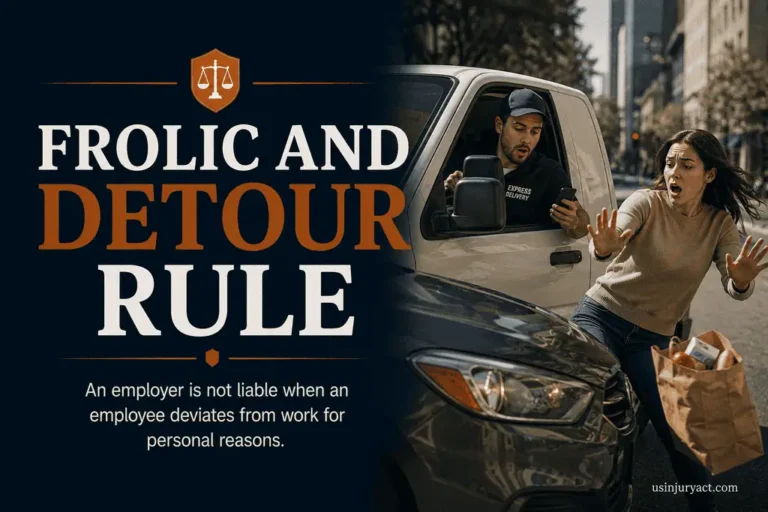
The question of if the employee was acting within the scope of their employment at the time of an accident can determine whether you can hold the employer financially responsible in a personal injury claim.
That is where the frolic and detour rule comes in.
Frolic and detour doctrine has elaborated employer liability law across the United States for over a century, and knowing how it works can make a big difference in recovering your full compensation.
We wrote this article to breaks down the frolic and detour rule in clear terms, explains how courts distinguish between the two categories, walks through real world scenarios, and tells you exactly which states apply this doctrine and how.
What Is the Frolic and Detour Rule?
The frolic and detour rule is a legal doctrine in tort law that limits an employer’s vicarious liability when an employee deviates from their assigned duties or authorized route during the course of their work.
Under the doctrine of respondeat superior, employers are generally held responsible for the negligent acts of their employees performed within the scope of employment. The frolic and detour rule carves out exceptions to that liability.
The rule traces back to the 1834 English case of Joel v. Morison, where the court drew a distinction between minor deviations and substantial ones.
American courts adopted and refined this doctrine over the following two centuries, and it now operates as a foundational principle in employment and tort law throughout the United States.
At its core, the rule asks one question which is “At the time of the injury, was the employee on the employer’s business, or on their own personal errand? If the latter, the employer may escape liability entirely.
What Is the Difference Between Frolic And Detour?
Courts and legal scholars have long distinguished between two types of employee deviations. The difference matters enormously in a personal injury case.
What Is a Detour In Law?
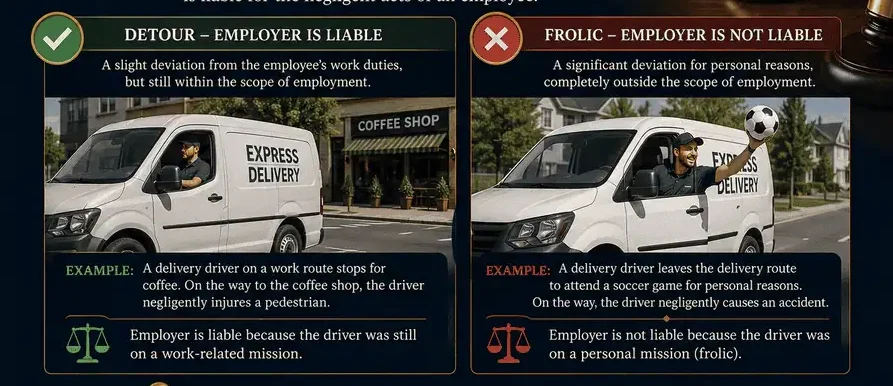
A detour is a minor, reasonably foreseeable departure from an employee’s authorized route or duties. When an employee takes a detour, courts typically find that the employer is still liable for any injuries that occur during that deviation.
The reasoning is that small deviations are a normal and expected part of sending employees out into the world to conduct business.
Consider a delivery driver who is supposed to take a direct route across town but stops briefly at a fast food restaurant to grab lunch before continuing to the delivery destination.
That stop is a detour
The employee has deviated slightly from the assigned route, but the overall purpose of the trip remains the employer’s business.
If the driver causes a car accident on the way out of that parking lot, the employer can still be held liable.
What Is a Frolic In Law?
A frolic is a substantial and independent departure from the employee’s job duties for entirely personal purposes.
When an employee goes on a frolic, they have, in effect, stepped outside the scope of their employment altogether. Courts generally find that the employer is not liable for injuries that occur during a frolic.
Using the same example, suppose that same delivery driver finishes one route and, instead of returning to the warehouse, drives two hours out of their way to visit a friend, has a few drinks, and then causes an accident on the drive back.
That is a frolic.
The employee was pursuing a personal goal that had nothing to do with their job. The employer, in most states, would not be held responsible for injuries caused during that excursion.
How Courts Decide – Scope of Employment Analysis
There is no universal bright-line rule that tells a court exactly when a detour becomes a frolic. Courts across the United States apply a multi-factor analysis to make that determination. The factors typically examined include:
- The time spent on the deviation and how far it was from the employee’s assigned duties or route
- The purpose of the deviation and whether it served any dual business and personal function
- Whether the type of deviation was reasonably foreseeable to the employer
- Whether the employee had returned to their authorized duties at the time the injury occurred
- The nature of the employment and the degree of independence the employee exercises generally
The more a deviation resembles a personal errand with no connection to the job, the more likely a court is to classify it as a frolic.
The more it resembles a minor inefficiency or convenience stop during an otherwise job related activity, the more likely a court is to call it a detour.
More Instances of the Frolic and Detour Rule
A pharmaceutical sales representative is assigned to make client visits in a specific territory, after completing her last appointment, she drives 45 minutes out of her way to visit her mother for several hours and then causes a collision on the way back to the office.
A court would very likely classify this as a frolic because the visit to her mother had no business purpose.
The employer would be able to argue successfully that they should not be liable for injuries caused during that personal excursion.
Had the sales rep instead stopped briefly at a nearby coffee shop for ten minutes before continuing her regular route, that same court might call it a detour and hold the employer liable.
Here’s another instance
A construction worker drives a company truck to pick up materials, on the way back he stops at a convenience store three blocks off the approved route to grab a snack. While pulling out of the parking lot, he backs into another vehicle.
Most courts would treat this as a detour rather than a frolic. The deviation was minor, the employee was still in transit on a work assignment, and a brief personal stop of this kind is reasonably foreseeable when an employer sends a worker out in a vehicle.
The Returning Employee Doctrine
One of the more nuanced applications of the rule involves what happens when an employee who went on a frolic has started heading back toward their job duties.
Courts in several states recognize what is sometimes called the ‘returning employee’ doctrine.
Under this approach, once an employee who went on a frolic turns back toward the employer’s business purpose, liability may reattach at some point during the return trip.
The exact moment that happens varies by jurisdiction, but the principle depicts the legal reality that the line between personal conduct and employment is not always cleanly drawn.
Which States Apply the Frolic and Detour Rule?
The frolic and detour rule is recognized in every U.S. state, though the specific tests courts apply differ. Below is a sampling of how selected jurisdictions handle the doctrine:
California
California courts apply the well-established scope of employment test and recognize both frolic and detour distinctions. The California Civil Jury Instructions (CACI) specifically address employer liability for employee conduct. California’s Labor Code also plays a role in frolic analysis in employment cases.
New York
New York courts follow the frolic and detour rule with particular attention to the degree of deviation. The New York Pattern Jury Instructions address respondeat superior, and courts have consistently held that an employee’s substantial personal deviation terminates employer liability.
Texas
Texas applies a dual purpose test in many cases. Under Texas case law, if a trip serves both a business purpose and a personal one, the employer may still be liable. Only pure personal excursions are treated as frolics.
Florida
Florida courts analyze scope of employment under established respondeat superior principles and apply the frolic/detour distinction to determine employer liability in negligence claims.
Illinois
Illinois recognizes the doctrine and applies it in personal injury actions, particularly in cases involving vehicle accidents during work-related travel.
Pennsylvania
Pennsylvania courts have long applied this doctrine and frequently distinguish between minor deviations and substantial personal detours in employment liability cases.
While the names and precise contours of the tests vary, every state where respondeat superior applies will use some version of the frolic and detour analysis to determine employer liability.
Employer Liability and Why This Matters for Your Claim
For injury victims, getting employer liability right is a financial lifeline. Individual employees often lack the insurance coverage or personal assets to fully compensate someone for serious injuries, medical bills, lost wages, and pain and suffering.
Employers, on the other hand, typically carry commercial liability insurance with much higher policy limits.
This is why personal injury attorneys spend significant time investigating what an employee was doing at the exact moment of an accident.
They will pull employment records, GPS data, phone records, time sheets, and witness statements to establish what the employee was assigned to do and what they were actually doing when the accident happened.
If the employer argues that the employee was on a frolic, your attorney’s job is to show that the deviation was minor enough to constitute a detour, that the employer authorized or implicitly permitted the activity, or that the employee had already returned to scope of employment when the accident occurred.
The Dual Purpose Doctrine
One important modification to the strict frolic and detour analysis is the dual purpose doctrine. Courts in many states, including Texas, California, and New York, have held that when an employee’s trip serves both a personal purpose and a legitimate business purpose, the employer can still be liable even if the personal component was significant.
The doctrine most often comes up when employees are traveling to or from home while simultaneously performing work tasks, such as responding to client calls or transporting work materials.
The dual purpose doctrine means that even when an employee’s actions were partly personal, a skilled personal injury lawyer may still be able to establish employer liability.
What You Should Do After an Accident Involving an Employee
If you are injured in an accident involving someone who appears to be working at the time, document everything immediately. Note the name of the company on any vehicle involved, take photographs of any uniforms, logos, or company markings, and gather witness information. This evidence may be critical in proving the employee was acting within the scope of their employment.
Do not assume that the employer is off the hook simply because the employee claims they were on a personal errand. It is a legal conclusion that only a court or a jury can make after examining all the evidence.
An experienced personal injury attorney can investigate whether the frolic and detour rule applies and can build the strongest possible case for holding the employer responsible.