Ever wondered why some civil lawsuits succeed even with limited evidence while others fail despite compelling stories? The answer almost always lives in the burdens of proof.
Specifically, it lives in the difference between the burden of production and the burden of persuasion. These two concepts govern who must present evidence, how much evidence must be presented, and ultimately who must convince the factfinder.
Every civil case in the United States, from personal injury claims to contract disputes to civil rights actions, is shaped by how these two burdens are allocated, shifted, and discharged.
This guide gives you a thorough breakdown of both burdens, how courts apply them, how they interact, and what they mean for your case if you are the plaintiff or defendant in any civil proceeding.
So What Is Burdens of Proof In Civil Law
The term “burden of proof” is frequently used as a catch-all phrase, but it actually encompasses two related but distinct obligations that can rest on different parties at different stages of a civil proceeding.
Federal courts and virtually all state courts recognize this two-part structure, drawn from the Federal Rules of Evidence and the Restatement of Evidence.
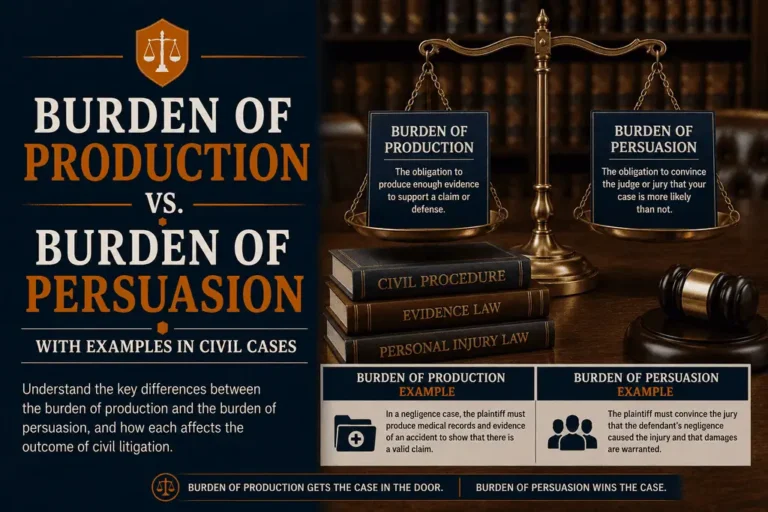
The burden of production, also called the burden of going forward with evidence or the burden of production of evidence, refers to a party’s obligation to introduce enough evidence on a particular issue to make that issue a triable question of fact.
If a party fails to meet its burden of production, the court may rule against it as a matter of law, through summary judgment or a directed verdict, without ever letting the jury decide.
The burden of persuasion, also called the risk of non-persuasion, is the obligation carried by a party to convince the factfinder (judge or jury) that the facts on a given issue support their position to the required degree of certainty.
The burden of persuasion determines who loses if the evidence on an issue is evenly balanced or genuinely uncertain. It is the ultimate measure of who bears the risk of doubt.
The Burden of Production Explained
The burden of production is primarily a procedural and evidentiary tool and the threshold a party must cross to keep an issue alive in litigation. Before a jury can decide a question of fact, a party must first produce enough credible evidence that a reasonable jury could find in that party’s favor.
Courts evaluate this at the directed verdict or summary judgment stage.
How Courts Evaluate Whether the Burden of Production Is Met
Judges apply a “reasonable jury” standard when evaluating the burden of production. The question is not whether the judge personally believes the evidence, but whether a rational trier of fact could accept it.
This is a notably low bar as a single credible witness, a single authenticated document, or a single piece of physical evidence can, in the right context, satisfy the burden of production and send an issue to the jury.
Under Federal Rule of Civil Procedure 56 governing summary judgment, the non-moving party must produce sufficient evidence to create a genuine dispute of material fact. If it cannot, summary judgment is granted in the moving party’s favor.
The same logic applies at trial under Rule 50, which governs motions for judgment as a matter of law (formerly directed verdicts).
In practice, the burden of production can shift during trial.
In employment discrimination cases governed by the McDonnell Douglas burden-shifting framework established by the U.S. Supreme Court in 1973, the plaintiff first bears the burden of production to establish a prima facie case of discrimination. Once satisfied, the burden of production shifts to the employer to articulate a legitimate, non-discriminatory reason for the adverse employment action.
If the employer meets that burden, the burden of production shifts back to the plaintiff to demonstrate pretext. Note that throughout this entire sequence, the burden of persuasion never shifts; it remains on the plaintiff throughout.
Example of Burden of Production in a Personal Injury Case
A plaintiff sues a trucking company for injuries sustained when a commercial truck ran a stop sign and struck her vehicle. Her burden of production requires her to introduce enough evidence that a jury could reasonably find the truck driver ran the stop sign. She produces traffic camera footage showing the truck passing through the intersection without stopping, her own eyewitness account, and testimony from a bystander who witnessed the collision.
This evidence easily satisfies the burden of production. The defendant cannot obtain summary judgment, and the case proceeds to trial for the jury to weigh the evidence on credibility and damages.
The Burden of Persuasion Explained
The burden of persuasion is what most people mean when they casually refer to “burden of proof.” It is the obligation to actually convince the factfinder. Critically, the burden of persuasion generally does not shift during trial. Whoever carries it at the outset of a case typically carries it through the verdict.
The Three Standards of Persuasion in Civil Cases
Civil cases in the United States employ three distinct standards for the burden of persuasion, depending on the nature of the claim and the stakes involved.
Preponderance of the Evidence is the default standard in civil litigation. It requires the party with the burden to prove that their version of facts is more likely true than not, meaning greater than 50% probable. Courts often describe it as tipping the scales, however slightly, in the party’s favor. This is the standard used in virtually all personal injury, negligence, breach of contract, and most other civil tort cases.
Clear and Convincing Evidence is an intermediate standard requiring the party to prove that a claim is highly probable and substantially more certain than a mere preponderance. Courts apply this elevated standard in civil cases involving fraud, intentional misconduct, the termination of parental rights, certain civil commitment proceedings, and claims for punitive damages in many states. New York, California, and Texas, among others, apply the clear and convincing standard to fraud and civil rights claims.
Recommended: Preponderance of the Evidence vs Clear and Convincing Evidence
Beyond a Reasonable Doubt is the highest evidentiary standard in American law and is almost exclusively reserved for criminal prosecutions. It rarely appears in civil cases, though some courts have applied it in quasi-criminal civil penalty proceedings.
Who Carries the Burden of Persuasion in Civil Cases?
In most civil cases, the plaintiff carries the burden of persuasion on all elements of the claim. This means the plaintiff must persuade the jury that duty, breach, causation, and damages all exist by a preponderance of the evidence. If the jury finds the evidence 50-50 on any essential element, the plaintiff loses on that element, and the claim fails.
Affirmative defenses, however, shift the burden of persuasion to the defendant. When a defendant asserts contributory negligence, statute of limitations, assumption of risk, comparative fault, or similar affirmative defenses, the defendant bears the burden of persuading the jury that those defenses are established by a preponderance of the evidence.
This is a critical allocation that experienced defense attorneys leverage heavily.
Example of Burden of Persuasion in a Medical Malpractice Case
A patient sues a hospital alleging that a nurse’s failure to monitor post-operative vitals caused a preventable cardiac event. The plaintiff bears the burden of persuasion by a preponderance of the evidence on all four elements of negligence. The defense presents evidence suggesting the cardiac event was caused by the patient’s pre-existing heart disease and would have occurred regardless of monitoring. The jury is left uncertain.
In states applying comparative fault, the jury must assign percentages. If the plaintiff cannot tip the scales past 50% on causation, the plaintiff loses on that element. The burden of persuasion means the plaintiff bears the risk of that uncertainty.
How the Two Burdens Interact in Practice
The burden of production and the burden of persuasion operate at different stages of a case and serve different purposes. The burden of production is a judicial gatekeeping mechanism.
It filters out claims and defenses that lack any evidentiary support before they reach the jury. The burden of persuasion is the jury’s ultimate instruction about which party bears the risk of losing when facts are genuinely disputed.
A party can satisfy the burden of production and still lose if it fails to carry the burden of persuasion. Producing some evidence is not the same as producing convincing evidence.
This distinction plays out with significant consequence in civil rights litigation, fraud cases, and complex negligence suits where circumstantial evidence must do heavy lifting.
Burden Shifting Versus Burden Allocation
Courts carefully distinguish between true burden shifting, where the burden of persuasion actually moves to the opposing party, and presumption-based shifts, where only the burden of production moves.
Most burden shifts in civil cases are production shifts, not persuasion shifts. The McDonnell Douglas framework in employment discrimination is a classic production-shift example. The plaintiff never loses the ultimate burden of proving intentional discrimination by a preponderance of the evidence.
True persuasion shifts are relatively rare in American civil law. Some states shift the burden of persuasion to the defendant on certain affirmative defenses.
California for example, places the burden of persuasion on a defendant to prove consent as an affirmative defense in intentional tort cases.
Pennsylvania requires defendants asserting the learned intermediary doctrine in pharmaceutical cases to prove it by a preponderance.
Practical Impact on Personal Injury Litigation
In personal injury cases, you as the plaintiff control the narrative when you understand how both burdens work. Your attorney’s job at the outset of discovery is to ensure the burden of production on every element of your negligence claim can be met with admissible evidence.
Interrogatories, depositions, requests for production, and expert witness designations are all tools aimed at satisfying your burden of production.
As trial approaches, your attorney will shift focus to the burden of persuasion, crafting arguments, exhibits, and expert testimony designed to tip the preponderance scales in your favor on every disputed element.
Understanding that the defense will attack both burdens simultaneously helps you anticipate the structure of trial and the defendant’s strategy.
Here’s An Example To Drive The Point Home: Products Liability and Dual Burden Analysis
A consumer is injured by a power tool that allegedly malfunctioned due to a design defect. The plaintiff’s burden of production requires introducing evidence of the defect, such as an expert report documenting the design flaw and a manufacturing log showing the defect was present when the tool left the factory.
Once that evidence is introduced, the case survives summary judgment. At trial, the plaintiff’s burden of persuasion requires convincing the jury by a preponderance that the design defect actually caused the injury, not operator error.
The defendant can counters with its own expert claiming the injury resulted from misuse. After weighing both sides by the jury, the plaintiff can only win if the jury finds it more likely than not that the defect was the cause.
State-by-State Variations in Burden Allocation
While the structure of burden of production and burden of persuasion is consistent across federal courts under the Federal Rules of Evidence, individual states vary in how they allocate these burdens in specific contexts.
In California, the burden of persuasion on the issue of comparative fault rests on the defendant, who must prove the plaintiff’s contributory negligence by a preponderance.
In New York, plaintiffs bear the burden of proof on all elements of negligence, including the absence of contributory negligence in certain older common law contexts.
Texas allocates the burden of proof on affirmative defenses to the defendant by statute under the Texas Civil Practice and Remedies Code.
Florida’s comparative negligence statute, significantly amended in 2023 to adopt a modified comparative fault system, places the burden on the defendant to prove plaintiff’s negligence exceeded 50%.
Illinois and Ohio follow traditional preponderance standards for plaintiffs on all elements of negligence claims, with defendants bearing the burden on affirmative defenses including assumption of risk and statute of limitations.
Having a good grasp of both the burden of production and the burden of persuasion gives you and your attorney a strategic map of your case.
Every piece of evidence you gather, every expert you retain, and every argument you build serves one of these two burdens. Neglecting either one leaves you exposed to dismissal before trial or an unfavorable jury verdict at trial.
Skilled personal injury attorneys manage both burdens simultaneously throughout every phase of litigation.