Intervening cause and superseding cause are two of the most misunderstood concepts in U.S. tort law, yet they can be the deciding factor in who pays for your injuries.
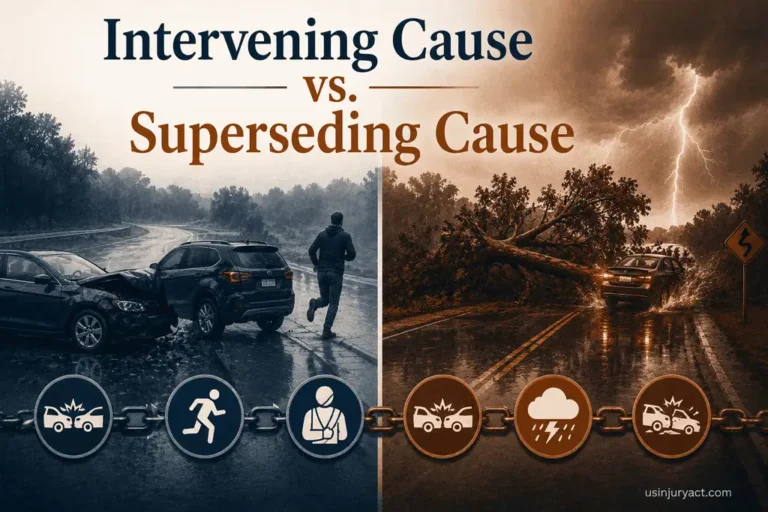
An intervening cause is a new act or event that occurs after a defendant’s negligent conduct and contributes to the plaintiff’s harm. A superseding cause is a specific type of intervening cause so extraordinary and unforeseeable that it breaks the chain of causation and relieves the original defendant of liability.
The difference matters enormously in personal injury cases because defendants routinely try to label any intervening event as superseding in order to escape responsibility. This guide will help you to be able to tell them apart.
Proximate Cause As The Foundation
Before you can appreciate the distinction between intervening and superseding causes, you need to grasp proximate cause, sometimes called legal cause.
Negligence law does not make a defendant responsible for every consequence that flows from their wrongful act. It only holds them responsible for consequences that are a natural, probable, and foreseeable result of their negligence. This is the proximate cause requirement.
Recommended: Actual vs. Proximate Cause
The landmark U.S. case that shaped modern proximate cause analysis is Palsgraf v. Long Island Railroad Co. (New York, 1928). Judge Benjamin Cardozo’s majority opinion established that the scope of a defendant’s duty extends only to those plaintiffs who are foreseeably in the zone of danger created by the negligent act.
See: Cardozo Foreseeability Test
The dissent by Judge Andrews, while unsuccessful in that case, offered a broader direct cause view that some states still apply.
See: Andrews Proximate Cause Test
Both views continue to shape how courts analyze intervening and superseding causes today.
What Is an Intervening Cause?
The Core Definition
An intervening cause is any act or event that occurs after the defendant’s negligent conduct caused the plaintiff’s injury, such that it contributes to the injury, and was not the original force set in motion by the defendant.
The critical point here is that the mere existence of an intervening cause does not automatically break the defendant’s chain of liability. Courts examine two things:
- Was the intervening act foreseeable?
- Did the defendant’s negligence remain a substantial factor in producing the harm?
An intervening cause that is foreseeable does not cut off the original defendant’s liability. It adds a concurrent tortfeasor to the picture, but both may remain liable under joint and several liability principles that apply in states like California (with modifications), New York, Illinois, and Massachusetts.
Example of Foreseeable Intervening Causes
Suppose a property owner negligently leaves a large hole uncovered on their sidewalk. A pedestrian falls in, suffers a broken leg, and is taken to a hospital. At the hospital, a nurse makes an error in administering medication, which prolongs the recovery.
The hospital negligence is an intervening cause. But is it foreseeable that someone injured in an accident will receive medical treatment, and that medical treatment might carry its own risks? Courts almost universally say yes.
This is the medical malpractice after an accident scenario, and the original tortfeasor remains responsible for the aggravated harm because subsequent medical care is a foreseeable response to the initial injury.
What Is a Superseding Cause?
The Definition That Breaks the Chain
A superseding cause is an intervening act so extraordinary, unforeseeable, or independent that it legally severs the causal connection between the original defendant’s negligence and the plaintiff’s injury.
When a court finds a superseding cause, it releases the original defendant from liability for the consequences that flowed from that superseding event.
The Restatement (Second) of Torts, Section 440, defines a superseding cause as one that prevents the actor from being liable for harm to another that the actor’s antecedent negligence is a substantial factor in bringing about.
Courts examine factors including:
- The foreseeability of the intervening act.
- Its probability of occurrence.
- Whether the defendant’s conduct created the very risk that the intervening cause exploited.
- The degree of culpability of the intervening actor.
Key Factors Courts Use to Identify a Superseding Cause
- The intervening act was highly extraordinary given the circumstances.
- The intervening act operated independently of the original negligence.
- The harm that resulted was entirely different in kind from what the original negligence made likely.
- The intervening actor acted with criminal intent or recklessness, making their act the dominant cause.
- The original defendant could not have reasonably anticipated the type of harm that actually resulted.
Instances That Illustrate the Difference Between Intervening Cause and Superseding Cause
Negligent Driver and a Reckless Bystander (Intervening, Not Superseding)
A truck driver negligently spills flammable liquid across a highway. Traffic slows. A passing motorist flicks a cigarette out the window, igniting the spill and causing an explosion that injures several people.
The motorist’s act is an intervening cause. Is it superseding? Courts analyzing similar scenarios frequently say no. Flammable liquid spilled on a road creates an obvious fire hazard.
The possibility that someone might introduce an ignition source is not so extraordinary that it rises to the level of a superseding cause. The truck driver’s negligence remains a proximate cause of the resulting harm.
Slip and Fall Leading to Criminal Attack (Potentially Superseding)
A store owner negligently leaves a wet floor unmarked. A customer slips, is not seriously hurt, but while sitting on the floor waiting for help, a third party who entered the store with criminal intent assaults and robs her.
The assault is an intervening cause. In most jurisdictions, a random criminal attack in a store that had no prior security incidents would qualify as a superseding cause, breaking the chain of liability between the wet floor and the assault.
However, if the store was in a high-crime area with a known history of robberies and the owner had taken no security precautions, courts might find the criminal attack was foreseeable and therefore not superseding.
Negligent Construction and a Catastrophic Storm (Context Dependent)
A contractor negligently installs a roof that does not meet building code standards for wind resistance. Three months later, an unusually severe storm with winds far exceeding normal seasonal averages strikes the area. The roof fails.
Defendants argue the storm was a superseding cause. Plaintiffs argue that contractors must build to code precisely to protect against foreseeable storm conditions, even severe ones.
Courts generally split here based on how extreme the storm was. A Category 1 hurricane in a hurricane-prone state is a foreseeable event. A once-in-a-century storm of unprecedented severity has a stronger argument for superseding cause status.
Defective Vehicle and a Second Collision (Foreseeable Intervening Cause)
An automaker sells a vehicle with a defective steering column. The driver loses control and the car drifts into another lane. A third driver, reacting to the sudden obstruction, swerves and strikes a guardrail.
The third driver’s reaction is an intervening cause. But courts analyzing products liability and traffic accident scenarios consistently find that a secondary collision caused by a driver reacting to an obstacle is entirely foreseeable. The automaker remains liable to the secondary collision victims as well.
Medical Negligence Aggravating an Original Injury (Classic Foreseeable Intervening Cause)
This is the most well-established scenario in American tort law. When a plaintiff suffers an injury due to another’s negligence and later receives negligent medical treatment that worsens the injury, the original tortfeasor is liable for the aggravated harm.
The reasoning is simple: getting medical treatment after an injury is not just foreseeable; it is virtually certain. Medical treatment always carries some risk of error. The original tortfeasor takes their victim as they find them and must account for the foreseeable risks of the medical care the victim will need.
How the Superseding Cause Defense Plays Out in Court
The Defense Strategy
When a defendant invokes the superseding cause defense, they are essentially asking the jury to find that the causal connection between their conduct and the plaintiff’s harm was broken by someone or something else.
Defense attorneys will emphasize the extraordinary, independent, or criminal nature of the intervening act to make it appear that their client’s role was too remote to justify liability.
The Plaintiff’s Counter-Strategy
Experienced personal injury lawyers fighting the superseding cause defense focus relentlessly on foreseeability. They present evidence that the type of intervening act that occurred was within the range of normal human experience given the circumstances the defendant created.
They use expert testimony, statistical data, prior incidents, and the defendant’s own records to show the intervening act was anything but extraordinary.
Jury Instructions and the Role of the Jury
Whether an intervening cause becomes a superseding cause is ordinarily a question of fact for the jury, not a legal question decided by the judge alone.
This is significant because it means the outcome depends heavily on how well the evidence is framed. Judges instruct juries using pattern instructions, such as those published by the Judicial Council of California (CACI 430 series) and comparable bodies in Texas, New York, Florida, and other states.
Practical Takeaway
If the defendant in your case is claiming that someone else’s act broke the chain of causation, that argument needs to be challenged immediately through discovery, expert retention, and early motion practice.
The superseding cause defense is powerful but highly fact-dependent, and it can be defeated with the right evidence.