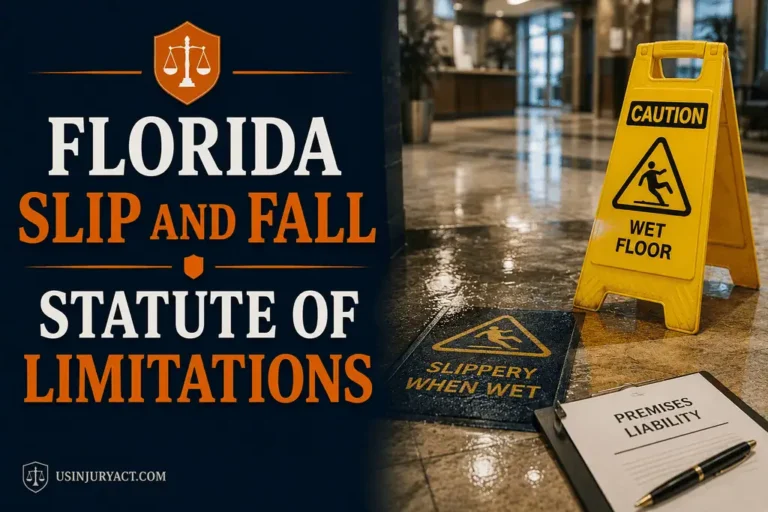
The Florida slip and fall statute of limitations controls exactly how long you have to file a lawsuit against a negligent property owner, and missing that deadline typically means losing your right to recover any compensation at all.
hence the need for this detailed guide that walks you through the current law, the specific rules that apply to your case, the exceptions that can extend or shorten your window, and the strategic steps you need to take right now to protect your claim.
You will also find clear answers to the most-searched questions surrounding Florida premises liability deadlines, including how the 2023 legislative changes affect pending and future cases, what happens when a government entity owns the property, and how courts treat discovery of injuries in delayed-onset situations.
The Core Deadline: How Long You Have to Sue in Florida
The Two-Year Rule Under Florida Statute 95.11
Effective March 24, 2023, Florida reduced its personal injury statute of limitations from four years to two years. This change, codified in Florida Statute Section 95.119 (5a), applies to negligence-based claims including slip and fall accidents.
If your injury occurred on or after that date, you have exactly two years from the date of the accident to file your civil lawsuit in a Florida court
For injuries that occurred before March 24, 2023, the prior four-year period still applied, but the legislature included a transition provision stating that if the remaining time under the old law was more than two years, the new two-year rule would effectively govern once the transition period expired.
This legislative shift was part of House Bill 837, one of the most significant overhauls of Florida tort law in recent decades. The bill also modified comparative fault standards, bad faith statutes, and attorney fee provisions, but the limitations change is the one with the most immediate practical impact on injured Floridians pursuing slip and fall claims.
When the Clock Starts Ticking
The limitations period generally begins on the date of the accident itself, not the date you hired an attorney or the date your medical treatment ended. Florida courts apply the accrual rule, meaning the cause of action accrues when the negligent act causes a legally cognizable injury. In most slip and fall cases, that is the moment you hit the ground.
However, the delayed discovery rule can shift the start date in cases where the injury was not immediately apparent. Under the discovery rule, the statute of limitations begins when the plaintiff knew or reasonably should have known that an injury existed and that it was causally linked to the fall.
This doctrine most often arises in cases involving gradual soft tissue damage, herniated discs that were not immediately symptomatic, or traumatic brain injuries whose full effects emerged days after the event.
Premises Liability and the Duty of Care That Drives Your Claim
Invitees, Licensees, and Trespassers
Florida slip and fall law is rooted in premises liability doctrine, and your legal status on the property at the time of your injury defines the duty of care owed to you. Florida recognizes three categories of entrants.
Invitees
An invitee is someone who enters property with the owner’s express or implied invitation for a business or public purpose.
Customers in retail stores, patients in medical offices, and guests in hotels are classic examples of invitees. Property owners owe invitees a duty to maintain the premises in a reasonably safe condition and to warn of known hazards that the invitee would not reasonably discover.
Licensees
Licensees enter with the owner’s permission but for their own purposes, such as a social guest at a private residence. Owners owe licensees a duty to warn of known dangers but are not required to inspect for unknown defects.
Trespassers
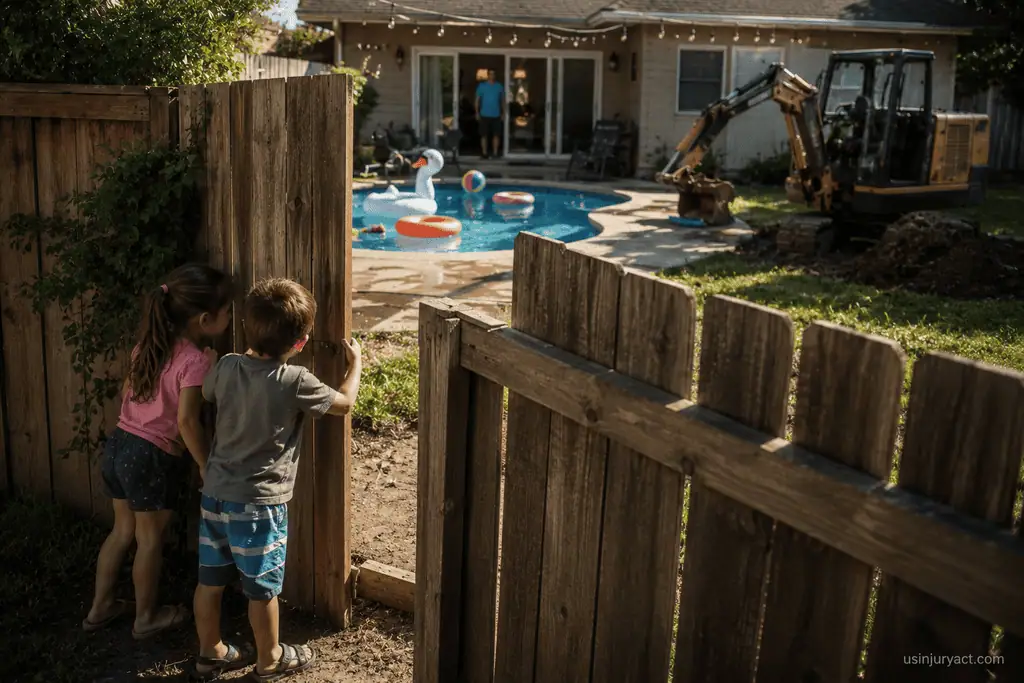
Trespassers generally receive the least protection, though Florida law still prohibits willful or wanton injury of a trespasser. The attractive nuisance doctrine creates a higher duty toward child trespassers who are drawn to dangerous conditions like swimming pools or construction equipment.
The Actual or Constructive Notice Requirement
Florida Statute Section 768.0755 governs transitory foreign substances in business establishments and requires a slip and fall plaintiff to prove that the business had actual or constructive knowledge of the dangerous condition.
Actual knowledge means someone on the premises knew the hazard existed.
Constructive knowledge can be established by showing that the condition existed long enough that reasonable care would have discovered it, or that the condition occurred with regularity making it foreseeable.
This is one of the most litigated issues in Florida slip and fall cases. Defense attorneys routinely argue that the spill was fresh and the store had no opportunity to clean it up. Your attorney will subpoena surveillance footage, maintenance logs, and employee records to establish how long the hazardous condition existed.
For Example
A shopper slips on a puddle near a refrigerated display case in a supermarket. Surveillance footage later shows the puddle had been visible for 47 minutes before the fall with multiple employees walking past it. That footage is strong constructive notice evidence and directly affects the viability of the claim.
Special Rules That Modify the Standard Deadline
Claims Against Florida Government Entities
If your slip and fall occurred on property owned or controlled by a Florida state agency, county, municipality, or school district, the Florida Tort Claims Act under Chapter 768.28 of the Florida Statutes imposes a critical pre-suit notice requirement.
You must provide written notice of your claim to the agency and to the Florida Department of Financial Services within three years of the incident. This notice requirement is entirely separate from the two-year suit filing deadline.
The government then has six months to investigate and respond before you can file a lawsuit. The practical effect is that if you want to sue a government entity for a slip and fall, you must act quickly.
Waiting 18 months to consult an attorney in a government-property case often means the pre-suit notice is not filed in time even if the litigation deadline has not yet technically passed.
Government liability is also capped under Florida law. As of recent statutory amendments, individual claimants are generally limited to $200,000 in recovery and $300,000 maximum per incident (total for all claimants combined) from a single government entity absent a specific legislative appropriation for a higher amount.
Minors and the Tolling Provisions
When the slip and fall victim is a minor, Florida law tolls or pauses the statute of limitations until the child reaches the age of 18. At that point, the two-year period begins to run.
It simply means a child injured in a fall at age 10 would technically have until age 20 to file suit. However, experienced attorneys consistently advise filing well before that extended window closes because evidence may deteriorates and witnesses may be harder to locate as time goes on, long before the legal deadline arrives.
Fraudulent Concealment and Equitable Tolling
If the property owner or their insurer actively concealed facts relevant to your claim, Florida courts may apply equitable tolling to extend the filing deadline.
This doctrine is narrow and requires clear evidence that the defendant took affirmative steps to hide the dangerous condition, falsify inspection records, or mislead you about the cause of your injury.
Simply failing to volunteer information is generally not enough to trigger equitable tolling.
Comparative Fault and How It Affects Your Recovery
Florida’s Shift to Pure Comparative Negligence
House Bill 837 also changed Florida from a pure comparative negligence state to a modified comparative fault system. Under the 2023 law, if you are found to be more than 50 percent at fault for your own slip and fall injuries, you are completely barred from recovery.
This is a dramatic departure from the prior rule, which allowed even a 99 percent at-fault plaintiff to recover one percent of their damages.
In practical terms, this means defense attorneys now aggressively argue that you were distracted by your phone, wearing inappropriate footwear, ignored warning signs, or were in an area you were not supposed to be just to shift more fault against you and potentially bar your recovery if they succeed in assigning more than 50% of the fault to you
Therefore, your attorney must proactively build a record showing the property owner’s negligence was the dominant cause of your fall.
Damages Available in a Florida Slip and Fall Case
Your recoverable damages fall into two broad categories which are economic and non economic damage.
Economic damages include all out-of-pocket financial losses including medical bills both past and future, lost wages, reduced earning capacity, physical therapy, assistive devices, and home modification costs if your injuries are severe.
Non-economic damages cover pain and suffering, emotional distress, loss of enjoyment of life, permanent disfigurement, and loss of consortium for an injured spouse.
House Bill 837 limited non-economic damages in medical malpractice cases but did not impose a general cap on slip and fall non-economic damages for most claimants.
Real-World Instance
A 58-year-old construction supervisor slips on an unmarked wet floor at a hotel lobby during a business trip, shattering his wrist and rupturing a cervical disc. His claim properly includes emergency surgery costs, two weeks of lost wages, projected future surgeries, permanent reduced grip strength affecting his career, and pain and suffering.
Each category requires separate documentation and expert support.
Steps to Take Immediately After a Florida Slip and Fall
Evidence Preservation Is Your Most Urgent Priority
The hours and days after your fall are when your case is won or lost from an evidence standpoint.
- Photograph the exact location, the hazard that caused the fall, any warning signs that were or were not present, your footwear, and your injuries.
- Request that a manager complete an incident report and obtain a copy before you leave.
- Identify and collect contact information from every witness.
- Send a written preservation letter to the property owner or their legal counsel immediately, demanding that all surveillance footage, inspection logs, cleaning schedules, prior incident reports, and maintenance records be preserved.
Property owners routinely overwrite or destroy surveillance footage within 30 to 72 hours as a matter of standard business operations, not necessarily bad faith, but your attorney can send a spoliation letter to create legal liability for destruction after notice.
Seek Medical Treatment and Create a Paper Trail
Go to an emergency room or urgent care the same day. Courts and insurance companies heavily scrutinize gaps in medical treatment as evidence that you were not seriously injured.
That means every visit, every prescription, and every therapy session creates a contemporaneous record that connects your injuries to the fall.
Never understate your pain levels to treating physicians.
Contact a Florida Slip and Fall Attorney Before Speaking to Insurers
The property owner’s insurance adjuster may contact you quickly with a sympathetic tone and an early settlement offer.
Do not give a recorded statement without legal counsel because anything you say will be analyzed for inconsistencies and used to minimize your claim.
Florida personal injury attorneys handling slip and fall cases almost universally work on a contingency fee basis, so you pay nothing unless and until you recover.
Your Next Steps Before the Deadline Passes
Florida’s two-year statute of limitations is unforgiving, and courts rarely grant exceptions outside of the narrow tolling doctrines described above.
So if your injury happened in the last 18 months, act now, and if it happened more than 20 months ago, you should still contact an attorney today because your window may be closing within weeks.
The value of your Florida slip and fall claim, your ability to recover premises liability damages, and your access to justice all depend on filing before time runs out.