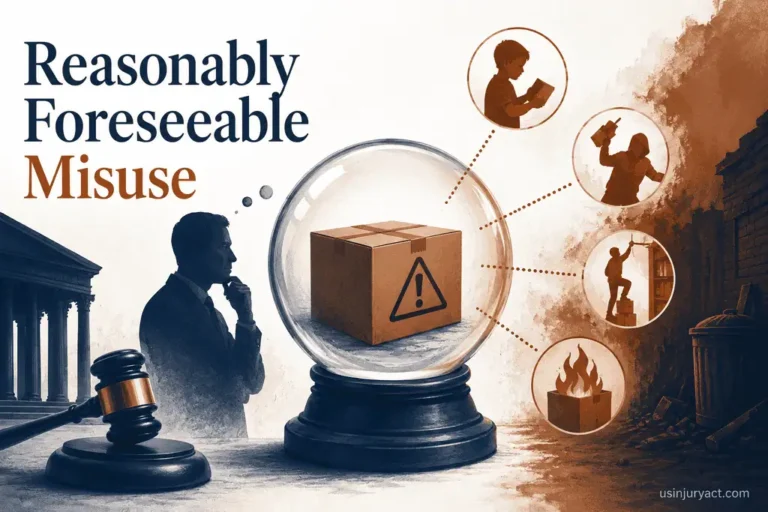
Reasonably foreseeable misuse is the legal principle that holds a product manufacturer liable when a consumer uses a product in an unintended but predictable way and suffers an injury as a result.
In U.S. product liability law, a company cannot simply point to its instruction manual and walk away. If your product’s design or marketing makes a particular misuse predictable, the law expects you to account for it.
For injury victims, this doctrine opens the door to compensation even when they were not using a product exactly as directed.
This guide breaks down what reasonably foreseeable misuse means, how courts apply it, how it differs from ordinary product misuse, and what it means for your product liability claim in 2026.
What Reasonably Foreseeable Misuse Means in Product Liability Law
Under the Restatement (Third) of Torts: Products Liability, Section 2, a product is defective in design when the foreseeable risks of harm could have been reduced or eliminated by a reasonable alternative design.
Embedded in this standard is the expectation that manufacturers must anticipate not just intended uses, but reasonably foreseeable ones, including foreseeable misuse.
The key word is “reasonably.” Courts do not require manufacturers to guard against every conceivable misuse of their products. But when evidence shows that a particular type of misuse is common, predictable, or even observable in the market, the manufacturer has a duty to account for it in product design, warnings, and packaging.
This doctrine is at the intersection of design defect claims, failure to warn claims, and comparative fault. It affects how liability is allocated, how damages are calculated, and how successfully a defendant can raise the reasonably foreseeable misuse defense.
The Legal Foundation: Where This Doctrine Comes From
Restatement (Third) of Torts
The Restatement (Third) of Torts is the most authoritative secondary source on product liability in the United States. Comment p to Section 2 explicitly addresses the misuse defense, clarifying that product misuse does not bar recovery when that misuse was reasonably foreseeable to the seller or distributor.
Most states that have adopted strict liability principles follow this standard, including California, Texas, New York, Illinois, Florida, New Jersey, Pennsylvania, and Ohio.
How Courts Define “Foreseeable”
Courts typically use objective standards to decide what is foreseeable. A misuse is foreseeable if a reasonable person in the manufacturer’s position would have anticipated it given the product’s nature, the population that uses it, past injury reports, industry knowledge, and common consumer behavior.
Expert testimony from human factors engineers, safety analysts, and product designers is frequently used to establish foreseeability at trial.
The California Supreme Court’s decision in Pike v. Frank G. Hough Co. (1970) was an early landmark that acknowledged foreseeable misuse as a factor in product liability analysis. Since then, courts across the country have steadily expanded this principle.
Types of Reasonably Foreseeable Misuse
1. Predictable Overuse or Overloading
Consumers routinely exceed recommended limits on products. For instance, a ladder rated for 250 pounds is predictably going to be used by someone who weighs 260 pounds. A power tool with a recommended duty cycle is predictably going to be run continuously.
If the manufacturer knows this happens frequently and fails to design against it or warn about it meaningfully, that overuse becomes foreseeable misuse for which the manufacturer can be held responsible.
2. Unintended but Predictable Repurposing
People use products in ways they were not designed for, and manufacturers often know this happens. A kitchen chair is not designed to be stood on, but manufacturers know people do it constantly. A household cleaning chemical is not designed to be mixed with bleach, but the industry knows it happens.
When injury results from this type of repurposing, courts examine what the manufacturer knew or reasonably should have known about the behavior.
3. Foreseeable Use by Vulnerable Populations
If a product is sold in a context where it is predictably going to be accessed by children, elderly users, or people with diminished physical capacity, the manufacturer must design for that reality.
A medication sold without child-resistant packaging in a pharmacy where families shop is an example of failing to account for foreseeable access by a vulnerable population. Toy manufacturers, pharmaceutical companies, and household product makers all face this category of liability.
4. Foreseeable Removal of Safety Features
Safety guards on power equipment get removed. Helmet chin straps go unfastened. Interlock switches on industrial machines get bypassed.
When these behaviors are so common that the industry is aware of them, courts often hold that the manufacturer should have designed the product to be safer even without those features intact, or at minimum issued more forceful warnings.
5. Foreseeable Use Outside of Intended Environment
A product designed for indoor use that is predictably going to be used outdoors, or a tool designed for professional use that ends up in the hands of consumers, raises reasonably foreseeable misuse questions.
If marketing channels, distribution networks, or product branding make it predictable that the product reaches users outside the intended environment, the manufacturer cannot simply disclaim that risk.
Examples of Reasonably Foreseeable Misuse
The Riding Lawn Mower Scenario
Consider a riding lawn mower equipped with a reverse-operation cutoff switch designed to stop the blades when the mower is in reverse.
Manufacturers began receiving reports that users routinely disabled this switch because they found it inconvenient when mowing in tight spaces. When a child was subsequently run over during a reverse maneuver, courts in multiple jurisdictions found the manufacturers liable because the removal of the safety feature was foreseeable.
The U.S. Consumer Product Safety Commission data confirmed the pattern of bypass behavior. This is the classic reasonably foreseeable misuse scenario because the manufacturer knew users were defeating the safety feature and did not redesign to prevent it or issue more prominent warnings.
The Prescription Drug Off-Label Use Scenario
Pharmaceutical manufacturers are well aware that physicians prescribe drugs off-label for uses the U.S. Food Drug Administration did not specifically approve.
When a drug prescribed off-label causes harm due to a failure to warn about risks relevant to that use, courts have analyzed the situation through a foreseeable misuse lens.
If the manufacturer knew off-label prescribing was common and failed to update its labeling to address known risks in those contexts, liability can attach.
The Industrial Equipment Consumer Purchase Scenario
A nail gun manufactured for professional construction crews is sold through a major retail chain that primarily serves DIY consumers.
A homeowner buys it, uses it without the safety training a professional would have, and suffers a serious puncture wound. The fact that the product was sold through consumer retail channels makes its use by untrained individuals foreseeable, and courts have used this reasoning to find manufacturers responsible for inadequate consumer-directed warnings.
The Multi-Surface Cleaner Mixing Scenario
Household chemical manufacturers know from decades of poison control data and safety research that consumers mix cleaning products.
When a consumer combines a bleach-based cleaner with an ammonia-based product and suffers respiratory injury, the mixing is foreseeable misuse. A manufacturer that fails to include bold, prominent warnings about the danger of mixing may face liability even though the consumer combined two separate products they were not supposed to combine.
Foreseeable Misuse vs. the Product Misuse Defense
What the Misuse Defense Looks Like
Manufacturers and their defense attorneys routinely raise the product misuse defense, arguing that the plaintiff’s injury resulted from an unforeseeable, abnormal use that the company could not have anticipated and was not required to design against.
If the defense succeeds in convincing the jury that the misuse was unforeseeable, it can bar recovery entirely in some states or reduce the plaintiff’s award through comparative fault.
How Plaintiffs Counter the Misuse Defense
The plaintiff’s response centers on evidence of foreseeability. This includes internal corporate memos showing awareness of the misuse pattern, prior incident reports filed with the CPSC, industry safety standards that address the misuse, consumer research data, and expert testimony establishing that the behavior was widely known and predictable.
Product liability attorneys who handle these cases build their foreseeability arguments through aggressive discovery and expert witness development.
The Comparative Fault Overlay
Even where a misuse is deemed foreseeable, comparative fault principles still apply in most states.
States like Texas, Florida, California, and Colorado use modified comparative fault, meaning your damages can be reduced by your percentage of fault. In pure comparative fault states like New York, Louisiana, and Mississippi, you can still recover even if you were mostly at fault, though your damages will be reduced proportionally.
Only in a handful of states with contributory negligence rules, like Alabama, Maryland, Virginia, and North Carolina, can your own fault completely bar recovery.
How Foreseeable Misuse Affects Your Product Liability Claim
Design Defect Claims
In a design defect claim, you argue that the product’s design itself was unreasonably dangerous.
Foreseeable misuse strengthens this argument because it shows the manufacturer knew users would behave a certain way and still chose a design that left them unprotected.
The consumer expectations test and the risk-utility test are the two primary standards courts apply, and both incorporate the concept of foreseeable use and misuse.
Failure to Warn Claims
Failure to warn is often the strongest theory in foreseeable misuse cases.
If the manufacturer cannot redesign the product to make it safe against the foreseeable misuse, it must at minimum warn users clearly and prominently about the risk.
Warnings buried in the back of a 40-page manual in small print do not satisfy this duty when the manufacturer knew the misuse was common and the risk was serious.
Manufacturing Defect Claims
Manufacturing defect claims are less commonly paired with the foreseeable misuse doctrine, since they involve a specific product that deviated from its intended design.
However, where a manufacturing flaw makes a product especially vulnerable to a foreseeable misuse that would not have caused injury in a properly manufactured unit, the doctrine can still be relevant to damages and causation analysis.
Damages You Can Recover
In successful product liability cases involving foreseeable misuse, victims can recover economic damages including medical expenses, future medical costs, lost wages and earning capacity, as well as non-economic damages including pain and suffering, emotional distress, and loss of enjoyment of life.
In cases where the manufacturer showed conscious disregard for consumer safety, punitive damages are also available in many states.
What Attorneys Look for When Building a Foreseeable Misuse Case
Experienced personal injury attorneys investigating a foreseeable misuse claim look first for evidence that the manufacturer was on notice.
This includes CPSC complaint databases, prior lawsuits involving the same product, internal testing records, engineering change orders, and marketing materials that suggest awareness of the actual use patterns in the market.
They then build the causation chain, showing that the foreseeable misuse directly caused the specific injury. When required, they retain experts in biomechanics, human factors engineering, and product safety to testify about what a reasonable manufacturer should have done differently.
In many cases, the strongest evidence comes from the manufacturer’s own documents obtained during discovery.
If your injury involved a product you were not using in a perfectly standard way, do not assume you cannot recover. The question is not whether you used it exactly as directed, but whether your use was predictable to a reasonable manufacturer.
That is a fact-specific question that a qualified attorney can help you answer.