Filing a personal injury claim without a lawyer is possible, and can even be the right choice for some situations.
If your injuries are minor, liability is clear, and you are comfortable navigating paperwork and negotiation, you can handle the claims process on your own and keep every dollar of whatever you recover.
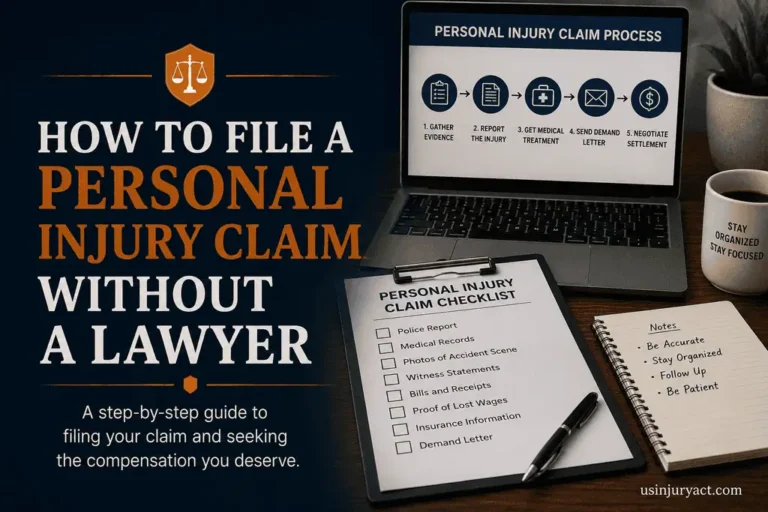
This guide walks you through every step of filing a personal injury claim without an attorney, from gathering evidence immediately after the incident to negotiating a final settlement with the insurance company.
When Filing Without a Lawyer Actually Makes Sense
The decision to go without an attorney should be based on a realistic assessment of your claim, not a general desire to save money on legal fees.
There are cases where self-representation is genuinely practical, and cases where it is likely to cost you far more than you save.
Cases Better Suited for Self-Representation
Minor soft-tissue injuries such as mild whiplash or bruising that fully healed within a few weeks, clear-cut liability with a police report confirming fault, a cooperative at-fault insurance company willing to engage reasonably, and damages under $10,000 are the factors that make a self-represented claim most feasible.
Small claims court also provides a streamlined path for smaller injury claims. California allows claims up to $12,500 in small claims court, while some states like Tennessee and Georgia set the limit at $25,000.
Small claims procedures are designed to be accessible without legal training, and judges in those venues expect to see self-represented parties.
Cases Where an Attorney Is Strongly Advisable
Serious injuries requiring surgery, hospitalization, or long-term treatment, permanent disability or disfigurement, a disputed liability theory where the other side claims you were at fault, or a situation involving multiple defendants or a government entity are all strong indicators that you need legal representation.
The value of these cases is too high, and the legal complexity too significant, to navigate alone.
How to File a Personal Injury Claim Without a Lawyer Step-by-Step
Step One: Document Everything Immediately
The foundation of any successful personal injury claim without an attorney is documentation. Begin collecting evidence as immediately after the incident as your physical condition allows.
At the Scene
- Photograph the scene from multiple angles, including any hazard that caused the injury, road conditions, vehicles involved, and any visible injuries on your body
- Get the names, phone numbers, and insurance information from all other parties involved
- Collect contact information from eyewitnesses before they leave
- Request that law enforcement respond and file a report if the incident involves a vehicle or occurs on a public street
- Note the exact time, weather conditions, and any statements made by the other party
If a business premises was involved, such as a slip and fall in a store, notify a manager before leaving and request that an incident report be completed. Ask for a copy.
In the Days Following
Write a detailed personal narrative of what happened while your memory is fresh and include everything like what you were doing before the incident, the sequence of events, what you saw and heard, and how you felt immediately after.
This personal account becomes part of your personal injury claim file and helps maintain consistency throughout the process.
Begin keeping a pain journal to document your symptoms daily, including pain levels, limitations on activity, sleep disruption, and emotional effects.
This journal is direct evidence of your pain and suffering damages and is particularly valuable in cases where non-economic damages are a significant portion of the claim.
Step Two: Seek Medical Treatment and Follow It Through
Seeking prompt medical treatment is not only about your health, it is about creating a documented medical record that connects the incident to your injuries.
If you wait days or weeks to see a doctor, the insurance company will argue that your injuries were not caused by the incident or were not serious enough to justify significant compensation.
Choosing the Right Medical Provider
Go to the emergency room if your injuries are serious or if you are uncertain about their severity.
For less acute injuries, see your primary care physician within 24 to 48 hours, follow all referrals to specialists, and attend every follow-up appointment.
If you skip treatment sessions or ignore medical recommendations, the insurance adjuster will use those gaps as evidence that you were not truly injured.
Understanding the Medical Records You Will Need
The medical records you will use in your claim include emergency room notes, primary care physician records, specialist reports, diagnostic imaging results such as X-rays or MRIs, physical therapy records, prescription records, and any physician opinions about causation or the permanence of your injuries.
You have the legal right to request these records from every provider, and they should be provided to you in a reasonable time.
Step Three: Calculate Your Damages
Knowing how to value your personal injury damages is the most important analytical step in filing without a lawyer and undervaluing your claim is one of the most common mistakes self-represented claimants make.
Economic Damages: Tally Every Dollar
Go through every expense related to the incident and your injuries:
- All medical bills, including emergency care, surgery, specialist visits, imaging, therapy, and prescriptions
- Future medical costs, if your doctor has indicated ongoing treatment will be needed
- Lost wages, calculated by your pay stub or W-2 records and documented in writing by your employer
- Property damage, supported by repair estimates or replacement value documentation
- Transportation costs to medical appointments
- Any out-of-pocket costs paid as a result of the injury
Add all of these up to get your total economic damage figure, and keep every receipt and bill as supporting documentation.
Non-Economic Damages: Pain and Suffering
Non-economic damages are harder to quantify but must be included, and two methods are commonly used to calculate the figure.
The per diem method assigns a dollar value to each day you experienced pain, then multiplies by the number of days.
For instance, if your recovery took 90 days and you assign $100 per day of pain, that produces $9,000 in pain and suffering.
The multiplier method takes your total economic damages and multiplies them by a number typically between 1.5 and 5, with the multiplier reflecting the severity and duration of your injuries.
A mild injury with full recovery might use a multiplier of 1.5, while a permanent or severe injury might justify a multiplier of 4 or 5.
Insurance adjusters use their own internal formulas, and they will not simply accept your calculation, but having a clear, defensible methodology shows you are serious and knowledgeable about your claim.
Step Four: File the Insurance Claim
Now that you have your documentation and your damages calculation, you are ready to formally notify the at-fault party’s insurance company and open a claim.
Notifying the Insurance Company
Contact the at-fault driver’s liability insurer directly to report the accident and your injuries and provide basic factual information that includes the date, location, vehicles involved, and the general nature of your injuries.
Do not give a recorded statement at this stage because insurance companies use recorded statements to find inconsistencies they can use against you later.
You are not legally required to give a recorded statement to the other party’s insurer in most states, and in filing a personal injury claim without an attorney, protecting yourself from this tactic is critical.
Learn more about what to say and not to say to insurance adjusters to be on the safer side.
The Demand Letter
Once your medical treatment is complete or you have reached what doctors call maximum medical improvement (the point where your condition has stabilized), draft and send a formal demand letter.
This document is the centerpiece of your claim and must be thorough and persuasive.
Your demand letter should include:
- A factual narrative of how the incident occurred and how the defendant was at fault
- A description of your injuries and the medical treatment you received, with references to your records
- Your full itemization of economic damages with supporting documentation
- A clear explanation of your pain and suffering claim and the methodology used to calculate it
- A specific dollar amount that you are demanding as full settlement of all claims
- A deadline for the insurer to respond, typically 30 days
Send the demand letter by certified mail and keep a copy as it establishes a clear record and starts the negotiation clock.
Step Five: Negotiate the Settlement
The insurance company will typically respond with a counteroffer significantly lower than your demand. This is normal, and negotiating a personal injury settlement without a lawyer requires patience, documented responses, and a clear bottom line.
Responding to Low Offers
When the adjuster’s counteroffer arrives, do not accept or reject it immediately, instead, ask them to provide a written explanation of how they arrived at their figure.
This forces them to justify the number and often reveals gaps in their reasoning you can respond to.
- If they cite a pre-existing condition, address it with your medical records.
- If they dispute liability, respond with your evidence.
- If they claim your injuries were less severe than documented, point to your physician’s notes and diagnostic findings.
Counter their offer with a number lower than your original demand but higher than their counteroffer, and provide written justification for every component.
Negotiation is a process of incremental movement, and having documented justification for each number you propose demonstrates that you are serious.
Knowing When to Accept
Settlement is appropriate when the offer reflects a fair value for your documented damages, when the cost and stress of continued negotiation or litigation outweighs the potential gain, and when you have confirmed that the offer is within a realistic range for your type of injury in your state.
Research jury verdicts for similar injuries in your state using public resources or legal verdict databases to calibrate your expectations.
The Release Agreement
When you accept a settlement, the insurer will ask you to sign a release.
The release document permanently extinguishes all your legal claims related to this incident against the defendant and the insurer.
Read it carefully before signing to make sure it accurately describes the incident, the parties, and the claims being released.
If future medical needs are a possibility and not fully reflected in the settlement, signing a broad release may leave you with no recourse because once signed, there is no going back.
What to Do If Negotiations Break Down
If the insurance company refuses to make a reasonable offer and your claim has real value, you have two options
- File in small claims court if the amount is within that court’s jurisdiction.
- Consult with an attorney about filing a formal lawsuit.
Many attorneys offer free consultations and may take on cases even mid-process, particularly if they see strong liability and significant damages.
Keep the statute of limitations in your state in mind throughout this entire process. Filing a personal injury lawsuit after failed negotiations must happen before that deadline because the negotiation or insurer delay will not be an excuse or extends the clock.
Filing a personal injury claim without a lawyer is achievable when you approach it with discipline, thorough documentation, and a clear understanding of your rights.
The claimant who shows up with organized records, a well-reasoned demand letter, and a clear understanding of their damages is taken more seriously by insurance adjusters than one who makes an undocumented verbal demand.
If at any point the case grows in complexity or value, consulting an attorney is not a retreat but a smart business decision.