
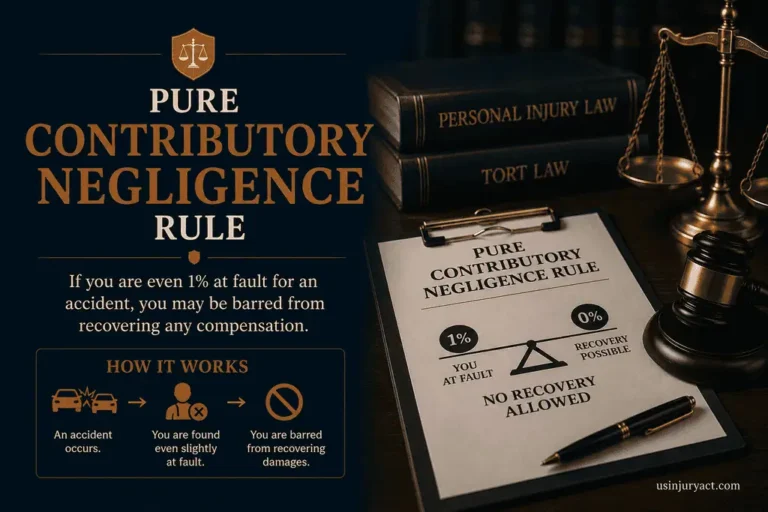
If you live in one of a small handful of U.S. states and you were even slightly at fault for the accident that injured you, you may be completely barred from recovering any compensation at all.
This is the harsh reality of pure contributory negligence, one of the most plaintiff-unfriendly legal doctrines still in use in American tort law today.
What Is Pure Contributory Negligence?
Pure contributory negligence also know as contributory negligence or contributory fault is a legal rule that bars a plaintiff from recovering damages if their own negligence contributed in any way to causing the incident, no matter how minimal their fault was.
Even if you were just 1% responsible and the defendant was 99% at fault, you receive nothing. No medical bills, lost wages, pain and suffering.
This doctrine stands in stark contrast to the comparative fault systems used in most other states, which allow injured parties to recover a portion of damages proportional to the defendant’s share of fault.
If you are involved in a personal injury claim in a contributory negligence state, you need to know exactly how this rule works and why it matters so much to your case.
The Historical Origins of Contributory Negligence
The contributory negligence doctrine traces its roots to the 1809 English case of Butterfield v. Forrester, which established the principle that a plaintiff who could have avoided injury through ordinary care cannot recover from a negligent defendant.
American courts adopted this rule widely throughout the 19th century, and for decades it was the dominant negligence standard across the country.
Over the 20th century, scholars, courts, and legislators increasingly criticized pure contributory negligence as fundamentally unjust.
The doctrine allowed defendants who were overwhelmingly at fault to escape all liability simply by showing the plaintiff bore some minor responsibility.
The trend shifted heavily toward comparative negligence systems, particularly after the landmark California Supreme Court decision in Li v. Yellow Cab Co. in 1975, which rejected contributory negligence in favor of pure comparative fault.
Today, only a small group of U.S. jurisdictions retain the pure contributory negligence rule which makes it a critical factor in evaluating any personal injury claim in those states.
Pure Contributory Negligence States: 2026 List
As of 2026, the following jurisdictions use pure contributory negligence as their standard for personal injury cases:
- Alabama
- Maryland
- Virginia
- North Carolina
- Washington, D.C.
These five jurisdictions represent a significant departure from the nationwide norm.
Every other U.S. state uses some form of comparative negligence that allows plaintiffs to recover even if they bear partial fault compared to the defendant.
If your accident occurred in any of the above jurisdictions, the contributory negligence bar is a real and serious threat to your claim.
How Courts Define Negligence in a Contributory Negligence State
In contributory negligence states, the plaintiff’s conduct is measured by the same standard applied to the defendant: ordinary reasonable care. The question is what a reasonably prudent person would have done in the same circumstances.
If the plaintiff failed to exercise that level of care and that failure was a proximate cause of the accident, contributory negligence may apply.
For example, if you were crossing a street at a crosswalk but failed to look both ways, and a speeding driver struck you, the defendant may argue your failure to look contributed to the collision.
If a jury agrees, even slightly, your entire claim is defeated in a contributory negligence state regardless of how recklessly the driver was operating their vehicle.
Real World Application of Pure Contributory Negligence
Scenario One: The Car Accident with Minor Lane Drift
Rebecca is driving on a two-lane highway in Virginia. A commercial truck drifts across the center line and strikes her vehicle head-on.
She sustains severe injuries including a traumatic brain injury and multiple fractures. The defense lawyer reviews her dashcam footage and argues that she had briefly drifted two inches over the lane marker moments before impact.
If a jury finds that Rebecca’s minor lane drift was even 1% a contributing cause of the accident, Virginia’s pure contributory negligence rule would bar her from recovering anything from the truck driver or his employer.
This example illustrates how aggressively defense attorneys use contributory negligence in these states. Even the most minor plaintiff conduct becomes a litigation weapon.
Scenario Two: The Slip and Fall on Wet Floors in Maryland
David slips on an unmarked wet floor in a Maryland grocery store and breaks his hip. The store had no wet floor sign posted and the floor had been wet for 45 minutes before the fall.
However, David was looking at his phone when he walked into the area. The defense argues that his failure to watch where he was going constitutes contributory negligence.
In Maryland, if the jury finds David was even marginally inattentive and that inattention contributed to the fall, he recovers nothing, despite the store’s clear negligence in failing to warn customers of the hazard.
Scenario Three: The Bicycle Accident in Washington, D.C.
A cyclist in Washington, D.C. is struck by a car making an illegal turn. The cyclist was not wearing a helmet at the time. The defense argues that failure to wear a helmet constitutes contributory negligence.
Courts in D.C. have grappled with helmet-related contributory negligence arguments, and while some courts have limited this argument to damages for head injuries specifically, the risk of the doctrine barring recovery entirely remains a genuine threat in contributory negligence jurisdictions.
The Last Clear Chance Doctrine: A Lifeline for Plaintiffs
Recognizing the harshness of pure contributory negligence, courts in contributory negligence states developed the last clear chance doctrine as a mitigating rule.
Under this doctrine, even if the plaintiff was contributorily negligent, they can still recover if the defendant had the last opportunity to avoid the accident and failed to take it.
For example, if a pedestrian is standing in the road in a position of peril due to their own negligence, but the driver sees the pedestrian with enough time to stop or swerve and fails to do so, the pedestrian may still recover under the last clear chance doctrine despite their own initial negligence.
The defendant’s superior opportunity to avoid the harm shifts the liability back.
Last clear chance does not eliminate the contributory negligence bar entirely, but it provides plaintiffs’ attorneys with an important legal argument to preserve recovery in cases where the defendant clearly had the final opportunity to prevent the accident.
Assumption of Risk and Its Relationship to Contributory Negligence
Assumption of risk is a related but distinct doctrine that often appears in cases from contributory negligence states.
When a plaintiff voluntarily encounters a known risk, they may be found to have assumed that risk and therefore be barred from recovery.
Unlike contributory negligence, which is based on careless conduct, assumption of risk is based on knowing and voluntary acceptance of a danger.
In Virginia, Maryland, Alabama, North Carolina, and D.C., assumption of risk operates as a complete bar to recovery in most circumstances, similar to contributory negligence.
Defendants frequently raise both defenses simultaneously, increasing the challenge for plaintiffs in these jurisdictions.
Comparative Negligence: How the Other 45 States Handle Shared Fault
To appreciate how severe contributory negligence is, it helps to see how other states handle the same situations. Forty-five states and the federal system use some form of comparative negligence, which comes in two main versions.
Pure comparative negligence, used in states like California, New York, and Florida, allows a plaintiff to recover even if they are 99% at fault. Their recovery is simply reduced by their percentage of fault. A plaintiff who is 70% at fault and has $100,000 in damages recovers $30,000.
Modified comparative negligence, the most widely used system, bars recovery only when the plaintiff’s fault reaches a threshold, typically either 50% or 51%. States using the 50% bar include Colorado, Georgia, and Idaho. States using the 51% bar include Texas, Illinois, and Ohio. Plaintiffs below the threshold recover damages reduced by their percentage of fault.
In every comparative negligence state, The instances of Rebecca’s brief lane drift, David’s phone distraction, and the D.C. cyclist’s lack of a helmet would reduce but not eliminate their recovery. In a contributory negligence state, these same minor facts can mean zero compensation.
Defense Strategies in Contributory Negligence States
Defense attorneys in Alabama, Maryland, North Carolina, Virginia, and D.C. are trained to aggressively search for any evidence of plaintiff fault.
They review accident reports for officer notations about plaintiff behavior, comb through medical records for pre-existing conditions that might have contributed to injury, analyze surveillance footage frame by frame, and depose witnesses to extract any statement that places even marginal blame on the plaintiff.
This aggressive posture means that plaintiffs in these states must work with attorneys who understand how to proactively counter contributory negligence arguments.
That means gathering evidence that negates plaintiff fault, using accident reconstruction experts, and preparing witnesses to clearly articulate the sequence of events.
How to Protect Your Claim in a Pure Contributory Negligence State
If you are pursuing a personal injury claim in a contributory negligence state, several strategies can help protect your recovery.
- Be extremely careful about what you say to insurance adjusters or investigators. Any statement that even hints at personal responsibility can be weaponized against you.
- Gather as much evidence of defendant fault as possible at the scene: photos, witness names, surveillance camera locations, and physical evidence.
- Retain a personal injury attorney who practices specifically in your state before you speak with anyone else.
An attorney who understands the local contributory negligence law can position your case properly from day one and respond effectively to contributory negligence arguments before they gain traction.
Pure Contributory Negligence Summary
Pure contributory negligence is a doctrine that demands respect for its severity. If you are injured in Alabama, Maryland, North Carolina, Virginia, or Washington, D.C., even a small finding of personal fault can erase your entire right to compensation.
This makes legal representation in these jurisdictions not merely helpful but essential.
The good news is that experienced personal injury attorneys in contributory negligence states know how to fight these defenses effectively through their experiences and expertise.
With the right legal strategy, strong evidence, and a thorough presentation of the defendant’s overwhelming fault, you can overcome the contributory negligence bar and recover the compensation you deserve.