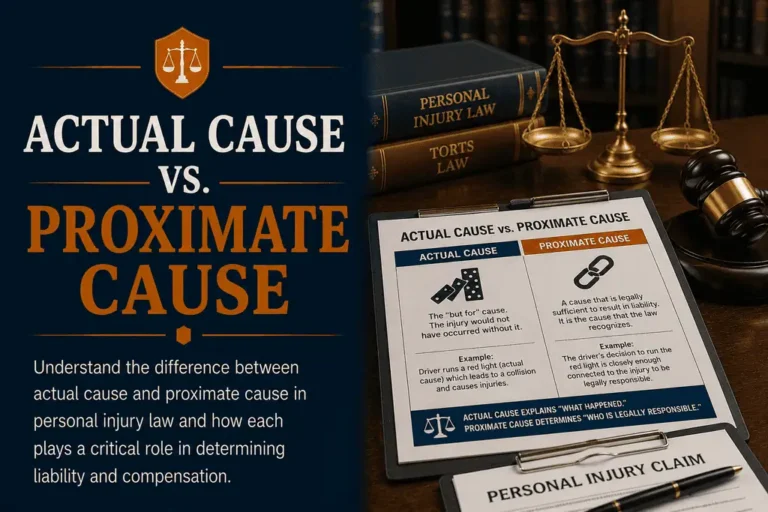
When you file a personal injury lawsuit, two of the most pivotal legal questions your attorney must answer is if the the defendant’s conduct actually cause your injury, and was that injury a legally foreseeable result of what the defendant did?
These are not the same question; Actual cause and proximate cause in negligence are two distinct legal elements, and both must be satisfied before a court will hold a defendant liable. If your attorney cannot establish both, your claim may fail even when the defendant behaved recklessly.
So we decided to breaks down the actual vs. proximate cause distinction with precision, explains how courts in every U.S. jurisdiction apply both doctrines, and walks through real-world scenarios that illustrate exactly how these concepts operate in litigation.
The Two-Part Causation Requirement in U.S. Negligence Law
American negligence law, traced back to the common law and codified through decades of state court decisions, requires a plaintiff to prove four elements
- Duty of Care
- Breach Of That Duty
- Causation From The Breach
- Damages Suffered
Causation is itself a two-layered test. Courts split it into cause-in-fact, which is commonly called actual cause, and proximate cause, also described as legal cause.
A defendant’s conduct must satisfy both layers before liability attaches, failing either one is fatal to a negligence claim.
The Restatement (Third) of Torts: Liability for Physical and Emotional Harm, adopted in large portions by courts across the country, treats these as separate but interrelated inquiries.
- Actual cause is a factual yet simple question: Did the defendant’s act or omission truly produce the plaintiff’s harm?
- Proximate cause is a normative, policy-driven question: Should the law hold this particular defendant responsible for this particular harm, given the nature and foreseeability of the injury?
What Is Actual Cause in Negligence?
Actual cause, sometimes called cause-in-fact, is the foundational causal link between a defendant’s conduct and a plaintiff’s injury.
Courts across the United States use two primary tests to establish actual cause: the but-for test and the substantial factor test. Both are essential tools in your attorney’s arsenal.
The But-For Test
The but-for test asks a deceptively simple question in this form:
But for the defendant’s conduct, would the plaintiff’s injury have occurred?
If the answer is no, then the defendant’s conduct is an actual cause of the harm. If the injury would have happened regardless of what the defendant did, then the defendant did not actually cause the harm, and the claim fails at this threshold.
Suppose a driver runs a red light and collides with your vehicle. But for the driver running that light, would you have been struck? No.
Therefore, running the light is an actual cause of your injuries. The but-for test is clean, logical, and works well in the vast majority of tort cases.
The Substantial Factor Test
The but-for test becomes strained in cases involving multiple defendants whose concurrent negligence all contribute to a single indivisible injury.
Courts developed the substantial factor test to handle these situations.
Under this approach, a defendant’s conduct is an actual cause if it was a substantial contributing factor in bringing about the plaintiff’s harm, even if another cause could have produced the same injury independently.
This test is applied in many states including California, New York, and Pennsylvania when cases involve concurrent causation.
The California Supreme Court has long recognized the substantial factor test in cases where independent causes cooperate to produce a single injury, as reflected in decisions tracing back to Mitchell v. Gonzales (1991).
Example of Actual Cause Analysis
A construction company negligently leaves an open trench on a public sidewalk without barriers or lighting. A pedestrian falls into the trench at night and suffers a broken leg. The but-for test applies cleanly: but for the company’s failure to secure the trench, the pedestrian would not have fallen. Actual cause is established.
Now imagine two construction companies left separate debris on the same sidewalk, and the combined debris caused the pedestrian to trip. Either of the two pile alone might have caused the fall. Courts would apply the substantial factor test to hold both companies liable.
What Is Proximate Cause in Negligence?
Even after actual cause is established, a defendant is not automatically liable until proximate cause is also established.
Proximate cause, also called legal cause, limits liability to harms that are a reasonably foreseeable consequence of the defendant’s negligent conduct. It is the law’s mechanism for preventing defendants from being held responsible for every conceivable ripple effect of their actions, no matter how remote or extraordinary.
The proximate cause doctrine is grounded in what we call foreseeability. A defendant is proximately liable when the type of harm that occurred, and the general manner in which it occurred, were reasonably foreseeable to a person in the defendant’s position at the time of the negligent act.
Courts do not demand that the exact sequence of events be foreseeable, only that the general category of harm was within the risk created by the negligence.
The Palsgraf Standard – The Cornerstone of Proximate Cause Doctrine
No discussion of proximate cause in American tort law is complete without Palsgraf v. Long Island Railroad Co. in 1928, decided by the New York Court of Appeals under Chief Judge Benjamin Cardozo.
In Palsgraf’s case, railroad employees negligently helped a passenger board a moving train, dislodging a package of fireworks. The fireworks exploded, and the blast toppled scales at the far end of the platform, injuring a woman named Palsgraf standing some distance away.
Judge Cardozo held that the railroad owed no duty of care to Palsgraf because the harm to her was not a foreseeable consequence of negligently helping a passenger board a train.
Duty of care is the first element that must be present before a negligence case can proceed and in situation where there is no duty of care, there can’t be other subsequent elements in a civil case.
Recommended: Cardozo’s test for foreseeability and duty of care
Intervening and Superseding Causes
As stated above, in a negligence or personal injury lawsuit, a plaintiff must show that the defendant’s conduct was the proximate cause of the injury. Sometimes, however, another event occurs after the defendant’s negligence and contributes to the harm. Courts then analyze whether that later event is an intervening cause or a superseding cause.
An intervening cause is any event that occurs after the defendant’s negligent act but before the final injury. An intervening cause does not automatically relieve the defendant of liability. If the intervening event was reasonably foreseeable, the original defendant can still be held fully responsible.
A superseding cause is a special type of intervening cause that is so unexpected, independent, and unforeseeable that it breaks the chain of legal causation. When a superseding cause exists, the original defendant may no longer be liable for the later harm because the new event becomes the legal cause of the injury.
Example 1: Intervening Cause That Does Not Break Liability
A driver runs a red light and crashes into another vehicle. The injured victim is taken to a hospital, where a doctor negligently worsens the victim’s injury during treatment.
Intervening cause: The doctor’s negligent medical treatment.
Superseding cause: None.
Courts often view medical treatment after an accident as a foreseeable consequence of the original crash. Even if the doctor makes mistakes, the original driver may still be liable because it is foreseeable that an injured person will require medical care.
The chain of causation remains intact, and both the driver and the medical provider may share responsibility for the damages.
Example 2: Superseding Cause That Breaks Liability
A store owner negligently leaves a large spill on the floor and a customer slips, falls, and suffers minor injuries. While waiting outside for emergency assistance, the customer is struck by a meteorite, causing catastrophic injuries.
Intervening cause: The meteorite impact.
Superseding cause: The meteorite impact.
The meteorite strike occurred after the store owner’s negligence and contributed to the customer’s harm, making it an intervening cause.
However, it is also extraordinarily unforeseeable and unrelated to the dangerous floor condition, and because the event is so unusual, a court would likely treat it as a superseding cause that breaks the chain of proximate causation.
The store owner could still be liable for the slip-and-fall injuries but likely not for the catastrophic injuries caused by the meteorite.
With this explanation, you should agree that we can say every superseding cause is an intervening cause, but not every intervening cause is a superseding cause.
And the key question is usually foreseeability. If the later event was foreseeable, liability often remains. If it was highly unforeseeable, it may cut off liability entirely.
Key Differences Between Actual and Proximate Cause
The clearest way to grasp the distinction is this: actual cause answers the “did it happen” question while proximate cause answers the “should the law care” question.
Actual cause is a factual, scientific inquiry. Proximate cause is a legal and moral boundary-setting exercise.
Actual cause is determined by applying the but-for test or the substantial factor test to the real sequence of events.
Proximate cause is evaluated by asking what a reasonable person could have anticipated, and it involves judicial policy judgments about fairness and the appropriate scope of liability.
How These Doctrines Operate State by State
Courts across the United States generally agree on the framework for actual cause, relying on the but-for and substantial factor tests.
Proximate cause, however, shows more variation at the state level, particularly in how courts define foreseeability and treat intervening causes.
Real-World Litigation Impact And Why Both Elements Matter in Your Case
If you have been injured by someone’s negligent conduct, your attorney will build causation arguments on two simultaneous tracks.
- On the actual cause track, expect your legal team to gather medical records, accident reconstruction reports, and expert witness testimony to connect the defendant’s conduct directly to your injury.
- On the proximate cause track, your attorney will argue that your type of injury was a foreseeable and natural consequence of the defendant’s conduct.
Example: Premises Liability and Causation Analysis
A grocery store fails to clean up a liquid spill in its produce aisle. A shopper slips, falls, and breaks her wrist. While being transported to the hospital by ambulance, the ambulance is rear-ended by a distracted driver, and the shopper suffers a neck injury in the collision.
Those are the kind of cases that are real and happens daily within the United states, hence the importance of actual cause in contrast to proximate cause.
The doctrines directly govern whether you collect compensation for your injuries.
Courts apply both tests rigorously, and a thorough plaintiff’s attorney will anticipate defense arguments on both fronts long before trial.
If you have been injured through someone else’s negligence, consult an experienced personal injury attorney who can evaluate the strength of your causation arguments under the specific laws of your state.