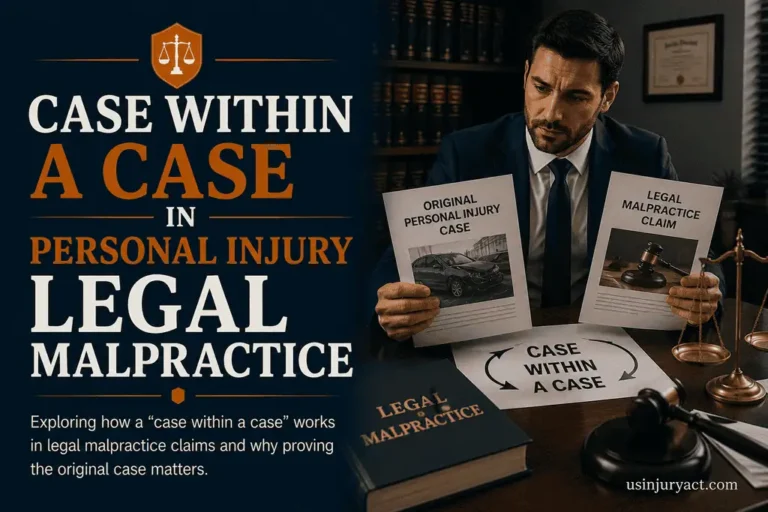
If your personal injury attorney botched your case, you might be wondering what it actually takes to hold them accountable. The answer almost always involves a legal doctrine known as the case within a case in personal injury malpractice litigation.
This concept is an important and challenging element of any legal malpractice claim arising from a personal injury case, and failing to satisfy it is the most common reason these claims fail in court.
This piece elaborate precisely what the case within a case doctrine requires, how courts apply it, what evidence you need to build it, why it is so demanding, and what strategic decisions your legal malpractice attorney must make when litigating it.
The Core Concept Of Case Within a Case
The Fundamental Requirement
In legal malpractice litigation arising from a personal injury case, the plaintiff (the former client) must prove more than the fact that their attorney was negligent. They must also prove that they would have obtained a better outcome in the underlying personal injury case if the attorney had not committed the negligence.
This second layer of proof is the case within a case.
Think of it this way: your legal malpractice lawsuit contains two embedded trials. The outer trial is about whether your attorney acted negligently. The inner trial is a reconstruction of your original personal injury case.
In the inner trial, your malpractice attorney must prove, to the same standard of proof required in the original personal injury action, that you had a meritorious personal injury claim, that the attorney’s negligence caused the loss or diminishment of that claim, and that you can put a dollar figure on what the claim was worth.
Courts consistently require this showing as a matter of causation. Even if your attorney was clearly negligent, if your underlying personal injury claim had no merit, no recoverable damages, or was speculative in value, you have suffered no actual harm from the malpractice.
The case within a case requirement ensures that malpractice recoveries are grounded in real losses, not theoretical ones.
The Standard of Proof
In most states, the standard of proof for the inner case (the reconstructed personal injury claim) is the same preponderance of evidence standard that would have applied in the original personal injury litigation.
That means you must show that it is more likely than not that you would have prevailed and that the recovery would have exceeded what you actually received, if anything.
Some courts have debated whether the lost chance doctrine should apply in legal malpractice cases, allowing a plaintiff to recover for the diminished probability of a successful outcome even without proving they more likely than not would have won.
The majority view in U.S. courts rejects this approach in the legal malpractice context and requires the full preponderance showing. This is a demanding burden, and it is why legal malpractice cases require careful evidentiary preparation.
How the Case Within a Case Works in Practice
Reconstructing the Original Personal Injury Claim
The practical challenge of the case within a case is that your malpractice attorney must try a personal injury case that never actually went to trial.
If your original claim was a car accident case that settled for far less than its value because your attorney failed to retain an accident reconstruction expert, your malpractice attorney must now litigate that car accident case from scratch, including presenting the evidence that should have been gathered the first time, and asking a jury to decide how much the case would have been worth had the proper expert been retained.
This requires assembling the same category of evidence that should have been in your original case: medical records, physician testimony about your injuries and prognosis, economic experts to calculate lost earnings and future medical costs, accident reconstruction experts if liability was disputed, and lay witness testimony about how your injuries have affected your daily life.
In essence, you are trying to populate the record with the evidence your negligent attorney should have developed.
What the Malpractice Jury Evaluates
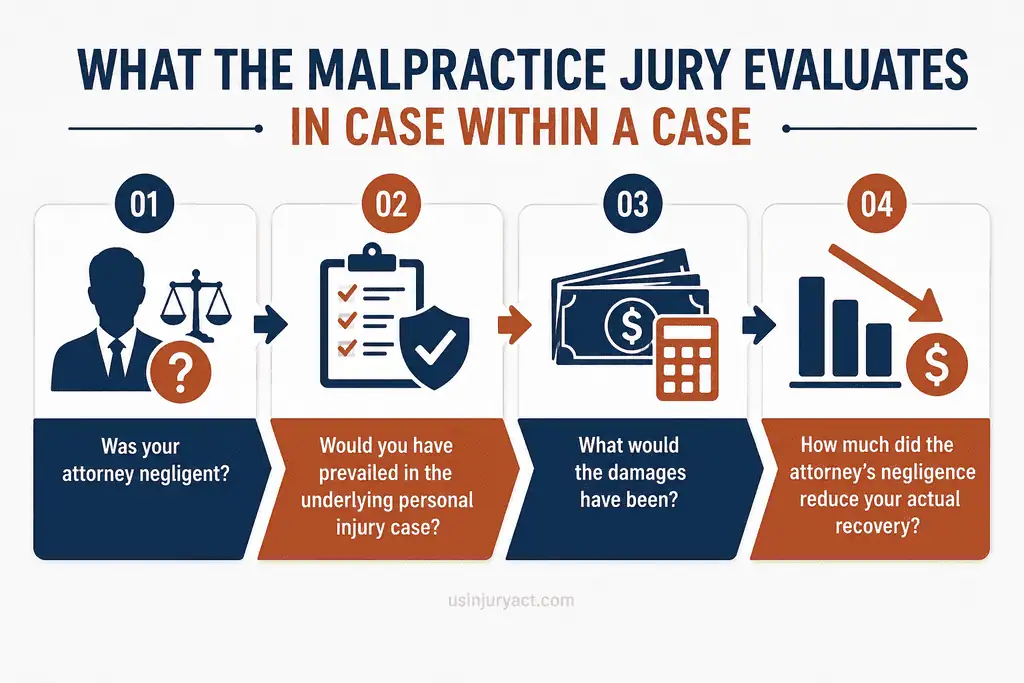
The jury in your legal malpractice case will be asked to evaluate several separate questions like
- Was your attorney negligent?
- Would you have prevailed in the underlying personal injury case?
- What would the damages have been?
- How much did the attorney’s negligence reduce your actual recovery?
These are the same questions a jury would have answered in your original personal injury case, now layered with an additional threshold question about attorney negligence.
This is genuinely more difficult than a straightforward personal injury trial, because jurors must think counterfactually, meaning they must reason about what would have happened in a different proceeding that never took place.
The Role of Expert Witnesses
Expert witnesses are absolutely indispensable in a legal malpractice case built on the case within a case doctrine. You will typically need two separate categories of experts.
The first is a legal malpractice expert, usually an experienced personal injury attorney or former judge, who will testify about the standard of care owed by personal injury attorneys in your jurisdiction, how your attorney deviated from that standard, and what a competent attorney would have done differently.
The second category covers all the substantive experts you would have needed in your original personal injury case.
If your case involved a trucking accident, you need a trucking safety expert to establish the defendant driver’s violations If it involved medical malpractice, you need a physician expert. If it involved catastrophic injury, you need a life care planning expert and an economist to calculate future costs.
Skimping on this expert infrastructure is the most common reason legal malpractice cases are dismissed or result in inadequate verdicts
The Causation Problem – The Hardest Part of the Case Within a Case
Proving the Attorney’s Negligence Actually Caused the Loss
Causation is the most disputed element of the case within a case, Your attorney will argue that even if they were negligent, you still would not have prevailed in the underlying personal injury case, or that the settlement you received was reasonable given the facts.
This is the defense strategy in virtually every legal malpractice case – attack causation by attacking the merits of the original claim.
For example, suppose your attorney missed the statute of limitations in a slip-and-fall case against a retail store. Your malpractice attorney must now prove not only that the filing deadline was missed, but that your slip-and-fall case had merit, that you would have established the stores negligence in maintaining the premises, and that your damages were what you claim.
If the defense can show that your underlying slip-and-fall case had serious liability problems, like the lack of any notice to the store about the hazardous condition, it directly undermines causation.
Concurrent Causation and Comparative Negligence
Another wrinkle that arises in the causation analysis is comparative negligence.
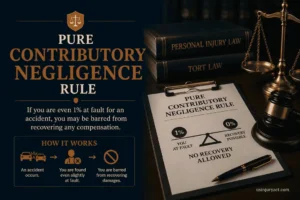
If your original personal injury case was in a comparative fault state, and you bore some percentage of fault for the accident, the value of the underlying case must be discounted accordingly.
In a state like Florida, which applies pure comparative negligence following the 2023 tort reform change from pure to modified comparative fault under HB 837, if you were more than 50% at fault you cannot recover in the underlying personal injury case.
This means your case within a case analysis must account for your own comparative fault percentage when calculating the lost value of the original claim.
Similarly, if there were multiple defendants in the original personal injury case and your attorney failed to name all of them, you must prove not only that each unnamed defendant was liable but also what proportion of the total damages they would have contributed. T
is analysis can become extraordinarily nuanced when dealing with joint and several liability rules that vary by state.
Special Circumstances That Complicate the Case Within a Case
Settlements That Were Inadequate Rather Than Cases That Were Lost
The case within a case doctrine does not apply exclusively to situations where a case was completely lost. It also applies when a case was settled for less than its true value due to attorney negligence.
In this scenario, your malpractice attorney must prove what the case would have settled for, or what a jury would have awarded, absent the attorney’s negligence.
This is sometimes called a lost value claim rather than a lost case claim, and it requires the same comparative analysis of what the case was actually worth versus what was recovered.
These cases are often harder to quantify than clear-cut cases involving missed statutes of limitations, because settlement values are inherently uncertain and a reasonable range of outcomes always exists in personal injury litigation
The defense will argue that the settlement was within a reasonable range regardless of any alleged negligence. Your experts must be able to establish, with credible evidence, that the settlement fell materially below the range that would have been achievable with competent representation.
The Impact of Jurisdiction on the Case Within a Case Standard
The case within a case doctrine is applied differently in various jurisdictions, and this matters enormously if you are evaluating a potential claim. Some states, such as California, have applied a more plaintiff-friendly standard in certain circumstances by allowing recovery where the attorney’s negligence deprived the client of a substantial chance at recovery, even if proof of a guaranteed win is lacking.
Other states apply the doctrine rigidly and require the plaintiff to prove by a preponderance of evidence that they would have won both on liability and damages.
In New York, courts have applied the case within a case standard consistently and require plaintiffs in legal malpractice actions to show that they would have prevailed in the underlying action but for the attorney’s negligence.
See Davis v. Klein (1994) and its progeny.
Texas applies a similarly strict approach under the Texas Supreme Court’s decisions in the professional malpractice context.
When the Underlying Case Was Settled Pursuant to a Release
A particularly challenging application of the case within a case doctrine arises when the original personal injury case was settled pursuant to a general release, and the client later claims the attorney should have obtained a higher settlement.
Courts in this situation must grapple with the preclusive effect of the release on the malpractice claim and must evaluate whether the malpractice caused the inadequate settlement or whether the settlement was a product of the inherent uncertainty in personal injury valuation.
Some courts treat the settlement as evidence of the value of the underlying claim but allow the malpractice plaintiff to introduce evidence that the settlement was depressed by the attorney’s failures.
Others apply a full case within a case analysis as though no settlement had occurred. The approach taken by the court in your jurisdiction significantly affects how you build and present the malpractice case in a personal injury settlement dispute.
Building a Strong Case Within a Case – Strategic Guidance
Start With a Full Audit of the Underlying Case File
Before any malpractice lawsuit is filed, your attorney should obtain and review every document in your former attorney’s file. This includes all correspondence, medical record requests, investigative reports, expert communications, settlement negotiation emails, and internal attorney notes.
The case file often contains the clearest evidence of what the attorney did and failed to do, including dates that establish missed deadlines or investigative steps that were never taken.
Engage Expert Witnesses Early
Given the dual-layer complexity of the case within a case, expert witnesses in a personal injury legal malpractice case should be engaged as early as possible.
Your legal standard of care expert needs time to review the full file and prepare a comprehensive opinion on how the attorney deviated from the standard of care.
Your substantive personal injury experts need time to reconstruct the liability and damages picture from the original accident or incident.
Quantify Damages Precisely
One of the most common weaknesses in legal malpractice cases is imprecise damages quantification. General assertions that the case was worth more are not sufficient.
You need economic experts to calculate lost earnings capacity, life care planners to project future medical costs, and medical experts to establish the permanence and severity of your injuries.
The more precisely you can document the gap between what you receive and what you should have received, the stronger your case within a case becomes.
The case within a case in Summary
The case within a case doctrine in personal injury legal malpractice is one of the most intellectually demanding requirements in civil litigation. It forces your attorney to try two cases simultaneously: the malpractice case against your former lawyer and the original personal injury case that was lost or diminished by that lawyer’s failures.
Success requires meticulous preparation, strong expert testimony, and an attorney who is deeply skilled in both personal injury law and professional malpractice.
So if your personal injury attorney’s negligence cost you a fair recovery (or if you believe so), the case within a case standard is the lens through which your entire claim will be evaluated, and meeting it should be the organizing principle of your legal strategy from day one.