

If your personal injury case ended in a result that felt far worse than it should have, and you believe your lawyer is to blame, you are wondering: can I sue my personal injury lawyer? The answer is yes, you can, but only under specific legal conditions.
Attorney malpractice claims are one of the most nuanced areas of civil litigation in the United States, and before you decide to take action, you need to know what actually qualifies as legal malpractice, what you must prove to win, and what the realistic path forward looks like.
This post covers every dimension of suing a personal injury lawyer so you can make an informed decision.
What Is Legal Malpractice and How Does It Apply to Personal Injury Cases?
Legal malpractice occurs when an attorney’s performance falls below the standard of care that is expected of an attorney of similar ability or legal training.
In the context of personal injury law, it means the attorney fails to provide competent representation and that failure directly causes financial harm to the client.
This can be in situations of lawyer missing the statute of limitations or one who settles your case without your informed consent for far less than its actual value.
However, not every bad outcome qualifies suing your personal injury attorney. Courts across the United States consistently hold that an unfavorable result alone does not constitute malpractice.
Juries sometimes return defense verdicts even in strong cases, and Insurance companies sometimes refuse to pay fair amounts.
The question is not whether you lost, the question is whether your attorney’s conduct fell below the accepted standard of care and caused that loss.
The legal standard for attorney malpractice is measured against what a reasonably competent attorney in the same practice area and jurisdiction would have done under similar circumstances.
This is a professional negligence standard, not a perfection standard. But it is a meaningful one, and courts take it seriously.
The Four Elements You Must Prove in a Malpractice Case
To successfully sue your personal injury lawyer for malpractice, you must establish four distinct legal elements. These are recognized in virtually every U.S. jurisdiction and form the backbone of any legal malpractice claim.
- Attorney-Client Relationship: You must show that a formal attorney-client relationship existed, which is generally easy to establish if you signed a retainer agreement or paid a fee.
- Breach of Duty: You must prove your lawyer’s conduct fell below the standard of care, typically requires testimony from an expert attorney who can explain what a competent lawyer would have done differently.
- Causation: You must show that the breach directly caused your harm.This is where most malpractice cases succeed or fail as courts require a “case within a case” analysis, meaning you must prove you would have won or recovered more in your original case had your lawyer performed properly.
- Actual Damages: You must have suffered measurable financial harm. Emotional distress about your lawyer’s conduct is not enough, you must show you lost money you otherwise would have received.
Common Ways Personal Injury Lawyers Commit Malpractice
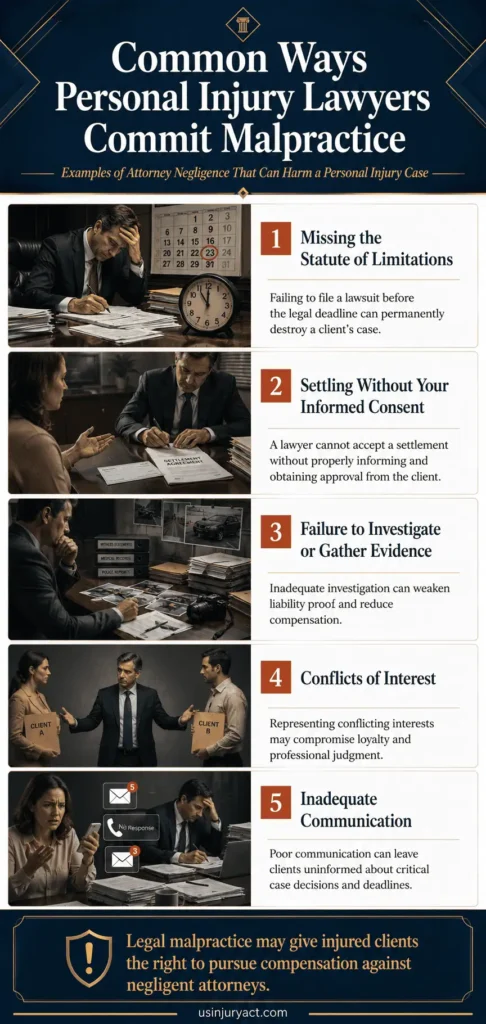
Legal malpractice in personal injury cases can stem from a range of attorney failures. Some of the most frequently litigated scenarios in courts across the country include the following.
Missing the Statute of Limitations
Every personal injury claim has a deadline, called the statute of limitations, by which you must file suit or forever lose your right to recover. These deadlines vary by state and by the type of injury.
In California for instance, most personal injury claims must be filed within two years of the injury. In Texas, the deadline is also two years. New York allows three years for most personal injury cases, while states like Kentucky and Maine extend that window to five and six years respectively.
If your attorney missed the filing deadline, your case was dismissed, and you would have had a strong claim, you have a compelling malpractice case.
This is one of the clearest forms of attorney negligence because it is objectively verifiable.
Settling Without Your Informed Consent
An attorney cannot accept a settlement on your behalf without your knowledge and approval. If your lawyer settled your case for an amount you never agreed to, or failed to inform you of a settlement offer before the deadline to accept it passed, that constitutes a serious breach of professional duty.
The American Bar Association’s Model Rules of Professional Conduct, which most states have adopted in some form, explicitly require attorneys to abide by a client’s decision on whether to settle.
Failure to Investigate or Gather Evidence
Personal injury cases live and die on evidence, and a lawyer who fails to preserve surveillance footage, skips witness interviews, neglects to obtain medical records, or does not hire the right expert witnesses may irreparably damage your case.
If that failure led to a lesser recovery or an outright loss, you may have grounds for a malpractice claim.
Conflicts of Interest
If your attorney had a financial or personal interest that conflicted with your best interests and failed to disclose it, your case may have been compromised as a result.
Conflicts of interest are taken seriously by state bar associations and courts alike. A lawyer who represents both you and the driver who hit you, for instance, cannot competently serve either client.
Inadequate Communication
While poor communication alone does not create a malpractice claim, chronic failure to keep you informed of critical developments such as court dates, settlement offers, or evidence problems can be part of a larger pattern of negligence that harmed your case.
The “Case Within a Case” Standard
Of all the elements in a legal malpractice claim, causation is the most demanding. Courts in states including Texas, Florida, New York, California, Illinois, and Pennsylvania consistently require you to prove what your original case would have produced but for your lawyer’s negligence. This is commonly referred to as the “case within a case” doctrine.
In practice, this means your malpractice attorney must essentially relitigate your original personal injury case inside the malpractice trial. They must show that you had a valid underlying claim, that you would have prevailed or received a larger settlement, and that your damages are a direct consequence of your lawyer’s failure.
This is why legal malpractice cases are expensive and difficult to pursue. You are not just proving that your lawyer did something wrong, you are proving that you had a winning personal injury case and your lawyer’s negligence cost you the victory.
Real-World Instance: Missed Statute of Limitations
Suppose you were injured in a slip and fall accident at a commercial property in Ohio, which has a two-year statute of limitations for personal injury claims.
You retained an attorney shortly after the accident, paid a retainer, and followed up repeatedly over the next 20 months, your attorney reassured you the case was progressing but never filed suit. The deadline passed and your claim was time-barred.
In this scenario, you would have strong grounds for a malpractice claim, you can show the attorney-client relationship existed through the retainer agreement.
A legal expert can testify that no competent Ohio personal injury attorney would allow the statute to expire without filing or at least advising the client.
You can present evidence of your injuries and the liability of the property owner to show what your case was worth. The financial difference between what you would have recovered and the zero dollars you received constitutes your malpractice damages.
This type of case is among the most litigated malpractice scenarios in the country and among the most winnable when facts are clear.
How to Sue Your Personal Injury Lawyer: The Practical Steps
1. Gather Your Case Documents
Start by collecting every document related to your original personal injury case and your relationship with your attorney including the retainer agreement, all correspondence, court filings, medical records your attorney had, any settlement offers that were presented or rejected, and a written timeline of events from your perspective.
2. File a State Bar Complaint If Appropriate
Filing a complaint with your state bar association does not automatically create a malpractice case, and it will not recover money for you. But bar disciplinary records can support your civil claim and may lead to an investigation that uncovers additional evidence of misconduct.
Every state has a bar association with a disciplinary process, you can find your state bar through the American Bar Association’s directory.
3. Hire a Legal Malpractice Attorney
You will need a lawyer who specializes in legal malpractice to evaluate and pursue your claim. These attorneys understand both the procedural requirements and the “case within a case” burden you face. Many offer free consultations and work on contingency for strong cases, be upfront about the facts and bring every document you have gathered.
4. Be Aware of the Malpractice Statute of Limitations
Legal malpractice claims also have their own statute of limitations, which is separate from the one in your original case.
In most states, you have between one and four years to file a malpractice lawsuit after you knew or should have known of the attorney’s negligence.
Missing this deadline will bar your malpractice claim just as missing the original one barred your injury claim, therefore prompt action is advised.
Damages Available in a Successful Malpractice Suit
If you win a legal malpractice case, the damages are typically designed to put you in the position you would have been in had your attorney performed competently.
It generally means recovering the amount you would have received in your original personal injury settlement or verdict, minus the attorney’s fee that would have been deducted.
In some cases involving especially egregious conduct, punitive damages may also be available, though courts award these sparingly.