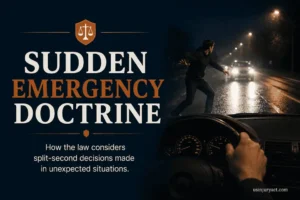

Car accidents happen in seconds and decisions are made even in fractions of those seconds. When something unexpected and dangerous appears out of nowhere, a driver or another person may react in a way that causes an accident even though their reaction in isolation would look like negligence.
The sudden emergency doctrine is the legal principle that addresses this scenario and acknowledges that the standard of care we expect from reasonable people changes when they are confronted with a sudden, unexpected threat they did nothing to create.
If you are involved in a personal injury case and either you or the other party reacted to a sudden emergency, this doctrine could be a decisive factor in determining liability.
What Is the Sudden Emergency Doctrine?
The sudden emergency doctrine is a legal defense in tort law that holds a person to a reduced standard of care when they are confronted with a sudden and unexpected peril that they did not create through their own negligence.
Under ordinary negligence law, we ask what a reasonably prudent person would have done in the same circumstances. The sudden emergency doctrine modifies this inquiry by asking what a reasonably prudent person would have done when suddenly confronted with a genuine emergency, without adequate time to reflect.
The theoretical basis of the doctrine is based on the fact that it is unfair to judge split-second reactions made under duress by the same standard we apply to ordinary, deliberate choices made in calm conditions.
A driver who swerves violently to avoid a child who has just run into the road is making a decision under extreme pressure in milliseconds. Holding that driver to the same deliberate standard of care as someone who carelessly runs a red light would be unjust.
The Legal Elements of the Sudden Emergency Doctrine
For the sudden emergency doctrine to apply, specific conditions must be met. Courts across the United States have generally required the following elements:
Element 1: A Sudden and Unexpected Emergency
The peril must have arisen suddenly and without advance warning, tt must have been genuinely unexpected, not merely surprising.
A slick road on a rainy day is not a sudden emergency for a driver who should have known rain was expected and adjusted their speed accordingly.
But a tire that blows out without warning, a driver who suddenly crosses the center line, or a large animal that leaps onto the highway with no time to react may constitute a sudden emergency depending on the circumstances.
Element 2: The Defendant Did Not Create the Emergency
This is perhaps the most critical limitation of the doctrine. If the defendant’s own negligence created or substantially contributed to the emergency, they cannot invoke the doctrine as a defense.
A driver who was speeding recklessly cannot claim sudden emergency when their excessive speed contributed to their inability to stop in time.
A person who was texting while driving cannot invoke sudden emergency when the pedestrian they hit was visible for several seconds before impact.
The emergency must have been created by some external force or event outside the defendant’s control.
Element Three: The Reaction Was That of a Reasonable Person Under Emergency Conditions
The doctrine does not excuse all reactions, only reasonable ones. Courts still apply an objective standard, but they calibrate it to the emergency situation. The question is not what the calmest, most skilled person could have done, but what a reasonable person suddenly confronted with the same emergency and having the same general knowledge and experience, would have done.
An extreme, irrational overreaction that a reasonable person would not have made does not qualify for protection
Real World Instances of the Sudden Emergency Doctrine
1. The Blown Tire
A driver is traveling on the highway at a lawful speed with properly maintained tires. Without any warning, the front right tire suffers a sudden blowout. The vehicle pulls sharply to the right. The driver jerks the wheel left to compensate, overcorrects, and strikes a vehicle in the adjacent lane.
A court evaluating this situation would likely find that the blowout was a sudden emergency that the driver did not create, and would assess the driver’s response against the standard of a reasonable person experiencing an unexpected tire failure at highway speed, not the standard of someone making a planned lane change.
2. The Sudden Medical Emergency
A driver with no history of cardiac disease suffers a sudden and unforeseeable heart attack while driving. They lose consciousness and the vehicle drifts across lanes, injuring another driver.
Courts have applied the sudden emergency doctrine, and in some cases the related sudden incapacitation doctrine, to hold that a driver who suffers a genuinely unforeseeable medical emergency cannot be held to the ordinary negligence standard.
The key limitation is that the medical event must have been genuinely unexpected. A driver who knows they have a condition that causes sudden loss of consciousness and drives anyway is in an entirely different legal position.
3. The Unexpected Vehicle in the Wrong Lane
A driver is traveling in their lane on a two-lane road when a vehicle from the opposite direction suddenly crosses the center line directly in front of them. The driver, with only a second or less to react, swerves into a ditch to avoid a head-on collision, loses control, and strikes a fence, injuring their passenger.
The sudden emergency doctrine would likely be available to this driver. The oncoming vehicle created the emergency, the driver did not contribute to it, and swerving to avoid a head-on collision is exactly what a reasonable person in those circumstances would do.
The Sudden Emergency Doctrine and Comparative Negligence
The relationship between the sudden emergency doctrine and comparative negligence is one of the more nuanced areas of personal injury law. In states that apply comparative fault, the sudden emergency doctrine does not operate as a complete bar to the plaintiff’s recovery. Instead, it can influence how fault is allocated between the parties.
If the defendant successfully establishes the sudden emergency defense, it may reduce the percentage of fault assigned to them, since the jury is instructed that they should judge the defendant’s reaction against the emergency standard rather than the ordinary negligence standard and it can significantly affect the final damages calculation in a comparative negligence state.
States That Recognize the Sudden Emergency Doctrine
The sudden emergency doctrine has been recognized in most U.S. jurisdictions, though its status has evolved and in some states has been abolished or narrowed:
- New York: New York courts have long applied the sudden emergency doctrine in vehicle accident cases like in the case of Pelletier v Lahm . New York’s Pattern Jury Instructions include instructions on the emergency doctrine that allow juries to apply a modified standard of care.
- Texas: Texas recognizes the sudden emergency doctrine and applies it in negligence cases where defendants can show an unexpected peril arose without their fault.
- California: California courts have applied the emergency doctrine and addressed it in both vehicle accident and premises liability contexts. However, California courts have also noted that the doctrine does not create a separate standard of care but rather informs what a reasonable person would do under the emergency circumstances.
- Florida: Florida courts recognize the sudden emergency doctrine and have applied it in auto accident cases.
- Illinois: Illinois recognizes the doctrine in negligence cases. Illinois courts have addressed the key element that the emergency must not have been caused by the defendant.
- Pennsylvania: Pennsylvania applies the sudden emergency doctrine and has addressed it in both vehicle accident and general negligence contexts.
- Colorado: Colorado has notably abolished the sudden emergency doctrine as a separate instruction, holding that the concept is already embedded within the general reasonable person standard.
- Arkansas: The Arkansas Supreme Court has also abolished the doctrine as a separate jury instruction, finding it redundant with ordinary negligence analysis.
The Abolition Trend and What It Means
A growing number of states have abolished the sudden emergency doctrine as a separate legal instruction, not because they deny that emergencies affect the standard of conduct, but because they believe the concept is already captured within ordinary negligence analysis.
The argument is that when a jury asks what a reasonable person would have done, that question naturally accounts for the circumstances, including any emergency conditions.
A separate sudden emergency instruction, critics argue, improperly highlights the defendant’s circumstances and invites sympathy that distorts a fair negligence analysis.
States that have moved in this direction include Colorado, Oregon, and Arkansas, among others. In these states, counsel may still argue the emergency context to a jury, but they cannot request a specific sudden emergency instruction.
The practical difference is subtle but can affect how prominently the emergency defense is presented and weighted.
Limits of the Sudden Emergency Doctrine
The doctrine is not a free pass, as courts are vigilant about defendants who try to invoke sudden emergency to escape liability for their own prior negligence.
If the evidence shows that a driver was already driving dangerously, was impaired, was distracted, or was violating traffic laws before the alleged emergency arose, their invocation of the doctrine will be challenged aggressively.
Plaintiff’s attorneys will look for evidence that the defendant created or contributed to the emergency, that the reaction was unreasonable even under emergency conditions, and that a more careful driver could have anticipated and avoided the situation entirely.
How the Sudden Emergency Doctrine Affects Your Personal Injury Claim
If the person who caused your accident is invoking the sudden emergency doctrine, you need an attorney who will thoroughly investigate what happened before the alleged emergency arose.
Was the defendant driving safely? Were they attentive? Did they have any warning, however brief, that a danger was developing? Could a more careful driver have avoided the situation entirely?
The answers to these questions can expose the claimed emergency as the product of prior negligence, stripping away the doctrine’s protection.
Conversely, if you were the one who reacted to a sudden emergency and you are being blamed for the accident, the sudden emergency doctrine may protect you from being found negligent for an honest and reasonable reaction to a threat you did not create.
Sudden Emergency Doctrine In Summary
The sudden emergency doctrine is a testament of something fundamentally true about human experience which is that we cannot always be expected to react perfectly when danger arrives without warning.
The law recognizes this, but it also sets clear boundaries as the emergency must have been genuine, must have been sudden, and must not have been the product of the defendant’s own negligence.
Within those boundaries, the doctrine ensures that people are not held to an impossible standard when fate put them in a dangerous situation.
If the sudden emergency doctrine is a factor in your personal injury case, do not try to evaluate it alone.
The factual investigation required to support or defeat this defense is detailed and technically demanding.
An experienced personal injury attorney can make the difference between a fair outcome and one that does not accurately account for what really happened.