Before any personal injury lawsuit can succeed, one foundational question must be answered: Did the person who caused your harm actually owe you a legal obligation to act carefully?
That obligation is what the law calls a duty of care, and it is the very first element any plaintiff must establish in a negligence claim. because:
- Without duty, there is no negligence.
- Without negligence, there is no liability.
- Without liability, there is no compensation.
This guide explains exactly what duty of care means in U.S. personal injury law, how courts determine its existence and scope, and how it plays out across the full range of personal injury cases you are most likely to encounter.
The Legal Definition of Duty of Care
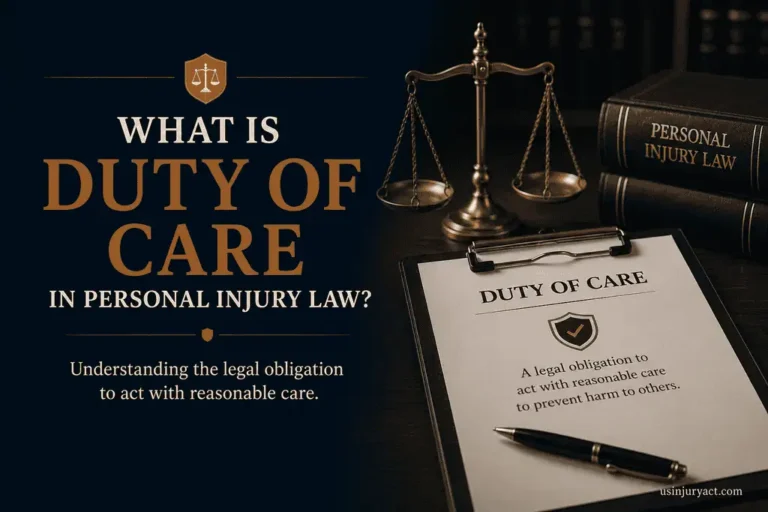
In personal injury law, a duty of care is a legally recognized obligation to exercise reasonable caution to avoid causing foreseeable harm to others. It is not a moral obligation, though morality often informs its content.
It is a legal relationship between two parties that is created by the circumstances they find themselves in.
Duty of care is not universal and the law does not require that every person protect every other person from every possible harm. Instead, it requires that you act with reasonable care toward those who could foreseeably be harmed by your conduct.
The closer the relationship, the more specific the activity, and the more foreseeable the risk, the more clearly a duty of care exists.
The Historical Foundation: Donoghue v. Stevenson and the Neighbor Principle
The modern conception of duty of care in common law derives from the landmark British case Donoghue v. Stevenson (1932), which has profoundly influenced American tort law.
Lord Atkin articulated what has come to be called the neighbor principle which means you owe a duty of care to persons who are so closely and directly affected by your acts that you ought reasonably to have them in contemplation when directing your mind to the acts or omissions in question.
American courts adopted and adapted this reasoning, ultimately anchoring duty of care analysis in foreseeability. If it was reasonably foreseeable that your conduct could injure someone in the plaintiff’s position, you likely owed that person a duty of care.
How Courts Determine Whether a Duty of Care Exists
Courts across the United States use a combination of factors when deciding if a duty of care existed between a defendant and a plaintiff in a personal injury case.
No single factor is always determinative, but together they form a framework for legal analysis.
Foreseeability of Harm
The most important factor is foreseeability. Courts ask whether, at the time of the defendant’s conduct, it was reasonably predictable that the conduct could result in harm to someone in the plaintiff’s position. If the answer is yes, foreseeability supports the existence of a duty.
Relationship Between the Parties
Certain relationships carry well-established duties of care. Drivers owe duties to others on the road, doctors owe duties to their patients, employers owe duties to their employees, landlords owe duties to their tenants.
These relationship based duties have been recognized by courts and codified in statutes over decades, and they rarely require complex analysis to establish.
Policy Considerations
Courts also consider broader policy implications when deciding duty questions.
- Should the law impose a duty here?
- Would doing so encourage safer conduct?
- Would it result in unlimited liability or create unmanageable burdens on society?
These policy questions explain why, for example, bystanders with no special relationship to a victim generally do not have a duty to rescue them, even though failure to do so might seem morally troubling.
Common Examples of Duty of Care in Personal Injury Cases
Duty of care shows up differently depending on the context, and examining specific scenarios helps clarify how this element actually operates in litigation.
Motor Vehicle Accidents
Every driver owes a duty of care to other drivers, passengers, cyclists, motorcyclists, and pedestrians. This duty is reinforced by state traffic laws and extends to basic obligations such as obeying speed limits, yielding at appropriate times, and avoiding impaired driving.
When a drunk driver runs a red light and hits another vehicle, the duty of care is unquestionable. The analysis moves quickly to whether the driver breached that duty as the second element of negligence after duty of care.
Medical Malpractice
The duty of care in a medical context is particularly demanding because of the specialized knowledge doctors, nurses, surgeons, and other healthcare professionals possess.
A physician owes a patient a duty to provide care that meets the standard exercised by a reasonably competent physician in the same or similar specialty under similar circumstances.
This standard is defined by expert testimony, medical literature, and the accepted practices of the profession at the time of treatment.
When a surgeon leaves a foreign object inside a patient after a procedure, or when a physician fails to order tests that would have detected a dangerous condition, the question of duty is rarely disputed.
The dispute typically centers on the standard of care and whether the defendant’s conduct fell below it.
Premises Liability
Property owners owe visitors a duty of care that varies based on the visitor’s status.
- Invitees, such as customers at a store, are owed the highest duty. Owners must inspect for hazards, make repairs, and warn of known dangers.
- Licensees, such as social guests, are owed a duty to warn of known hazards.
- Trespassers are historically owed only a duty to avoid willful harm,
The rule of trespassers however has been relaxed in many states, particularly for child trespassers under the attractive nuisance doctrine.
The attractive nuisance doctrine holds that a property owner owes a duty of care to children who trespass and are injured by an artificial condition on the property that is both likely to attract children and dangerous.
Swimming pools, trampolines, and heavy machinery are classic examples of attractive nuisances.
Products Liability
Manufacturers, distributors, and retailers owe consumers a duty of care with respect to the products they place into the stream of commerce. This duty encompasses the design of the product, the manufacturing process, and adequate warnings about known risks.
When a defective product injures a consumer, the duty analysis is intertwined with the specific theory of products liability, which might be negligence, strict liability, or breach of warranty.
When No Duty of Care Exists
The law does not recognize a duty of care in every situation, and knowing where the boundaries are is just as important as knowing where the duty applies.
The general rule in American law is that there is no affirmative duty to rescue a stranger from danger you did not create.
If you witness a drowning but played no role in causing it, you are not legally obligated to jump in and help, though Vermont and a handful of other states have enacted limited duty-to-rescue statutes.
This rule reflects the common law distinction between misfeasance, actively causing harm, and nonfeasance, failing to act.
However, exceptions abound. If you caused the danger, if you have a special relationship with the victim such as a parent-child or employer-employee relationship, or if you undertook a rescue and then abandoned it in a way that worsened the victim’s situation, a duty can arise even from inaction.
The Standard of Care: What Reasonable Conduct Looks Like
Establishing that a duty exists is only the beginning. The content of that duty, what it actually requires, is measured by the standard of reasonable care. A reasonable person is expected to act as a prudent individual of ordinary intelligence would act under the same circumstances.
This standard scales with expertise. A pediatrician is held to the standard of a reasonably competent pediatrician, not a general practitioner.
A licensed electrician is held to the standard of a skilled tradesperson in that field.
The elevated expertise raises the expected level of care.
The standard can also be informed by statutes and regulations. When a defendant violates a statute that was designed to protect against the specific type of harm suffered by the plaintiff, many courts apply the doctrine of negligence per se, which treats the statutory violation as evidence of breach, or in some states as a conclusive presumption of breach.
Duty of Care in a Slip-and-Fall Case
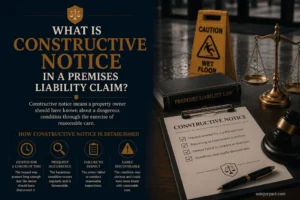
A woman visits a home improvement store to purchase materials for a renovation project for instance. She is a paying customer and therefore an invitee, the category owed the highest duty of care. An employee mopped an aisle and placed no wet floor sign. The woman slips, falls, and fractures her hip.
The store owed her a duty of care as an invitee on its premises. That duty required the store to take reasonable steps to ensure the premises were safe, including properly warning customers of temporary hazards created during routine maintenance.
The failure to post a wet floor sign was a breach of that duty. The fracture was a direct and foreseeable result. Her substantial medical bills, rehabilitation costs, and pain and suffering form her compensable damages.
Duty of Care in a Dog Bite Case
Another instance is a six-year old child is bitten by a neighbor’s dog while playing in a shared common area of a residential complex. The dog had previously snapped at another resident, and the owner had been warned.
Most states impose strict liability on dog owners for bites, but some apply a one-bite rule, requiring proof that the owner knew of the dog’s dangerous propensity.
In either framework, a duty of care analysis is central. The dog owner had a duty to prevent foreseeable harm to others that his animal could cause. Prior aggressive behavior put him on notice of the risk. His failure to restrain the dog was a breach of that duty. The child’s injuries were a direct result.
Summary: Duty Of Care
Duty of care is the foundation on which all personal injury claims are built. It is the law’s way of asking: Was this person responsible for protecting you from the harm you suffered? Answering that question correctly requires a careful analysis of the relationship between the parties, the foreseeability of harm, and the specific standard of conduct required in the circumstances.
If you were hurt because someone failed to meet their duty of care toward you, you may have a right to compensation that an experienced personal injury attorney in your jurisdiction can help you pursue.