Every winter, a significant number of Americans slip on ice in a parking lot and suffer injuries that range from bruised tailbones to shattered wrists and traumatic brain injuries.
If that happened to you, one question almost certainly runs through your mind before you even leave the ground: who is legally responsible for this?
The answer is not always obvious. Liability for icy parking lot falls sits at the intersection of premises liability law, contract law, and local municipal codes. Getting it wrong can mean losing your right to compensation entirely.
This article walks you through exactly how liability is determined, who the likely defendants are, what legal doctrines control your case, and how to build the strongest possible claim after a parking lot ice fall.
The Legal Foundation: Premises Liability and the Duty of Care
When you slip on ice in a parking lot, your legal claim will most likely fall under premises liability law, a branch of tort law that holds property owners and occupiers responsible for dangerous conditions on their land.
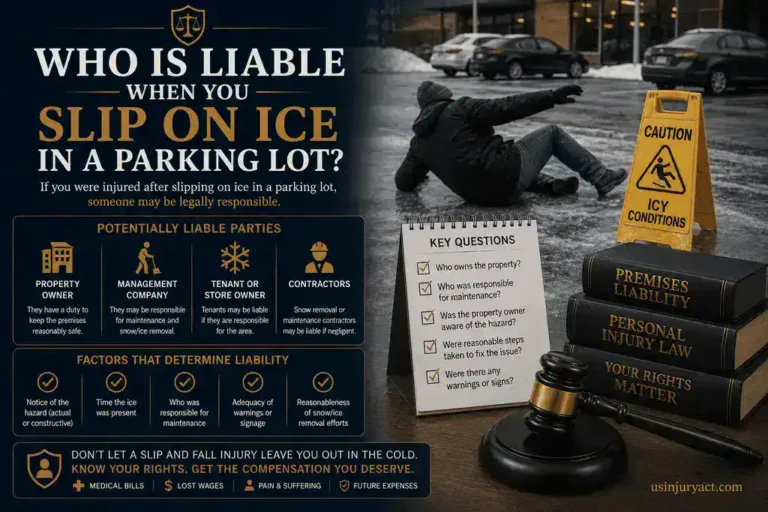
The central question is straightforward: did the responsible party know, or should they have known, about the ice, and did they fail to fix it or warn you in a reasonable amount of time?
Under premises liability doctrine, the duty owed to you depends heavily on your legal status as a visitor. In most parking lot slip-and-fall scenarios, you are an invitee, meaning you entered the lot with the owner or occupant’s express or implied permission for a commercial purpose.
Customers at a grocery store, shoppers at a strip mall, patients at a medical office, and diners at a restaurant all qualify as invitees.
As an invitee, you are owed the highest duty of care. The property owner or possessor must not only fix known hazards but also actively inspect the premises to discover and address unknown ones.
This is a powerful legal standard that significantly strengthens your case compared to the lower duties owed to licensees or trespassers.
Who Is Actually Liable: Breaking Down the Possible Defendants
One of the most confusing aspects of a parking lot ice injury is figuring out exactly who owns, controls, or maintains the lot. In many cases, more than one party shares legal responsibility.
The Property Owner
The owner of the underlying real estate carries a fundamental obligation to maintain safe conditions on the property. Even if the owner leases the building and lot to a tenant, they may retain liability depending on the terms of the lease.
Many commercial leases assign snow and ice removal duties to the tenant, but courts often hold that such assignments do not fully extinguish the owner’s duty to the public.
Consider a scenario where a national retail chain leases a standalone building from a local investment group. The lease says the tenant is responsible for snow removal. A customer slips on an untreated patch of black ice in the lot at 7 a.m., two days after a storm. If the owner knew the tenant consistently failed to treat the lot adequately but took no action, the owner may still share liability.
The Tenant or Business Occupant
If a business operates out of the lot, it almost certainly owes an independent duty to maintain safe conditions for its customers, regardless of who technically owns the pavement.
Courts across the country, from New York to California, consistently hold that the entity in actual possession and control of a property is responsible for keeping it free of unreasonable hazards.
This means if you slip on ice in a grocery store parking lot, the grocery chain can be held liable even if it does not own the land. The fact that customers rely on the lot to access the store makes the chain an occupier with legal obligations.
The Snow Removal Contractor
Many property owners and tenants hire third-party contractors to handle snow and ice removal. If a contractor performed substandard work, such as salting only the main aisles but ignoring pedestrian walkways, or plowing in a way that created hazardous ice dams near parked cars, that contractor may be directly liable to you under negligence principles.
This issue frequently comes up in class action and multi-plaintiff litigation. Courts have held that independent contractors who assume control of snow removal duties also assume a duty of care to foreseeable third parties, including the store’s customers.
That means you can sue the contractor directly, independently of suing the property owner or tenant.
A Government Entity
If the parking lot is attached to a public building such as a government office, courthouse, or public transit hub, a government entity may own and control the lot.
However, suing a government entity adds procedural complexity. Most states require you to file a formal Notice of Claim within a strict deadline, sometimes as short as 30 to 90 days after your injury.
Missing this deadline can permanently bar your lawsuit. Always consult an attorney immediately if you believe a public entity is involved.
The Natural Accumulation Rule and Why It Matters
Some states have adopted a doctrine called the natural accumulation rule, which holds that property owners are not liable for injuries caused by natural accumulations of snow and ice, meaning precipitation that fell naturally without any human interference. Illinois has historically been one of the stronger adherents to this doctrine, though courts have narrowed its reach significantly over time.
However, the natural accumulation defense is frequently defeated when the owner or contractor took some action that made the natural condition more dangerous.
If a contractor plowed snow from the lot and piled it in a way that caused meltwater to run across a pedestrian path and refreeze overnight, the resulting ice is an unnatural accumulation. That distinction transforms the property owner’s immunity into liability.
Even in states that recognize the natural accumulation rule, courts have found exceptions for situations where the owner had actual knowledge of a recurring icing problem.
If a landlord knows that a particular corner of the parking lot consistently develops black ice due to poor drainage but takes no steps to address it, a court may view that knowledge as defeating any claim that the accumulation was purely natural and unforeseeable.
Proving Negligence After a Parking Lot Ice Fall
To win a slip-and-fall case involving ice in a parking lot, you generally must establish four elements of negligence: duty, breach, causation, and damages.
- Duty is typically the easiest element. As discussed, property owners and occupiers owe invitees a duty of reasonable care.
- Breach is where the real fight begins. You need to show the defendant knew, or in the exercise of reasonable care should have known, about the icy condition, and that they failed to fix it within a reasonable time.
- Causation requires showing that the icy condition was the direct and proximate cause of your fall and your injuries. This sounds simple, but defense attorneys will argue that you were distracted, wearing improper footwear, or that you failed to notice obvious warning signs. You need to counter these arguments with solid evidence.
- Damages encompass everything you lost because of the fall: medical expenses, lost wages, pain and suffering, future medical costs, and in severe cases, loss of consortium or permanent disability.
Evidence That Wins Parking Lot Ice Slip Cases
The strength of your case depends almost entirely on the evidence you preserve in the hours, days, and weeks after your fall. The following types of evidence have proven decisive in parking lot ice injury lawsuits across the country.
- Surveillance footage from the property, surrounding businesses, or traffic cameras capturing the condition of the lot and your fall
- Photographs and videos of the exact location, ice condition, lack of sand or salt, and any signage or absence thereof, taken as soon as possible after the incident
- Weather records from the National Oceanic and Atmospheric Administration, including temperature data, precipitation timing, and freeze-thaw cycles in the days before your fall
- The property’s snow removal logs and maintenance records, obtained through a formal discovery request or pre-suit subpoena
- Witness statements from anyone who saw the condition before or after the fall, including other customers, employees, or bystanders
- Your medical records establishing the nature and extent of your injuries, beginning with the emergency room visit on the day of the accident
Contributory and Comparative Negligence: Can Your Own Actions Reduce Your Recovery?
Most states now follow some form of comparative negligence, which means your compensation can be reduced by the percentage of fault attributed to you. If a jury finds you were 20 percent at fault for your fall because you were looking at your phone, you collect 80 percent of your damages.
A small number of states, including Alabama, Maryland, North Carolina, and Virginia, still follow contributory negligence, an older and harsher rule that bars any recovery if you were even one percent at fault. In these states, the defense will aggressively argue that you noticed the ice or should have taken a different path.
Courts and juries evaluate your behavior against what a reasonable person would have done under the same circumstances. Wearing appropriate winter footwear, paying attention to your surroundings, and using available handrails or cleared pathways all support the argument that you acted reasonably.
Real-World Scenarios: How These Cases Play Out
Scenario One:
A woman parks at a chain pharmacy in Ohio the morning after a freezing rain event. There is no sand or salt on the lot, no warning cones, and no cleared path to the entrance. She slips within ten feet of the store entrance and breaks her wrist.
The pharmacy chain had received a weather advisory the prior evening and had a contractual obligation to have the lot treated by 6 a.m. Treatment did not occur until noon. A court finds the pharmacy liable because it had advance notice of the condition and failed to act.
Scenario Two:
A man in Minnesota slips in an apartment complex parking lot and fractures his hip. The lease says the property management company handles all exterior maintenance. The management company hired a landscaping contractor who doubled as a snow removal service in winter.
Investigation reveals the contractor last treated the lot three days before the fall during a period when overnight temperatures dipped below freezing and caused the lot to refreeze.
The contractor and the management company are both named as defendants, and the jury apportions fault 60 percent to the contractor and 40 percent to the management company.
Scenario Three:
A teenager slips on black ice in a government-owned parking structure attached to a city hall in New Jersey. The city claims it is immune under sovereign immunity.
The plaintiff’s attorney files a timely Notice of Claim, then establishes that the city had received multiple prior complaints about the section of the structure where the fall occurred.
The court denies the city’s motion to dismiss, finding that the city’s actual knowledge of the recurring hazard defeats any immunity argument and that the dangerous condition statute creates an independent waiver of immunity.
Statutes of Limitations
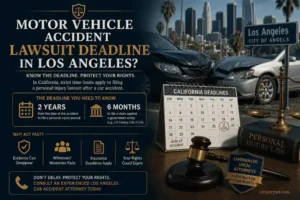
Every state imposes a deadline, called the statute of limitations, on personal injury lawsuits. For slip-and-fall cases, this period is most commonly two years, though it can be as short as one year or as long as three years depending on the state. Missing the deadline means you lose your right to sue forever, no matter how strong your case is.
Claims against government entities are subject to even tighter deadlines through the Notice of Claim requirement. If you were injured on public property, assume your window is dramatically shorter than the standard limitations period and contact a personal injury attorney immediately.
In Summary
A slip on ice in a parking lot is never a simple accident. It is a legal event with potentially dozens of responsible parties and a complex set of legal rules that vary by state.
Property owners, tenants, contractors, and government entities can all bear liability depending on who controlled the lot, what they knew, and what steps they failed to take.
Your best move after any icy parking lot fall is to document everything, seek prompt medical attention, and consult a personal injury attorney who handles premises liability cases in your state.
The law is on your side when negligence caused your fall. Make sure you take the steps necessary to enforce your rights.