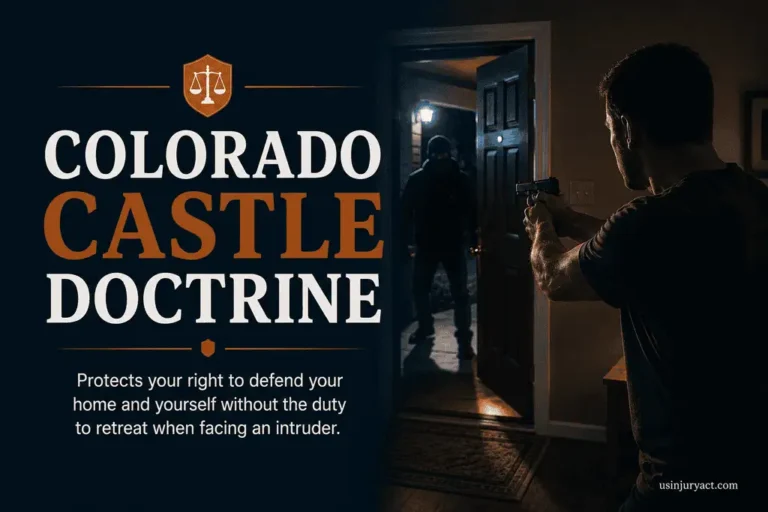
Colorado’s Castle Doctrine, known colloquially as the “Make My Day” law, is a mostly misunderstood and frequently misquoted self-defense statutes in American law. Many people believe it gives homeowners unlimited authority to use deadly force against anyone who enters their property uninvited.
It does not i the real sense because the law is specific, has defined limits, and the legal immunity it provides is conditional to an extent.
If you live in Colorado or own property in the state, having a good level of knowledge on exactly what the Castle Doctrine says, when it applies, and where its protections end is essential.
This information also matters if you have been charged with a crime following an incident in your home, or if you are a victim trying to understand what legal rights apply to your case.
This article delivers a precise and thorough examination of Colorado’s Castle Doctrine, tracing its statutory language, its application by Colorado courts, how it differs from other states’ self-defense laws, and the real consequences of invoking it incorrectly.
Colorado Castle Doctrine: The Text and Statutory Authority Behind Colorado’s Make My Day Law
Colorado’s Castle Doctrine is codified at Colorado Revised Statutes Section 18-1-704.5, enacted in 1985. The statute grants legal immunity to a resident of a dwelling who uses any degree of physical force, including deadly force, against an unlawful intruder if:
- The intruder has made an unlawful entry into the dwelling
- The resident has a reasonable belief that the intruder has committed or intends to commit a crime against a person or property in addition to the unlawful entry itself
- The resident reasonably believes that the intruder might use physical force against any occupant of the dwelling
All three conditions must be present. The statute does not permit the use of force simply because someone enters without permission. There must be a reasonable belief of additional criminal intent and a reasonable belief that force might be used against an occupant.
The word “reasonable” appears throughout the statute and is the central legal battleground in any Make My Day case. Colorado courts evaluate reasonable person standard from the perspective of the homeowner’s situation.
What “Dwelling” Means Under the Statute
The protection under Colorado’s Castle Doctrine applies to a dwelling, which the statute defines as a building or structure used as a permanent or temporary home or place of lodging. This includes a house, an apartment, a mobile home, or any place where a person regularly sleeps or lives.
Importantly, the Make My Day law does not extend to businesses, garages that are detached from the home, or outdoor areas of a person’s property such as a yard, driveway, or porch unless Colorado courts have extended the definition in specific fact patterns.
It is a critical distinction from some states that have broader Castle Doctrine provisions covering the curtilage, the area immediately surrounding a home.
Colorado has also not adopted a “Stand Your Ground” law in the same form as Florida or Texas, which remove the duty to retreat in any location where a person has a legal right to be. Colorado’s Make My Day law is specifically tied to the home, not to public spaces.
The Immunity Provided: Criminal and Civil Protection
An important feature of Colorado’s Make My Day law is that it provides immunity from both criminal prosecution and civil liability. Section 18-1-704.5(3) states that a resident who acts in compliance with the statute is immune from any criminal charges and from civil liability to the intruder or to any person claiming through the intruder. The dual immunity is a major legal protection.
In states without equivalent provisions, a homeowner who uses deadly force against an intruder and is not prosecuted criminally might still face a wrongful death lawsuit from the intruder’s family. Colorado’s statute explicitly closes that avenue, provided the homeowner meets all the statutory conditions.
However, immunity is not automatic as homeowner must request a hearing to determine immunity before trial. Colorado courts conduct these hearings at which the defendant bears the burden of establishing the statutory conditions by a preponderance of the evidence. If the court finds the conditions were met, the case is dismissed.
The Burden of Proof and How Courts Apply the Standard
One frequently confused aspect of Colorado’s Make My Day law is who bears the burden of proof in a self-defense immunity hearing. Under the statute and Colorado court precedent, the defendant claiming immunity must demonstrate that the conditions of the statute were satisfied. This is different from a standard criminal trial where the prosecution must prove guilt beyond a reasonable doubt.
The defendant must show by a preponderance of the evidence, meaning more likely than not, that:
- The entry was unlawful
- The defendant had a reasonable belief of criminal intent beyond mere trespass
- The defendant had a reasonable belief that the intruder might use physical force against an occupant
Colorado courts usually scrutinized each of these elements carefully and cases where the intruder was unarmed, where the entry was arguably permitted, or where there was no clear indication of criminal intent beyond trespass have resulted in courts denying immunity.
What the Make My Day Law Does NOT Cover
Invited Guests and Social Visitors
The Make My Day law does not apply to people who entered the dwelling with the resident’s permission, even if the relationship later deteriorates and the person refuses to leave. A domestic partner, a guest, or a family member who was invited into the home does not become an unlawful intruder simply by outstaying their welcome or engaging in a dispute.
Several Colorado criminal cases have involved defendants who attempted to invoke the Make My Day law after confrontations with individuals who had originally entered lawfully.
Courts have consistently held that the statute requires an unlawful entry, and a person who was invited in, even under contentious circumstances, did not make an unlawful entry.
Outdoor Areas and Businesses
As noted above, the statute is specific to a dwelling, therefore using force against a person on your porch, in your yard, or in a commercial space you own is not protected by the Make My Day statute.
In those scenarios, the general self-defense provisions of Colorado Revised Statutes Section 18-1-704 apply, which require proportionality and sometimes impose a duty to retreat depending on the circumstances.
Aggressor Situations
Colorado law, consistent with self-defense principles nationwide, does not allow a person who is the initial aggressor to claim self defense immunity.
That means if the homeowner initiated the confrontation, escalated the situation to violence, or provoked the intruder into responding physically, the conditions for Make My Day immunity are not met.
Comparison With Other States’ Castle Doctrines
Colorado’s Make My Day law is notable for being one of the earliest and most publicized state Castle Doctrine statutes. However, it is more restrained than the laws of some other states.
Florida’s Castle Doctrine, codified at Florida Statute Section 776.013, operates alongside the state’s Stand Your Ground law and creates a presumption of reasonable fear when a person forcibly enters a dwelling. Florida places the burden on the prosecution to rebut that presumption, which is the reverse of Colorado’s approach.
Texas Penal Code Section 9.32 allows use of deadly force to protect property in some circumstances and has broader provisions for defense of property than Colorado. Texas also does not impose a duty to retreat in a location where a person has a legal right to be.
In contrast, some states like New York maintain a strong duty to retreat even in the home before using deadly force, making those states far more restrictive than Colorado when it comes to self-defense in dwelling situations.
Let’s Create A Home Intruder Scenario
Imagine a Colorado homeowner who wakes at 2 a.m. to the sound of breaking glass, they find a stranger inside their home who has forced open a back window. The intruder is rifling through a purse near the kitchen, and when the homeowner calls out, the intruder does not flee. if the homeowner reasonably believes the intruder may be armed and is fearful of physical harm, the homeowner may use a firearm in self-defense.
In this scenario, the Make My Day law’s conditions appear to be satisfied because the entry was unlawful, the conduct of rifling through property suggests criminal intent beyond mere trespass, the homeowner had a reasonable belief that the intruder, who did not flee after being discovered, might use force.
Now let’s change the facts slightly.
A neighbor, who regularly has access to the home and sometimes house-sits, enters through the back door at 2 a.m. without notice because they are returning a borrowed item.
The homeowner, not knowing it is the neighbor, confronts and uses force.
In this scenario, whether the entry was truly unlawful becomes the central factual dispute, and the Make My Day immunity may not apply because the neighbor arguably had implied permission to enter.
These scenarios illustrate why the Make My Day law requires careful factual analysis in every case and a reminder that the statute is not a blanket authorization, it requires all three conditions to be genuinely present.
Criminal Defense Strategy Under the Make My Day Law
For a Colorado criminal defense attorney, the Make My Day law represents a powerful pretrial tool.
The immunity hearing mechanism allows the defendant to seek dismissal of charges before ever facing a jury. A successful immunity hearing eliminates civil liability to the intruder’s estate.
Defense attorneys must build a compelling factual record for the hearing, including evidence of the unlawful entry, testimony about the homeowner’s state of mind, any physical evidence of the intruder’s conduct, and documentation of the intruder’s criminal history if available.
The hearing is essentially a mini-trial, and the strategic choices made at that stage can determine the outcome of the entire case.
Colorado’s Castle Doctrine In Summary
Colorado’s Castle Doctrine, the Make My Day law, provides meaningful and powerful legal protection to homeowners who face genuine threats inside their dwellings. But that protection is conditional, requires satisfying specific statutory elements, and is not available in every situation involving force used on one’s property.
If you have used force inside your home and are facing criminal charges or civil liability, consulting a Colorado criminal defense attorney immediately is essential. The Make My Day immunity hearing is a critical procedural opportunity, and the time to build your case for that hearing is before charges are formally prosecuted, not after.
For victims of violence who have suffered harm and are evaluating their legal options in Colorado, the same precision matters. The statute provides clear immunity when its conditions are met, and understanding the boundaries of that immunity determines what civil claims, if any, remain viable.