When an American witnesses emergencies in public: cardiac arrests on sidewalks, car accidents on highways, overdoses in parking lots, the instinct to help is natural but so is fear of being sued. Good Samaritan Law exists precisely to resolve that conflict.
It is one of the most practically important areas of U.S. personal injury law, and yet it remains widely misunderstood by both the general public and many legal practitioners.
This guide defines Good Samaritan Law clearly, explains how it works in all 50 states, covers real world examples, outlines when it protects you and when it does not, and answers the most common questions people ask about this doctrine.
What Is Good Samaritan Law?
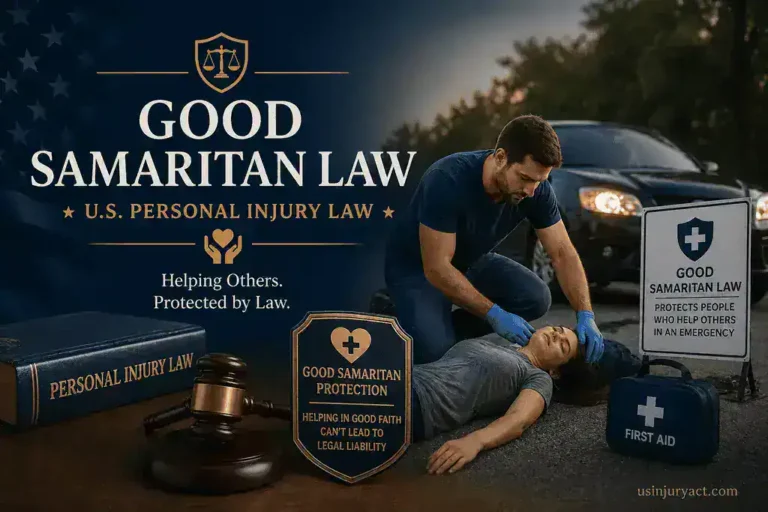
Good Samaritan Law refers to a body of statutes enacted across U.S. states that provide legal protection to individuals who voluntarily render emergency assistance to injured or ill persons.
The central purpose of these laws is to remove the threat of civil liability from people who act in good faith to help others during emergencies, even if their assistance causes unintended harm.
Legal Definition
In legal terms, a Good Samaritan statute grants immunity from civil liability to a person who, without compensation and without a preexisting duty to act, voluntarily provides emergency care or assistance to another person in apparent need.
The immunity shields the helper from negligence claims brought by the person they attempted to assist or by that person’s representatives.
Most statutes define the protected conduct as ’emergency care’ administered at the scene of an emergency. Some statutes are narrow and apply only to specific acts such as CPR or the use of an automated external defibrillator (AED).
Others are broader and cover a wide range of first aid and medical assistance.
Origin and Purpose
The modern Good Samaritan statute emerged in California in 1959. Before that law, American tort law offered no consistent protection to bystanders who helped in emergencies. A rescuer who made a mistake during a rescue attempt could face a negligence lawsuit just as any healthcare provider could.
This deterrent effect was considered a serious public policy problem. Lawmakers recognized that potential civil liability was discouraging ordinary citizens from rendering aid that could save lives.
The name itself comes from the biblical parable of the Good Samaritan, in which a traveler stops to help a stranger who has been beaten and left on the road. The legal concept captures the same principle which is rewarding and protecting altruistic intervention.
Role in Tort Law and Personal Injury Cases
Within tort law, Good Samaritan statutes operate as affirmative defenses to negligence claims. Normally, a person who renders assistance to another assumes a duty of reasonable care for the duration of that assistance.
If the assistance falls below the standard of care and causes harm, the helper can be held liable in negligence. Good Samaritan statutes create a statutory exception to this general rule.
In personal injury litigation, a defendant who rendered emergency assistance will often assert Good Samaritan immunity as a defense. The burden then shifts to the plaintiff to demonstrate that one or more conditions of the statute were not satisfied, thereby defeating the immunity claim.
Key Elements of Good Samaritan Law
While the specifics vary by state, most Good Samaritan statutes share a core set of requirements. All of these conditions must typically be satisfied for the immunity to apply.
Good Faith Requirement
The helper must act in good faith, meaning with a genuine, honest intent to provide assistance. A person who claims to help but is actually motivated by a desire to cause harm or who acts recklessly while purporting to assist does not qualify for protection under most statutes. Courts examine the totality of conduct to determine whether good faith was present.
No Expectation of Compensation
Good Samaritan immunity applies only to voluntary, gratuitous assistance. If the helper receives or expects to receive payment for the assistance, the protection under most statutes is lost. This is a critical distinction that affects how the law treats medical professionals who happen to respond to off duty emergencies.
Emergency Situation Requirement
The assistance must be rendered in response to an actual emergency. An emergency is typically defined as a sudden, unexpected event that requires immediate action to prevent death or serious bodily harm. The law does not extend to non urgent situations where there was time to summon professional help before intervening.
No Gross Negligence or Reckless Conduct
This is perhaps the most litigated element. Virtually all Good Samaritan statutes withdraw protection if the helper was grossly negligent or reckless. Ordinary negligence, meaning a minor mistake or error in judgment under stressful conditions, is generally protected. Gross negligence, meaning a conscious and extreme departure from reasonable conduct, is not. The line between the two is often disputed in court.
When Good Samaritan Law Applies
Medical Emergencies
The most common scenario involves bystander CPR. If a person collapses in a shopping mall and a bystander begins chest compressions that result in broken ribs, a Good Samaritan statute will typically protect the bystander from a lawsuit alleging that the compressions caused injury, provided the bystander acted without compensation and in good faith.
Similarly, a person who uses an AED on a cardiac arrest victim and causes additional injury through improper placement is generally protected under both general Good Samaritan statutes and specific AED protection laws that exist in most states.
Car Accidents
A driver who stops at the scene of a motor vehicle accident and attempts to pull an injured person from a burning vehicle, but accidentally worsens a spinal injury in doing so, may be protected by Good Samaritan immunity. The key considerations are whether the situation appeared to be a genuine emergency and whether the helper acted reasonably under the circumstances.
Public Incidents
A bystander who performs the Heimlich maneuver on a choking person at a restaurant, a passerby who restrains a person having a seizure to prevent further injury, or a neighbor who provides first aid to a child who has fallen from a bicycle are all classic Good Samaritan scenarios where state statutes typically provide protection.
When Good Samaritan Law Does Not Apply
Gross Negligence
If a helper performs actions that no reasonable person would undertake under the circumstances, courts may find gross negligence and deny immunity. Examples include performing improvised surgery with non sterile tools in a non urgent situation, or administering a medication without any basis for believing it would help rather than harm.
Intentional Harm
If the harm caused was intentional rather than accidental, Good Samaritan immunity does not apply. A person who strikes an accident victim while claiming to be performing first aid has committed an intentional tort and receives no statutory protection.
Duty to Act Situations
In certain relationships, a legal duty to render assistance already exists independent of any voluntary choice. Parents have a duty to assist their minor children. Employers may have duties regarding employees in certain contexts. Where a preexisting duty exists, the voluntary nature of the act is absent and Good Samaritan immunity may not apply in the same way.
Paid Professionals in Some Contexts
Healthcare providers who are on duty and acting within the scope of their employment when they render emergency care may not qualify for Good Samaritan protection under statutes that require the assistance to be voluntary and uncompensated.
However, most states have separate or overlapping provisions that protect off duty healthcare workers who respond to emergencies.
Good Samaritan Law Examples
Example 1: Protected (Cardiac Arrest)
| PROTECTED
Marcus witnesses a man collapse at a gym. He is not a medical professional. He begins CPR and continues for several minutes until paramedics arrive. During CPR, he breaks three of the victim’s ribs. The victim survives and later sues Marcus for the broken ribs. Under most state Good Samaritan statutes, Marcus is immune from liability. He acted voluntarily, without compensation, in good faith, in a genuine emergency, and his conduct was not grossly negligent. CPR related rib fractures are a known and accepted risk of the technique. |
Example 2: Protected (AED Use)
| PROTECTED
A store employee uses an AED on a collapsed customer in accordance with the device’s voice prompts. The shock does not restore normal rhythm, and the customer sustains a minor burn at the electrode site. Most states have specific statutes protecting AED users in addition to general Good Samaritan provisions. The employee is protected. |
Example 3: Not Protected (Gross Negligence)
| NOT PROTECTED
A bystander at a car accident decides to perform an improvised tracheotomy on a person who is breathing but appears distressed. The procedure causes life threatening bleeding. Courts would likely find that this conduct constitutes gross negligence. No reasonable person without surgical training would perform such an intervention on a breathing person. Good Samaritan immunity would not apply. |
Example 4: Not Protected (Compensation)
| NOT PROTECTED
A nurse who is paid to staff a corporate event administers first aid to an injured attendee during the event. Because she is being compensated to provide exactly this type of service, the voluntary and gratuitous nature of the assistance is absent. Good Samaritan immunity likely does not apply, and she would be held to the professional standard of care for a nurse. |
Example 5: Gray Area (Off Duty Doctor)
| GRAY AREA
A physician who happens to be dining at a restaurant and responds to a fellow diner’s medical emergency is in a more complex position. Most states protect off duty healthcare providers under Good Samaritan statutes, especially when no compensation is received. However, courts in some states have held that physicians are held to a higher standard even when off duty because of their specialized training. The outcome depends heavily on the specific state statute and the facts of the case. |
Good Samaritan Law by State: A Detailed Breakdown
Understanding Good Samaritan Law by state is essential because these statutes are not uniform across the country. The scope of protection, the categories of protected persons, and the specific conditions for immunity vary significantly from one jurisdiction to another.
Oklahoma
Oklahoma’s Good Samaritan Law is relatively limited in scope compared to many other states. Under Oklahoma Statutes Title 76, Section 5, persons who render emergency care in good faith at the scene of an emergency are protected from civil liability, but only for ordinary negligence.
The statute was historically interpreted narrowly, providing protection primarily for basic interventions such as CPR, control of bleeding, and simple first aid. Oklahoma does have specific provisions protecting persons who use AEDs in an emergency, provided the AED was properly maintained and the user acted in good faith.
The state does not impose a general duty to assist on bystanders.
Texas
Texas has one of the broader Good Samaritan frameworks in the United States. Under the Texas Civil Practice and Remedies Code, Chapter 74, Subchapter H, and the general Good Samaritan Act, individuals who in good faith administer emergency care at the scene of an emergency are immune from civil liability for acts performed during the emergency.
The Texas statute explicitly covers both healthcare providers acting outside their normal professional capacity and ordinary citizens. It also covers persons who stop at a motor vehicle accident and provide assistance, a scenario expressly addressed by the Texas Transportation Code.
Texas courts have generally applied Good Samaritan immunity broadly when the factual requirements of the statute are satisfied.
Importantly, Texas does not require bystanders to render assistance. There is no general duty to act for private citizens. However, once a person voluntarily begins to render assistance, they must not abandon the victim in a worse position than they found them.
Florida
Florida Statutes Section 768.13 establishes the state’s Good Samaritan Act, which provides immunity to any person who gratuitously and in good faith renders emergency care or treatment at the scene of an emergency outside of a hospital, doctor’s office, or other place having proper medical equipment.
Florida’s statute is notable for its explicit inclusion of persons who provide emergency care related to the use of an AED. Florida law requires AEDs to be available at certain public facilities and provides complementary immunity to users who act in good faith.
The Florida statute also protects medical professionals who render emergency care outside of their professional context.
California
California Civil Code Section 1799.102, known as the ‘Emergency Medical Care’ statute, provides that a person who in good faith, and not for compensation, renders emergency care at the scene of an emergency shall not be liable for any civil damages resulting from any act or omission.
California was the first state to enact a Good Samaritan statute in 1959, and the law has been interpreted by California courts numerous times over the decades.
One significant California Supreme Court decision, Van Horn v. Watson (2008), initially raised concerns by suggesting that Good Samaritan protection applied only to medical care and not to rescue actions more broadly.
The California Legislature subsequently amended the statute in 2009 to clarify that protection extends to emergency medical care rendered at an emergency scene.
Georgia
Georgia Code Section 51-1-29 provides immunity to persons who render emergency care in good faith to injured persons at the scene of an accident or emergency. Georgia courts have held that the statute requires the emergency to be sudden and unexpected, the care to be rendered in good faith, and the helper to have acted without gross negligence.
Georgia has separate provisions addressing AED use. Under Georgia law, persons and entities that acquire AEDs for public use are protected from liability when the devices are properly maintained and users respond in good faith to emergencies. Georgia does not require bystanders to assist.
Arizona
Arizona Revised Statutes Section 32-1471 and related provisions establish a framework for Good Samaritan immunity in the state. Arizona provides protection to persons who render emergency care in good faith at the scene of an emergency, including CPR and the use of AEDs.
Arizona’s statute includes specific provisions for AED related emergencies that go beyond the general Good Samaritan framework. Arizona also provides immunity for emergency care rendered during sporting events or public gatherings, which has been particularly relevant in cases involving athletics related cardiac events.
Courts in Arizona have noted that the statute is to be construed broadly in furtherance of its purpose of encouraging emergency assistance.
Colorado
Colorado has one of the most comprehensive Good Samaritan statutes in the United States. Colorado Revised Statutes Section 13-21-108 provides broad immunity to persons who render emergency care at the scene of an accident or other emergency, including both laypeople and healthcare providers.
Colorado’s statute is distinctive in its explicit coverage of emergency responders, including volunteer firefighters and emergency medical technicians who may not be acting in an official capacity at the time. The statute covers a wide range of emergency actions, from basic first aid to more advanced interventions.
Colorado also has specific provisions addressing drug overdose situations. The state’s Drug Overdose Response Act provides immunity from prosecution for drug possession offenses to persons who call 911 in good faith to report an overdose and remain on scene.
Colorado courts have applied the Good Samaritan statute liberally, consistent with the legislative intent to remove barriers to emergency assistance.
States That Require Assistance
Most U.S. states impose no legal duty on private citizens to render assistance to strangers in need. However, a small number of states have enacted ‘duty to rescue’ statutes that require bystanders to render or summon assistance in certain circumstances.
- Minnesota: Requires a person at the scene of an emergency to give reasonable assistance to any person exposed to or suffering grave physical harm. Violation is a misdemeanor.
- Vermont: Requires any person who knows another is exposed to grave physical harm to give reasonable assistance when it can be rendered without danger or peril to the helper or to third parties.
- Rhode Island: Requires a person present at an accident or scene of violence where another has suffered serious bodily injury to immediately seek medical assistance or notify law enforcement – Section 11-56-1
In contrast, the vast majority of states impose no duty on private citizens to render assistance. In these states, a person may legally choose not to help, and that choice cannot form the basis of civil liability.
Federal vs. State Law
Good Samaritan Law in the United States is almost entirely a matter of state law. There is no comprehensive federal Good Samaritan statute that applies to emergency assistance rendered on the ground by private citizens.
However, federal law does address certain specific contexts. The Aviation Medical Assistance Act of 1998 provides liability protection to medically qualified individuals who render assistance during in flight medical emergencies on commercial aircraft.
This federal statute reflects Congress’s recognition that in flight emergencies require a federal framework, given the interstate nature of air travel.
The federal Volunteer Protection Act (42 U.S.C. Section 14501) provides some protections to volunteers acting on behalf of nonprofit organizations, but this statute does not function as a general Good Samaritan law and does not cover most bystander emergency assistance scenarios.
The Cardiac Arrest Survival Act encouraged states to adopt AED deployment programs and provided a framework for AED related immunity, but the actual immunity provisions were implemented through state law.
For the vast majority of emergency assistance situations, the applicable law is the Good Samaritan statute of the state in which the assistance was rendered.
Special Situations Under Good Samaritan Law
Drug Overdose Good Samaritan Laws
One of the most significant expansions of Good Samaritan protection in recent decades involves drug overdose situations. As the opioid epidemic escalated in the 2010s, lawmakers recognized that bystanders were failing to call 911 during overdose emergencies out of fear of drug related criminal prosecution.
In response, nearly all states have enacted drug overdose Good Samaritan laws, which provide immunity from prosecution for minor drug offenses such as simple possession when a person calls 911 in good faith to report an overdose. The scope of these laws varies significantly by state.
Some states provide immunity only to the caller, while others extend protection to the overdose victim as well. These drug overdose Good Samaritan laws are distinct from civil Good Samaritan immunity and operate in the criminal law context.
AED Usage Protections
All 50 states and the District of Columbia have enacted specific legal protections for the use of automated external defibrillators.
Most of these statutes are layered on top of general Good Samaritan protections and provide immunity to AED users who act in good faith, to persons and entities responsible for AED acquisition and maintenance, and to physicians who provide medical oversight for AED programs.
The requirements for AED immunity vary by state. Some states require AED users to have received training. Others provide immunity regardless of training, recognizing that AEDs are designed to be used by untrained laypersons.
Medical Professionals vs. Ordinary Citizens
The application of Good Samaritan Law to medical professionals is more complex than for ordinary citizens. Most state statutes include medical professionals in their definition of protected persons, provided the care is rendered voluntarily and without compensation.
However, courts have sometimes held medical professionals to a higher standard when evaluating whether their conduct was grossly negligent, reasoning that a physician’s or nurse’s professional training should inform how their emergency conduct is evaluated.
Good Samaritan Law in Personal Injury Cases
How Attorneys Use It as a Defense
When a client faces a personal injury claim arising from emergency assistance they rendered, a skilled personal injury defense attorney will typically assert Good Samaritan immunity as an affirmative defense in the answer to the complaint.
The attorney will then develop the factual record to establish each element of the immunity: that the situation was a genuine emergency, that the assistance was voluntary and uncompensated, that the helper acted in good faith, and that the conduct did not constitute gross negligence.
How Plaintiffs May Challenge It
Plaintiffs who wish to overcome a Good Samaritan defense typically challenge one or more of the statutory elements. Common challenges include:
- Arguing that the situation was not a genuine emergency and that there was time to summon professional help.
- Arguing that the helper received or expected compensation.
- Arguing that the conduct crossed the line from ordinary negligence into gross negligence.
- Arguing that the helper was on duty as a paid professional at the time.
- Arguing that the specific statute does not cover the type of assistance rendered.
Burden of Proof
In most states, once a defendant raises Good Samaritan immunity as a defense, the burden shifts to the plaintiff to prove that one or more of the immunity’s conditions were not satisfied.
This means the plaintiff must produce evidence sufficient to overcome the presumption of immunity, typically by a preponderance of the evidence.
Litigation Strategies
Effective litigation of Good Samaritan cases requires careful attention to the specific language of the applicable state statute. Courts construing these statutes apply standard principles of statutory interpretation, and small differences in statutory language can produce significant differences in outcome.
Attorneys on both sides must be prepared to argue the language of the statute, the legislative history, and any appellate court decisions that have interpreted the provision.
Common Misconceptions About Good Samaritan Law
Misconception 1: You Can Always Be Sued
Many people believe that Good Samaritan Law provides absolute protection from lawsuits. It does not. The law provides immunity from liability, which means a court may dismiss a lawsuit if the immunity applies.
But anyone can file a lawsuit alleging anything, and a defendant may incur legal costs even if the suit is ultimately dismissed. The immunity is a defense that must be asserted and proven in court.
Misconception 2: You Must Always Help
In the vast majority of states, private citizens have no legal duty to render assistance to strangers. While there may be moral obligations, the law does not require you to act. Only a small number of states impose a duty to assist in certain emergency situations.
Misconception 3: Good Samaritan Law Protects All Actions
Good Samaritan immunity is not unlimited. It does not protect grossly negligent or reckless conduct. It does not protect intentional harm. It does not typically apply when the helper is being compensated. And it applies only to emergency situations, not to follow up care rendered after the emergency has passed.
Frequently Asked Questions About Good Samaritan Law
What does Good Samaritan Law protect?
Good Samaritan Law protects individuals who voluntarily render emergency care or assistance in good faith from civil liability for ordinary negligence arising from that assistance. It is designed to encourage bystander intervention by removing the fear of being sued for good faith mistakes made during emergency assistance.
Can you be sued under Good Samaritan Law?
Yes, a lawsuit can always be filed. Good Samaritan Law provides immunity from liability, not immunity from being sued. However, if the immunity applies, the case should be dismissed. Many such lawsuits are resolved on motions to dismiss or for summary judgment once immunity is established.
Does Good Samaritan Law apply in all states?
All 50 states have some form of Good Samaritan protection, but the scope, requirements, and coverage vary significantly. Some states offer broad protection, others offer narrower protections limited to specific acts. A few states also impose a duty to assist, which coexists with the Good Samaritan protections.
Are doctors protected under Good Samaritan Law?
In most states, doctors and other healthcare providers who voluntarily render emergency care off duty and without compensation are protected under Good Samaritan statutes. However, courts may apply a heightened scrutiny to their conduct given their professional training. The specifics depend on the state.
What is gross negligence in Good Samaritan Law?
Gross negligence is a conscious, willful, or wanton disregard for the safety of others that goes far beyond ordinary negligence. In the Good Samaritan context, it typically refers to conduct so reckless or careless that no reasonable person would have engaged in it under similar circumstances. Gross negligence voids Good Samaritan immunity in virtually every state.
Does Good Samaritan Law cover drug overdose situations?
Most states have enacted specific drug overdose Good Samaritan laws that provide criminal immunity, typically from drug possession charges, to persons who call 911 in good faith during an overdose. These laws are separate from general civil Good Samaritan immunity. Coverage varies by state.
Does Good Samaritan Law protect AED users?
Yes. All 50 states have specific legal protections for persons who use AEDs in good faith during cardiac emergencies, often layered on top of general Good Samaritan protections. Requirements for protection, such as training or proper maintenance of the device, vary by state.
What happens if you stop helping someone mid emergency?
In most states, once a person voluntarily begins to render assistance, they must not abandon the victim in a worse position than they found them. If a helper stops assisting and leaves the victim worse off, the Good Samaritan protection for prior assistance may be compromised and a duty to continue assistance may have been created.
Is Good Samaritan Law a federal or state law?
Good Samaritan Law is almost entirely a matter of state law in the United States. There is no comprehensive federal Good Samaritan statute. Each state has its own statutes with its own requirements, scope, and limitations.
Does Good Samaritan Law apply to bystanders on private property?
Most Good Samaritan statutes do not limit protection to public places. They apply wherever an emergency occurs, including private property. The key factors are whether the situation was a genuine emergency, whether the helper acted voluntarily and without compensation, and whether the conduct was in good faith without gross negligence.