One of the most common defenses a property owner raises after someone is injured on their premises is “We didn’t know about the dangerous condition.”
In everyday life, ignorance often provides an excuse but in personal injury law, it frequently does not.
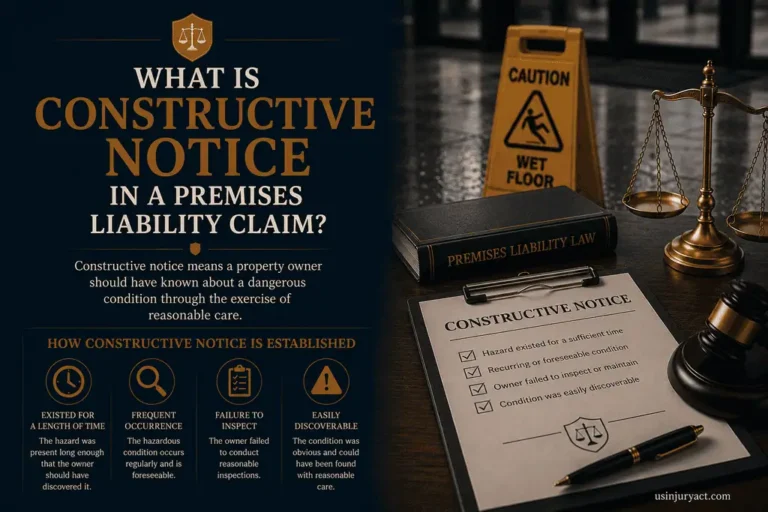
The doctrine of constructive notice is the legal principle that holds property owners responsible for dangerous conditions they did not actually know about but should have known about had they exercised reasonable care.
It is one of the most powerful and misunderstood concepts in premises liability and it plays a decisive role in slip and fall cases, trip and fall claims, and other injuries arising from dangerous property conditions.
This piece explains what constructive notice means in a personal injury claim, how courts evaluate it, and how it compares to actual notice.
You’ll also see through detailed scenarios how constructive notice either builds or defeats a premises liability case.
What Is Constructive Notice in Legal Terms
Constructive notice is knowledge that the law presumes a party has, regardless of their actual awareness, because the information was available and discoverable through the exercise of ordinary diligence.
In the premises liability context, it means that a property owner is deemed to have known about a dangerous condition if that condition existed for a long enough period that a reasonable property owner conducting regular inspections would have discovered and corrected it.
Courts do not require a plaintiff to prove the defendant actually knew about the hazard.
Proving actual notice, that someone told management about the spill, that an employee saw the danger and ignored it, or that the owner directly observed the problem, is the stronger and simpler path to liability.
But when actual notice cannot be proven, constructive notice provides a second and independently powerful basis for holding a property owner accountable.
The legal foundation for constructive notice traces directly to a property owner’s general duty of care toward lawful visitors.
Property owners, businesses, landlords, and municipalities have an ongoing obligation to inspect their premises, identify hazardous conditions, and take reasonable steps to correct or warn about dangers.
When they fail to fulfill this obligation, and an injury results from a condition that a proper inspection would have revealed, constructive notice attaches.
Actual Notice vs. Constructive Notice: A Clear Distinction
Actual Notice
Actual notice means the property owner or their employees had direct, firsthand knowledge of the dangerous condition before the injury occurred.
This knowledge can come in many forms. For instance, a customer could have verbally informed a store manager about a leaking ceiling, a maintenance worker might have noted the damaged floor tile in an inspection report, an employee could have witnessed a spill and failed to clean it up.
In each case, the property owner had actual, subjective awareness of the hazard.
Proving actual notice is typically straightforward if evidence exists like incident reports, employee statements, maintenance logs, surveillance footage of employees observing the hazard, or prior complaints from customers all constitute actual notice.
Constructive Notice
Constructive notice requires a different evidentiary approach. You must show not that the defendant knew but that they should have known.
This is demonstrated by establishing two things: first, that the dangerous condition existed for a sufficient period of time that a reasonable inspection would have discovered it; and second, that the defendant’s inspection and maintenance routines were either absent or inadequate.
Time is the central variable in constructive notice analysis as a puddle of water that appeared thirty seconds before someone slipped on it is legally very different from a puddle that has been sitting on a grocery store floor for two hours.
The longer a dangerous condition has existed, the more firmly constructive notice attaches to the property owner.
How Courts Evaluate Constructive Notice: The “Time on the Floor” Problem
The most litigated aspect of constructive notice in slip and fall cases is sometimes called the “time on the floor” problem.
To establish constructive notice through the duration of a condition, a plaintiff’s attorney must present evidence suggesting that the dangerous condition existed long enough for a diligent property owner to discover it.
Courts and juries consider several types of evidence in making this assessment. The physical characteristics of the hazard itself are often telling.
A spill that has been on the floor long enough to accumulate dirt or footprints around it, or one in which the liquid has begun to dry at the edges, suggests it has been there for a meaningful period of time.
These physical markers are sometimes called “track marks” or “shopping cart marks” when carts have been rolled through the area multiple times.
Surveillance footage is particularly powerful evidence in constructive notice analysis. If cameras captured the hazard forming and recorded the passage of time before the injury, that footage can establish with precision how long the condition existed.
Many personal injury attorneys, upon accepting a premises liability case, immediately send a spoliation letter to the property owner demanding preservation of all surveillance footage.
The frequency and adequacy of inspections is equally important.
Most businesses have written inspection protocols requiring employees to check certain areas at regular intervals.
If a store claims to inspect every aisle every 30 minutes but has no inspection logs for the time period in question, the absence of records speaks volumes.
Conversely, if inspection logs show that an employee checked the area and found nothing two minutes before the injury, it becomes much harder to establish that the dangerous condition existed long enough for constructive notice to apply.
Illustrating Constructive Notice
A shopper slips and falls in the produce section of a large grocery store, landing on a wet floor and fracturing her elbow. The store claims no employee reported a spill and no one knew the floor was wet. There are no witnesses who saw how or when the spill occurred.
The plaintiff’s attorney subpoenas surveillance footage from the store. The footage reveals that water had been dripping from a refrigerated display case for at least 90 minutes before the fall, forming a puddle that gradually expanded across the aisle.
During that 90 minute window, employees passed through the aisle on multiple occasions, and a store manager walked directly past the puddle twice. The attorney also discover that the store’s inspection protocol requires produce section checks every 20 minutes but inspection logs for that morning are blank.
The combination of the 90 minute duration, the manager’s proximity to the hazard, and the failure to follow inspection protocol establishes constructive notice. The jury finds that the store, through the exercise of reasonable diligence, would have discovered and corrected the spll long before the plaintiff was injured.
Constructive Notice in Premises Liability Against Municipalities
Constructive notice also plays an important role in premises liability claims against government entities, such as cities or counties responsible for maintaining public sidewalks, roads, and parks.
In these cases, additional legal requirements often apply.
Many jurisdictions require plaintiffs to demonstrate not only that the dangerous condition existed for a sufficient period but also that the municipality had a reasonable opportunity to discover and correct it through its established inspection and maintenance programs.
Some jurisdictions apply what is called a “prior written notice” requirement for claims against municipalities, meaning the municipality must have received written notice of the specific defect before the injury in order to be held liable.
This requirement is more demanding than constructive notice because it eliminates the possibility of relying on the duration of the condition alone. Plaintiffs in those jurisdictions must identify documented prior complaints or reports to establish the municipality’s knowledge.
In jurisdictions without prior written notice requirements, constructive notice against a municipality operates similarly to constructive notice against a private property owner: the plaintiff must show the defect existed long enough and was obvious enough that a reasonable inspection program would have caught it.
What Evidence Builds a Strong Constructive Notice Argument?
Effective constructive notice arguments are built on a combination of evidence types.
Physical evidence of the condition’s duration, such as dirt accumulation, drying patterns, or wear marks, provides circumstantial proof of how long the hazard existed. Surveillance footage, when preserved, is the most powerful direct evidence.
Inspection records are crucial in both directions. The absence of inspection logs supports the plaintiff’s argument that the property owner was not exercising reasonable diligence. The presence of logs with an entry just before the accident weakens the constructive notice argument. But if logs are produced only after litigation is filed and the entries appear suspicious or inconsistent with other evidence, the credibility of those records becomes its own issue at trial.
Expert witnesses in premises safety, slip and fall mechanics, and property maintenance standards can testify about the minimum inspection frequency that ordinary care requires in a given type of property, what a reasonable inspection would have revealed, and what corrective measures should have been taken.
In A Nutshell
Constructive notice in a personal injury claim is the legal recognition that a property owner’s duty of care does not disappear simply because they chose not to look.
When a dangerous condition exists on their premises long enough that a reasonable inspection would have discovered it, the law presumes the owner knew about it.
This presumption protects injured individuals from being denied compensation simply because the responsible party failed to fulfill their most basic obligation of knowing about the condition of the property they control.